Tough Guy

I didn’t see David Poland‘s very rough, blunt, hellfire-and-damnation piece about Deadline Hollywood Daily‘s Nikki Finke until today….sorry. He makes some good points; the writing is very clean and straight because he’s not hemming and hawing in the least. (He also throws in a belitting comment about yours truly in the process.) He’s not afraid of being Finke’s enemy, and I admire the ballsiness in that.

Then again he’s always been heavily into wearing robes and passing judgment. I know that when Rabbi Dave decides to unload on an enemy, deep down he’s mainly looking for one thing to happen (and I know because I’ve tasted it first-hand). He wants you to throw yourself on the temple steps and beg for forgiveness. If you can’t or won’t do that, or if you feel that life isn’t entirely a black-or-white, good-or-bad proposition, he wants you to quit journalism. I don’t think he wants his enemies to hang themselves, but he wouldn’t entirely mind it if they did.

That’s more or less the deal here . He wants his enemies fired, taken down, ruined, destitute, weeping. He’s an extremely bright guy and a very tough hombre, but he’s a fuming, finger-pointing purist. His is the hand that smiteth.

Reaching Out

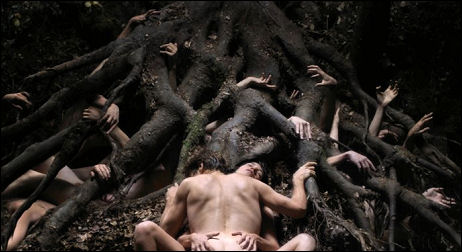
I’m convinced that the primary inspiration for this Dante-esque writhing-in-the-forest scene, which is the first-anywhere-image from Lars von Trier‘s Antichrist, is the menacing-arms-protruding-from-the-wall scene in Roman Polanski‘s Repulsion. That plus any number of paintings inspired by Dante Alighieri ‘s The Divine Comedy, I mean. That’s Willem Dafoe and Charlotte Gainsbourg front and bottom-center in this still.

Antichrist, which will presumably premiere at the ’09 Cannes Film Festival, begins with a married couple (Dafoe, Gainsbourg) grieving over the death of their son. Dafoe’s character is a therapist; I don’t know what Gainsbourg’s character is defined by other than her feelings of woe about their lost child. They retreat to a cabin in the woods and eventually run into all sorts of horrific manifestations, which are at least partly based in their psychologies. Because Lars von Trier doesn’t do horror-for-horror’s-sake.

Triple Dipping

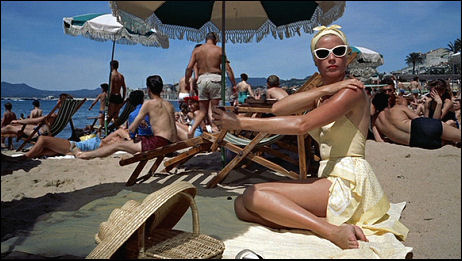
I’ve never been more than mildly attracted to Alfred Hitchcock‘s To Catch a Thief, but I’ve been in love with Robert Burks‘ VistaVision photography, which won the 1956 Best Cinematography Oscar, since I was in my mid teens. No film delivers the splendor of the Cote d’Azur with more erotic punctuation, or is better at capturing that hazy-sunlight effect at midday and even the hillside and seaside aromas, which you can easily recollect and almost smell during a viewing.


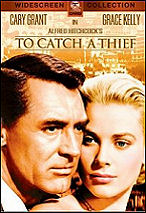
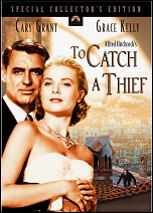
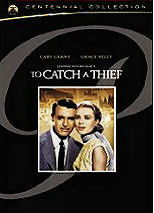
(l. to r.) The initial ’02 To Catch a Thief release; the ’07 Special Collectors editon, and the ’09 Special Centennial edition.

Which is why I’m about to buy my third DVD of the damn thing today. The latest upgrade is out and I have no choice.

The visual quality of the current Special Centennial edition is said by DVD Beaver’s GaryTooze to offer “a significant improvement over the 2007 edition with a higher bitrate and the rendering of colors is far superior with no hint of boosting as we saw in the [2007] SE.”

The first To Catch a Thief DVD, which came out on 11.5.02, was thought even back then to be somewhere between nothing special and somewhat crappy. It made Burks’ large-format photography look like it was captured on regular 35mm.

Nearly five years later, on 5.8.07, came the To Catch a Thief Special Collectors Edition, which added (or restored) a strong greenish tint to the nighttime rooftop scenes, and looked truly exceptional when played on a Bluray player and shown on a decent-sized high-def screen. I was blown away when I looked at this version on my just-purchased Bluray player and 42″ plasma screen last November. It almost flirts with Bluray quality in certain scenes.

And now — today — comes the To Catch a Thief Centennial Collection version, which reportedly delivers an improvement over the ’07 release and therefore an even more choice experience for guys like myself. The stills I’ve seen indicate color that is slightly less (the greenish rooftop efect is toned down) and more natural looking.

“By placing the film on one disc without any extra the compression has improved and even detail has advanced a notch,” Tooze has written. “The softer palette suits the film very well and it has a warmth that was devoid in the previous editions. Aside from seeing this in Blu-ray, this is fabulous news.”

This is perhaps the most significant divider between serious film lovers and people who just like movies. The former will always buy (not rent) the latest upgrade of this or that movie in order to have the finest rendering in order to simply look at the fucker — i.e., to sink into the visual bath of it and go “aahhh.” And the latter will rent this or that film on Netflix in order to watch the story and savor the emotional-aesthetic ride. They have no upgrade hunger and satisfied with “good enough” in the bitrate department.

In fact, I know a major Manhattan-based film critic who watches films at home on a plain old small-screen TV and a regular-scale DVD player, and doesn’t feel a particular need to upgrade. Imagine!

Eisenberg Eisenberg

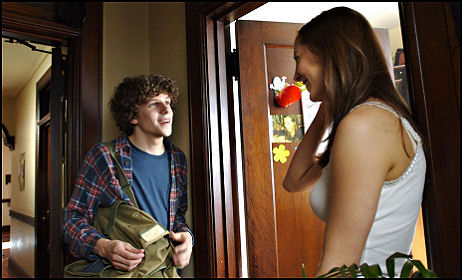
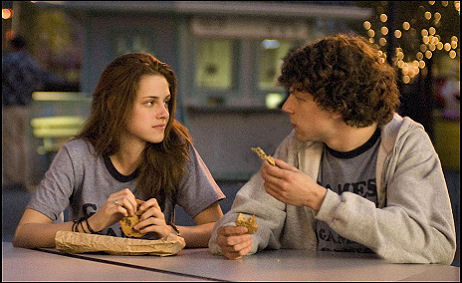
It’s no secret that two smallish films about a young, highly intelligent curly-haired guy trying find his footing in life — The Education of Charlie Banks and Adventureland — are opening within a week of each other, and soon. March 27th and April 3rd respectively. And that both have the earnest, curly-haired Jesse Eisenberg in the lead role.


Jesse Eisenberg and Eva Amurri in The Education of Charlie Banks.

Kristen Stewart and Eisenberg in Adventureland.

And that both Eisenberg characters — — I’m sure they share many similarities but this one I’m dead certain of — experience erotic-emotional longings for a attractive classy-soulful 20something girl — Kristen Stewart in Adventureland and Eva Amurri (the daughter of Susan Sarandon) in Charlie Banks.

I missed Adventureland at Sundance (where it received a positive if unspectacular response) but I’ll be catching it tomorrow. It’s obviously the more broadly accessible audience film between the two, and the hand of director Greg Mottola (Superbad) tells you it’s not submental.

I haven’t seen Banks but it’s said to be a character-driven period piece, set on the Vassar campus in the early ’80s, about a bright dweeb (Eisenberg) having to deal again with an old high-school rival (Jason Ritter). The was directed by Limp Bizkit’s Fred Durst.

I have a slight problem with the title of Durst’s film. The Education of Charlie Banks suggests that it’s about some kind of primal, life-changing lesson that shapes the character of young Mr. Banks. Not “an” education but “the” — big difference. Except daily life is a constant education. School is never out in this sense, and who’s to say which life lesson you absorb is the big one that really matters?

That’s why I love the title of Nick Hornsby and Lone Scherfig‘s An Education so much. It doesn’t imply that what Carey Mulligan‘s character learns over the course of it is a major game-changer; it simply says that she picks up a thing or two.

Bloody Subtitles Scandal

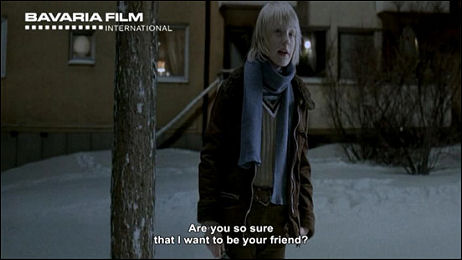
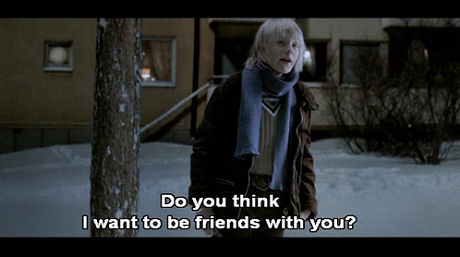
Last night Icon of Fright’s Rob G. posted a carefully assembled rant piece about a dumbed-down subtitle problem on the recently released DVD and Bluray of Tomas Alfredson‘s Let The Right One In, the Swedish vampire film that was praised to the heavens when it came out last fall.

Magnolia Home Entertainment issued the DVD and Bluray on Tuesday, March 10th. The film was theatrically released in the U.S. via Magnet, a Magnolia division geared to releasing the “wild, unquantifiable and uncompromised,” according to a 9.11.07 press release. Well, somewhat less wild when it comes to home video.

In a series of screen-grab comparisons between the original DVD screener and the DVD, Mr. G. persuades that the subtitles “have been drastically changed since the last time I saw it, and completely dumbed down.”

Except he really means “subtly” rather than “drastically.” The “basic gist” of what the characters are saying remains, he says, but “the dark humor, subtleties and character nuances which made the movie so powerful” are “completely missing.” And pretty much “every single line of dialogue is completely off” in this respect, which more or less ruins Alfredson’s film for anyone who saw it theatrically and remembers it with any particularity.

The original screener says that the subtitles were done by Ingrid Eng. Rob G. has theorized that “in order to re-use the subtitles for the American version of the DVD, Magnolia probably had to pay Ingrid again for her services. Rather than do that, perhaps they hired someone else to do the translations on the cheap.”

I tried to post this last night but I was too fagged and shagged. I wrote a highly-placed Magnolia friend this morning to see what the explanation might be.

It’s been alleged but nor proven that the Canadian edition from Mongrel Media has Eng’s original English subtitles.