Whatever Works at Ziegfeld

Woody Allen‘s Whatever Works, which opened the Tribeca Film Festival this evening, is a kind of dry farce that isn’t naturalistic for a second and is basically about manner and whimsy and bile, and it certainly doesn’t go for broke. But it’s fairly enjoyable. It’s sometimes hilarious, especially when it rips into idiocy and thoughtlessness among the populace, and particularly red-state characters and values. It contains some wonderful zingers including a beautiful anti-NRA joke — if only Charlton Heston had lived to hear it! And a gem about automatic toilets, and another about Barack Obama and taxis.
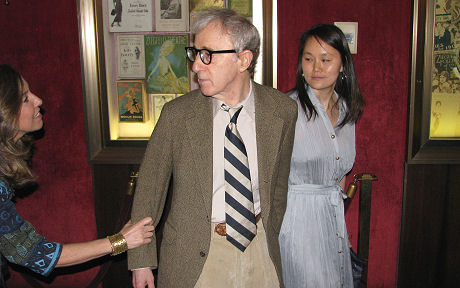
(l. to r.) 42West partner Leslee Dart, Woody Allen, Soon-Yi Previn.

But it’s also partly stiff and unconvincing and perhaps a bit too mean-spirited, even for a film about a bitter misanthrope. And yet it turns around and goes easy at the end, which I oddly liked and didn’t like at the same time. It sure as hell isn’t about realism, and yet the fakeness of Whatever Works is pleasing. And I was often delighted that the people-are-no-damn-good humor is as scalding as it is.
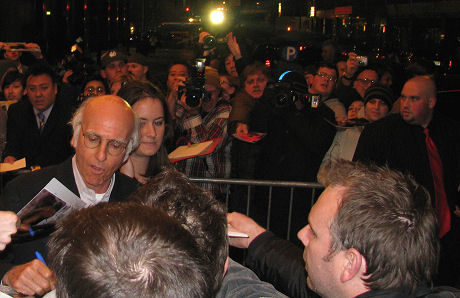

Whatever Works star Larry David outside Ziegfeld following Tribeca Film Festival opening-night screening.

Set in lower Manhattan, Whatever Works is about a unlikely “comfort” affair (as opposed to a genuine love affair) between a grumpy genius mathematician (Larry David) and a bright but uneducated Southern girl (Evan Rachel Wood) that reminded me at times of Annie Hall, but only somewhat. Think of that one scene in Hannah and Her Sisters when Max Von Sydow, playing a cynical painter, rails against money-mad Christian preachers, and then multiply it 100 times and then make it a bit meaner.
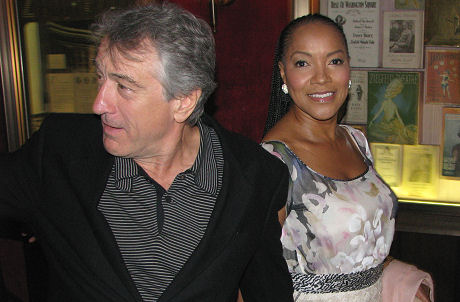

Tribeca Film Festival co-founder Robert DeNiro, wife Grace Hightower.

But what the characters say and finally do in Whatever Works isn’t cause for anyone’s misanthropy. The story is about people changing and adapting and going with the flow, and it ends on a gracious and generous note.
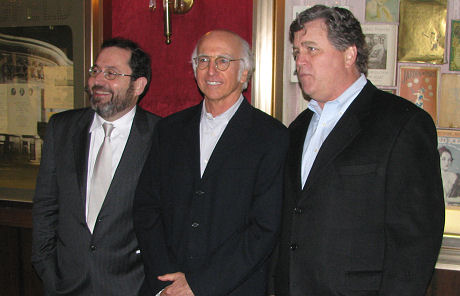
Sony Classics co-chiefs Michael Barker (l.) and Tom Bernard (r.) flanking David.

I’m too whipped to write further but I’l jump into this tomorrow morning.
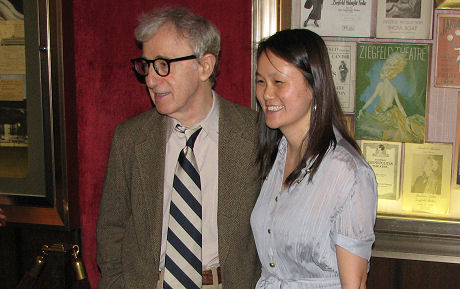

Allen, Soon-Yi Previn.

Facts Are Facts

Regards to Movieline‘s Kyle Buchanan for mentioning yours truly in a summary of noteworthy Hollywood bloggers who feud (or have feuded). But I must again dispute that among other peeves I “regularly rail against Hispanics,” as Buchanan has written.

If I rant about “Hispanic party elephants” who live above my apartment, I’m simply saying that these coarse and thoughtless people happen to be Hispanic. (Should I say they’re German?) It’s not railing to report that a mother of apparent Hispanic ancestry has taken her two year-old daughter to see Eli Roth‘s Hostel 2. Ditto if I happen to notice a group of overweight Hispanic teenagers hanging at Carl’s, Jr. These observations have triggered judgments, okay, but they began as simple observations.

Frown

In a Time magazine q & a with Roger Ebert about his Overlooked Film Festival (today through 4.26), movie maven S. James Snyder (formerly of the New York Sun) asks, “I try to keep up on movies, but I’ve never heard of two of this year’s selections: Sita Sings The Blues and Nothing But The Truth. Why haven’t I heard about these, and why have you chosen them for the festival?” Does anyone believe that Snyder has been living in a mile-deep mine shaft? I hate it when journalists are disingenuous.

Watch The Swagger

I like this Al Pacino/Devil’s Adovocate rap better than his big devil speech at the end. “That Florida stud thing…’scuse me, ma’am, did I leave my boots under your bed? Not the Trojan army — just little ole’ me. How the hell did that happen? They don’t see me comin’ — that’s what you’re missing.'”

Where’s Johnny?

Since he broke through with a star-making performance 40 years ago in Easy Rider, Jack Nicholson — who today turns 72 — has made 45 films, or a little more than one a year. Except he hasn’t made a film since ’07’s The Bucket List and apparently has no irons in the fire. So what’s going on? His absence has just hit me so I’m asking. I’m thinking of Jack Cardiff having worked until his early ’90s. There’s no fun in sitting around.

Eye of Cardiff

Cinematographer Jack Cardiff is no longer with us. Is there sadness in having lived 94 robust years, and in having shot 73 movies over a 72 year career? None I can sense. My favorite Cardiff-shot film is John Huston‘s The African Queen (’51), which I think was the first major-studio film to capture African locations in Technicolor. My second and third faves are The Vikings (’58), which Cardiff shot for director Richard Fleischer, and John Irvin‘s The Dogs of War (’80) — Cardiff’s last truly decent film.

Other noteworthy films shot by Cardiff (running backwards) include Girl on a Motorcycle, Fanny, Legend of the Lost, War and Peace,The Barefoot Contessa, The Black Rose, Alfred Hitchcock‘s Under Capricorn, The Red Shoes, Black Narcissus and Michael Powell‘s A Matter of Life and Death (a.k.a., Stairway to Heaven). Cardiff’s first job was uncredited photography on the 1935 version of The Last Days of Pompeii (when he was 21); he also shot a 1984 TV miniseries version with the same title.

Tribeca in the Fall

Does it not seem likely (if not inevitable) that the Tribeca Film Festival will soon decide to become a mid-fall film festival, launching sometime in mid-October or thereabouts? I’ve been hearing that one for…I don’t know, two of three weeks? Or maybe it started when Geoff Gilmore left his Sundance post to become the new TFF honcho, and the talk just didn’t around to me until last month.

As the Tribeca Film Festival launches this evening with an opening-night screening of Woody Allen‘s Whatever Works, the back-in-New-York John Anderson essentially argues for a fall switchover in a Village Voice piece.

“Right now, fall is the New York Film Festival’s turf,” he explains. “Started in the ’60s, the NYFF — built around about two dozen of what are deemed the best films of the festival year — represents a kind of classic, Cannes-style, two-week-long soiree: black-tie on opening night, an audience largely of subscribers, and a selection of films that have either gotten distribution already, or probably won’t. As such, it’s a purely cultural event.

Tribeca, however, “currently dwells in no-man’s-land,” he says. “It hardly wants to be a springtime NYFF, but at the same time, it can’t be a major player in April because it doesn’t have the cachet to draw films away from next month’s Cannes, and is too long after January’s Sundance to get producers to hold off premiering there.

“[But] if Tribeca moved to the fall, it could free itself from the spring season’s logjam, wherein SXSW, the Los Angeles film festival, and even less competitively minded fests like San Francisco and Seattle vie for the same films. ‘It would be a roll of the dice,’ said Variety critic Todd McCarthy, ‘but if studios knew they could open films in November at Tribeca, they wouldn’t have to show them early in September at Toronto.’

TFF co-founder Jane Rosenthal “makes the very valid point that much of Tribeca is weather-dependent — the annual street fair and even the drive-in movies are springtime events. But the cachet of a late-October/early-November TFF — when distributors would be falling all over each other to premiere their awards-season films at a major New York festival — might be more than its organizers could resist.”

Rosenthal’s weather argument has convinced me that TFF is definitely planning a fall move because it’s so specious. Yes, New York City weather is a tad warmer in April than October, but not dramatically. Both months lean more towards pleasant and/or palatable than not. Okay, so you’d wear a sweater and jacket to a TFF street fair or drive-in movie in October…big deal.

“‘I think there are old models here,’ said Gilmore, asked to survey his new city and the future of festivals in general. ‘To be honest, that’s the kind of question I think about a lot: how to reinvent festivals, what they should be doing, whether or not their agendas– which have evolved greatly — need to be rethought completely.’

“It’s worth noting,” says Anderson, “that one of the things that occurred over the course of Gilmore’s tenure at Sundance was its transformation from a ‘discovery’ festival to a market and showcase. It’s probably a symptom of success, but thanks largely to Sundance, there’s no such thing as a discovery festival anymore. The feeding frenzy goes on all year long.”

The big Gilmore quote in Anderson’s piece, already pointed out by Spoutblog‘s Katrina Longworth, is a lulu: “When one considers what’s going on technologically and commercially, [Gilmore] said, there’s a real question about whether festivals ‘are going to be obsolete in a decade, because people won’t find them valuable anymore — they won’t be the platform from which people need to operate.'”

Oh, sure — let’s start junking all the film festivals as we approach 2020 and henceforth just stay indoors and watch all the new independent movies on our iMacs. Who needs to discover new movies communally? Who needs to fraternize, gauge the mood, sip wine, laugh, exchange opinions, and get an organic sense of things? Let all of that go. In fact, if we plan it right it ten years from now we can limit our social-contact activities to (a) grocery-buying, (b) visits to 24-Hour Fitness, (c) the occasional play, and (d) family and in-law visits.

Trek Raves

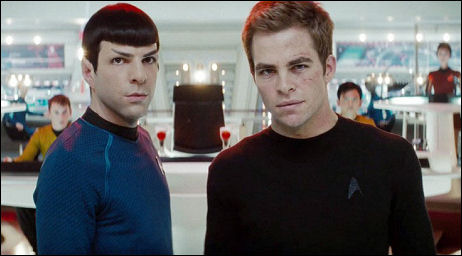
“Blasting onto the screen at warp speed and remaining there for two hours, JJ Abrams‘ new and improved Star Trek will transport fans to sci-fi nirvana,” writes Variety‘s Todd McCarthy. “Faithful enough to the spirit and key particulars of Gene Roddenberry‘s original conception to keep its torchbearers happy but, more crucially, exciting on its own terms in a way that makes familiarity with the franchise irrelevant, Abrams’ smart and breathless space adventure feels like a summer blockbuster that just couldn’t stay in the box another month.

Star Trek here joins the James Bond series as the long-term ’60s franchises that have been most successfully rebooted, although the current accomplishment is the more surprising since, after 10 films and a succession of TV series, Star Trek was widely thought to have exhausted itself. While respectfully handling the Roddenberry DNA, Abrams and longtime writing cohorts Roberto Orci and Alex Kurtzman have successfully transferred it to a trim new body that hums with youthful energy.”

I wont see it until, like, the 30th, but here’s an impression I tapped out after seeing a half hour’s worth of footage last December:

“It zips along and is enveloping and beautiful to watch — highjly pleasurable to just friggin’ look at. It’s buoyant and bountiful of spirit, it’s pop celestial, it’s Young Men in Space. The massive super-cities shrouded in mist in the Iowa flatlands — superb concept! Zachary Quinto‘s Spock has focus and authority, and was my favorite for that. Pine, for me, has the necessary force and swagger and I applaud Abrams’ balls in not casting a Shatner clone.

“Pine is certainly an everyman James Tiberius Kirk. A Kirk who is first brawn, anger and bluster, and secondly a Kirk who develops the character and courage to grow his inner strength. A Kirk who is part Luke Skywalker, part surfing instructor, part lifeguard, part first baseman for the St. Louis Cardinals, partly a guy who could have costarred in Mike Judge‘s Office Space, part poet, part motorcycle mechanic.”

Return of Mood Hair

The first remarked-upon instance of “mood hair” since Mickey Rourke‘s appearance as the sometimes white-haired, sometimes grayish-black haired, sometimes grayish white-and-brown-haired Det. Stanley White in Year of the Dragon (1985) has been pointed out by Variety critic Todd McCarthy in his rave review of JJ AbramsStar Trek.


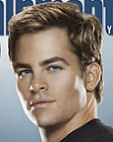
Chris Pine in Star Trek; Mickey Rourke in Year of the Dragon.

McCarthy doesn’t make a big deal out of it, but he does note that the mane of young Chris Pine, who plays a kind of surfer-dude version of Cpt. James Kirk, “varies from reddish to blond in some instances [so] someone should decide about his hair color.”

The term “mood hair” was coined 24 years ago by critic Elvis Mitchell in his review of The Year of the Dragon. It was quoted by New Yorker critic Pauline Kael in her review of same.

All About The Hammerheads

I was told yesterday afternoon to watch for a leap-out New York Observer piece about the Hollywood blogger/columnist. Called “Get Me Rewrite!” and written by John Koblin, it turned up last night at 11:39 pm. Ten minutes later I was going…this? It’s a scamper through the poppy fields, is what it is.

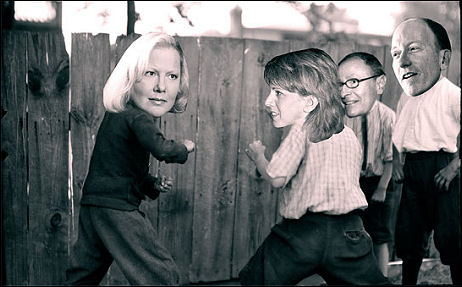
Photo totally stolen from New York/Vulture’s summary of Koblin’s piece. Cheers to photo illustrator Everett Rogue.

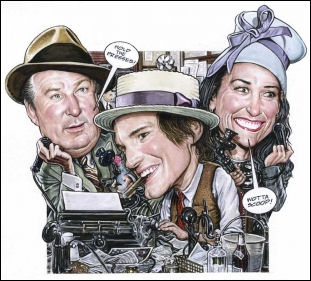
Drew Friedman‘s illustration of Alec Baldwin, Ashton Kutcher and Demi Moore in Walter Burns/Hildy Johnson/Front Page garb told me not to expect much, and so I wasn’t disappointed.

Boil the snow out of it and Koblin’s piece (a) summarizes that the leading Hollywood reporting blogs (as opposed to opinion/personality/reporting/cherry-pick ghoulash columns like my own, which isn’t mentioned) have pretty much elbowed Variety and the Hollywood Reporter aside; (b) recaps last month’s Nikki Finke vs. Sharon Waxman/The Wrap feud and that brief little dust-up between Patrick Goldstein and Variety‘s Brian Lowry; (c) includes some anti-Waxman views by the eternally dour Anita Busch, chiming in “from beyond the journalistic grave”; and (d) mentions that a slew of enterprising celebrity-actors (Kutcher, Baldwin, etc.) are churning out their own stuff on the Huffington Post. And that’s more or less it.

In short, Koblin’s view is that the most noteworthy online Hollywood coverage is more or less generated by the hammerheads — i.e., two hard-charging women who focus pretty much on the Hollywood economy, the labor disputes, the politics, the hires and fires, the agencies and all that trade jazz. Which are all fine and necessary but where’s the music, man? Waxman-Finke are but one piece of the pie. Goldstein, at least, is a serious film lover and all the more intriguing and readable for that.

Otherwise Koblin ignores not just HE but David know-it-all Poland and Movie City News, Variety‘s Anne Thompson , The Envelope, In Contention, the various seasonal currents, the flavor, the flow, Movieline, Awards Daily, and everyone else.

“Variety [has] ceded its grip on the town entirely,” Koblin writes, “and now the Hollywood press corps is in a state of revolution. There is no power structure. It’s all turned inside out and upside down. Everyone claims victory, but no one seems to have it, nobody is powerful enough to measure it. And, above all, it’s one nasty, mean, shrill place.”

Ex-Variety editor Peter Bart says that “for one thing, you have bloggers who need traffic and are desperate for attention. The overriding truth of the blogging community is they’re trying to figure out how to monetize their endeavors. So you have to call attention to yourself. On that side, you have a clear motive.”

“I do think it’s kind of surprising that Sharon Waxman even has a blog,” Busch tells Koblin. “I think she’s even one of the worst journalists I’ve ever encountered. I’ve never seen anybody that ignores the basics of Journalism 101 as she does. I find it surprising that she’s got this blog. I try not to click through on Sharon’s Web site because I don’t want someone who doesn’t care about journalism to succeed.” See what I mean? She just oozes the stuff.

Waxman says that she feels “sorry for Anita Busch for saying such a thing like that…I think that’s a pretty sad statement…I think it says more about her than me.” Waxman also unloads on Finke, to wit: “Nikki has her own view of reality which does not always accord to reality as others see it. The way she twists things and the way she always manages to bend the facts — and I put facts in quotes — is in a way that suits her.”

The L.A. Times was going to own Hollywood, Koblin writes, “but that never happened. The L.A. Times became hamstrung by too many internal conflicts (competing desks going after the same story, staffers upset that the website gives into celebrity link-baiting temptations) and, of course, a staff that is less than half the size of what it was eight years ago.

“And they suffer from a similar problem to Variety. Bloggers like Nikki Finke have been nimble and fast, and while an L.A. Times reporter is on the phone waiting for confirmation, Nikki puts it up regardless if it’s right or wrong.”

Busch gets in one good quote, though: “Hollywood is a small town filled with sociopaths. And when you’re assigned to cover that? You really have to be on your feet.”