Last Non-Embrace

My final invitational Cannes activity was trying to attend the Inglourious Basterds party, which began under beach tents opposite the former Noga Hilton (now called the Palais Stephanie) around 10 pm last night. A dense pack of tuxedoed, dressed-to-the-nines types who’d just come from the Basterds screening at the Grand Lumiere were packed around the entrance. It looked like a mound of termites except for the size of the termites and the quality of their apparel and coifs.
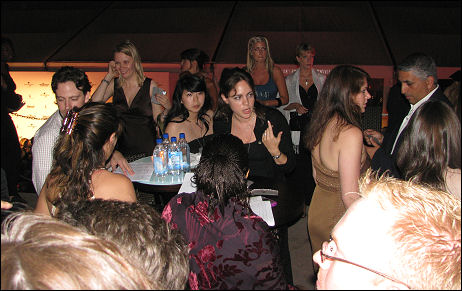
Except there was no entrance — the security goons had every everything thoroughly blocked off — and even people with hard tickets were looking anxious and desperate. I scrunched and winnowed my way through three separate lines, each time being told to go to the other line. At least one Weinstein Co. publicist (i.e., Emily Feingold) stood in the entrance area but told me she couldn’t do anything to help. Indiewire‘s Eugene Hernandez was standing and surging alongside; Variety‘s Sharon Swart and Michael Fleming joined the throng at a later point. “Emily Feingold…your friends are suffering!”

When it comes to ritualized humiliations I’m at a slight disadvantage because I have a threshold of dignity — a line I will not cross. I hit it after a good 20 minutes of trying to get in when word came down for the fourth time to try another approach and that “anyone without a hard ticket will have to wait.” This despite several of us having been told to come with the assurance that our names would be at the door. That was it. I walked down the Croisette a free man — liberated, breathing clean air, Papillon reborn.
McQueen Downgrade

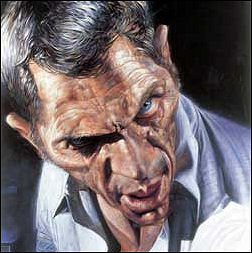
In his latest thelmagazine video essay, Matt Zoller Seitz explains that while Steve McQueen will always be Steve McQueen, “calling him a great actor, or even a great leading man, is a bit of a stretch.” The piece is linked to the McQueen tribute that begins today through the Film Society of Lincoln Center.

“Steve McQueen is the gold standard for movie tough guys,” he begins. “Stoic, street-smart, unfussy, supercompetent and absolutely, positively not to be fucked with; the consummate man of action. He’s the guy every guy secretly wants to be — unassuming but deadly, and always in charge. McQueen’s grace isn’t the deliberate, predmeditated grace of a ballet dancer, but of a footballer spotting an opening and slipping through it for a goal.

“He’s one of the most sheerly pleasurable physical actors in movie history. Even in repose or when performing mundane tasks, he seems charged with energy. The camera loves him, and directors acknowledge this by serving up seemingly obligatory scenes of McQueen donning and divesting himself of his character’s uniform (the bulletproof vest in The Getaway, the shoulder holster in Bullitt), giving viewers a chance to admire his lanky physique and a demeanor that would seem insufferably smug if he weren’t a working class guy playing working class guys — a peasant prince who earned his royal title.

“McQueen doesn’t join the club, he just visits, always keeping one eye on the exit.

But after thinking things through, Seitz’s McQueen infatuation “got downgraded to affection and respect,” he says. “A masculine code that insists on always being right and in control, and that withholds affection from women for the sake of seeming cool, is neither real nor useful, and ultimately ruinous to viewers who uncritically embrace it. It seems altogether fitting that McQueen spent a fair part of his screen career behind bars. Over the years, he built himself a lucrative and comfortable onscreen prison, and unlike his characters, he lacked the skills, or the will, to break out.”

Friend & Foe

Variety‘s Todd McCarthy has praised Quentin Tarantino‘s Inglourious Basterds as “a completely distinctive piece of American pop art with a strong Euro flavor…by turns surprising, nutty, windy, audacious and a bit caught up in its own cleverness, [it’s] an increasingly entertaining fantasia in which the history of World War II is wildly reimagined so that the cinema can play the decisive role in destroying the Third Reich.”

But the Guardian‘s Peter Bradshaw is calling it “a colossal armour-plated turkey from hell…awful…achtung-achtung-ach-mein-Gott atrocious. It isn’t funny; it isn’t exciting; it isn’t a realistic war movie, yet neither is it an entertaining genre spoof or a clever counterfactual wartime yarn. It isn’t emotionally involving or deliciously ironic or a brilliant tissue of trash-pop references. Nothing like that.”

And I called it “a fairly engaging Quentin chit-chat personality film in World War II dress-up. It’s arch and very confidently rendered from QT’s end, but it’s basically talk, talk, talk…low story tension…no characters are subjected to tests of characters by having to make hard choices and stand up for what they believe, and nobody pours their heart out. What they do is yap their asses off. Cleverly and enjoyably at times, yes, but brisk repartee does not a solid movie make.”

I didn’t say but am saying now that the best movies are always defined, in part, by the things that are not said — by undercurrents that you feel or sense but which aren’t directly commented upon. Inglourious Basterds has a delicious undercurrent of tension in the first Col.-Landa-vs.-French-farmer scene, but otherwise it’s pretty much all on the surface.

Weinstein Roofies

Giggly girls hanging out on the roof of the Weinstein Co. penthouse at the Gray d’Albion residence, taken two days ago. If these women lived in ancient Egyptian times they’d be palace courtesans.


Monday, 5.18, 7:35 pm.

Monday, 5.18, 7:37 pm.

Wednesday, 5.18, 3:30 pm.

Up To The Challenge

IFC has shown chrome steel cojones in agreeing to distribute Lars Von Trier‘s Antichrist. (They’ve also acquired Ken Loach‘s Looking for Eric and the Romanian anthology farce Tales From The Golden Age, which I saw last night — half amused, half meh. Marketing/distribution suggestions: (a) Don’t market it as a serious film but as a hoot; (b) Make a deal with a toy company to sell battery-powered toy foxes covered with blood and afterbirth that say “chaos reigns!” when you pull their tail; (c) After the initial release sell it to the midnight-movie freaks as something that only the truly freakish of mind can handle — i.e., are you man enough to see Antichrist?.

Curbside


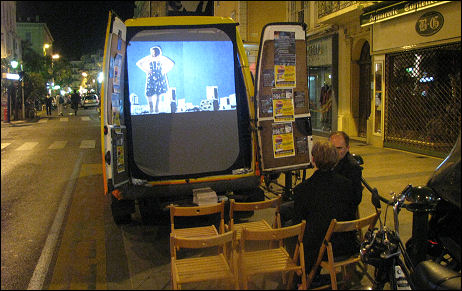
While I love the spirit of film festival van screenings, I would never sit down and watch a film this way. A trailer, perhaps, but never a feature.

Long Run Foreseen

“How hot is James Cameron‘s Avatar?,” asks N.Y. Times reporter Michael Cieply. “Hot enough that Imax so far has not lined up any other Hollywood movies for its ultra-big screen theaters between Fox’s release of Mr. Cameron’s 3-D science fiction thriller on Dec. 18 and the arrival of Tim Burton‘s Alice in Wonderland on March 5.

“Things could change. But the Imax people are mulling whether the several hundred large screens by then expected to be up and running with commercial films (as opposed to the museum-type fare) will be needed for almost three months to satisfy demand for Mr. Cameron’s first feature film since Titanic.”

“Bubblegum Sidedish”

“No matter how much extreme contextualization and heavily stylized techniques Quentin Tarantino [uses] in Inglorious Basterds, it feels like a bubblegum sidedish to the heavy dinner plate of his career,” says Indiewire‘s Eric Kohn.

“Despite a World War II setting, Inglorious Basterds mainly feels like an homage to crime and thriller movies, using Nazis as cardboard villains in a facile manner akin to the Indiana Jones franchise.

“As the story [builds] into an espionage drama, Tarantino churns out the most conventional accomplishment of his career, Jackie Brown included. Sure, you can tear apart the layers of references to countless genres from multiple eras, but not with the same relish allowed by Kill Bill or Pulp Fiction, where reading into the text and digging its natural flow were not mutually exclusive.

“That’s hardly the case here. To watch Basterds without considering Tarantino’s implementation of enyclopedic movie knowledge makes it into a breezy, insignificant experience. Basterds is a talk-fest. Anyone familiar with the Tarantino touch will testify that the director likes to make his characters talk and talk and talk — and sometimes so that it ends up absorbing the spotlight. In Basterds we see the worst side-effects of this tendency.”

Well Said

Here’s that riff from Quentin Tarantino this morning about why the Cannes Film Festival is so important and exciting. “One of the things I love about Cannes is [that] during this time on the Rivera, cinema matters — it’s important,” he said. “And even when people boo [and whatnot], it’s out of passion. It’s not just these images glazing over you — it matters, it means something.

“And all of the world’s film press from the planet earth — America, England, Iceland, Greenland…they’re all here. Bam, at once. Everyone here at the exact same time. They argue and they jostle and do this and do that, and it’s like the cat is out of the bag for the entire planet earth. And I’m down with that. I am not an American filmmaker — I make movies for the planet earth, and Cannes is the place [for that to happen].”

Basterds Encounter


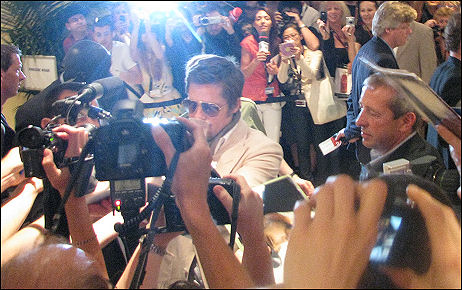
Brad Pitt signing autographs or shaking hands or something in the vein outside the Salle de Presse following this morning Inglourious Basterds press conference.

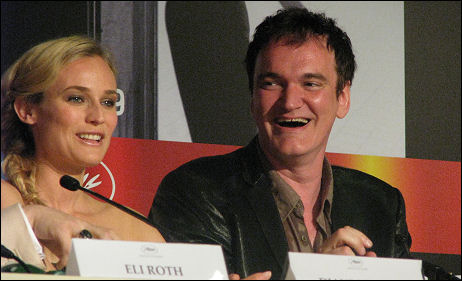
Inglourious Basterds costar Diane Kruger (l.), director-writer Quentin Tarantino — 5.20, 11:42 am.

French actress Melanie Laurent, who gives one of the film’s two standout perfs as Jewish refugee who inherits a Parisian movie theatre. (The other is given by Christoph Waltz as the brilliantly evil Col. Hans Landa.)

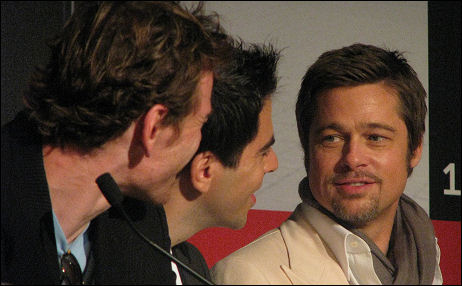
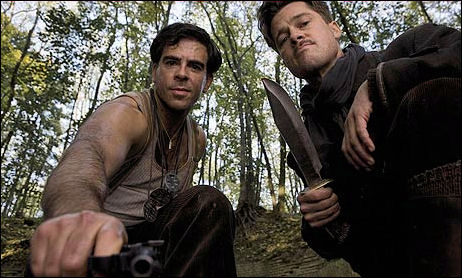
Costars Michael Fassbender, Eli Roth, Brad Pitt