Agora’s Pointed Scorn

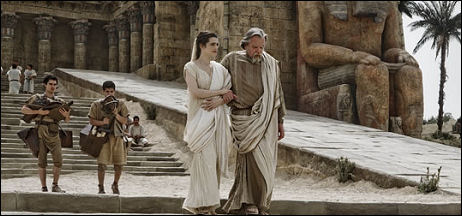
Alejandro Amenabar‘s Agora, which I caught late yesterday morning, is a visually ravishing, intelligently scripted historical parable about the evils of religious extremism. And I don’t mean the kind that existed in 4th century Alexandria, which is when and where this $65 million dollar epic is set. I mean the evils of the present-day Taliban and the Neocon-aligned Christian right, and the way Agora metaphorically exposes these movements for what they are.

As Adam Curtis‘s The Power of Nightmares sagely explained, these two extremist faiths are similar in their loathing for liberalism and militant yearning to turn back the clock and to above all hold high the flag of religious purity. The 9/11 attacks kicked off their holy war against each other — a war that fortified their positions in their respective cultures during the Bush years.

And now comes Agora, dramatizing how purist zealotry among 4th Century Christians led to the persecuting of Jew and pagans, to the sacking and burning of the great library of Alexandria, and to the murder of Hypatia (Rachel Weisz), the first widely-noted female scholar who taught philosophy, astronomy and mathematics. (Note to whiners: Noting a well documented event that happened 1600 years ago can’t be called a spoiler.)

Amenabar’s film, an English-language Spanish production that was shot in and around Malta, seems to me like the most thoughtful and intellectually-talky big-screen epic ever made, although there’s a fair amount of strife and sword-stabbing and mob violence all through it. The intense conflicts, exacting and cultured dialogue, dashing visual energy and top-notch performances from Weisz, Max Minghella, Oscar Isaac, Rupert Evans, Ashraf Barhom, Rupert Evans and Michael Lonsdale make Agora more than gripping for its entire 141 minutes. I was surprised, really, that it moved as fast as it did.

Some are calling it too talky or insufficiently emotional, whcih translates into the imprecise term known as “boring.” It isn’t that, trust me, although I admit it’s hard to imagine the U.S. fans of sludge entertainment being keen to see it. You need to be keyed into what it’s saying about our world and to be rooting against the bad guys (i.e., old-time Christians) to really get into it, I suppose, although the high-quality sheen is unmistakable in every department. It’s well worth it for the CG alone.

Common Language

This morning’s screening of Ken Loach‘s Looking for Eric, a mildly engaging well-made film about a British middle-aged postal worker and soccer fan that isn’t likely to see U.S. distribution, reminded me of the difficulty I’ve had in the past in deciphering rural British, Irish and Scottish accents in films. The Manchester accents in Loach’s drama make the dialogue (in the early portions at least) nearly impossible to understand. The obvious remedy would be subtitles. I’m a huge fan, for example, of Paul Greengrass‘s Bloody Sunday, but I never really understood what was being said all around until the subtitled DVD came out.

“Why Did You Make This Film?”

Polite but mild applause greeted the Antichrist team — director Lars Von Trier, stars Willem Dafoe and Charlotte Gainsbourg — as they walked into the Salle de Presse at 12:35 pm, or about 75 minutes ago. But then someone yelled “boo!” Dafoe and Von Trier, as you can see, chuckled at this. And then once the photos had been taken and everyone was settled, Daly Mail columnist Baz Bamigboye asked the first question, which was fairly hostile.

“Why did you make this movie?” he said, clearly outraged. Von Trier, Dafoe and Gainsbourg all gave Bamnibgoye, who was standing on the right side of the room, quizzical “what’s up with this guy?” looks. “I don’t feel I have to explain myself,” Von Trier said. “Yes, you do!,” Bamigboye sternly replied. “Yes, you do. You’ve come here to Cannes, the festival; has chosen it, we’ve all seen it…and I think you have an obligation to explain why you made it.” Von Trier again demurred, sidestepped, shook it off.

That was the only confrontational moment. All questions in all press conferences tend to be asked in an extra-polite, deferential, obliquely phrased vein, and this one was no exception. There was some humorous quips from Von Trier (“I am the world’s best director”), some laughter from the crowd, and very little in the way of soul-baring. Dafoe said Von Trier was “a great director” and was quickly corrected by Von Trier saying “the greatest” (or words to that effect).

If you hadn’t seen Antichrist you would have had the impression from the questions and answers that it was, all right, shocking or challenging and yes, clearly disliked in some quarters, but a film that could or should be regarded with perhaps a certain whimsy or even (with an accommodating pro-Lars attitude) as a harmless cinematic diversion — a “dream,” a work of pure imagination.

Scan


The Disney team has invited journos to watch footage of Robert Zemeckis’ and Jim Carrey’s A Christmas Carol at noon today. I wasn’t invited but wouldn’t be attending anyway due to the Lars von Trier/Antichrist press conference, which is where I’m filing from (standing in front of the dais) and which is just about to start.

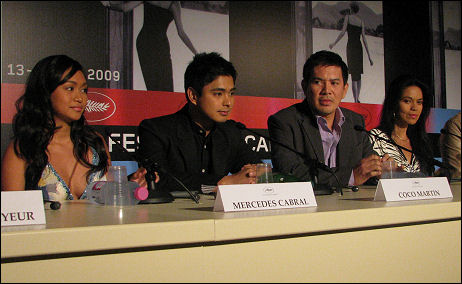
Kinatay director Brilliante Mendoza and his cast at press conference a day or two ago.

Flat To Me

A bright, blunt-spoken Croatian distributor I know was sizing up the festival at Saturday night’s Taking Woodstock party. “Nothing…nothing has really turned anyone’s head here,” he said. He was speaking generally and a bit cynically, of course. But I agree with him, then and now.

No film shown at the festival so far has homered or even tripled. Some sevens and eights by the sights of certain critics and buyers but no nines and definitely no tens. No film overwhelmingly leads as a likely Palme d’Or winner. No film shown here seems destined to open in the States to huge commercial or critical acclaim. No film has attracted undiluted affection or excitement.

Besides Up, I mean. But that’s not really a Cannes film, or rather the kind of film that I associate with the particular specialness of this festival.

I’ll allow that Jacques Audiard‘s A Prophet, Andrea Arnold‘s Fish Tank and Jane Campion’s Bright Star have stirred admirers in certain corners.

The good news is that Michael Haneke‘s The White Ribbon is being screened on Wednesday night so at least I’ll have a shot at that before leaving on Thursday.

Generous

“What can be said is that von Trier, after what many found the agonizing boredom of his previous Cannes films Dogville and Manderlay, has made a film that is not boring. Unendurable, perhaps, but not boring. For relief I am looking forward to the overnight reviews of those who think they can explain exactly what it means.” — Roger Ebert writing about this evening’s Antichrist screening.

“Talking Fox”

Reuters’ Mike Collett-White reports that Danish director Lars von Trier “elicited derisive laughter, gasps of disbelief, a smattering of applause and loud boos on Sunday as the credits rolled on his drama Antichrist at the Cannes Film Festival.

“The film, starring Willem Dafoe and Charlotte Gainsbourg as a couple seeking to overcome the grief of losing their only child, has quickly become the most talked-about at this year’s festival, which ends on 5.24.

“Cannes’ notoriously picky critics and press often react audibly to films during screenings, but Sunday evening’s viewing was unusually demonstrative. Jeers and laughter broke out during scenes ranging from a talking fox to graphically-portrayed sexual mutilation.

“Many viewers in the large Debussy cinema also appeared to take objection to Von Trier’s decision to dedicate his film to the revered Soviet director Andrei Tarkovsky. Applause from a handful of viewers was drowned out by booing at the end.”

Antichrist = Fartbomb

I ran right up to the Orange wifi cafe after escaping from Lars von Trier‘s Antichrist, which had begun at 7:30 pm in the Salle Debussy. I sat down and wrote for a solid hour, so charged by what I’d just seen and what had just happened — easily one of the biggest debacles in Cannes Film Festival history and the complete meltdown of a major film artist in a way that invites comparison to the sinking of the Titanic — that I didn’t pay attention to the fact that my plug adapter wasn’t giving power.

The computer went down and I lost everything. Seven or eight really

good paragraphs.

It’s now 10:42 pm and the Orange cafe is about to close. It’s over and finished and I’m sick of this day. It’s been one thing after another today (heat, sweat, lost power cord) and I know when I’m beaten and drained. I’ll sit down and write more again tomorrow. But my God, what a screening! What a reaction! Critics howling, hooting, shrieking.

There’s no way Antichrist isn’t a major career embarassment for costars

Willem Dafoe and Charlotte Gainsbourg, and a possible career stopper for Von Trier.

It’s an out-and-out disaster — one of the most absurdly on-the-nose, heavy-handed and unintentionally comedic calamities I’ve ever seen in my life. On top of which it’s dedicated to the late Russian director Andrei Tarkovsky, whose rotted and decomposed body is now quite possibly clawing its way out of the grave to stalk the earth, find an axe and slay Von Trier in his bed.

Here’s a portion of Von Trier’s “director’s confession” from the press book:

“Two years ago I suffered from depression. Everything, no matter what, seems unimportant, trivial. I couldn’t work. Six months later, jsut as an exercise, I wrote a script. It was a kind of therapy, but also a search, a test to see if would ever make another film.

“The script was finished and filmed without much enthusiasm, made as it was using about half of my physical and intellectual capacity. Scenes were added for no reason. Images were composed free of logic or dramatic thinking. They often came from dreams I was having at the time, or dreams I’d had earlier in my life.

“In any case I offer no excuses for Antichrist. Other than my absolute belief in the film — the most important film of my entire career!”

A man whom I’ve admired and respected for many years has lost his mind for the time being, or at last lost it while he was writing and shooting the film. I just can’t fathom how the director of Breaking The Waves and Dancer in the Dark and Dogville could have made something so amateurishly awful. The decent and compassionate thing would be to forget Antichrist and to forgive Von Trier. To put it aside and move on on all fronts.

I know that if I had been in Dafoe or Gainsbourg’s shoes I would have come to my senses and walked off the film. I would have said “go ahead, sue me — I welcome a lawsuit!” and walked home proudly and at peace.

No Dilly-Dally

I was going to riff positively on Alejandro Amenabar‘s Agora, but it’s 7:04 pm and Lars von Trier‘s Antichrist starts in 26 minutes. I’ll probably file after I get out around 9:30 or 10 pm.

Schamus-Lee

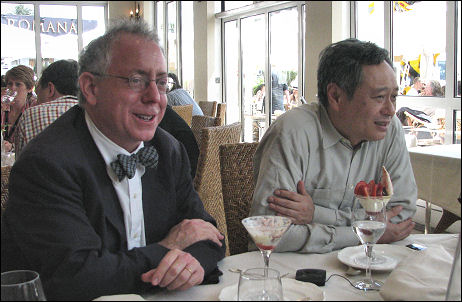
During today’s Taking Woodstock press luncheon at the Calrton — Sunday, 5.17, 2:25 pm. The mounted mini-camera blocking my view of Schamus for the first 20 or 30 seconds belongs to journalist Sperling Reich.

Woodstock Chat

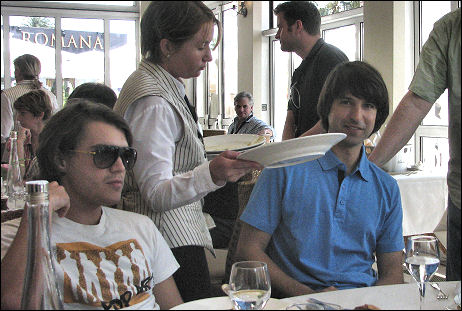
Staying for almost all of Alejandro Amenabar‘s 141-minute Agora at the Grand Lumiere caused me to arrive 15 minutes late to the 12:30 pm Taking Woodstock press luncheon at the Carlton. But no biggie. Here‘s costars Emile Hirsch and Demetri Martin riffing and responding. The recording muffles out for a minute due to Martin having inadvertently placed a cloth napkin on top of my digital recorder.

Imelda Staunton, who portrays Demetri Martin‘s constantly agitated and strident Jewish mom, was talking as I sat down at my table. She was asked about the film’s lack of Woodstock Music Festival concert footage, and her response was that we’ve all seen Michael Wadleigh‘s Woodstock and that “it’s already been done.”

I could’ve responded by saying “that’s not the point” but I didn’t want to be contentious. I could’ve said that no one expected director Ang Lee to use concert footage to any great degree but that the utter absence of any such footage feels curious, like a movie about a family of Normandy hotel owners grappling with the traumatic events of D-Day and not seeing a single soldier or warship or airplane. (I would’ve inserted maybe 90 seconds of concert footage in short little cuts throughout Taking Woodstock‘s third act.)

Staunton’s character has one silly-giggly Marx Bros. moment in the film when she and her husband eat four marijuana-spiked brownies. That’s a whole lot of THC for a very rigid-mannered middle-aged person who’s never turned on her life, which applies in this instance. A friend and I once chugged a chocolate milkshake mixed with a finely-ground ounce of pot, and we didn’t come down for two full days. It was like we were tripping.


Taking Woodstock producer-screenwriter James Schamus, director Ange Lee — Sunday, 5.17, 1:35 pm.

I mentioned to Martin that Elliot Tiber, the guy he portrays in Taking Woodstock, was 34 in 1969 and had led a fairly full life by that time, and yet it seems that he’s playing him younger or certainly wet behind the ears, and, as Todd McCarthy observed, that the template seems to be based upon Dustin Hoffman‘s Benjamin Braddock. Martin, an easygoing guy with a nice smile, sidestepped this one, saying mainly that he wouldn’t want to be compared to Hoffman, etc.

Hirsch and Martin were asked if they’d detected any difference so far in reactions to Taking Woodstock from older, boomer-aged viewers vs. under-30 types. They said they hadn’t. Hirsch acknowledged or noted that the Woodstock Festival doesn’t mean as much (or anything at all) to twentysomethings, and speculated that 20 or 30 years hence he might hear a similar underwhelmed reaction from younger people about, say, the election of Barack Obama.

I asked Lee and producer-screenwriter James Schamus if either of them had turned on at all during their wayward youth — i.e., dropped acid or mescaline or peyote or even if they were at least serious potheads. Lee has never been “experienced,” they said, and I thought I heard Schamus say he hadn’t touched the stuff either. But a journalist friend told me later that Schamus had copped to a little experimentation in the old days.


Nice shades, T-shirt, etc. Attitude down pat.