Enemies vs. Burger Crowd

The thrust of this Kim Masters/Daily Beast hit piece (“The Knives Are Out for Michael Mann“) is that if and when Public Enemies tanks with Mr. and Mrs. Joe Schmoe and their kids over the July 4th holiday then it’s curtains for Mann in terms of getting any kind of heavy funding for his next film.

Haven’t I already figured this out? Mr. and Mrs. Joe Schmoe and their kids will not be all that happy with Public Enemies — let’s face it. It’s not a mojo burger, pickles and potato chip type of film and it never will be.

I heard today from an older North Carolina couple. Not very sixpacky in their taste and attitudes (the husand is former Manhattan-based entertainment reporter Lewis Beale), but they went to the film today and here’s what they thought. “The Beales saw it today, and loved it,” Lewis wrote. “We agree that it’s an art film, which is why it’s really problematic at the b.o. But languid, elegaic and beautifully shot. Depp and Cotillard are great. Stirring social-political subtext (lone entrepreneur up against big business and big government). A major work.”

Masters also reports that Johnny Depp decided not to talk to Mann at some time during filming — big deal.

Call A Spade

“I think the idea of going to conservative Republicans, who are essentially representing the insurance companies and the drug companies, and watering down this bill substantially, rather than demanding we get 60 votes to stop the filibuster….I think that is a very wrong political strategy.” — Sen. Bernie Sanders (I-Vermont), quoted in 7.1 Huffington Post story about health care strategy.

“No Jean, No Money!”

I can’t watch the young Harve Presnell sing “They Call the Wind Maria” in Paint Your Wagon. I’ve never watched him sing in The Unsinkable Mollie Brown. I just tried to watch this clip of him signing a duet with Julie Andrews — painful. To me he’ll always be grumpy old Wade Gustafson in Fargo, which he nailed to the wall. He died yesterday at age 75 from pancreatic cancer.

Karl’s Seven Films

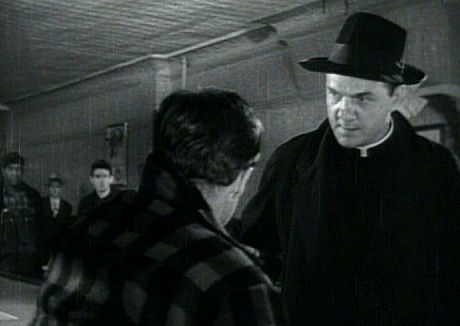
The legendary Karl Malden died today at age 97. We should all be around so long and look back on such a full and accomplished life. Malden was a solid and believable presence in 70 films on top of his run in that 1970s TV cop series, called Streets of San Francisco. But he earned major artistic esteem in only seven films, three of them with Marlon Brando and spanning an 11 year period, from 1951 to ’62.

Malden’s first blue-ribbon, brass-ring film was A Streetcar Named Desire (’51), in which he played the beefy momma’s boy Mitch, the best friend of Brando’s Stanley Kowalski. The next Brando pairing came with On The Waterfront (’54), in which Malden played Father Barry. His third and final Brando collaboration was in One-Eyed Jacks (’61), in which he played the cowardly and sadistic Dad Longworth, under Brando’s direction.

Malden was also excellent as the chief detective in Alfred Hitchcock‘s I Confess (’53); as the obsessive high-strung father of Jimmy Piersall (Tony Perkins) in Fear Strikes Out (’57); opposite Burt Lancaster in Birdman of Alcatraz (’62), in which he played Alcatraz warden Harvey Shoemaker; and as Warren Beatty‘s dad in John Frankenheimer‘s All Fall Down (’62).

Okay, I’ll throw in his role as Gen. Omar Bradley in Patton (’70) and make it eight. But he only had one or two decent scenes in that Franklin Schaffner film, which George C. Scott owned top to bottom.


With Marlon Brando in On The Watrerfront.

I love Malden’s third-act Waterfront moment with Brando in the Hoboken bar when he snaps at the bartender, “Gimme a beer!” And his line to Eva Marie Saint in the beginning: “You think I’m just a gravy-train rider with a turned-around collar…don’t you? Don’t you? (Pause) I see the sisters taught you not to lie.”

In Streetcar Malden says to Vivien Leigh, “I was fool enough to believe you were straight.” And she answers “Straight? What’s ‘straight’? A line can be straight, or a street. But the heart of a human being?”

I love the One-Eyed Jacks moment when the hog-tied Brando spits in Malden’s face just before being bull-whipped on Main Street; ditto Brando’s faking Malden out in the final shoot out, running and diving into the dust and shooting Malden in the back three times.

Tall Guy

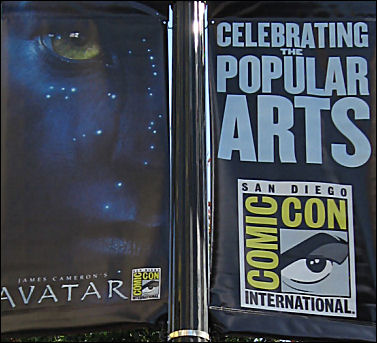
The recent revealing of a ComicCon banner image of a Na’vi, a tallish, cat-eyed, blue-skinned resident of Pandora in James Cameron‘s forthcoming Avatar, is regarded as big news in some circles.

Distinction

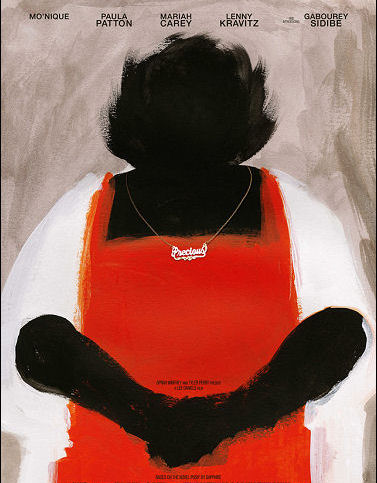
Lionsgate’s arty new one-sheet for Lee DanielsPrecious (11.6), which HitFix’s Gregory Ellwood exclusively revealed this morning, is stylish and striking — a visual hint that Precious isn’t up to the usual-usual. It tells you it’s a film that comes to grips and flexes artistic muscle.


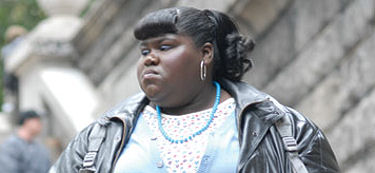
Gabourey Sidibe

The silhouette figure is a slight cheat. I presume it’s meant to be Gabourey Sidibe , the morbidly obese young girl who plays Precious, but the silhouette is of a woman who should probably be described, in all fairness, as simply large or overweight. I’m just saying.

I just watched the trailer again and as much as the film touched me when I saw it in Cannes I don’t know if want to see it again. That is, I don’t know if I can take more hangin’ time with Mo ‘Nnique’s mother-from-hell character. She’ll almost certainly be nominated for Best Supporting Actress, but “the pleasure of her company” is not a term that comes to mind. What comes to mind, in all honesty, is that spending time with a person this deplorale and abusive is an unpleasant thing no matter you slice it. Except Mo ‘Nique really knocks it out of the park in her final confession scene.

No Win

Over 90 minutes of work time today plus 75 minutes of same yesterday were consumed by arguing with the Orwellian fiends at AT&T over European data charges. They’re claiming I racked up data charges of $253.89 from using my AT&T Air Card while in France and Spain. Except (a) I never once used it and (b) even if I had used it wouldn’t have functioned because you can’t get an AT&T signal over there with a U.S. Air Card. They’re also saying I used 49 megabytes in iPhone data charges on top of a pre-purchased 200 meg usage allotment for a total of $345.00. All through my time there I carefully monitored the iPhone usage tracker on the iPhone and stopped using AT&T air when I hit 198 megs. All in all they tried to hit me for $1285. They took off $300 but you can’t win with these guys. One way or another they’ll stick it to you. Intentionally.

Mincing Crudup/Brando

Listen to the real J. Edgar Hoover here and here — his way of speaking was clipped and municipal, but there was no trace of a British accent or a speech tendency that was anything close to fey or foppish (in a tinsel-and-cold-cream Marlon Brando/Mutiny on the Bounty sense). But Billy Crudup‘s Hoover in Public Enemies (listen to a clip of him speaking from the 55 to 1:01 marks in this hi-def trailer) is clearly doing that. He sounds like an English swell, a country club type, an Oxford debating star. Why?

Sidewalk Showdown

After last Thursday night’s all-media screening of Public Enemies, I was praising Michael Mann‘s gangster flick while two formidable critics — Entertainment Weekly‘s Owen Gleiberman and renowned essayist and filmmaker Godfrey Cheshire — were putting it down, wearing faint grins of dismissal as they said it really didn’t deliver.

“I hear you,” I said. “You’re saying it doesn’t do the thing you wanted to see it do. But…you know, it’s an art film!” Gleiberman’s reply was somewhere between skeptical and incredulous: “An art film?” “Well, yeah,” I said, feeling sheepish in the face of withering disdain. But why sheepish when it’s true? Public Enemies is an art film first and a popcorn film second (if not third or fourth). I’ve been at this racket for over 25 years and I know what I’m talking about. But on some level I felt slightly chagrined for having used a simplistic term.

And then this morning along came Manohla Dargis, the N.Y. Times critic, starting her review with the following sentence: “Michael Mann’s Public Enemies is a grave and beautiful work of art.”

Gleiberman didn’t end up writing the EW review — Lisa Scharzbaum did, giving it a B-minus.

Au Natural Visual Milestone

In his review of Universal Home Video’s DVD of Henry Hathaway‘s Trail of the Lonesome Pine (out July 7th), DVD Beaver’s Gary W. Tooze says the digital mastering of this 73 year-old film “may be one of the best looking SD transfers I’ve ever seen of a film over 50 years old.
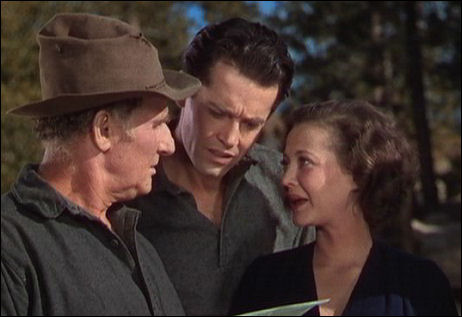

(l. to r.) Fred Stone Henry Fonda, Sylvia Sidney in Trail of the Lonesome Pine (1936)

“The colors look wonderful — no bleeding. Detail is shockingly strong. I didn’t see anything on the box about restoration. It can look a shade glossy but it’s also extremely clean with no untoward chroma or disturbing artifacts. I’m both utterly impressed and perplexed at how it can look this good. Wow!”

I love that N.Y. Times critic Frank Nugent devoted the first five paragraphs of his nine-graph review (dated 2.20.36) to Trail‘s groundreaking cinematography, being the first color feature to be shout outdoors.

“Color has traveled far since first it exploded on the screen last June in Becky Sharp,” Nugent began. “Demonstrating increased mastery of the new element, Walter Wanger‘s producing unit proves in The Trail of the Lonesome Pine, which opened yesterday at the Paramount, that Technicolor is not restricted to a studio’s stages, but can record quite handsomely the rich, natural coloring of the outside world and whatever dramatic action may be encountered in it.

“The significance of this achievement is not to be minimized. It means that color need not shackle the cinema, but may give it fuller expression. It means that we can doubt no longer the inevitability of the color film or scoff at those who believe that black-and-white photography is tottering on the brink of that limbo of forgotten things which already has swallowed the silent picture.
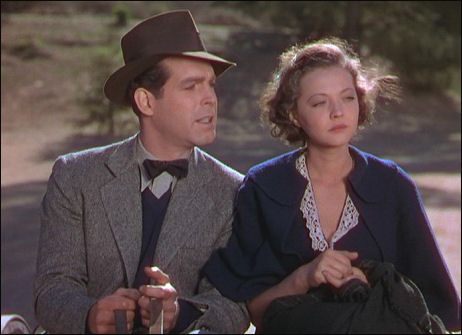

Fred McMurray, Sylvia Sidney

“Chromatically, Trail of the Lonesome Pine is far less impressive than its pioneer in the field. Becky Sharp employed color as a stylistic accentuation of dramatic effect. It sought to imprison the rainbow in a series of carefully planned canvases that were radiantly startling, visually magnificent, attuned carefully to the mood of the picture and to the changing tempo of its action.

“The new picture attempts none of this. Paradoxically, it improves the case for color by lessening its importance. It accepts the spectrum as a complementary attribute of the picture, not its raison d’etre.

“In place of the vivid reds and scarlets, the brilliant purples and dazzling greens and yellows of Becky, it employs sober browns and blacks and deep greens. It may not be natural color, but, at least, it is used more naturally. The eye, accustomed to the shadings of black and white, has less difficulty meeting the demands of the new element; the color is not a distraction, but an attraction–as valuable and little more obtrusive than the musical score.

“Lest this be interpreted as a completely eulogistic bulletin, let it be known that the Paramount’s new film is far from perfect, either as a photoplay or as an instrument for the use of the new three-component Technicolor process. Again speaking of the color, it would appear that blue still baffles the camera, that light browns have a tendency to run to green, that red is either extremely red or hopelessly orange. These are remediable defects, we feel, and ones that Hollywood’s skill will overcome.”