



I’ve never been more than mildly attracted to Alfred Hitchcock‘s To Catch a Thief, but I’ve been in love with Robert Burks‘ VistaVision photography, which won the 1956 Best Cinematography Oscar, since I was in my mid teens. No film delivers the splendor of the Cote d’Azur with more erotic punctuation, or is better at capturing that hazy-sunlight effect at midday and even the hillside and seaside aromas, which you can easily recollect and almost smell during a viewing.
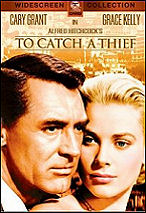
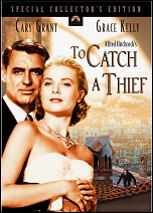
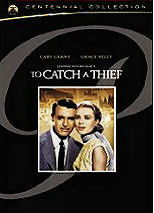
Which is why I’m about to buy my third DVD of the damn thing today. The latest upgrade is out and I have no choice.
The visual quality of the current Special Centennial edition is said by DVD Beaver’s GaryTooze to offer “a significant improvement over the 2007 edition with a higher bitrate and the rendering of colors is far superior with no hint of boosting as we saw in the [2007] SE.”
The first To Catch a Thief DVD, which came out on 11.5.02, was thought even back then to be somewhere between nothing special and somewhat crappy. It made Burks’ large-format photography look like it was captured on regular 35mm.
Nearly five years later, on 5.8.07, came the To Catch a Thief Special Collectors Edition, which added (or restored) a strong greenish tint to the nighttime rooftop scenes, and looked truly exceptional when played on a Bluray player and shown on a decent-sized high-def screen. I was blown away when I looked at this version on my just-purchased Bluray player and 42″ plasma screen last November. It almost flirts with Bluray quality in certain scenes.
And now — today — comes the To Catch a Thief Centennial Collection version, which reportedly delivers an improvement over the ’07 release and therefore an even more choice experience for guys like myself. The stills I’ve seen indicate color that is slightly less (the greenish rooftop efect is toned down) and more natural looking.
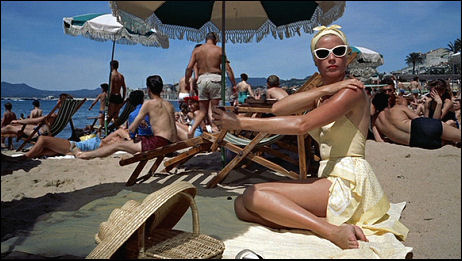
“By placing the film on one disc without any extra the compression has improved and even detail has advanced a notch,” Tooze has written. “The softer palette suits the film very well and it has a warmth that was devoid in the previous editions. Aside from seeing this in Blu-ray, this is fabulous news.”
This is perhaps the most significant divider between serious film lovers and people who just like movies. The former will always buy (not rent) the latest upgrade of this or that movie in order to have the finest rendering in order to simply look at the fucker — i.e., to sink into the visual bath of it and go “aahhh.” And the latter will rent this or that film on Netflix in order to watch the story and savor the emotional-aesthetic ride. They have no upgrade hunger and satisfied with “good enough” in the bitrate department.
In fact, I know a major Manhattan-based film critic who watches films at home on a plain old small-screen TV and a regular-scale DVD player, and doesn’t feel a particular need to upgrade. Imagine!
It’s no secret that two smallish films about a young, highly intelligent curly-haired guy trying find his footing in life — The Education of Charlie Banks and Adventureland — are opening within a week of each other, and soon. March 27th and April 3rd respectively. And that both have the earnest, curly-haired Jesse Eisenberg in the lead role.
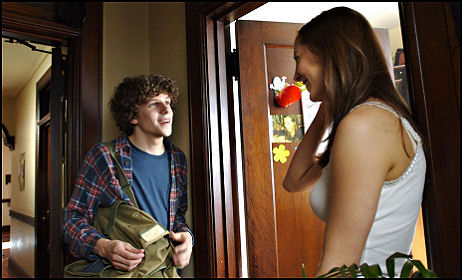
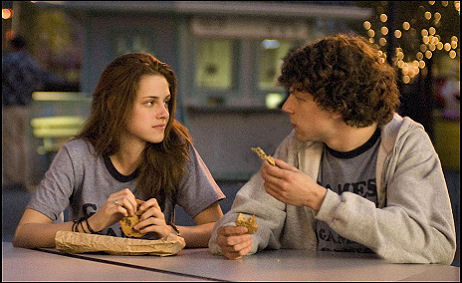
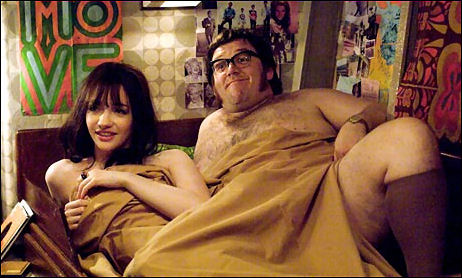
And that both Eisenberg characters — — I’m sure they share many similarities but this one I’m dead certain of — experience erotic-emotional longings for a attractive classy-soulful 20something girl — Kristen Stewart in Adventureland and Eva Amurri (the daughter of Susan Sarandon) in Charlie Banks.
I missed Adventureland at Sundance (where it received a positive if unspectacular response) but I’ll be catching it tomorrow. It’s obviously the more broadly accessible audience film between the two, and the hand of director Greg Mottola (Superbad) tells you it’s not submental.
I haven’t seen Banks but it’s said to be a character-driven period piece, set on the Vassar campus in the early ’80s, about a bright dweeb (Eisenberg) having to deal again with an old high-school rival (Jason Ritter). The was directed by Limp Bizkit’s Fred Durst.
I have a slight problem with the title of Durst’s film. The Education of Charlie Banks suggests that it’s about some kind of primal, life-changing lesson that shapes the character of young Mr. Banks. Not “an” education but “the” — big difference. Except daily life is a constant education. School is never out in this sense, and who’s to say which life lesson you absorb is the big one that really matters?
That’s why I love the title of Nick Hornsby and Lone Scherfig‘s An Education so much. It doesn’t imply that what Carey Mulligan‘s character learns over the course of it is a major game-changer; it simply says that she picks up a thing or two.
Last night Icon of Fright’s Rob G. posted a carefully assembled rant piece about a dumbed-down subtitle problem on the recently released DVD and Bluray of Tomas Alfredson‘s Let The Right One In, the Swedish vampire film that was praised to the heavens when it came out last fall.
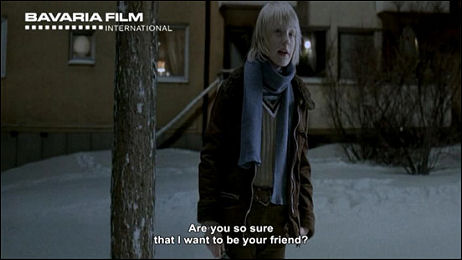
Magnolia Home Entertainment issued the DVD and Bluray on Tuesday, March 10th. The film was theatrically released in the U.S. via Magnet, a Magnolia division geared to releasing the “wild, unquantifiable and uncompromised,” according to a 9.11.07 press release. Well, somewhat less wild when it comes to home video.
In a series of screen-grab comparisons between the original DVD screener and the DVD, Mr. G. persuades that the subtitles “have been drastically changed since the last time I saw it, and completely dumbed down.”
Except he really means “subtly” rather than “drastically.” The “basic gist” of what the characters are saying remains, he says, but “the dark humor, subtleties and character nuances which made the movie so powerful” are “completely missing.” And pretty much “every single line of dialogue is completely off” in this respect, which more or less ruins Alfredson’s film for anyone who saw it theatrically and remembers it with any particularity.
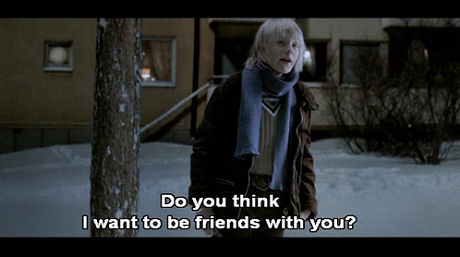
The original screener says that the subtitles were done by Ingrid Eng. Rob G. has theorized that “in order to re-use the subtitles for the American version of the DVD, Magnolia probably had to pay Ingrid again for her services. Rather than do that, perhaps they hired someone else to do the translations on the cheap.”
I tried to post this last night but I was too fagged and shagged. I wrote a highly-placed Magnolia friend this morning to see what the explanation might be.
It’s been alleged but nor proven that the Canadian edition from Mongrel Media has Eng’s original English subtitles.
In a week-old interview with the Village Voice‘s Aaron Hillis, The Girlfriend Experience director Steven Soderbergh is asked if the film, a portrait of a life of a beautiful high-end Manhattan prostitute, is a metaphor for Soderbergh’s own life and career.
Sundance journalists who saw the film suggested that Soderbergh sees himself as the prostitute being paid big bucks to deliver certain high-end services and yet getting bad reviews from the movie-reviewing, buzz-spreading journalists, who are repped in the film by the sleazy Glenn Kenny character, who has it off with Sasha-the-prostitute and then pans her “performance.”
Soderbergh answers that “it’s kind of hilarious for somebody to look at that and assume I’m making some larger comment about my work — or that the movie’s an exploration of what happens to somebody when they get bad reviews. It’s not a metaphor for anything.” But later on in the interview he says, “I don’t see any difference between what Sasha is doing in the movie and what I do for Warner Bros. The character in the movie is doing what she wants to for money, and so am I.”
We’re talking superb black and white photography here. Very carefully lighted. It’s also a high-end Helmut Newtonish coffee-table book shot. In no way cheap or common. That’s a pretty good excuse for posting it, I think. I’m sitting at a Le Pain Quotidien at 7th and 58th, and I just saw it and went “whoa…okay.” Here’s to the 40-plus years.
Because Anne Hathaway was so good as a neurotic, drug-addled wreck in Rachel Getting Married, swaggering producer-mogul Harvey Weinstein has persuaded her to become officially “attached” — i.e., interested but unsigned — to play the famously neurotic, drug-addled neurotic Judy Garland in both stage and film adaptations of Gerald Clarke‘s Get Happy: The Life of Judy Garland, which the Weinstein Company has optioned the film and stage rights for.


Hathaway also resembles the younger, unspoiled Garland of the 1940s and early ’50s, and could be made up to look like the lined, haggard and agitated woman she became toward the end of her life.
In a special Daily Beast article called “Hollywood’s Most Threatening Blog,” Kim Masters explains why Variety and the Los Angeles Times have so much to lose in their battle to bring down Deadline Hollywood Daily’s Nikki Finke. But Masters reporting doesn’t suggest, much less contend, that the Times is trying to wound or disparage Finke. Her piece is pretty much a gender-war-barricades attack upon Variety editor Peter Bart, whom she calls an “old-media dinosaur” who “doesn’t get it.”
Finke “has broken some controversial stories in Hollywood, so it’s not surprising to see her become one herself,” Masters begins. “This weekend, Variety launched an extraordinary three-pronged attack that was ostensibly aimed at blogging in general but clearly was aimed at [Finke] in particular.
“The package included a column by Bart under the headline ‘Hollywood’s Blog Smog‘ that bemoans the fact that blogs are sometimes used as weapons of intimidation by players in the industry who know how to manipulate them.
“Then there was a Cynthia Littleton article that seemed to be little more than an extension of Bart’s editorial; the headline — ‘Tempest of the Toldja! Journalists‘ — was clearly aimed at Finke because a screaming ‘TOLDJA!!’ in her headlines is one of her signatures. ‘
“And Finke was [also] blasted in a piece from columnist Michael Fleming (‘How I Got Blogged Down‘) about the difficulty of maintaining journalistic standards given the overheated online competition.
“Bart’s coordinated attack — indeed the whole whiny Variety package — sounds too much like the enraged cry of an old-media dinosaur trying to defend what’s left of its terrain.
“Whatever Finke may have to say about Variety, Bart did a lot to damage himself in one of the closing paragraphs of his column. He allows that he admires Finke’s energy and dedication while bemoaning ‘her dissing of fellow news gatherers, her personal vendettas and her use of intimidation.’ And then he continues: ‘She once attended Miss Hewitt’s classes in New York, which taught upscale girls how to be warm and cuddly. I’d like her to take a warm-and-cuddly refresher course.’
“If that line doesn’t show how profoundly Bart just doesn’t get it, it’s hard to imagine what would.”
In other words, if Finke was a guy — some kind of tough-talking, finger-poking Walter Winchell-like internet gunslinger — Bart would never have written about how he needs to watch his manners or be more respectul of his elders.
Update: Finke posted a response to the brouhaha at 2:32 pm, or six minutes ago. She discloses that on 2.27 Variety president/publisher Neil Stiles “called me saying Reed Business Information CEO Tad Smith was pushing him to discuss an acquisition of my site.” But the deal was dead two days later, she says, because Bart heard about it third-hand (from Variety-hosted columnist Anne Thompson) and threw a fit over “not [being] consulted by his overlords about the overture.”
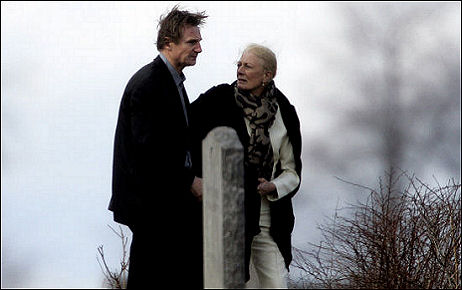
It may sound like the wrong thing to say but this shot of Liam Neeson and Vanessa Redgrave at yesterday’s funeral for the late Natasha Richardson in Millbrook, NY., looks like a carefully composed shot (certainly in terms of lighting and framing) from a feature. Not a super-immaculate Vittorio Storaro composition but like something out of a Noah Baumbach film. One glance and you can feel it. Gray skies, somber garb, bush branches, despairing looks.
This photo alone, which sits atop a 3.22 Guardian takedown piece by Nick Adams about director-writer Richard Curtis and his latest film The Boat That Rocked (opening 4.1 in England, 8.29 stateside), has instilled serious concerns.
Observe and Report “is not a movie about a guy who becomes a hero [but] a guy who’s decided in his own mind that he is one, all evidence to the contrary. Referring to this movie and Paul Blart: Mall Cop in the same breath because they’re both about mall cops is like comparing Straw Dogs to Babe because they’re both set on a farm.” — from Moises Chiullan‘s just-posted review of Jody Hill‘s upcoming Warner Bros. release, which is opening 4.10.
Anyone out there who believes that the Warner Bros. copy line on the Observe and Report poster is meant to be understood in this light — i.e., that Rogen’s character is delusional — doesn’t know much about studio marketing. The poster obviously isn’t taking the idea of Rogen’s mall cop being a hero seriously — the shades make it clear he’s a self-absorbed doofus — but the poster isn’t even flirting with the idea that the character may be seriously deranged in a Travis Bickle sense of the term. There isn’t a wisp of a hint of this in the poster art.
The Playlist is reporting about having spoken to a source in Austin during SXSW about Terrence Malick‘s Tree of Life undergoing additional shooting and that the film “is about a year away from completion and maybe a year and half away total.” Which means, if this turns out to be valid information, that we’re looking at a mid-2010 release.
Malick’s parallel IMAX project is said to be titled Voyage of Time. An anonymous Awards Daily commenter who claimed to be posting from Malick’s home town of Austin (but who could in fact be the great Ahmed Khan posting from Kabul) wrote earlier this month that Time will run in the vicinity of 45 minutes, that some Time footage may be used for Tree of Life, and that it’ll be released simultaneously with Tree of Life.
Clearly, Malick has an attachment to secrecy. He seems to live for it almost. To be able to work within such an utterly secret vacuum that no one is able to learn any substantive-sounding information is perhaps (who knows?) the bottom-line electric lightning-bolt element in Terrence Malick’s life and head. Secrecy! But with all the sniffing around no one, it seems, has stopped to consider the absolute lunacy of attempting to blend a story about an anxious 20th Century man (Sean Penn) and recollections of his distant father (Brad Pitt) with prehistoric pre-time elements, including a prehistoric creature sleeping in a sea of magma. Good God!
Until somebody closer to the action or someone with a professional rep with some kind of valid professional relationship with Malick spills I’m treating the whole thing as one big dinosaur wank.