Bingham vs. Cancer?

As a reader of Walter Kirn‘s “Up In The Air“, Matthew Morettini suspects that Jason Reitman shot Up In the Air with an undercurrent of fatality in mind — i.e., George Clooney‘s Ryan Bingham suspecting his days may be numbered.

Those who haven’t seen the film should know that spoilers follow.

“Kirn’s 2001 novel is told in the first-person from Bingham’s point-of-view,” Morettini begins. “By the time we reach the third act, after a series of strange and confusing episodes, it becomes clear that Bingham is an unreliable narrator. It is only in the last few pages that we learn he has been suffering from seizures, black-outs for hours on end, and has an upcoming appointment at the Mayo clinic for treatment of this unnamed affliction.

“In short the book has a twist ending that makes you go back and rethink everything you read. I think director-cowriter Reitman had the same ending in mind when he made the movie only to pull his punches in post.

“The first clue to Reitman’s intention is the ‘Would you like the cancer?/Would you like the can, sir?’ joke during Bingham’s maiden flight. When I saw this scene, I immediately knew the meaning of the signal since I’d read the book. My presumption was that unlike Kirn in the novel, Reitman was going to be a bit more clever about planting clues about Bingham’s health throughout the story.

“As it stands in the film now, without the twist, the ‘cancer/can, sir’ joke is an odd bit that doesn’t really make sense. It’s merely a joke that seems to have been written to demonstrate Bingham is preoccupied with thoughts of cancer and death.

“There are other hints of mortality. If you go back and watch the movie again in your mind, almost everything else Bingham does makes more sense if we suspects he may be dying.

“As in the novel, Bingham is obsessed with frequent flier miles. (One million in the book, ten million in the film) “I would be number seven,” he explains. “More people have gone to the moon.” If we look at his quest through a mortal lens, we see that instead of just being a guy trying to score points, Bingham is someone racing the clock, trying to achieve something that would give his life a kind of meaning before he meets his early end.
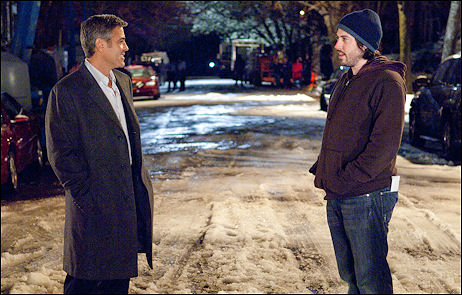

George Clooney, Jason Reitman

“Bingham’s rash decision to throw away his whole life/relationship philosophy as he tries to connect with Alex in Chicago is something a sick guy with emotional avoidance issues might just do.

“Ditto his reaching out to reconnect with his family in northern Wisconsin, however awkwardly, and his trip down memory lane when he and Alex break into his old high school. Not to mention his ‘we all die alone’ declaration whenever he discusses relationships with Natalie.

“My gut tells me that Reitman watched his movie from start to finish and decided the ending was dark enough without piling a cancer diagnosis upon his main character.

“I’m not arguing that movie needed the twist; it works brilliantly without it. But the threads of this lost ending are woven through the film, and I do think it was there at the start. I think the whole story was started down that path and I think Clooney played the character as a goner, and that Reitman had second thoughts in post.

Sidenote: Morettini says that when Bingham tells his boss (Jason Bateman) that he doesn’t remember a bridge-jump suicide threat of one of the women Natalie laid off, “it didn’t read to me that he was protecting Natalie…it seemed to me he that he just forgot about the incident altogether.” That’s obviously not true. Bingham had forgotten nothing. He was protecting Natalie. And himself, of course.

Disney Hands

Shared by Mickey and Minnie Mouse, Goofy, Donald Duck, etc. I found these in the Elizabeth Taylor-Nicky Hilton cottage late this afternoon.


Saturday, 1.2.10, 3:10 pm.

Best January Hate-On

Where do they find directors like Mark Steven Johnson, whose latest effort, a vapid chick flick called When In Rome, opens in late January? One look at the trailer tells you everything. Look at his hack moves, hack TV-series lighting aesthetic, hack preferences for extra-broad comedic reactions, etc. Why are young chick flicks always so vapid and inexpertly made? Is it because producers fear that young women wouldn’t see them if they were of a higher calibre?

Closer

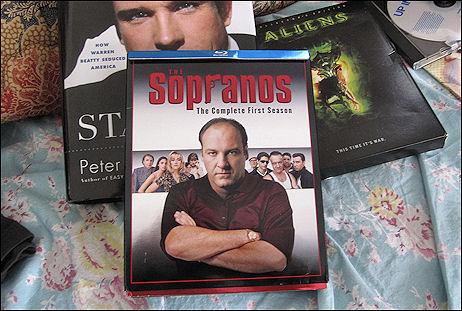
I’m not going to try to out-describe a riff by DVD Beaver’s Gary Tooze on the Sopranos Complete First Season Bluray that I got for Christmas. I can’t help being impressed by “it’s like watching an Ektachrome slide show in perfect continuous motion” — that’s a very good line. So is “the resolution is so good that we are aware of no pixels, just substance.”

Beyond the obvious Blu-ray factor, the reason for the exceptional clarity is that The Sopranos “was very directly filmed, without massive quantities of post-production filtering and manipulation,” he notes. “We are just that much closer to the source here than many of today’s movies. The Sopranos has more in common with a motion picture feature than a television series, so it makes sense that it should look like film, despite that it’s undergone transition and compression with a digital interface presented through a digital medium. Grain is very tight, but image resolution is tighter; impression is voyeuristic, which, I am certain is the intention.”

White Night


Saturday, 1.2.10, 9:25 am — view from the historic Elizabeth Taylor-Nicky Hilton cottage (local legend says they stayed here in ’50 or ’51 for two or three weeks during their brief and stormy marriage) in Wilton, Connecticut.

Evil Maestro

In a 12.31 Salon piece that I initially ignored, Matt Zoller Seitz declares that Osama bin Laden was the aught decade’s most effective showman — a man who understood the power of nightmares better than any horror film director.

“The time between the first impact and the fall of Tower Two was about the length of a Hollywood feature,” Seitz remarks. “Even if one or more of the flights had been significantly delayed prior to takeoff, the most spectacular visuals of 9/11 most likely still would have been staggered and would have occurred within a comparable time frame.

“The message of 9/11 was content. The attack was form. Whoever devised it had the mentality of a suspense film director: Don’t deliver all the whammies at once. Space them out.

“There’s a word for all this. It’s showmanship — the thing we experience, or masochistically hope to experience, each time we go to the movies.

“The image of the burning towers is clarifying symbol, a glyph that unifies the experience of that day — our memory of what it felt like, our sense of what it meant. Say the day’s two numbers, nine and 11, in the presence of any living soul, then ask what they just saw in their heads, and they’ll give the same answer: the towers.

“The attack was its own emblem, its own insignia. It may even have been intended, as certain brazen horror film images are intended, to contaminate once-mundane events: riding in an elevator, climbing stairs, looking at a skyline, watching a plane land. The burning towers were meant to be photographed, written and sung about, sketched and painted, represented in film and video, on cotton T-shirts and black velvet canvasses, in watercolor and needlepoint and Lego. They were meant to persist in living memory and beyond. They are a memento of trauma devised by those who inflicted it.

“Posters that sprung up after 9/11 declared, ‘We Will Never Forget.’ As if there were any alternative.”

All But Settled

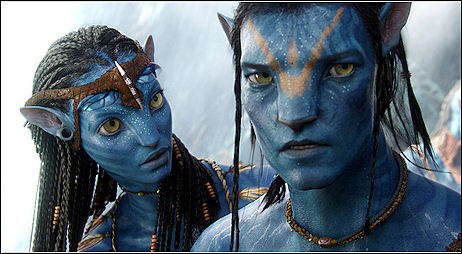
Something snapped into place when I read this 1.3.10 Manohla Dargis piece about movie-watching eternals and technology. I’d just scanned the latest Avatar box-office numbers ($800 million worldwide two days ago, expected to surpass $1 billion in a week or so) and the guesswork had suddenly gone out of the equation — Avatar is the Best Picture front-runner. It opened 15 days ago and this much is certain.

The four main reasons are (a) the lasting emotional wow, (b) the way it seems to have re-energized the moviegoing experience through 3D (which will henceforth be a potent exhibition attraction), (c) the Alexander-ish worldwide box-office domination and (d) the immensely satisfying depiction of the defeat of Bush-Cheney corporate militarism (and the right-wing blogger fury that has resulted).

The backlashers have all been heard and barely made a dent. The only thing that can turn it around is if Academy voters don’t give a shit what people like me are saying and vote for Up In The Air or The Hurt Locker for their own reasons. But even for that to happen Up In The Air has to somehow find fresh wind. The Hurt Locker has continued to find new energy all along, most recently through the year-end critics awards. The case has been more than made.

But — tell me if I’m wrong — there’s a resolve in Dargis’s words and feelings that seems to affirm Avatar‘s inevitability.

“At a movie theater rigged for 3-D projection, I saw Avatar with an audience that watched the screen with the kind of fixed attention that has become rare at the movies. True, everyone was wearing 3-D glasses, which makes it difficult to check your cellphone obsessively, but they also seemed captivated.

“When it was over, people broke into enthusiastic applause and, unusually, many stayed to watch the credits, as if to linger in the movie. Although much has been made of the technologies used in Avatar, its beauty and nominal politics, it is the social experience of the movie — as an event that needs to be enjoyed with other people for maximum impact — which is more interesting.

“That’s particularly true after a decade when watching movies became an increasingly solitary affair, something between you and your laptop. Avatar affirms the deep pleasures of the communal, and it does so by exploiting a technology (3-D), which appears to invite you into the movie even as it also forces you to remain attentively in your seat.

“You can get lost in a movie, or so it seems, and melt into its world. But even when seated third row center and occupying two mental spaces, you understand that you and the movie inhabit separate realms. When I watched The Dark Knight in IMAX, I felt that I was at the very edge of the screen. Avatar in 3-D, by contrast, blurs that edge, closing the space between you and the screen even more.

“Like a video game designer, James Cameron seems to want to invite you into the digital world he has created even if, like a film director, he wants to determine your route. Perched between film and digital, Avatar shows us a future in which movies will invite us further into them and perhaps even allow us to choose not just the hero’s journey through the story, but also our own.”

Wait…I’m Late?

Okay, okay — Matt Shapiro‘s 2009 Cinescape summation is probably the best I’ve seen. (Not that I’ve watched dozens or even several.) But why wait until 12.31 to post it? And why didn’t I see it until last night? Most of us were in the mood now from 12.25 until 12.31, but no longer. Enough of this.

2010 Balloon Going Up

I’d like to start putting together a new 2010 Oscar Balloon, and then paste it underneath the current one when it’s done a week or so from now. The usual suggestions are requested — i.e., the most highly anticipated performers in the various categories, blah, blah. Starting all over.

Nobody knows a thing but Doug Liman‘s Fair Game, a dramatization of the Valerie Plame-Joseph Wilson drama, has to be formidable. (Plus I’ve heard some good things.) James L. Brooks‘ untitled romantic triangle with Reese Witherspoon, Paul Rudd and Owen Wilson seems vaguely promising. Ditto Clint Eastwood‘s Hereafter despite the iffy word on Peter Morgan‘s script. I’ll bet money that Anton Corbijn‘s The American, the George Clooney assassin-in-Tuscany movie, will be at least passably engaging, and that it’ll look absolutely terrific. David Fincher‘s The Social Network, a.k.a., “the Facebook movie,” has a first-rate Aaron Sorkin script (which I’ve read) and producer Scott Rudin behind it.

High-octane popcorn titles include David Gordon Green‘s Your Highness with Danny McBride, James Franco, Natalie Portman, Zooey Deschanel, etc. Phillip Noyce‘s Salt, trust me, will turn out to be a good deal more than some may be anticipating right how. Tony Scott‘s Unstoppable appears to be a more high-octane Runaway Train. Todd PhillipsDue Date is an amusing-sounding road movie deal with Robert Downey Jr. and Zach Galifianakis, Michelle Monaghan, Jamie Foxx, etc.

I know Paul Greengrass‘s Green Zone will be some kind of exceptional. No one expects too much from Martin Scorsese‘s Shutter Island, but it’s certainly seen as an exciting late-winter release.

Kris Tapley‘s 2010 wanna-sees include Chris Nolan‘s Inception, Darren Aronofsky‘s Black Swan, Lee Unkrich‘s Toy Story 3. Jon Favreau‘s Iron Man 2, Tim Burton‘s Alice in Wonderland, Ridley Scott’s Maximus Hood, Terrence Malick‘s The Tree of Life (Penn, Pitt, dinosaurs), Matthew Vaughn‘s Kick-Ass and Oliver Stone‘s Wall Street 2: Money Never Sleeps.

Button Button

For a couple of minutes everyone at last night’s party was watching or half-listening to CNN’s Anderson Cooper and Kathy Griffin do Times Square commentary, and suddenly a reporter was mentioning Rush Limbaugh being in the hospital, and somebody yelled out, “Is he dead?” This was a gathering of Fairfield County lefites, okay, but no one was drunk, and the fantasy did seem agreeable for a second or two.

It’s true — something in me wanted to hear “yeah, he’s gone.” I’m just being honest. The world might be a less fearful and blustery place without him, or at least until the next Limbaugh (just as bloated and blowhardy but younger) comes along. Honestly? If Frank Langella were to knock on my front door and hand me a wooden-box device with a red button on top and tell me that if I pushed the button Limbaugh would immediately die and no one would ever be the wiser, I might give the matter some thought.