Boy Pops Through

A little while ago I emerged from Taika Waititi‘s Boy, which is now, I’ve decided, the other strong-recommend film I’ve seen so far at Sundance 2010 (on top of Get Low). The third apparent winner, to go by the buzz, is Catfish. The problem is that I have a hard ticket to Four Lions, which will begin at the Egyptian at 5:30 pm. It’s now 4:40 pm so I have no time to write anything.


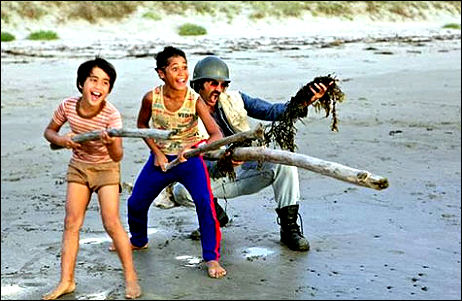
Te Aho Aho Eketone-Whitu (Rocky), James Rolleston (Boy), and director-actor Taika Waititi (Alamein) in Boy

I have time to say one thing. Waititi has a little bit of Wes Anderson in him. The movie is as freshly felt and stylistically alive as Bottle Rocket and Rushmore did in the mid to late ’90s.

Here’s a link to Julian Sancton‘s review of A Boy on vanityfair.com. I agree with pretty much every word. I’ll be sitting down after Four Lions and tapping out impressions of both films.

Downish, Trapped

I regret to say that John WellsCompany Men, a drama of layoffs and despondency affecting three Boston-area white-collar guys (Ben Affleck, Tommy Lee Jones, Chris Cooper), plays like an intelligent funeral in a nicely furnished minimum-security prison.

It’s an honest and competently assembled attempt to capture the Great Recession lamentations of the moment, but the story just kind of plods along. It feels lifeless and confined — stuck with itself with no escape plan. It’s kind of proud, in fact, of being a story about well-dressed prisoners and their wives and children. Each dawn I die.

Wells was obviously convinced that just telling these three stories in a plain, no-frills, reality-reflecting way would suffice. Over and over Company Men says that losing one’s job can be devastating on several levels, that unemployment requires lifestyle cutbacks, that older men need sometimes need the jolt of an affair to feel alive, that job-seekers frequently fall into denial and despair, and that this country’s inability to compete in the honest making of things amounts to a huge spiritual deficit.

Yeah — agreed, agreed. But I kind of knew or suspected all of this. And yet the movie confines itself in an upper middle-class ghetto that feels — I’m going to steal a line from Camille Paglia — so lacking in “the lurid pagan truth about life.”

There’s no madness, no sexual intrigue to speak of, no wily characters, no humor, no violence, no fist fights, and no Sopranos-style aplomb in portraying the grim or ironic undercurrent of things among suburbanites with power and money, etc.

Company Men is obviously occupying a portion of the same turf as Up In The Air minus the Clooney-and-Farmiga charm, the emotional resonance, the air miles, the sharp dialogue and the smartly angled characters.

Kevin Costner has a smallish role in Company Men as the house-renovating brother of Affleck’s wife, played by Rosemary DeWitt. He doesn’t have very many lines, but I wish the story had been mostly about him because he’s easily the most appealing personality on the boat. The second most engaging performance is given by Craig T. Nelson as the blunt-spoken CEO of the company whose cost-trimming decisions cause all the grief.

I’m genuinely sorry to have said most of this. A team of smart, sophisticated and well-intentioned people made Company Men , but it’s an absolute stiff in terms of real-world theatrical potential. I could see watching Company Men on HBO on a Sunday evening and going “yeah, not half bad,” but I wouldn’t dream of recommending it as a movie to go out and pay $12 bucks to see plus parking and popcorn.

Slippery Catfish

Okay, okay — I should have gone to see Henry Joost and Ariel Schulman‘s Catfish late yesterday morning. An MCN link calls it “Sundance’s sensation of the hour” and Marshall Fine says it’s “a film whose emotional journey is wholly unexpected and which takes the viewer on a ride he can never anticipate. It’s as visually low-tech as a movie can be, but these filmmakers prove that, with the right story, the images are in service to something much, much larger.”

Time and again at film festivals I’ve shown a remarkable genius for accidentally missing, sidestepping or deliberately not catching the proverbial “hot film.” I had just come out of Get Low yesterday morning and the notion of trudging it over to the Library for the 11:30 am Catfish screening was considered and discarded. Not enough time, didn’t have a hard ticket, hated (and still hate) the title, averse to docs about cyber relationships, etc. I’ll be able to see Catfish today at a 4:30 pm press showing, but I have a ticket to the highly anticipated terrorist comedy Four Lions at the Egyptian at 5:30 pm.

In The Company of Men


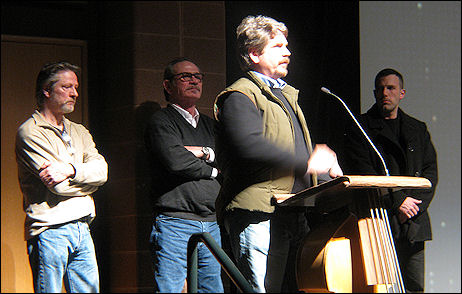
Following this evening’s Eccles screening of Company Men — (l. to r.) Chris Cooper, Tommy Lee Jones, director-writer John Wells, Ben Affleck. 1.22.10, 11:35 pm.

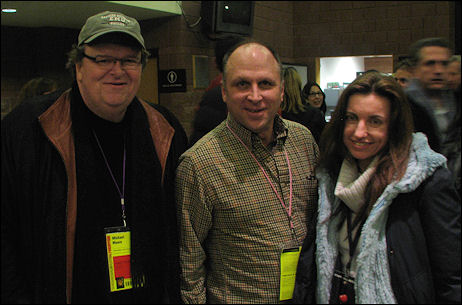
Prior to Company Men screening in Eccles lobby — Michael Moore, Apparition co-chief Bob Berney, an Apparition exec/ally whose name I should know. (Sorry.)

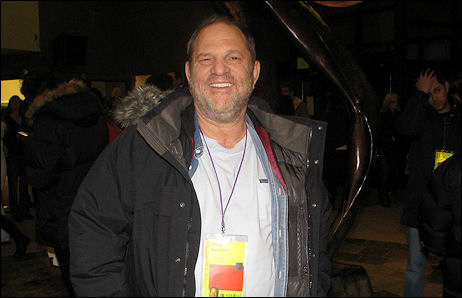
The indefatigable Harvey Weinstein — Eccles lobby, 1.22.10, 9:15 pm.

Hurt Disser

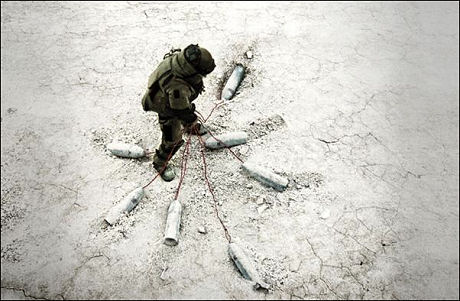
The problem with The Hurt Locker, in the view of Newsweek‘s Seth Colter Walls, is that it has no political inquisitiveness and is therefore way too opaque.

“Artists were put on earth to…give us insight and catharsis, not merely riff on the free-floating tensions that already dominate the mass consciousness,” he says. “The conventional wisdom is that Iraq War films have foundered at the box office because we have no appetite for them, but it might be that our appetite for them has been slight because they offer precious little nutrition. Nearly all of them are telling us pretty familiar war-is-hell narratives, even if those narratives are skillfully rendered in a technical sense.

The Hurt Locker gives us not only no context but no hint that the context is missing, since it mines the adrenaline of combat without mussing itself in the viscera of anything as dangerous as ideology. It’s a rip-roaring piece of suspense cinema, but decidedly no more than that.”

The Voidoid

I was on the Gaspar Noe boat after seeing Irreversible, but after seeing Enter The Void — a visually over-indulged and thoroughly sleazy after-death fantasy film — I’m totally off it until further notice. I’ll always admire Noe for being the go-for-broke provocateur — intensely opposed to typical shooting and cutting modes, pushing the boundaries as it were — but provocation in and of itself can get very old, especially when there’s next to no story being told and the characters are spiritually empty, pill-popping nowhere heads.

Noe has used, in these two films, an audacious, swirlygig crazy-bold shooting style. The camera rises and rotates and floats along and around, watching characters dealing or doing drugs and having sex (lots of that) from above, and flying over roofs and passing through walls and diving into gross toilets and bullet holes and squishy vaginas. But this camera language, if you will, is wildly undisciplined and grows tedious very quickly. Yes, it plays the visual panache card like few others films or filmmakers have ever dared or dreamed. But it’s essentially masturbatory.

I am going to take my time seeing the next Gaspar Noe film — that’s a promise. He’s no longer a must-see filmmaker.

Enter The Void is basically about the spirit wanderings of Oscar (Nathaniel Brown), a youngish kid who get shot to death inside a grimy toilet stall in a Tokyo club called The Void. His reason for lingering on earth is a pledge made to his sister Linda (Paz de la Huerta), a stripper/faux-prostitute whom he’s been living with in Tokyo, that they would never part, “no matter what.” So he floats and hovers over the people and places he knew in life.

But it all adds up to zip except for the initial intrigue of taking a ride with Noe’s camera, although that intrigue, as stated, goes out the window after 20 or 30 minutes. And then it becomes its own hell. For 156 minutes. People who take ecstasy and snort coke are deathly boring.

Get Low, Finally

I missed Aaron Schneider‘s Get Low in Toronto but finally saw it this morning. It’s a first-rate backwoods American drama with a touch of whimsy. Superbly acted by Robert Duvall , Bill Murray, Lucas Black, Sissy Spacek and Bill Cobbs. An eloquent, plain-spoken, true-heart thing about values, friendships, backstories and buried business. My next film, Gaspar Noe‘s Enter The Void, starts in two minutes. Later….

Scorsese Is No Monk

IFC.com’s Stephen Saito recently reported on last Saturday’s Martin Scorsese/LACMA event. Somone asked where Scorsese stood on film grain, and he might as well have said, “Uhm, I kind of get where Jeffrey Wells is coming from on this issue and he’s not altogether wrong. The grain monks have staked out a position that is perhaps a little too purist, too extreme,”

Saito recorded most of the conversation and has sent the full quote from Scorsese on film grain. Read it and weep, residents of the Abbey of St. Martin! If Scorsese isn’t with you, you’re finished.

“I think it’s an interesting point,” Scorsese began. “Some of the grain, in certain cases, I think it’s been…like Jack Cardiff, who when he was still alive was able to comment of course on all the restorations of Black Narcissus and all the other films begin made and I think in certain films in certain sections, they would’ve liked it better if the grain was less. They would’ve liked it better if the dissolves…the internegatives didn’t look like dupes. And we just have to settle. They had to settle.

”And I think to a certain extent, they would’ve liked it cleaner. Don’t forget too that the instance of three-strip Technicolor, look at that…they did a few years ago, they had a color film at the Academy and they showed a few seconds of Robin Hood digitally restored and I do know…I really believe that the cinematographer would’ve preferred to have it cleaner at the time. There’s no doubt.

“I happen to like grain because I’m used to seeing it, but when I see it cleaned up, it’s a whole other experience. I talked about the grain, for example, we were talking about lusting after those Red Shoes 16mm prints — even with the grain, it didn’t matter. But to see it in a new form, I think that’s what the filmmakers really would’ve preferred in most cases, unless it was a stylistic choice to go with grain.”

“Movie About A Poem”

Variety‘s Todd MCarthy has described Rob Epstein and Jeffrey Friedman‘s Howl as “an admirable if fundamentally academic exploration of the origins, impact, meaning and legacy of Allen Ginsberg‘s titular landmark poem, it is also an intriguing hybrid of documentary, narrative and animated filmmaking, one that needed to burst through the constraints of its conceptual origins as a docu to express everything on its mind.

“That said, how many remotely commercial films have ever had the nerve to build themselves around core sequences consisting of long swaths of poetry being read to eager listeners, whose rapturous reactions are recorded in enthusiastic detail? Even if the shock that Ginsberg’s bluntly sexual and provocative words carried then can’t possibly be felt the same way 55 years later, anyone who revels in the pure pleasure of the spoken word will receive rare gratification here.”

And Marshall Fine has called it “an imaginative and thoughtful work, one that illuminates a fascinating moment of cultural history and one of America’s great writers. Whether it will appeal to a mass audience — or even an arthouse crowd — is another question altogether. After all, before the screening last night, the directors thanked their producers for allowing them to make ‘a movie about a poem.’ Which is what they’ve done.”