
It’s Over

After Hurt Locker wins with the PGA, DGA, WGA, BAFTA, BFCA, NSFC, NYFCC, LAFCA, ACE, GIFA, and IPA plus a co-leading nine AMPAS nods including vital ones for directing, acting, screenwriting, and editing, “we can now say with more than a fair degree of certainty that we know which film will win the top Oscar,” writes And The Winner Is columnist Scott Feinberg.
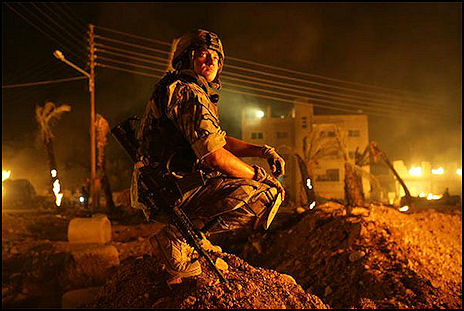
“Sure, arguments can be made for other films (and both studios and pundits are making them), and upsets can happen (you don’t have to remind me). But the fact of the matter is this: the raw data (precursor awards) and anecdotal evidence (conversations with actual voters) have rarely, if ever, given the same indication as clearly and consistently as they have this year: The Hurt Locker will win the 2009 Best Picture Oscar. Believe it — It’s true.”

Notes on Season‘s Pete Hammond half concurs, but he also says “not so fast, Sherlock.”

“The Academy’s new list of 10 best picture nominees, rather than five at BAFTA, plus the unknown effect of the preferential voting system (which BAFTA does not use) make it more difficult to gauge the influence of some of these precursor awards, save for PGA, which used the new Academy system this year. Of course we should remember Locker won a shocker of a win there too.

Plus Mark Boal‘s WGA win “was done without key Oscar nominees Inglourious Basterds and Up (both ruled ineligible by the WGA) as competition, so Boal was a lead pipe cinch to win there. He’s in a much tighter race for the Best Original Screenplay Oscar with Quentin Tarantino. But it should be noted that both Up and Basterds were against him at BAFTA where he had another victory for his script.

“Before either the WGA or BAFTA awards, I spoke to a producer and former studio head who told me he very much understands the psychology of Oscar voting. He predicted Hurt Locker would go all the way at the Oscars and said he voted for Carey Mulligan for Actress. I also keep hearing from others who say they are voting for Avatar, but as the above-noted producer points out, the ‘cumulative’ factor of a series of pre-Oscar wins can be a powerful aphrodesiac for Academy voters.”

The Wrap‘s Steve Pond adds this to the conversation:

Avatar is the reason the Oscar show will see its ratings increase dramatically, and Academy voters know that. Which makes Avatar the film that could possibly, conceivably throw the usual rules out the window and grab a win that hasn’t been indicated at any of the significant precursor awards.

I don’t believe it will. I look at all the other awards and see unmistakable indications that the people who decide these things think that The Hurt Locker is the best picture of the year.

“I think The Hurt Locker will win. I think it deserves to win. And I think that win will be extraordinarily popular within the Kodak Theater in two weeks. But over? Even after the events of the weekend, I can’t go there. Not yet, anyway.”

Choir Boys

There’s a riff about cops that I may have read in a Joseph Wambaugh book. It goes something like “poets, priests and politicians talk about what people might be, could be, should be, try to be. Cops deal with people as they are.” (If it’s not from Wambaugh, fine…whatever.) In this sense I feel a kinship with the law. No offense to 98% of HE talkbackers, but dealing with the talkback uglies really does affect your view of humanity to some degree. I’ve had the talkback thing going for almost four years now (it began in March ’06), and dealing with dozens of Mr. Hyde types, year in and year out, starts to affect your emotional makeup after a while.

Pile Just Got Higher

At the just concluded BAFTA awards in London, Kathryn Bigelow‘s The Hurt Locker has taken the awards for Best Picture, Best Director, Best Original Screenplay (won by Mark Boal), Best Editing, Best Cinematography (Barry Ackroyd) and Best Sound.

On top of which An Education‘s Carey Mulligan won for Best Actress, and A Single Man‘s Colin Firth won for Best Actor. Christoph Waltz and Mo’Nique, of course, won for Best Supporting Actor and Best Supporting Actress.

Clicks, Squeaks, Snips

Along with Avatar, Inglourious Basterds, Star Trek and Up, The Hurt Locker is nominated for a sound-editing Academy Award,” notes N.Y. Times staffer Virginia Heffernan. “For its cerebral, abstract and still deeply romantic sound tableau — a kind of sonic Cy Twombly painting — The Hurt Locker should win it.

“Sound editor Paul Ottosson‘s alignment of death and silence, instead of death and booms, partakes of an aesthetic based on the idea that you’re deaf when you die. On The Sopranos, a series known for its exquisite deployment of silence, Bobby Baccalieri says of dying, ‘You probably don’t hear it when it happens.’

The Hurt Locker is not cool. It’s hot and dry, a heaving desert parable with a mounting sandstorm howl at the center. The internal explosions matter more than the fireworks.

“Explaining the dynamics of roadside bombs in Iraq, Ottosson told Variety, You die not from shrapnel but the expanding air that blows up your lungs.’

“The top notes in the Hurt Locker soundtrack are arid metallic clicks, snips, squeaks and creaks, the chatter of wrenches and wire clippers, as bombs are defused in air so parched as to seem combustible itself. Men can hardly summon the spit or breath to speak.

“Much of the dialogue — which was almost all recorded on location in Jordan (and not looped in a studio) — is delivered in headsets, as soldiers hiss into one another’s helmets across desert expanses. To listen is to enter machinery, rib cages, ear canals and troubled lungs.”

Johnston vs. Exhib Cheapskates

In a 2.16 interview with Zaki Hasan (i.e, Zaki’s Corner), The Wolfman director Joe Johnston complains about something I and Roger Ebert and others have moaned about before — the deplorable tendency of commercial exhibitors to turn down the projection-light levels, which degrades the values in the film being shown.

“Standard projection brightness is intended to be 16 foot lamberts,” Johnston says. “This is a measurement of the amount of light reflected off the screen, back into a light meter. Projection bulbs are expensive, and if the urban myth is correct, there is a near monopoly on them so the manufacturer can name their price, which I’ve heard is around $400 each. These bulbs last longer if the current surging through them is dialed down, resulting in reduced foot lamberts which of course means a darker screen and a less vibrant image.

“The exhibitors save money by needing to replace projection bulbs less often and the filmgoing public gets a less satisfactory experience. You would be shocked to see the difference in image quality between 16 and 12 foot lamberts, 12 being a common meter reading at a lot of chain theaters. Only a few of the big premier theaters even bother to ‘read the screen’ and keep the brightness where it’s supposed to be.”

I was told a few years ago that some theatres actually dial the foot-lambert levels down to 10 or lower.

“People who love movies and want their money’s worth should demand that theater chains keep the brightness levels where they should be. Exhibitors should have a choice of who they buy the bulbs from, there should be market competition to bring the price down, and someone should invent a projection bulb that will only work at 16 foot lamberts..” Excellent idea, that last one.