The Fattest States

According to a five-month-old survey on weightlossdietwatch.com, Mississippi is the Jabba capital of the U.S. For five years straight it’s had the highest rates of adult obesity (32.5 percent). It also has the highest rate of obese and overweight children (ages 10 to 17) at 44.4 percent.

This is what rankles me about our health-care situation. Obviously not the Obama-proposed legislation (which the country definitely needs ) but the fact that the health prospects of your average sea lion rep a tremendous financial burden for everyone. The total cost of obesity, including “indirect costs,” is estimated to be $139 billion per year, and that ain’t hay.

Obese people pay 77% more for health care than normal-weighters. And two-thirds of American audlts are now either obese or overweight, the survey says. And most of the tonnage is accumulating in the poorer states in the South.

Clearly, buckets of Kentucky Fried Chicken pose a much greater threat to the lives of Americans than Middle-East terrorism. If obesity was smallpox or some other scary disease there would be sirens blaring and National Guard troops outside your windows right now.

Why hasn’t Barack Obama been more ardent about pushing a physical fitness program? Not just by giving a speech or two about it, but really getting on the train and urging schools to enforce exercise regimens like President Kennedy did in the early ’60s? I’m not exactly sure, but it probably has something to do with Obama’s not wanting to overly agitate obese swing voters.


Eloi Shields…Up!

The word is out among lightweight “entertainment”-seekers everywhere — don’t go see Greenberg! Too well reviewed (the highest-rated opener at Rotten Tomatoes), too smart, too psychologically recognizable, too neurotic, etc. It was in the low 80s earlier today, and is now sitting at 74 thanks to naysayers Kyle Smith, Katey Rich, Nick Schager, Mary F. Pols, Stephen Whitty, Betsy Sharkey, etc.

Whitty calls Ben Stiller‘s Greenberg “a nasty neurotic” and Greta Gerwig‘s Florence “a passive victim,” and adds, “If you’re looking for someone to identify with — well, pray you don’t find one here.” I didn’t identify with Greenberg, but I recognized him. And anyone who’s met a guy like this will recognize that Stiller gives a ballsy, dead-on performance. I for one loved some of his bits and lines. His irritation at a guy shrieking with laughter at a nearby table at Musso and Frank, for one. I’ve felt the exact same way a few times, and no character in any film I’ve ever seen has provided any sort of validation…until now.

Forget The Newbie

“As any video clerk can attest, movies with the same or similar titles can wreak havoc,” writes Philadelphia Inquirer critic Carrie Rickey. “After a preview of Repo Men (Universal, 3.19), the Jude Law sci-fi thriller about organ hijackers, a perplexed filmgoer friend asked, ‘Was I wrong to think this was a remake of that Emilio Estevez comedy?’

“What a difference a vowel makes!

Miguel Sapochnik‘s Repo Men (2010) is hard-core gore sci-fi starring Law and Forest Whitaker, and based on the sci-fi novel by Eric Garcia. Repo Man (1984) is a punk sci-fi comedy starring Estevez and Harry Dean Stanton, written and directed by Alex Cox.

“I love Cox’s movie, one of the great all-time cult films, and its droll perspective on the way the future looked in 1984. Set in a Los Angeles where all products are generic, all authority is suspect and aliens may be hiding in the trunk of your car, Repo Man is about Otto (Estevez) and his career repossessing stolen automobiles. (Otto: Auto.)

“I still crack up at the movie’s visual jokes about the sinister implications of tree-shaped air fresheners. I still crack up at its anarchic characters given to dialogue like, ‘Let’s go get sushi and not pay!’ And I love the film’s epiphany, delivered by the deadpan Tracey Walter: “The more you drive, the less intelligent you are.” And who doesn’t love the film’s transcendent climax, with a 1964 Chevy Malibu ascending to the heavens?

“I remember seeing the movie with my colleague Vince Canby who asked, with a delighted grin, “Did you ever expect to see a fusion of Close Encounters and Used Cars?”

Back-Asswards

Alan Poul‘s The Back-Up Plan (CBS Films, 4.23) is obviously a J.Lo rom-com — her first starring role in a mainstream comedy since ’02’s Maid in Manhattan. It’s also the sophomore offering from Les Moonvesnascent feature film division following Extraordinary Measures.

Obviously cut from the same formulaic cloth as 89 other films of this type. The marketing obviously invokes Sex & The City — same fonts, color scheme. I’m getting a bit of a small-screen feeling from the dialogue.

Overlord

HE was attacked by a D-Day-level spam invasion yesterday and this morning. I had to spend about 90 minutes this morning deleting over 300 spam posts, and not just recent ones but in threads reaching back to January and February. Manage comments, ban the poster, delete “comments.” I may have accidentally deleted one or two legit postings.

Strange Vogue

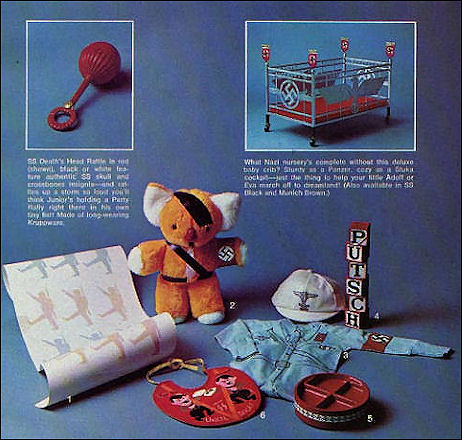
TMZ has posted a year-old Nazi-garbed photo session with Michelle McGee, the lady who had a thing with Jesse James (Sandra Bullock‘s estranged husband) and then ratted him out to In Touch magazine for $30 grand.

I don’t particularly care about this — James got what he deserved — but the photos took me back to a 1973 industrial-design photo piece in the old National Lampoon called “Nazi Regalia for Gracious Living.”

The article was written by Bruce McCall with photographs by Dick Frank. The product was “manufactured” by Harry Fischman, Alan Rose, Celia Bau, and David Kaestle. Elizabeth Benett did the illustrations.

The satire in “Nazi Regalia for Gracious Living” was aimed at American middle-class values. (I think.) I now believe it was feeding off the same risque cultural pollen that began to manifest about a year later in various arthouse films (as well as some from the sexploitation field). The common idea/attitude in these films was that under the uniforms Nazis (or Italian fascists) had heavily suppressed sex lives with gay, S&M and B&D inclinations.

Tinto Brass‘s Salon Kitty, Liliana Cavani‘s The Night Porter, Pier Paolo Pasolini‘s Salo and Bernardo Bertolucci‘s 1900 all worked this into their narratives. I remember Andrew Sarris describing this cinematic trend as “homosexual Nazi chic.”

Apparent common consensus still insists that the ultimate Nazi sexploitation film was David F. Friedman‘s Ilsa, She-Wolf of the SS.

“Excessive Vulgarity”

Jett went to see She’s Out of My League with a friend last night, and says that any critic who gives it a pass is out of their mind. “It’s as bad as The Ugly Truth, that Gerard Butler-Kathryn Heigel movie,” he says. “It’s a one-joke thing — she’s hot and you’re not.” And yet it has a 51% positive Rotten Tomatoes rating. That’s the easy-lay contingent in action.

I decided months ago that I wouldn’t see She’s Out of My League with a gun at my back. Unless…you know, Scott Foundas or some other tough critic went to bat for it.

Traffic

Nash Edgerton‘s The Spider, a nine minute and 11 second short, will be shown with The Square when it opens in early April. It’s been on the festival circuit for quite some time, but whatever.

Wine After Its Time

Last night I saw Joel and Nash Edgerton‘s The Square (Apparition, 4.6), a James M. Cain-like noir in a low-rent, not-terribly-bright, mullet-wearing Australian way. The Postman Always Rings Twice, Mate. I’ll hold my review for now, but the timing of the release is fair game for discussion, I think.

The Square was shot in ’07 and released in Australia in the summer of ’08. Apparition picked it up at last year’s South by Southwest and then waited for the right moment. I don’t want to sound like a jerk in Apparition’s eyes, but I think that an audience is missing something when watching a nearly three-year-old film in a first-run theatre.

I’m not saying The Square is a “dated ” film — it’s not. (Except for the fact that two blue-collar male characters wear ghastly 1980s mullets.) But there was an original spark that went into the filming of it — a spark and a climatorial vibe that had a lot to do with the specific conditions of life on the planet earth back then. And I think you lose the vitality of that chemical composition when you wait three years to show it. And I sensed a faint weathered factor as I was watching it. That or simply knowing it was shot in ’07 affected my perception.

Wine improves with age but movies — a living, breathing, moving-train art form — don’t. It’s not always true, but you often sense on some level the lack of mollecular immediacy and freshness in a film that was shot 18 months or two years before viewing. And you can really sense if it was shot three years earlier. Life’s particulars change in small and imperceptible ways as the months roll along, and then eventually they begin to stand out in stronger relief.

I don’t know what the rule of thumb needs to be, but it’s best if you see a film within a year or so of principal photography. That way it feels like a movie that belongs to the here-and-now. The initial September ’08 showings of The Hurt Locker, which was shot in ’07, felt more vital on some level than it did upon the commercial opening in June ’09, I can tell you. I’m sure there are dozens of examples.

I get that Apparition needs product and that they fell in love with the Edgerton brothers because suddenly these guys are in vogue. I saw Joel play Stanley Kowalski in A Streetcar Named Desire at BAM.

Heartland Scum

I agree with the guy who says “no handouts…you have to work for everything you get in life.” Damn straight. But the guys in this video are vermin — the absolute antithesis of the compassionate behavior that a certain wandering Hebrew advocated in his sermons.