
3-D on Brink of Over?

In an 4.9 interview with Variety staffers, DreamWorks animation honcho and longtime 3D advocate Jeffrey Katzenberg says that the degraded 3-D experience represented by Clash of the Titans will, if replicated to the extent that it becomes the industry standard, bring on the demise of 3D.
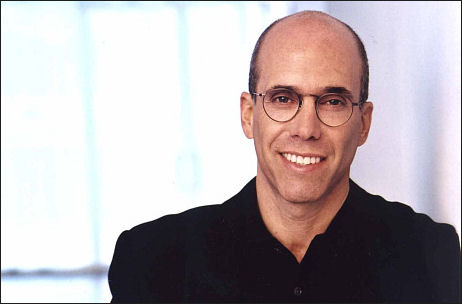

DreamWorks animation chief Jeffrey Katzenberg

“If we as an industry choose this 2D to 3D post-production conversion [as represented by Titans], it’s the end,” he declares. “As quickly as it got here, that’s how fast it will go away.

“We’ve seen the highest end of 3D in Avatar and you have now witnessed the lowest end of it with Titans. You cannot do anything that is of a lower grade and a lower quality than what has just been done on Clash of the Titans. It literally is ‘Okay, congratulations! You just snookered the movie audience.’

“The act of doing it was disingenuous. We may get away with it a few times but in the long run, moviegoers will wake up. And the day they wake up is the day they walk away from us and we blew it.

“Does it take the moviegoing public one movie, three movies, five movies to get to the point where they are discerning the difference between good and terrible? By the time that happens, there will be another 20 or 30 or 40 movies in the pipeline but we will already have killed that goose that is delivering us golden eggs.

“Every company right now is sitting, assessing what approach and what process and what economics to invest in the 3D platform. There are dozens of decisions literally that are about to be made or have just been made in the last 30 or 60 days and in the next 30 or 60 days, the sum of which will determine what happens to 3D.

“Starting with a filmmaker who designs and shoots his story with 3D as part of that storytelling is hugely different from a 2D film that is put through a down and dirty post-production technical process. It is absolutely analogous to taking a black-and-white film and colorizing it.

“So you have movies that are authored in 3D. You have movies that are conceived and post-produced in 3D and you have 2D movies that are converted. I say with absolute confidence that right now, today, for this year, there is no technology that exists that can take a 2D film and post-produce it into a 3D premium offering.

“We have seen post-production conversion of 2D movies to 3D which actually play pretty sensationally on a television. On a smaller monitor, the images hold up in a much more compelling way. So I think there is going to be a market for 2D conversion [for the home]. [But] I think it’s a disaster for movie theaters.

“[And] I am just sort of apoplectic about this because the revenue [today] from a successful 3D release net to the studios is greater than the erosion in the DVD market over the last two years. For the last 40 years every time we’ve reached an [economic downturn], something’s come along to save the movie business. Home television, pay television, VHS, DVD. Now 3D comes out of the blue, out of nowhere. Nobody expected this.”

A Variety staffer asks Katzenberg “why will these post-conversions kill 3D? In the early days of sound, there were quick-and-dirty conversions of silent movies to sound, and that didn’t kill talkies.”

“Here’s the difference,” Katzenberg replies. “We are asking moviegoers to pay a 50 percent premium to come see these films. So I think [there will be a] backlash. It will be a whiplash. They will walk away from this so fast. 3-D will go away, because with no premium being paid for it and the cost to exhibition in terms of what they have to invest in it, I think it all does collapse.

“So for the last four or five years, the raging debate here has been the inability of Hollywood to convince exhibition, because there’s really nothing in it for exhibition. It doesn’t change the economics of their business. They can’t charge more for a digital experience. The thing that finally got everybody off the dime was when there was something in it for exhibition, which was 3D.

“So now take that 3D out of the equation and you derail that digital train. And who’s the biggest beneficiary of digital, of a full digital platform? Hollywood. So when you want to talk about the effect of actually blowing this, it’s unbelievable.”
Lesson Learned

Watch this obviously weird, bordering-on-comedic Nike spot, and then go to David Matthewsaudio-overlay option piece on Deadspin.com and click on option 7. I don’t know the original audio source, but 7 rules.

As to Earl Woods‘ question about whether his son learned anything, I think there’s only one answer. “Yes, dad. Publicly humiliating my wife, my partner and the mother of my children was a terrible thing. Brutalizing the feelings of someone you trust and care for is truly bad for the soul.

“But honestly? Guys like me are gonna do what we’re gonna do. You can’t say this on The View but it’s true. The key thing for me is to henceforth show respect and consideration for my wife by being much, much more discreet. Because if you can’t be discreet, you shouldn’t cat around at all. You absolutely must show respect for your wife and partner — that’s the bottom line.”

Unclear Reception

Don’t be fooled by Date Night‘s 81% rating on Rotten Tomatoes. Many if not most of the positive reviews are of the “yes but” variety — i.e., “Yes, the movie underwhelms or disappoints, but Steve Carell and Tina Fey are great.”

Lou Lumenick‘s N.Y. Post review is deemed a positive red tomato, even though he calls the script “derivative and predictable,” and says that Carell and Fey’s behavior occasionally “defies all logic.” Calling it “a PG-13 version of After Hours with more than a bit of The Out-of-Towners thrown in” doesn’t sound like a thumbs-up to me.

There’s certainly no excuse for giving Date Night an out-and-out rave, such as the one submitted by USA Today‘s Claudia Puig: “This is the rare screwball comedy that’s superbly paced, cleverly plotted and hilarious from start to finish.” Not on this planet. At best Shawn Levy‘s film is an in-and-outer.

One possible explanation is that the interplay between Carell and Fey plus certain meditative portions of Josh Klausner‘s screenplay (i.e., mature married couple relating to each other with a semblance of honesty) has struck some kind of chord among female critics. The Philadelphia Inquirer‘s Carrie Rickey, Salon‘s Mary Elizabeth Williams, Variety‘s Lael Lowenstein and Time‘s Mary F. Pols also wrote about fluttery contact highs.

Stephen Whitty‘s review in the Newark Star-Ledger, trust me, is a much more honest reflection of the truth. As is David Germain‘s. As is my own.

Druggie

The dog has the best line. The blissful alpha sentiments at the end of the spot are empty, of course. What is this spot about? McDonalds — a safe haven for douches?

Dargis Hopper

And the Dennis Hopper tributes just keep on coming, the most recent from N.Y. Times critic Manohla Dargis. Except the opening graph says that Hopper has “acted for Quentin Tarantino.” Well, sorta kinda. Hopper costarred as “Eddie Scratch Zero” in Larry Bishop‘s Hell Ride (’08), an apparent stab at an “ironic” wink-wink ’70s biker exploitation pic a la Death Proof that Tarantino exec produced. Mainly a straight-to-DVDer following a limited theatrical debut in August ’08.

Alive, He Cried

There’s an almost startling intrigue — an odd vibrancy — to the non-concert footage of Jim Morrison in Tom DeCillo‘s When You’re Strange . Nobody has seen this footage, which is basically of Morrison driving and walking in the Southern California desert in a kind of dramatic or “acted” context. For this alone the doc is worth seeing.

Former Doors keyboardist Ray Manzarek (and producer of the doc) tells Movieline’s Stu VanAirsdale that “we’ve had the footage in storage, in one of those temperature-controlled storage vaults in Hollywood like you should do with all your film and all your tapes. It was there. It had been sitting there waiting to go to work — in cold storage. The footage said, ‘Any time you want to use us, we’re in shape here. We just need some processing.’ We had everything archived and just went to work on it.'”

I paid a visit to Morrison’s grave at Pere Lachaise cemetery in Paris about 22 years ago. This was when a marble bust of Morrison was still on top of the gravestone. Everything was covered in spray paint and graffiti. Empty bottles of alcohol, cigarette packs, butts and roaches littered the ground directly in front of it.

Loves of a Blonde

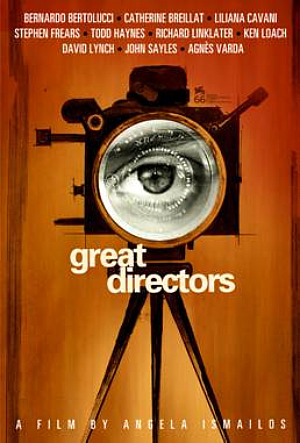
I enjoyed and admired Angela IsmailosGreat Directors when I saw it at last year’s Cannes Film Festival. A concise and well-shot personal tribute doc about Bernardo Bertolucci, Agnes Varda, Stephen Frears, Todd Haynes, David Lynch, Catherine Breillat, Richard Linklater, Ken Loach and John Sayles, it’s clearly an intelligent and nourishing tutorial — a Socratic inquiry about what matters and what doesn’t when it comes to making lasting films.

I said in my initial write-up that it’s “also about Ismailos’ golden blonde hair — a steady presence from start to finish.”

And yet, smart and agreeably illuminating as it is, I couldn’t at the same time honestly call Great Directors absolutely essential viewing. It’s not what I would call an especially novel or unusual doc, and the bottom line is that there’s no burning reason for it being a film except that Ismailos got to the filmmakers and put it together. Which is fine.

During last May’s showing I kept asking myself “who exactly is Ismailos, who funded the doc, how did she come to know these filmmakers and persuade them to sit down?,” etc.

Five years ago artnet.com described her as an “author and socialite.” I’ve also found a couple of shots of her at some lah-lah lawn parties in the Hamptons. That’s obviously not a crime, but at the same time…why her? And why me, for that matter? Why, I mean, am I writing about her film? Obviously because I was invited to see it, and because I liked it, and because I was invited to the after-party on a yacht in the Cannes marina (which I couldn’t attend). I guess I’m feeling a certain class-based resentment on some level. I’d like to think I do more than eat grass when it’s put before me, but the more I thought about it, the more this film made me feel…I don’t know exactly. I realize I’m not quite getting the thought out.

No disrespect intended, but I would be more interested in a doc about major directors by LexG than Ismailos. I just get the feeling that she socialized and blue-chipped her way into this project while LexG, suffering as he does on a nightly basis in the San Fernando Valley, has more of a blood-sweat-and-tears investment in transcendent films — he needs them like Gasim in Lawrence of Arabia needs water as he treks across the Nefud desert. Mailos, obviously bright and educated, could be the sensitive and concerned wife (or daughter) of a British officer based in Cairo who wants to make a film about the Arab uprising. Which is fine and good, admirable even, except for a certain vitality or hunger or need that only guys like Gasim have. That’s fair to say, I think.

Great Directors had its official premiere at the Venice Film Festival last September, and six months later Mark Urman‘s Paladin Films picked it up for distribution. It will open limited on 7.2.10.

Here’s a May 2009 flipcam interview with Ismailos by Anne Thompson, who was with Variety at the time:

Bop 'Til You Drop

I’m a late convert to Joan Rivers: A Piece of Work (IFC Films, 6.11), having missed it at Sundance and only just seen it a couple of days ago. I had relegated Rivers in recent years to an “uh-huh, whatever” status, partly because of her irksome red-carpet chatter and partly because of her 21st Century facial work, which suggests she may have been hurt in a terrible car crash (worse than Montgomery Clift) but was lucky enough to find a gifted plastic surgeon who was able to make her look as normal as possible.

Ricki Stern and Annie Sundberg’s documentary, which will play at the Tribeca Film Festival, has wiped that image away. It shows us what a “never say die” trooper Rivers is — 76 and combat-ready and slowing down for nothing. I now think of her as a highly admirable paragon of toughness and tenacity. Plus the doc deepens and saddens our understanding of who Rivers is, was and continues to be. Plus it has some excellent jokes (including one about anal sex that I laughed out loud at, and I’m basically a heh-heh type).

What a fighter she is…God! Frank and blunt, nothing off the table, takes no guff, lets hecklers have it in the neck, never stops performing, tough as nails.

One thing Stern and Sundberg don’t get into is the condition of Rivers’ personal life. I know she’s straight, so does she has a boyfriend of any kind? Even a platonic one? If they mentioned this aspect I missed it. I realize Rivers is too egoistically driven and too much of a busy-busy-bee to even think about making room in her life for any normally-proportioned relationship, but everyone needs a little TLC from time to time. Someone to be tender with, go out to dinner with, take walks with, etc.

Bake

Early last week New York weather, after a brief flirtation with spring jacket weather, was suddenly cold again. Then last weekend the warmth returned, and then yesterday it was suddenly summer in July. Ask anyone who’s lived here — New York heat waves don’t fool around. So I spent some time this morning installing the two air conditioners, and properly air-trapping the window sills with duct tape and asking the construction guys downstairs to cut a short piece of lumber to use as a window jam. So that’s what I was doing. And very soon I’ll be leaving for the Kick-Ass junket, which starts at 2 pm.

No Can Do

With next month’s Cannes Film Festival popping up in discussions, I’m reminded of the three pronunciations. Some say “Cahn” as in Star Trek: The Wrath of Khan, which is how you’re supposed to pronounce Caen, the medieval city two hours northwest of Paris. And some say Cannes properly, which is hard to phonetically describe except that you need to emphasize the “n” sound more than than the vowel, and that the vowel is more “an” than “anne.”

And then there’s the oafish American way of saying it, which is “can” as in tin can or Peter Pan. Remember Julia Roberts‘ flat rural twang-dang pronunciation of “Paayyhnn” in Steven Spielberg‘s godawful Hook? Like that.

As Ever

“The public have always, and in every age, been badly brought up. They are continually asking Art to be popular, to please their want of taste, to flatter their absurd vanity, to tell them what they have been told before, to show them what they ought to be tired of seeing, to amuse them when they feel heavy after eating too much, and to distract their thoughts when they are wearied of their own stupidity.” — Oscar Wilde, quoted in Ronald Bergan‘s 4.7 Guardian piece about the death of old-guard film criticism.