Flipping Point

“Not since Clark Kent changed in a phone booth has there been an instant image makeover to match Barack Obama‘s in the aftermath of his health care victory,” writes N.Y. Times columnist Frank Rich. “‘He went from Jimmy Carter to F.D.R. in just a fortnight,’ said one of the Game Change authors, Mark Halperin, on MSNBC. ‘Look at the steam in the man’s stride!’ exclaimed Chris Matthews. ‘Is it just me, or does Barack Obama seem different since health care passed?’ wrote Peter Beinart in The Daily Beast, which, like The Financial Times, ran an illustration portraying the gangly president as a newly bulked-up Superman.

“What a difference winning makes — especially in America. Whatever did (or didn’t) get into Obama’s Wheaties, this much is certain: No one is talking about the clout of Scott Brown or Rahm Emanuel any more.

“But has the man really changed — or is it just us? Fifteen months after arriving at the White House, Obama remains by far the most popular national politician in the country, even with a sub-50 percent approval rating. And yet he’s also the most enigmatic. While he is in our face more than any other figure in the world, we still aren’t entirely sure what to make of him.

“Depending on where you stand — or the given day — he is either an overintellectual, professorial wuss or a ruthless Chicago machine pol rivaling the original Boss Daley. He is either a socialist redistributing wealth to the undeserving poor or a tool of Wall Street’s Goldman Sachs elite. He is a terrorist-coddling, A.C.L.U.-tilting lawyer or a closet Cheneyite upholding the worst excesses of the Bush administration’s end run on the Constitution. He is a lightweight celebrity who’s clueless without a teleprompter or a Machiavellian mastermind who has ingeniously forged his Hawaiian birth certificate, covered up his ties to Islamic radicals and bamboozled the entire mainstream press.

“He is the reincarnation of J.F.K., L.B.J., F.D.R., Reagan, Hitler, Stalin, Adlai Stevenson or Nelson Mandela. (Funny how few people compared George W. Bush to anyone but Hitler and his parents.)

“No wonder that eight major new Obama books are arriving in the coming months, as Howard Kurtz reported in The Washington Post last week. And that’s just counting those by real authors, like Bob Woodward and Jonathan Alter, not the countless anti-Obama diatribes. There’s a bottomless market for these volumes not just because their protagonist remains popular but also because we keep hoping that the Obama puzzle might be cracked once and for all, like the Da Vinci Code.”
Hang Onto This


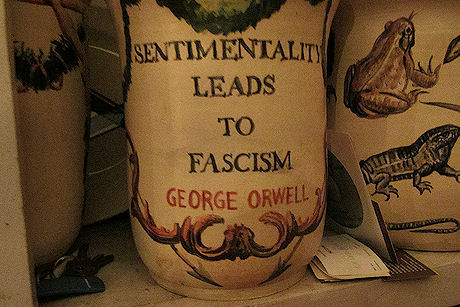
I’m not saying George Orwell didn’t know whereof he spoke. I’m saying I’m still working on the equation as it applies to 21st Century America. I suppose that the 1950s Ozzie and Harriet mostly-white America that the Tea Baggers (and certain conservatives) want to somehow resuscitate is a sentimental notion. Pic snapped in a kitchen last night at a party thrown for Beautiful Darling: The Life and Times of Candy Darling, Andy Warhol Superstar.

Friday, 4.2, 8:15 pm.

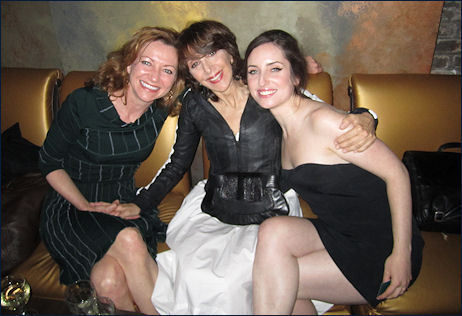
Breaking Upwards costars Julie White, Andrea Martin, and co-writer/costar Zoe Lister-Jones — a shot I meant to run two days ago.

Primary Colors a la Edwards?

Is West Wing creator Aaron Sorkin looking to turn the John Edwards sex scandal into a movie?,” Daily News columnists George Rush and Joanna Molloy have written. “We hear Sorkin is among those talking with William Morris Endeavor uberagent Ari Emanuel about optioning The Politician, the best-selling memoir by former Edwards aide Andrew Young. Reps for Sorkin and Emanuel didn’t get back to us. Young says: ‘I’ve heard a lot of strong names. I’d be honored if Aaron Sorkin is one of them.'”

Sweat Slap

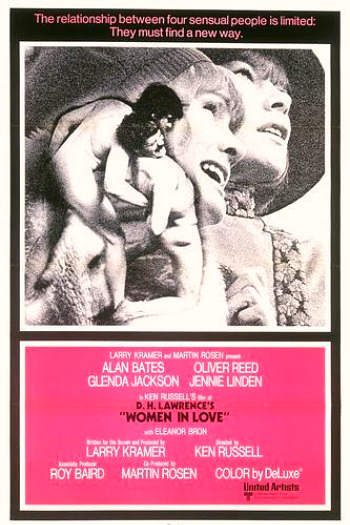
What was shocking or envelope-pushing three or four decades ago isn’t any more, or so we tend to think. But imagine this scene in a 2010 remake of Ken Russell‘s Women in Love with, let’s say, George Clooney and Matt Damon. Or with Johnny Depp and Leonardo DiCaprio. Difficult, isn’t it?

The scene is fascinating, I feel, for the way it skirts the edge of homoeroticism without ever quite going there, but in today’s climate would it even be shot? Would a producer, I mean, be able to fund a remake? You know that today’s Eloi would stampede in the opposite direction of any period adaptation of a D.H Lawrence novel. I know, I know — D.H. who?

More particularly would Clooney-Damon or DiCaprio-Depp even perform it? I wonder. If they did (and if the film turned out as well as Russell’s) this scene would be a bit of a “holy shit!” moment for a lot of people out there. Or would it? I’m mentioning this because the wrestling scene — famous in its time — has been largely forgotten, certainly among the 35-and unders (if they even knew of it in the first place). As has Women in Love itself, I suspect.

Apologies for this clip — it’s been idiotically layered with a ridiculous music track and the genitalia of Oliver Reed and Alan Bates have been CG’ed into a blur. Russell shot this scene straight on.

An early reviewer of Lawrence’s “Women in Love,” published in 1920, reportedly wrote, “I do not claim to be a literary critic, but I know dirt when I smell it, and here is dirt in heaps — festering, putrid heaps which smell to high Heaven.”

Red Robe

I was joshing the other day about the blue-eyed Jeffrey Hunter resembling Yeshua of Nazareth in Nicholas Ray‘s King of Kings. My point was that as theatrically phony and prettied-up as Hunter was, he fit the conventional white-bread Episcopalian image of the man. So he passed muster in a way that Leonardo DiCaprio-as-J. Edgar Hoover emphatically doesn’t.

The most temperamentally genuine J.C., I suspect, was portrayed by Enrique Irazoqui in Pier Paolo Pasolini‘s The Gospel According to St. Matthew. My all-time fave will always be Willem Dafoe in Martin Scorsese‘s The Last Temptation of Christ. The all-time worst is Max Von Sydow in George Stevens‘ repulsively phony The Greatest Story Ever Told, which imagined Judea as an almost totally barren land made of rock and sand (and located in Utah).

"Cheap Erotic Minds!"

Why did BBC guy Stephen Robb post a 50th anniversary piece on Alfred Hitchcock‘s Psycho (“How Psycho Changed Cinema“) on 4.1.10 when the film opened during the summer of 1960 — in Manhattan on 6.16, in England on 8.4, and in Los Angeles on 8.10? Not a huge deal but why not at least wait until June?

It’s probably impossible for 21st Century horror fans to understand what an astonishing jolt Psycho was to the complacent and certainly constipated middle-class American movie culture of 1960. Back then a shot of a toilet had reportedly never been seen in a film, much less footage of a toilet being flushed. (Heavens!) But I’m pretty much tapped on this film, to be honest. Too much has been written and commonly digested for anything new to be said.

It’s just a movie, as Hitchcock might have said, and not the Arc of the Covenant. Shot with for a price with a TV crew, and much of it on the Universal back lot, and with John Gavin‘s stiff acting mucking things here and there.

I can only savor Psycho now for (a) the wonderful visual economy in the story-telling, (b) elements containing those creepy allusions and intimations of horrible stuff to come, and (c) the way the dialogue in the parlor-snack scene between Janet Leigh and Anthony Perkins specifically forecasts the entire last-twelve-minute payoff.

My favorite Psycho moments:

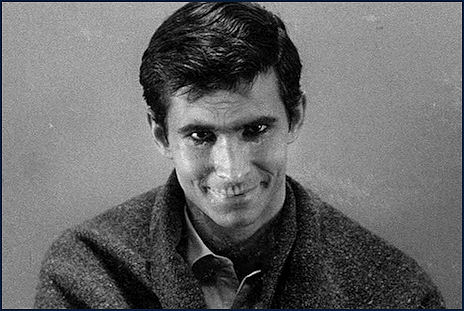
(a) The last frames of that final shot of Tony Perkins when his mother’s rotted skull and teeth begin to blend in. Shown for only an instant — that’s the charm of it.

(b) The look on California Charlie’s face when Janet Leigh agrees to pay $700 plus her 1956 Ford in a trade-in for a slightly newer used car.


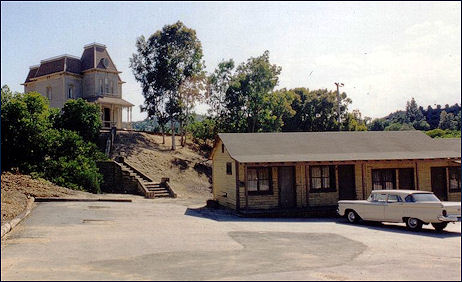
Original Psycho set on Universal back lot. (Snap taken in 2009.)

(c) That long shot, taken from the POV of a rain-dampened Leigh, of a silhouetted Perkins walking in front of a second-floor bedroom window, “playing” his mother in a dress with a cheap wig. First-timers don’t know what they’re seeing, but the shot is quite creepy if you’re back for seconds.

(d) “You know what I think? I think that we’re all in our private traps, clamped in them, and none of us can ever get out. We scratch and claw, but only at the air, only at each other, and for all of it, we never budge an inch.” (If this isn’t a dead-on description of the psychology of Glenn Beck, I don’t know what.)

(e) The shot of the ragged stuffed bunny on the bed, and the close-up of the 78 rpm of Beethoven’s “Eroica.”

(f) Martin Balsam‘s scene with Perkins in the motel office, and the way he gently prods at Perkins’ easy-to-spot fibbing. “Wanna check the picture again?” “Look, I wasn’t lying to you, mister. It’s just…” “Oh, I know, I know!”

(g) “Periwinkle blue.”

(h) “Now, that’s not buying happiness. That’s buying off unhappiness. Are, uh…are you unhappy?”

(i) “Run out and eat it.”

(j) “I couldn’t do that. Who would look after her? She’d be alone up there. The fire would go out. Cold and damp like a grave. If you love someone, you don’t do that to them, even if you hate them. People always call a madhouse ‘some place.’ Put her ‘in some place.’ Have you ever seen the inside of one of those places? The laughing and the tears, and the cruel eyes studying you? My mother there? But…but she’s harmless! She’s as harmless as one of those stuffed birds.”

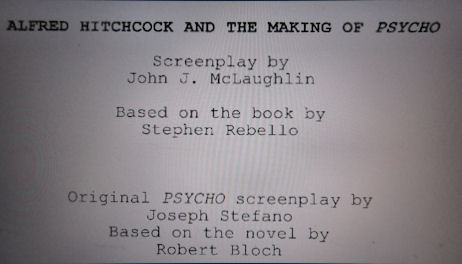
Whatever happened to Alfred Hitchcock Presents, the making-of-Psycho feature that Ryan Murphy was supposed to direct with Anthony Hopkins as Hitchcock? Obviously delayed if not shit-canned, but I wonder why. I still have my copy of John J. McLaughlin‘s script, which is dated 6.16.06.

As I mentioned in a 3.18 Eat Pray Love piece, it took Murphy “three years to get out of movie jail after Running With Scissors,” so I’m guessing it was at least partially Scissors that pushed the Hitchcock project into the swamp. Too bad. Hopkins would have been good.

At least there’s Chase Palmer‘s Number 13, that currently shooting British production about young Alfred (played by Dan Fogler, for God’s sake) making his unfinished first film, Number Thirteen, in 1922 while “getting caught up in a Hitchcockian dilemma when he ends up in a love triangle with two crew members while making the film,” etc.

Passion of J. Edgar

Okay, I’ve flipped through most of Lance Black‘s J. Edgar Hoover script — i.e., the one that Clint Eastwood reportedly intends to direct with Leonardo DiCaprio as the FBI kingpin — and I haven’t come upon a scene calling for DiCaprio to wear lace stockings and pumps and a cocktail dress. So we’re safe on that score.

But the scenes between Hoover and FBI ally/colleague/friendo Clyde Tolson (whose last name Black spells as “Toulson”) are fairly pronounced in terms of sexual intrigue and emotional ties between the two. Theirs is absolutely and without any qualification a gay relationship, Tolson being the loyalty-demanding, bullshit-deflating “woman” and Hoover being the gruff, vaguely asexual “man” whose interest in Tolson is obviously there and yet at the same time suppressed.

The script flips back and forth in time from decade to decade, from the 1920s (dealing with the commie-radical threat posed by people like Emma Goldman) to the early ’30s (the focus being on the Charles Lindbergh baby kidnapping case) to Hoover’s young childhood to the early ’60s (dealing with the Kennedy brothers), late ’60s (Martin Luther King‘s randy time-outs) and early ’70s (dealing with Nixon’s henchmen). Old Hoover, young Hoover, etc. Major pounds of makeup for Leo and whoever plays Clyde.

Intrigue vs. Zero

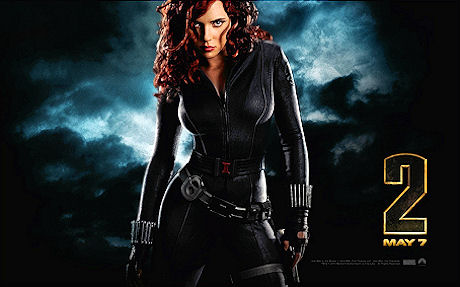
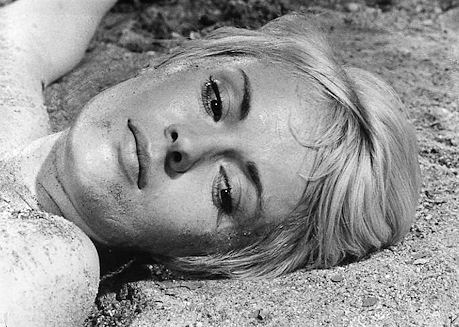
The intriguing shot, of course, is the black-and-white one of Jean Seberg. It just happened to be lying around and could have been something else, but it completely kicks the butt of the Scarlet Johansson/Iron Man 2 image, which popped up yesterday. Forget it — dont even discuss them in the same breath.

A reclining woman who’s indifferent to attention has a certain j’ne sais quoi that an aerobic kick-ass superbabe doesn’t seem to have the first clue about. Grains of sand are generally more interesting than spandex or tight rubber (or whatever it is). A woman looking off to the side has it all over one looking straight at you. I could go on like this all day.

Nicely (If Cynically) Said

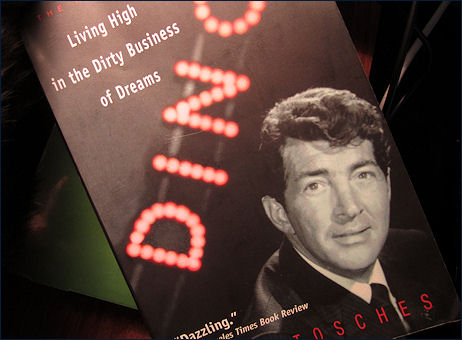
Halfway down page 281 in Nick ToschesDino: Living High in the Dirty Business of Dreams, the basic philosophy of Dean Martin in 1956, just before his breakup with Jerry Lewis, is summarized as follows:

“Jerry had his Beverly Hills psychiatrist, Dr. Henry Luster. Dean had himself, il dottore dell’io. Airs, waters and places had conspired against him. There could be no happiness but in waving away the world; none but in being apart, unthinking, unfeeling.

“He had heard of Dante and the Commedia, of the hundred cantos that rose toward a paradise of light, love and reason with a breadth of a woman at their heart. Pura luce, piena d’amore. But what was all the light and love in the world compared to a single good blowjob? That was what women did to men, turned them into fucking pazzo poets.

“And what the fuck did Dante know about hell? Dante Alighieri and Jerry Lewis. Nine years of listening to that mortucrist wail and whine — then he really could have written a fucking Inferno.

“Fuck it all. Fuck all that love, light and reason shit. Fuck Beatrice where she breathed. Fuck the moon in your eye like a big pizza pie. It was a racket, all right. You sang your song, you wrote your poem: a crust of bread, a jug of wine, and thou. It sounded so sweet. But a million bucks, a bottle of Scotch and a blowjob — that’s what it came down to. It was like the clown in the opera said: La commedia e finita!”

Good Pally

This is eight or nine days old but starting at 4:10 Jonah Hill plugged Greenberg fairly relentlessly during a Craig Ferguson visit. “Awesome movie, nothing to do with it, don’t work for it,” etc,

Platinum Blonde

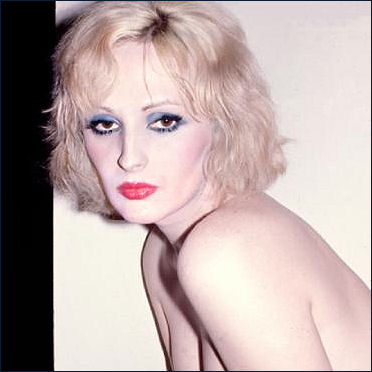
Candy Darling, who began life on the other side of the gender fence as James Slattery of Forest Hills, Queens (and later of Massapequa Park, Long Island), was genuinely charismatic, hugely likable and intriguing as hell — and as much of a tragic figure of the downtown Warhol realm as Edie Sedgwick, if not more so.

She too was a Warhol play-toy craving serious stardom, urgently self-created, consumed by lacquered Photoplay fantasy, hanging by an emotional thread, living for the sporadic glamour of scenes and clubs and flashbulbs, starved for attention, desperate to be loved, and finally dead from cancer at age 29.

Last night I saw James Rasin‘s Beautiful Darling: The Life and Times of Candy Darling, Andy Warhol Superstar as part of the New Directors, New Films series at the Museum of Modern Art. I expected to be amused and intrigued by another recap of the Warhol Factory era, and for the first half that was mainly the shot. But the last half and particularly the last third of this unusually intimate doc is more than touching. I felt profoundly moved. Really.

What it is, basically, is a story of Darling and her closest friend Jeremiah Newton, and how he’s tended to her legacy and kept the candle burning over the last 36 years since her death. Rasin uses Newton’s history and particularly his perspective as the emotional spine of the film.

I realize that Darling was played reasonably well by Stephen Dorff in I Shot Andy Warhol, but she should be played again in a feature based on her life, and this time by a woman.

Hers is a very sad tale about profound loneliness and not much real love — the story of a beautiful blonde knockout and an absolute world-class Kim Novak impersonator who could only thrive within a very particular downtown glammy realm in the mid to late ’60s and early ’70s, and with great difficulty, and how that realm slowly gave up on her after five or so years of flashbulb fame, but never she it.

I think Candy Darling would have been a much better choice to star in the misbegotten Myra Breckenridge than Racquel Welch. She was a real-deal glamour queen who was simultaneously about fake movie-star glamour and allure and an actual embodiment of same who meant every last word.

In his 2.17.72 review of Warhol’s Women in Revolt, N.Y. Times critic Vincent Canby wrote that Darling, one of the film’s three stars (along with Holly Woodlawn and Jackie Curtis), “sometimes looks like Marilyn Monroe and sometimes like Mrs. Nixon, and often sounds like Kim Novak,” She also “comes very close to being a real actress,” he said.

Before dying in March 1974, Darling left a note for her friends, to wit: “Unfortunately before my death I had no desire left for life. Even with all my friends and my career on the upswing I felt too empty to go on in this unreal existence. I am just so bored by everything. You might say bored to death. It may sound ridiculous but is true.”

Rasin said last night that there were no clips from Darlings’s scenes in Trash (’68) or Women in Revolt because the rights-holder, director-producer Paul Morrissey, who cooperated with Rasin by sitting for an interview, refused to give them up. This strikes me as shameful. You can’t really get Darling’s allure without absorbing her full-on Warhol act, and Morrissey saying “no” to a low-budget, hand-to-mouth tribute doc like this one seems mystifying.

But it’s not just these two films — there are relatively few clips of Darling from any films at all. Because of payment/rights issues, I presume. Nor does the doc mention several other appearances, ventures and tributes.


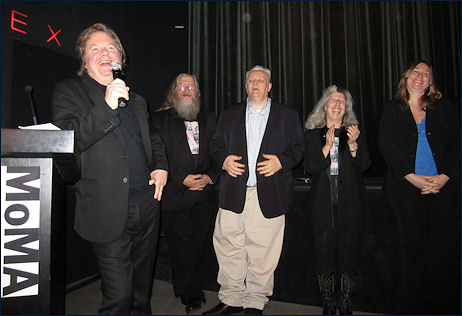
Beautiful Darling director James Rasin (l.) during q & a following last night’s screening. Newtoon (dark blazer, white hair) stands in middle.

Darling was an extra in Alan Pakula‘s Klute — no clip, no mention of this (although we’re shown footage of Klute star Jane Fonda hanging with Darling and the Warhol gang). No clip of her brief appearance in Lady Liberty, the 1971 Sophia Loren film. No clip from or mention of Wynn Chamberlain‘s Brand X, Silent Night, Bloody Night or Some Of My Best Friends Are….

I’ve read that Darling allegedly “campaigned” for the Welch role in Myra Breckinridge (1970), but again — no mention. Newton told me today that she met with George Cukor. Why didn’t Rasin ask Rex Reed, who costarred, for a comment?

Nor does it mention Dorff’s portrayal in I Shot Andy Warhol (’96).

Nor does it mention her having allegedly appeared in a 1973 Off-Broadway revival of The White Whore and the Bit Player.

Nor does it mention that Candy was portrayed by Michael-August Turley in the New York City production of Pop! in December ’08.

It not only mentions but plays a portion of Lou Reed‘s “Walk on the Wild Side,” of course — the song that immortalized her — but why didn’t Rasin talk to Lou?