The Light That Failed

In recognition of tomorrow’s (4.27) DVD release of Sidney Lumet and Tennessee WilliamsThe Fugitive Kind, or more precisely the Criterion Collection’s rendering, an appreciation by David Thomson currently sits on the Criterion site.
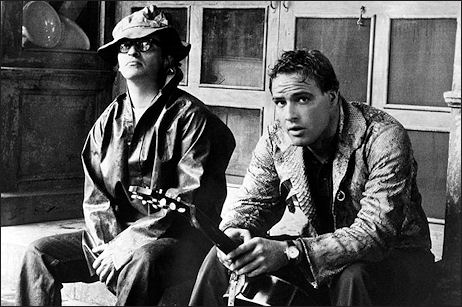

Sidney Lumet, Marlon Brando on the set of The Fugitive Kind.

“Movies are not just the sum of the stories that can be told about their shooting,” Thomson says toward the end. “The Fugitive Kind was unlike other films, and it was something Lumet had never tried before: a portrait of small-town meanness in which the outward action was to be fired by internal demons.

“In that sense, it was not too far from the wasteland of Psycho, which was filmed at the same time. Is Psycho a crime story from local papers (like In Cold Blood) or is it a movie that stirs at dysfunction in America? In the same spirit, The Fugitive Kind is true to the stark paranoia in Williams, minus the lush color and starry glory that marked the films of Cat on a Hot Tin Roof and Sweet Bird of Youth. Those hit movies look so much less now than Streetcar, Baby Doll and The Fugitive Kind.

“This is a mood picture, where, if you pay close attention, you can feel the lights come up and fade away to match the eloquence of the speeches. You can see the decor giving an emotional or spiritual force to the text. And you begin to hear Marlon Brando‘s shy lyricism rising in the long speeches — this Orpheus in a snakeskin jacket sings. Joanne Woodward gives one of the least guarded performances of her odd career. And Anna Magnani looks like a great sensualist terrified of getting her last chance.

“There’s no question that Magnani could do too much, but Lumet restrains her here and urges his cameraman to trust her tragic face and wounded voice. It was not often in this era that an actress shared the screen with Brando — so many were erased by his light. Lumet began by using markedly different lenses on the two leads, but as the film progressed, he let Magnani have more and more long-lens close-ups to match Brando’s. And so we feel their relationship growing in the most natural way.

“No one went to see the movie in 1960. It got no nominations at Oscar time. It lost a fortune. But it may be one of the most intriguing Tennessee Williams pictures, in that we are asked to weigh and consider the faults of its provincial society. It is about time we yielded our trust in box office, the Academy, and journalistic critics as measures of quality. We have to see the pictures for ourselves. In which case, it’s natural enough to notice that The Fugitive Kind is only two films before Lumet’s Long Day’s Journey into Night, another study of the light fading in a small town.”
Horse Farts

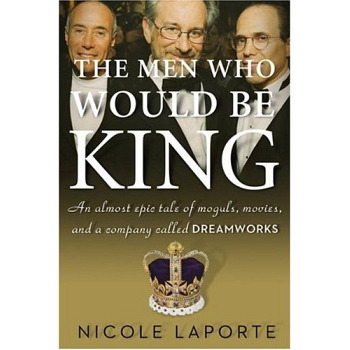
Someone who may be Russell Crowe is on Twitter and strongly disputing Gawker’s excerpt from Nicole LaPorte‘s upcoming DreamWorks book, “The Men Who Would Be King: An Almost Epic Tale of Moguls, Movies, and a Company Called DreamWorks” (Houghton-Mifflin, 5.4). The possible Crowe is saying, in fact, that “mentions of me are eg’s of distance from the truth [and a] waste of paper written by a lying horse’s ass.”

Hood Precedents

New tracking shows Ridley Scott‘s Robin Hood, which opens in 18 days, averaging a 38 definite interest — 43 from under-25 males, 42 over-25 males, 28 under-25 females and 38 over-25 females. It’s also averaging a 7 first choice — a figure that clearly needs to increase over the next two weeks.

I’m not looking to pour rain on anyone’s parade and I’m very much looking forward to Robin Hood, but Universal needs to buckle down and get on the stick, and fast. Iron Man 2 is opening only a week before Scott’s film and its average definite-interest and first-choice figures are 67 and 32, respectively. Not fair to compare an adult-angled historical pageant drama with a kid-friendly superhero comic-book movie? Fair enough, but Robin Hood still cost a bundle and needs to earn serious coin.

So what’s the Robin Hood problem, in a nutshell? There are two factors, a friend suggested this morning.

One is Russell Crowe being seen as a bully and a sorehead these days, or at the least not being popular enough to put arses in seats if the film looks a wee bit iffy. The other is a perception that Robin Hood is another Kingdom of Gladiator Forest with arrows and spears being propelled by men with beards who need baths.

The latter concern, in other words, is that Robin Hood is Scott’s third historical action-and-romance flick to do the same approximate things in a two-out-of-three equation — i.e., star Crowe (Gladiator and Robin Hood), deal with the Crusades (Kingdom of Heaven, Robin Hood), show large ancient armies in conflict in wooded areas with flying projectiles (Gladiator, Kingdom of Heaven, Robin Hood), depict a rebellious hero at odds with cynical tyrants (Gladiator, Robin Hood, Kingdom of Heaven), and cast an intriguing actress in her 30s as a romantic lure or foil of some sort (Cate Blanchett, Eva Green Connie Neilsen).

I don’t agree with this view. Every film is it own beacon, idea, construct, vision. And I sure as shit don’t see Crowe’s presence as anything but a guarantee of true grit and conviction. But as soon as I heard it put this way I had to admit my friend had a point.

Red Seats

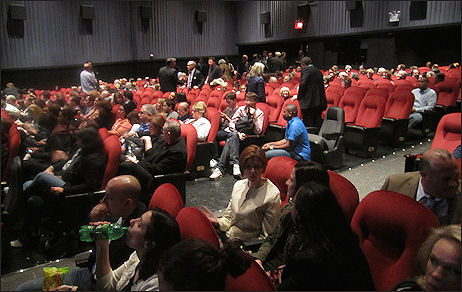
Except for one incorrect observation, Anthony Kaufman‘s 4.26 Indiewire piece about the response to Alex Gibney‘s Eliot Spitzer doc, which screened at Chelsea’s SVA theatre early Saturday evening, is righteously reported. The wrongo is Kaufman’s statement that “the film was one of a number of titles drawing a crowd larger than its theater over the weekend in New York City.” In fact, the screening was noteworthy for several seats in the rear section being unfilled.


Inside the Client-9 screening at SVA theatre — Saturday, 4.24, 6:10 pm.

The above photo was taken by yours truly a few minutes after the film was supposed to begin at 6 pm. Unless 45 or 50 people slipped into the theatre after the film began, sat in the empty seats shown in the above photo and then slipped out before the film ended, the crowd was far from overflow — it wasn’t even at capacity.

A day before the screening I was told by 42West rep that my seeing the Gibney-Spitzer doc wasn’t necessarily assured, although they’d do everything they could. A few minutes before the film began they told me they had no ticket to pass along. So I went up to Gibney, who was standing near the entrance, and asked what the deal was (“Why have a public festival showing if you’re going to keep press guys like myself from seeing it?”). I was then told by 42West to hang tight, and about ten minutes later they handed me a ducat. I was obviously thankful and told them so, but some kind of seating shenanigans were going on. The above photo shows, of course, that finding open seats wasn’t an issue.

I didn’t mention in my initial review, by the way, that Gibney’s doc reveals a surprise about Ashley Alexandra Dupre, the escort girl who was heavily publicized for having been Spitzer’s primary pleasurer. Well, the doc says Ashley did him exactly once — that’s right, once — but that another lady of the night, called “Angelina,” did Spitzer repeatedly, and that she was also heavily questioned by F.B.I. agents during their investigation of Spitzer’s hotel-room sessions.

I’ve been so blanketed by idea and image of Ashley Dupre and only Ashley Dupre having been Spitzer’s girl than the news about Angelina bounced off my head like a tennis ball. Physiologically I heard it but for strange emotional and psychological comfort reasons I rejected the information. But I now accept it.

DreamWorks Days

There are two interesting snippets from Michael Cieply‘s short N.Y. Times piece on Nicole LaPorte‘s upcoming history-of-DreamWorks book, “The Men Who Would Be King: An Almost Epic Tale of Moguls, Movies, and a Company Called DreamWorks” (Houghton-Mifflin, 5.4). Both involve Terry Press, the company’s battle-axe marketing chief.

The first is that “it was Ms. Press who had the courage to tell Steven Spielberg — correctly, as it turns out — that Amistad was not destined to win Oscars.” I spit my coffee out when I read this. A fact that was dead-pig obvious to anyone with a smidgen of taste had to be gently broken to Spielberg, who was so deeply embedded in his own little membrane that he actually thought he had an Oscar contender in that godawful film.

To my dying day I’ll remember how I felt when Anthony Hopkins‘ John Quincy Adams began to deliver his closing argument to the jury and John Williams‘ upifting music was mixed in so loudly that I was having trouble hearing some of the words. I was convinced that the projectionist had accidentally cranked up a separate music track by mistake.

The second snippet is a description of Press “sobbing as Bill Condon, the director of Dreamgirls, console[d] her on learning that the much-promoted movie musical had not been nominated for the Best Picture Oscar.” I wasn’t much of a Dreamgirls fan, but I can understand Press, who had worked so hard and so early to build awareness for Condon’s film and particularly to beat the Oscar drum for it, being shattered by this snub. Pretty much everyone was dumbfounded, but out of this debacle came what has now become a rule-of-thumb — don’t push your Oscar-calibre film too early or too hard.

Speaking of corporate membranes, I wonder if LaPorte’s book will report what I for one was feeling when DreamWorks publicity was just beginning to allow journalists to see American Beauty, which later won the Best Picture Oscar, in the late summer of ’99. What I detected felt like concern, or at least a form of uncertainty. I had to beg and beg to persuade them to let me see it. Their reluctance was such that it was hard not to suspect that something about Sam Mendes‘ film might be problematic.


Former DreamWorks marketing chief Terry Press; author Nicole LaPorte

After I finally saw American Beauty at Skywalker Sound on Olympic Blvd., I remember immediately phoning Mitch Kreindel, who worked right under Press, and saying, “Are you kidding me? This film is extra. It got right inside me. The plastic paper bag and the ending melted me down. It could go all the way.” But until that consensus began to build up and sink in, I don’t think some people in upper DreamWorks management (and I’m not saying Press was necessarily one of them) really knew what they had. And if they did know what they had, they sure gave a good impression to the contrary.

But you have to give Press credit for Ridley Scott‘s Gladiator snagging that Best Picture Oscar, I think, and especially for bad boy Russell Crowe also taking an Oscar for his performance as Maximus (which he seems to have revisited, in a sense, in his upcoming Robin Hood turn.) Crowe’s Gladiator performance was strong and impassioned, but it wasn’t that great. A lot of shrewd politicking went into that win, is all I’m saying.

Stars Are Over But…

The three basic points in David Gritten‘s 4.24 Telegraph piece about the waning of movie stardom (“Have Stars Lost Their Shine?'”) is that (a) yes, movie stars ain’t what they used to be, (b) they’re certainly getting less upfront cash and are increasingly settling for back-end deals but (c) they’re still pocketing relatively hefty amounts when they agree to make big dumb-ass CG Eloi tentpole films.

Bottom line: The idea of getting humungous paychecks for films that aspire to quality and class and end-of-the-year awards is pretty much out the window.

(a) “Increasingly fewer films are dependent on big-name stars for financial success. Instead, they’re mostly driven by a simple, compelling conceit, a remake of a success in another medium (The A-Team, Prince of Persia) or by being part of a lucrative franchise (Iron Man 2, Toy Story 3, Shrek Forever After, Twilight: Eclipse).”

(b) “But these films are pre-sold to the public on their overall concept. If they happen to feature stars whose popularity has recently dimmed, it doesn’t matter; they’re not the most important factor.. Movie stars are in decline because, for better or worse, movies simply no longer need them.”

(c) “Huge fees for stars have come to look like a ludicrous luxury. These days, actors who less than a decade ago were receiving $15 to $20 million upfront are now taking a modest advance and a share of back end profits — if any. Look back six or seven years, when leading A-listers included Tom Cruise, Julia Roberts, Nicole Kidman, Gwyneth Paltrow and Denzel Washington. One cannot say any of them is bigger now than then.”

(d) “It’s a telling reflection that at the height of Avatar‘s success, Sam Worthington and Zoe Saldana could have walked the length of Oxford Street without being stopped or recognized.”

Champ

Yesterday afternoon L.A. Times/”Company Town”‘s Ben Fritz reported that “just four days after debuting on store shelves, Avatar has sold 2.7 million Blu-ray discs to consumers in the U.S. and Canada, according to 20th Century Fox — more Blu-rays than any previous movie has sold.

“The previous record holder, The Dark Knight, has sold 2.5 million Blu-rays since its debut 16 months ago.

“Fox also sold 4 million standard definition DVDs. The combined total makes Avatar the biggest DVD launch of the year, breaking a previous mark of 4 million Blu-ray and DVDs combined set by The Twilight Saga: New Moon on its first weekend in March.”

Nice Outfit

If I had to listen to singing of this quality this for very long, I would literally get sick. Conan O’Brien and Jim Carrey performing Five For Fighting‘s “Superman (It’s Not Easy)” at Saturday night’s “Legally Prohibited From Being Funny On Television Tour” — Gibson Amphitheater, Los Angeles, 4.24.10.

Time Of Our Life


The Paris Metro never keeps people waiting for 15 minutes. Ever. Even on Sunday nights. This happens only in New York, and most frequently, in my experience, with the L line.

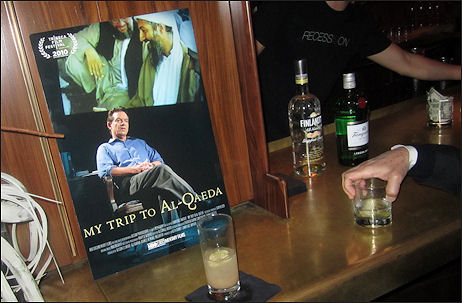
Taken during today’s Royalton Hotel after-party for Alex Gibney’s My Trip To Al-Qeada — Sunday, 4.25, 6:40 pm.

Nizza on Ninth Avenue near 45th Street — Sunday, 4.25, 8:55 pm.
Half of the Tirbeca Film Festival hub-bub has been occuring on West 23rd Street and Eighth Avenue, mostly at Chelsea Clearview Cinemas. That’s IHOP publicist Jeff Hill eyeballing the camera.
Talk-Through

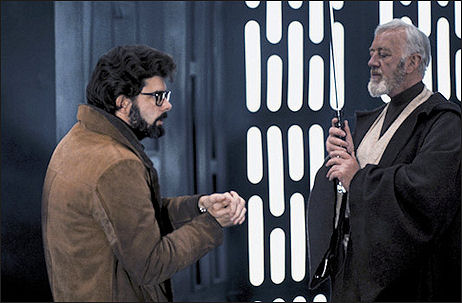
“And then you do this Jedi serenity waiting-to-die thing….yeah, that’s it…your eyes closed, waiting for it…and then…no, you won’t be struck or fall…your brown tunic will fall and Obi-Wan will just, y’know, dematerialize. That way he’ll transform rather than die, without actually getting tagged by a light saber. No, I just want it that way. Alec? I don’t care, dammit, if it makes no sense to you. Listen, Alec…I wrote this, I’m the director.”

Drugged Splendor

Selectively speaking, Ashley Horner‘s brilliantlove is an exceptionally hot and skillful depiction of sexual delirium. A tale about a lickin’ love affair between a couple of none-too-brights that succumbs to melodramatic poisoning by way of (horrors!) money and ambition, this British-produced Tribeca Film Festival entry, which I caught the night before last, is at the very least a stylistic stand-out. And yet I’m not sure where it stands (or writhes) in the annals of erotic cinema.

I know it feels a bit more feverish and free-fall than vaguely middlebrow sex films like Sex and Lucia and Warm Summer Rain and the like, but isn’t quite as kinky as Last Tango in Paris or graphic as The Brown Bunny or as given to obsessive perversity as In The Realm of The Senses, and yet it’s definitely a cut above. It’s certainly above the realm of Michael Winterbottom‘s 9 Songs, which I found tedious.

I said “selectively” because the story isn’t all that great. It would’ve been fine for me if brilliantlove had just been about the simple matter of Manchester (Liam Browne), a novice photographer, doing Noon (Nancy Trotter Landry), a taxidermist, over under sideways down. I certainly would have preferred a less dramatically loaded story. One about healing the broken wing of a small bird, let’s say, and the commitment that such an effort may require of two kids with very little money. Something along those lines.

That sounds like I’m describing straight hard-R porn, I realize, but Horner is very good at capturing that erotic dreamwhirl feeling that takes over when you’ve really lost yourself in someone else and you’ve long ago stopped noticing their less than radiantly attractive aspects because you’re just breathless and sliding around and shrieking and crying and finding God, or being kissed by Him/Her.

This movie really gets and recreates that, and it’s all the more remarkable due to the fact that Browne and Landry, while pleasantly or nominally attractive, aren’t model- or movie star-fetching. I for one have a major blockage about women with big feet, but Horner’s special touch somehow persuaded me to put this phobia aside.