Cannes vs. Volcano?

There’s a 4.20 story on the Huffington Post claiming that “scientists fear tremors [from] the Iceland’s Eyjafjallajokull volcano could trigger an even more dangerous eruption at the nearby Katla volcano, creating a worst-case scenario for the airline industry and travelers around the globe.

“A Katla eruption would be 10 times stronger and shoot higher and larger plumes of ash into the air than its smaller neighbor, which has already brought European air travel to a standstill for five days and promises severe travel delays for days more.”

If Katla erupts over the next few days there’s obviously a chance that Cannes Film Festival flights could be interrupted or affected to some degree. It’s only 19 days away. Perhaps airlines will re-figure established routes from the U.S. to southern France. You know…fly in a more southerly direction (over Spain, let’s say) and avoid the Northern European ash plume situation altogether.

Auteur de Voyage

“There’s always a feeling of slight excitement as your jet angles down and over the Mediterranean and gets closer and closer to the sparking blue water with the hills of Nice in the distance and the white beaches and palm trees and oceanside condos and whatnot….it’s quite a vibe.”

So began an e-mail I sent this morning to a friend who’s attending the Cannes Film Festival — two and a half weeks off — for the first time. She’s never been to southern France or the Cote d’Azur, never seen the Mediterranean…nothing. And was asking this and that question.

“I’m flying straight to Nice from NYC this time — never done that before,” I wrote. “Eight and a half hours…awful. I usually fly to Paris and give myself a leg-stretch for a couple of hours before taking an Easy Jet down to Nice. I don’t know what I was thinking when I booked it. I hate flights that last more than five or six hours.

“Cannes is teeming with little cafes and restaurants. But I’ve made a point in the past of eating only warm paninis out of the food trucks (cheaper) and free party food. The only time I pay for a meal is the first night at La Pizza, and perhaps one other time during the festival. My 24-7 motto is cheap-ass, cheap-ass, cheap-ass.

“And it’s going to be worse this time because I’m not eating pizza as a rule, and bread is a general no-no, of course, so fewer paninis. And I’m drinking less wine these days — water, Diet Coke instead. Beer is out. Free cappucinos inside the Orange press room inside the Palais. But I always grab a double cappucino before the first screening of the day at 8:30 am.”

My Aim Is True

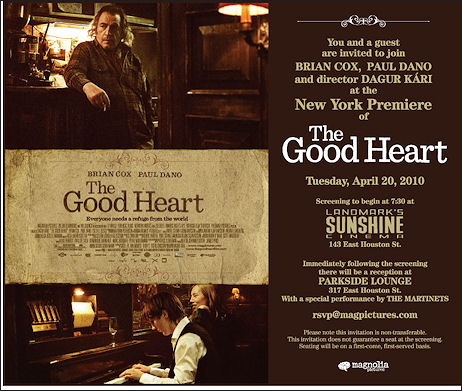
I was a little unsure at first about seeing Dagur Kari‘s The Good Heart (Magnolia, 4.30). I’m not a big fan of scruffy, armpit-scratching indie dramas about unlikely but nourishing relationships between oddballs, or in this particular case between a kind-hearted lost youth (Paul Dano) and an older, snarly, curmudgeonly barkeep (Brian Cox). I read the synopsis prior to Heart‘s Toronto Film Festival debut and went “later.”

But I went to last night’s premiere at the Sunshine Cinemas, persuaded in part by the respected reputation of the Iceland-born Kari (Noi The Albino, Dark Horse), and the re-teaming of the excellent Cox and Dano, who first worked together on Michael Cuesta‘s L.I.E. (which opened in New York on 9.7.01).

And sure enough, Cox and Dano are quite good. How could two of the finest character actors around right now disappoint? Fascinating fellows to the last. I was also taken with French actress Isild Le Besco, who plays a homeless person looking for shelter and whatever else. (Kari told me last night she’s directing her next French-language film sometime soon.)

Cox’s Jacques character struck me as a bit too angry and blustery, however. I just didn’t like him or want his company after a certain point. “Will you please chlll down?” I muttered at one point. “I mean, would it kill you to ease up and not be a cantakerous asshole every waking minute?” Life is short but time spent with a guy like Jacques in a movie can feel like an eternity. On top of which I don’t care for fellows who smoke and stink up the joint, and who cut farts while eating broccoli.

But I was held by Kari’s directorial discipline. Time and again The Good Heart cuts right to the story chase — it doesn’t dawdle or meander. Usually when strangers (i.e., the kind fated to be friends) meet in a small film, they paw at each other, spar, argue, dislike each other intially, bicker, betray each other…and then after 15 or 20 minutes they relax and find some way of being friends or at least partners. Kari doesn’t fool with that. Cox and Dano meet in a hospital room, and in the next scene they’re chatting and getting down to business. No muss or fuss.

The film runs 95 minutes. It costars a white duck who lives in a cage in the bar owned by Cox/Jacques. It has one of those muddy-bleachy color schemes — grayish blues, murky browns, blacks, whites, grayish skin tones.

"I Don't Follow"

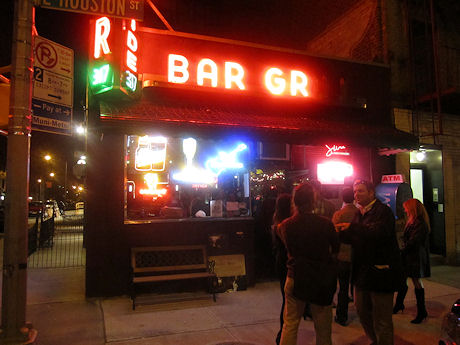
Last night’s post-premiere-screening party for The Good Heart (Magnolia, 4.30) happened at the Parkside Lounge (317 East Houston near Avenue B). The crowd included Good Heart director Dagur Kari, costar Paul Dano and g.f. Zoe Kazan. Not long after 11 pm The Martinets — the hard cranking garage-poet band fronted by Magnolia Pictures president Eamonn Bowles — took the stage in the rear room.


Magnolia Pictures president Eamonn Bowles during last night’s set at the Parkside Lounge.

This was my third Martinets encounter (the first happened five years ago at the Knitting Factory Tap Bar on Leonard Street), and I was reminded yet again that these guys are vigorous, fast and rock-sharp. They play crafty, well-shaped material with intellectually pointed lyrics, and Bowles “sings like a mad banshee and plays electric guitar like a ringin’ a bell,” as I wrote in ’05. The other Martinets are guitarist Daniel Rey, bassist Dave Rick and drummer Roger Murdock. Last night’s lead-off number was “I Don’t Follow.” (Or was it the second song?) It was all twangy kick-chop-bang-yow…whuh-buhm-buhm-buhm-bop.

I realized after listening to my video that my Canon SD1400 IS is a bust when it comes to recording amplified sound.


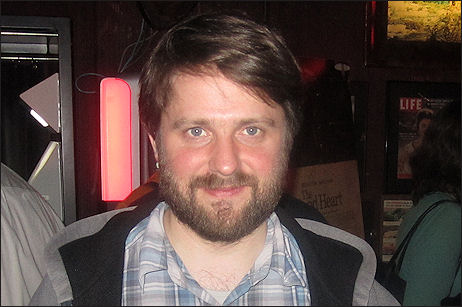
The Good Heart director-writer Dagur Kari — Tuesday, 4.20, 10:25 pm.

Parkside Lounge

Uhhm…Sorry

Yesterday the Daily Beast‘s Eric Pape reported that French President Nicolas Sarkozy “hand-delivered a letter from fugitive Oscar-winning filmmaker Roman Polanski last week to President Barack Obama on the sidelines of the international anti-nuke proliferation summit in Washington, according to a small and little-noticed article embedded in the prestigious French political magazine, L’Express.” I’m a Polanski forgiver, but if I were Obama I wouldn’t touch this one with a 20-foot pole.

Voynar Wrongo

In a defense of Kick-Ass and a jab at critics who’ve expressed distaste at the homicidal violence practiced by Chloe Moretz‘s Hit Girl, MCN’s Kim Voynar uses the old “what are ya squawkin’ about, this is just a movie” argument, which is a bullshit ploy.

Kick-Ass “isn’t real life [and] the people who ‘die’ in the film aren’t really dead, anymore than they are when Batman or Spider-Man take a bad guy down,” she says. “[And] Moretz doesn’t kill anyone any more than Jodie Foster really had sex with the adult men who wanted to have sex with a child prostitute in Taxi Driver or Brooke Shields really had her virginity auctioned off in Pretty Baby.

Kick-Ass is a comic book movie and a satire,” Voynar writes, “and the scenes with Hit-Girl, more than any other aspect of the film, make that clearly apparent.”

Maybe, but there’s a huge difference between a movie that is a satire and one that announces that it’s a satire in relentlessly broad terms, over and over and over. Satire that walks the walk is far better than one that mostly puts on airs and talks the talk.

Kick-Ass is of the second category, of course, and part of the thinking that goes along with “announced” satire, apparently, is that you don’t have to portray anything in the film as even remotely relatable to reality. You can make up your own dumb rules and do anything you want because you’re doing “satire,” which is presumed (in the minds of the filmmakers, I mean) to be a phony-baloney bullshit cartoon.

It’s apparently never occured to Kick-Ass director Matthew Vaughn and his ilk that a movie can be a satire and yet not feel compelled to tap moviegoers on the shoulder every other minute and say “you guys understand that we’re just kidding around in order to make a point, right?” That a satire, in other words, can actually invest itself in a semblance of reality, at least to the extent that it’s a little easier for audience members to roll with the elements (plot, characters, action) so it can sink in on some level.

Most moviegoers, I suspect, are kinda looking for most movies that are supposed to be “about” something to keep at least one foot on the ground — to not go completely off the rails. As Dr. Strangelove or The Hospital did, for instance.

This is why people are taking Moretz’s Hit Girl half seriously. Because it’s hard if not impossible to feel anything for a young girl who’s intended to be a complete jape, and so they’re stepping in and making her “real” in their heads at least. And because films that insist on a total disconnect from even a semblance of reality tend to be shitty to start with. “It’s just a satire” is a mediocre rationale, an easy way out.

Oh, and in my head? Jodie Foster was a little prostitute in Martin Scorsese‘s Taxi Driver — as far as I was able to suspend my disbelief, I mean — and so was Brooke Shields in Louis Malle‘s Pretty Baby.


Dreading of Rockwell

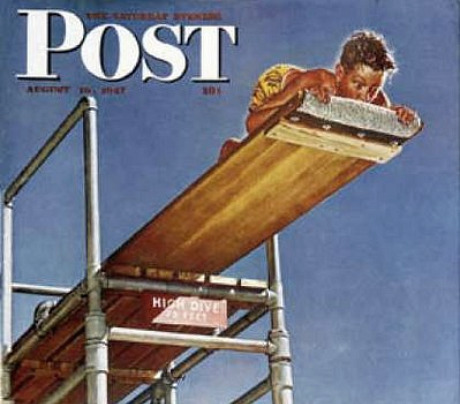
The admiration that Steven Spielberg and George Lucas have for Norman Rockwell, that legendary painter of long-gone, dead-and-buried Americana, is being officially acknowledged with a Smithsonian exhibition called “Telling Stories: Normal Rockman from the Collections of George Lucas and Steven Spielberg,” which will run for six months (7.2.10 through 1.2.11).

When I first read about this on Carrie Rickey‘s Philadelphia Inquirer blog I was reminded that the Rockman-esque influence is one of the biggest reasons why I despise Spielberg these days — i.e., because his films have been offering allusion after allusion and tribute after tribute to that sentimental notion of small-town America that Rockwell’s paintings are more or less synonymous with. I for one have always found this aspect of Spielberg’s films to be treacly and un-genuine.

We’re talking about a vision of America that may have had some ties to actual 1950s culture (i.e., when Spielberg and Lucas grew up) but which really came out of the 1920s and ’30s, and had actually begun to die in the wake of World War II, primarily from the corporate tract-home construction and suburbanization of Middle America and the various ’50s be-bop influences (Ginsberg-Kerouac-Burroughs, rock ‘n’ roll, Little Richard, Elvis Presley‘s hips) that began to change the way Americans saw themselves and behaved.

I worship anyone who can portray the character of rural old-time American life without undue sentiment (as David Lynch did in The Straight Story ) but this has always been beneath Spielberg’s interest or abilities.

"Thanks For The Warning"

This 40-day-old Robin Hood trailer is nicely done in the sense that the ad guys don’t seem to be pandering to mouth-breathers. On top of which any trailer that isn’t too plot-specific always gets my vote. Why am I posting this? Visual accompaniment, I suppose, to the welcome news that Ridley Scott‘s film (Universal, 5.14) will screen domestically on Tuesday, May 4th — a week before it shows in Cannes on Wednesday, May 11th.

I have to say that this German-language trailer strikes as slightly cooler on some level than the English-language one. Probably for no other reason than the German.

"I Am An Online Critic"

N.Y. Times critic Manohla Dargis recently spoke with WOSU‘s Steve Paulson, in part about the generally tiresome expectation of reciting a plot in a film review, and about the market validity and reach of her reviews (and A.O. Scott‘s). Paulson gently hints that the Times‘ long history and strong assocation with print may lead some to think of she and Scott as “dinosaurs,” but Dargis sets him straight.

Fantasy Lining

There’s one good thing about MGM’s current lack of liquidity, which has resulted in the suspension of development on Bond 23 — i.e., the 007 film that would have have been directed by Sam Mendes — and has banished Guillermo del Toro and Peter Jackson‘s The Hobbitt into the realm of financial uncertainty.

The good thing is that it’s now at least faintly possible that The Hobbitt could be scrubbed. This would obviously force Del Toro, who’s been prearing to direct the two-part epic, to make something more personal and particular — i.e., something in the realm of Pan’s Labyrinth. The shit-canning of The Hobbitt isn’t likely, I realize. Jackson will probably find alternate financing. But I can dream.

“Part of the reason they’re announcing the suspension of Bond 23 is that it clears the way for necessary payments to talent and others to be dropped for the time being,” a friend remarks.

Hard Decisions

If you’re filing like me (six or eight or ten posts daily) it’s all you can do to keep up with the regular Cannes Film Festival screenings plus whatever odd market screening you’re able to slip into. (Not to mention the occasional parties and press luncheons.) So let’s say plainly what most people would rather not say, which is that most waterfront-covering journalists might be able to attend one or two Director’s Fortnight screenings at best, and that’s if they’re seriously military.


Ellen Barkin in Cam Archer’s Shit Year

Of the just-announced 2010 Director’s Fortnight showings, I’ll be making an effort to see Cam Archer‘s Shit Year. Beyond that I’m not sure. I’d like to happen upon something stunning or breathtaking but how do you pinpoint such films in advance? Every day Cannes is a dawn-to-midnight struggle against the clock — you can’t mosey around.

If I plenty of nostalgic kick-back time I’d want to see 80 year-old Frederik Wiseman‘s Boxing Gym and maybe Stephen Kijak‘s Stones In Exile (i.e., a promotional tie-in to the 5.18.10 release of the remastered Exile on Main Street, about the recording of that classic Rolling Stones album in the South of France in ’71). Does anyone know anything solid about any of the DF selections?