No Les Grossman Intimacy

I love Tom Cruise‘s Les Grossman character as much as the next guy, but I wouldn’t want to hang with him all through the day and night. Les is comic relief — a guy you cut away to when you want to chuckle at some bespectacled, bald-headed rage monkey bellowing, howling and threatening to cut off the heads of other guys on the phone. You don’t want to get too close to a guy like this. He’s not Jerry Maguire. You want to laugh at his blitzkreig animal fury for four or five minutes and duck out of the room and go somewhere else.

So I really don’t see how Les carries a film, which is what the big news was today — i.e., an all-Les, all-the-time Les Grossman movie produced by Paramount and MTV Films, co-produced by Cruise and Red Hour Films’ Ben Stiller and Stuart Cornfeld with Michael Bacall (Scott Pilgrim vs. the World) writing the screenplay.

“Les Grossman’s life story is an inspiring tale of the classic human struggle to achieve greatness against all odds,” Stiller said in an official announcement. No, that’s not his story. Les Grossman’s story is a fitfully funny tale of the classic urge to rape, pillage, murder and destroy your enemies in life, and to murder their children and wives and friends and mistresses and neighbors in the bargain — to slice open their stomachs with Bowie knives and splatters their intestines on the floor.

Eat Now, File Later

Logical scheduling strategy led IFC Films and the Cultural Services of the French Embassy to throw an elegant journalist luncheon at Michael‘s for Daniele Thompson‘s Change of Plans, which won’t open until 8.27. I need to pick up a screener and watch the film before writing something about it, and it’s best to delay a few weeks anyway. I was among the many fans of Thompson’s Avenue Montaigne (’06), which ought to count for something.


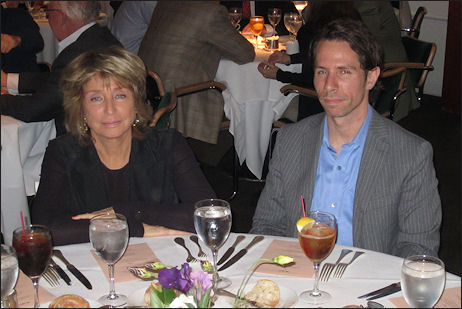
Change of Plan director-writer Daniele Thompson, FSLC senior programmer Scott Foundas (right-rear) — Wednesday, 6.9, 1:55 pm.

Attending today’s event were Thompson, critic/essayist John Anderson, Film Society of Lincoln Center senior programmer Scott Foundas, Village Voice critic Amy Dawes, N.Y. Press critic Armond White, IFC Film’s Ryan Werner, French Embassy rep Sandrine Butteau, myself and a few others.

De-Ball Expandables?

“The reason for that recent Expendables trailer selling cast and nothing else,” a guy tells me, “is the studio and Sylvester Stallone are still grappling with whether to go with an R-rated or PG-13 version. Obviously there would be very different tones in the campaign if it’s the former. I hope they go with the R-rated version, but apparently there’s pressure in the marketplace not to.”

If Lionsgate and Stallone are even toying with the possibility of going with a PG-13 version of The Expendables, then I don’t know what to say to them. It would be stunningly, breathtakingly stupid of them to put out a version that tones down the violence and the gore. It’s such a pathetic notion that I’m not going to sully this website by discussing it further.

For what it’s worth, the guy says he’s hearing that “the film works and is fun…and that Stallone and Stratham have wonderful chemistry.” I don’t buy a word of that! Not a word!

Lizabeth Scott-ish

I always feel a wee bit intimidated by exceptionally beautiful women of any age. Especially if they have strong, piercing eyes that seem to see past your facade and into the Welch’s grape jelly sitting in your chest. I managed to avoid choking during this morning’s interview with Winter’s Bone star Jennifer Lawrence (which ended about 35 minutes ago in a 36th-floor Waldorf Astoria suite), but it was touch-and-go at times. She’s got it.


Winter’s Bone star Jennifer Lawrence — Wednesday, 6.9, 11:25 am.

Cyrus In The Cold

Here‘s my 2010 Sundance Film Festival of Jay and Mark Duplass‘s Cyrus (Fox Searchlight, 6.18), posted on 1.26: “Most of Cyrus — the vast majority of it, I mean — is a mature, somewhat comedic and satisfying handling of an unusual romantic triangle situation — 40ish love-starved guy (John C. Reilly), 40ish mom (Marisa Tomei) and quietly psychotic fat-ass son (Jonah Hill).


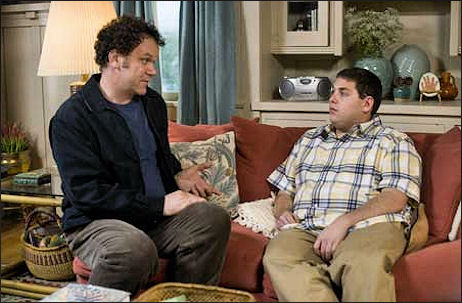
John C. Reilly, Jonah Hill in Cyrus (6.18).

“It’s ‘funny’ here and there but mostly it’s just believable, buyable and emotionally even-steven. A truly welcome surprise.

“In the hands of Adam McKay or Shawn Levy or one of the other big-studio whores, Cyrus would have been a Joe Popcorn torture-chamber movie like Stepbrothers, in which Reilly costarred with Will Ferrell. But it’s something else with the Duplass brothers running the show. It’s quietly absorbing and occasionally hilarious, and made all the better by superb acting.

“But those first 20 or so minutes are very weird. For during this period Cyrus plays like it was directed by McKay or Levy. Reilly behaves so over-the-top needy and neurotic and boorish and lacking in social skills that I was ready to leave. ‘I really don’t want to hang with this asshole,’ I was saying to myself. I was just about to bolt when all of a sudden Reilly hooked up with Tomei, went home with her, fell in love and turned into a different person.

“It plays as if the Duplass brothers suddenly changed their minds about Reilly’s character and decided to go with a much calmer and more emotionally secure vibe. It’s almost as if they sat down and said ‘we need to get the animals to see this so let’s make an animal comedy straight out of the Will Ferrell loser file so the Fox Searchlight trailer guys can sell this portion, and then turn around and make Cyrus into a whole ‘nother bird — a movie aimed at a smarter, more emotionally mature crowd — about 20 or so minutes into the running time.”

Slightly Less So

“In Jay and Mark Duplass‘s Cyrus, Jonah Hill is “as clean-shaven as a deacon, and his hair is tightly cropped. The change has the effect of making his eyes seem more pronounced, his bulk larger, his personality more aggressive. As Cyrus, a twenty-one-year-old living with his single mother, Molly (Marisa Tomei), Hill makes his lugubrious body work for him as a shield against experience. Cyrus has no interest in attracting girls; he’s a nonsexual boy, cloistered with the woman who raised him and whom he adores.

“At home with her, he composes New Agey music on a flotilla of synthesizers. This possessive recluse is often unlikable but never stupid. Molly, a generous-souled woman, takes up with a forlorn, long-divorced fellow, John (John C. Reilly), and Cyrus, who sees his hold over her threatened, tries to break up the affair with lies, guilt trips, and mock breakdowns. Our sympathies, of course, lie with the lover. Reilly, who has curly brown hair and rubbery features, shreds his usual baffled sexlessness; his John begins to fight, while Molly just tries to make everyone happy.

Cyrus was written and directed by the brothers Jay and Mark Duplass, who started out working in what’s loosely called the mumblecore movement, with no-budget pictures like The Puffy Chair (an absurdist road movie that turns serious, about the end of a love affair) and Baghead (a kind of Blair Witch Project homage). This is their first film made with established actors and a decent budget, yet they keep to their earlier aesthetic.

“They avoid the flash and the speed of commercial movies, moving in close with a handheld camera, and staying close as characters try to work out their confusion. The steady embrace of the actors produces intimate character details and awkward moments that land lightly, with a touch of off-kilter humor.

“But the Duplasses have put themselves in a paradoxical situation: the story of a sexually hungry boyfriend struggling against his lover’s creepy son has the built-in volatility of a commercial-movie premise. When Cyrus and John square off, the Duplass brothers might have turned in one of two directions: toward wild comedy or toward anguish and rage. There’s a dose of the latter, but the rage is quickly smothered in niceness, and the movie becomes tame.

“Avoiding commercial formulas and whipped-up moods isn’t enough to make a work of art. The Duplasses’ sensitivity, which is genuine, yields too much tepid relationship-speak, and Marisa Tomei, one of the most appealing actresses in Hollywood, is left with little to play. The characterization of Molly as a sexy Earth Mother who can’t speak her own mind is vapid and condescending, as if she weren’t as real to the filmmakers as the two men are. The Duplass brothers’ rebellion might really take off if they put women at the center of it.” — New Yorker critic David Denby in the current issue.