Keep A'Comin'

As I said on 4.8, I came away from Joan Rivers: A Piece of Work (IFC, 6.11) feeling a good amount of admiration for her. This 43 year-old clip from the Ed Sullivan Show isn’t included in Ricki Stern and Annie Sundberg‘s doc, but you can feel the same pizazz in the 33 year-old Rivers as you can in today’s version, in spades.

“I’m a late convert to Joan Rivers: A Piece of Work, having only just seen it,” I wrote a couple of months ago. “I had relegated Rivers in recent years to an ‘uh-huh, whatever’ status, partly because of her irksome red-carpet chatter and partly because of her 21st Century facial work, which suggests she may have been hurt in a terrible car crash (worse than Montgomery Clift) but was lucky enough to find a gifted plastic surgeon who was able to make her look as normal as possible.

“Ricki Stern and Annie Sundberg’s documentary has wiped that image away. It shows us what a never-say-die trooper Rivers is — 76 and combat-ready and slowing down for nothing. I now think of her as a highly admirable paragon of toughness and tenacity. Plus the doc deepens and saddens our understanding of who Rivers is, was and continues to be. Plus it has some excellent jokes (including one about anal sex that I laughed out loud at, and I’m basically a heh-heh type).

“What a fighter she is…God! Frank and blunt, nothing off the table, takes no guff, lets hecklers have it in the neck, never stops performing, tough as nails.”

A-Team Goes Down

So The A-Team cost about $100 million to produce (according to L.A. Times / “Company Town” reporter Ben Fritz) and God knows how much in marketing costs ($40 or $45 million?). And yesterday’s news that it’s likely to end up with a lousy $26 million this weekend constitutes a “soft but not terrible” opening, according to Fritz.


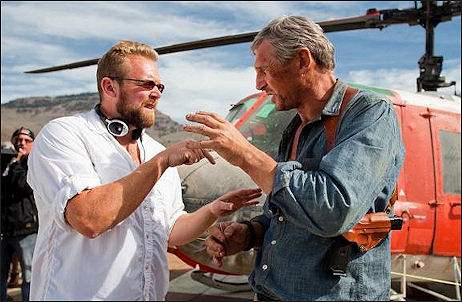
A-0Team< director Joe Carnahan, star Liam Neeson during filming.

Okay, so what figure would be considered terrible? Weren’t handicappers figuring it would at least top $30 million? It sure seems like a crash-and-burn to me.

If Joe Carnahan‘s film triples the first-weekend gross it’ll end up with a bit more than $75 million domestic, but will word-of-mouth be strong enough to ensure this? I doubt it. What was the after-vibe with paying audiences? Pure-guy movies always seem to hit the same ceiling of under $100 million.

The Karate Kid, which particular people don’t want to know about, was the big winner with $56 million on 3,663 screens or situations, obviously kicking the A-Team‘s ass to the curb.

The mostly awful A-Team reviews had nothing to do with this, I’m guessing. It just looked too extreme-cartoon and stupidly violent and blowhardy to too many people, I’m presuming. There’s also the possibility that people shared my reaction to Bradley Cooper on last weekend’s MTV Awards and said, “Look at that too-jolly, overly-beaming gladhander…I’m not going to The A-Team as a vote of protest about his personality.”

True Story

I bought an AT&T $300 data package prior to leaving Cannes, which was way too costly to begin with. It gave me 300 megs of data, but I’d burned through 260 or so by the end of the festival. So I called AT&T and asked if I could buy another $300 package, and they said nope — they can only sell one int’l data package per customer per month.

So I was forced to agree to pay an extra $60-something dollars per month for a year to be on their international data plan, which gives you unlimited overseas and Canada usage, and no horseshit. They also agreed to give me back the $300 I’d paid out previously if I would go for it, so I said okay.

But before giving the final approval I made double-triple sure that AT&T wouldn’t turn around and hit me with some outrageous charge, like they have twice before after my using their service in Europe. I asked the AT&T guy to state twice in Jack-and-Jill language that absolutely nothing shocking would happen charge-wise, and that all I’d see on my monthly bill when I got back would be an extra $60 per month.

Four days ago I called to see what the monthly is (I was figuring about $340-something as I’m already paying $280 for a family package, myself and the two boys with 2000 minutes total plus unlimited texting), and the message said that I owed AT&T about thirty-two hundred bills. Obviously a result of the int’l data package not having kicked in all the way through the system, and AT&T charging me on an international per-byte basis all through Cannes and Italy and Sicily.

I didn’t lose my temper. I simply called and explained what had happened, step by step, and that obviously somebody in the int’l department had made a mistake. It took about a half-hour of explaining and re-explaining and waiting and doing deep-breathing exercises, but the AT&T guy I called finally came back on the line and said he’d spoken to international and that I had nothing to worry about and that all I owed AT&T was my regular monthly and to forget about the $3200 figure. Whew!

But this is what AT&T is like. Untrustworthy, occasionally predatory, no coordination. If somebody says one thing the next guy will say something different. This is why everyone hates them, and why the option of switching to Verizon for iPhone service, which may happen sometime in the fall, is being seriously examined by more than a few AT&T customers.

Dead-Fi

Whenever I stay at Chance Browne‘s Ridgefield cottage (otherwise known as the Elizabeth Taylor-Nicky Hilton drunken-discord house, due to the famous couple having stayed there in ’50 or ’51), I have to resign myself to the fact that the AT&T signal will be completely absent. It’s unusual to check the air and see absolutely no bars at all. If I want to file anything I have to drive down to central Wilton, where you can at least get three or four bars.

Which Of These?

Here are two heavy-jolt Psycho-revisited trailers. I’d like a show of hands as to which is superior, cooler, more popular. The idea with both (which were posted eight months apart) was to sell Alfred Hitchcock‘s 1960 classic as if it had been just made, and obviously not with the rhythms and sensibilities and trailer chops of 50 years ago but those of today.

My inclination is to hand the prize to Cameron Arragoni‘s version, which was posted on 2.23.10. It’s clean, chilling, authoritative, grabby.

The other, created by “psycho28461” and posted on 6.18.09, is jumpier and creeper — it dives right into the mind of Norman Bates in the manner of Lodge Kerrigan mixed with Tony Scott — but it almost feels too manic-schizy at times, and the beginning seems a little too influenced by that “this is your brain on drugs” fried-egg ad from the ’80s.

New Sheriffs

In his final Real Time of the season, Bill Maher raved about Oliver Stone‘s South of the Border (Cinema Libre, 6.25) with pretty much the same terms I used last September after seeing the doc at Lincoln Center. The American news media hasn’t touched (and won’t touch) the doc’s central thesis with a ten-foot pole — i.e., most of South America is no longer being run by U.S.-allied tinhorn dictators, and that’s mostly a good thing.

“Is Stone’s documentary a hard-hitting portrait of South American political realities and particularly the reign of Venezuelan president Hugo Chavez?,” I wrote on 9.24.09. “No, but it’s a perfectly reasonable and welcome counter-view to the U.S. mainstream-media Kool-Aid version, which has always been reactionary and rightist-supporting and hostile to nativist movements.

South of the Border is a good deal more than just a friendly (i.e., non-condemning) portrait of Venezuela’s Hugo Chavez. It is actually a group portrait of all the left-leaning South American heads of state whose views represent a political sea change.

“Until relatively recently South American countries have been largely run by right-leaning frontmen for the oligarchs (i.e., the upper-crust elite), which have always been in league with U.S. interests and the coldly capitalist, market-driven finaglings of the International Monetary Fund. And the lower classes have always had to eat bean dip.

“But since the turn of the century a turnabout has begun to happen with the arrival of a generation of Bolivarian (i.e., nativist, anti-outsider) leaders with skeptical or contrarian attitudes about US manipulations — Chavez, Bolivia’s Evo Morales, Brazil’s Lula da Silva, Argentina’s Cristina Kirchner (along with her husband and ex-President Nestor Kirchner), Paraguay’s Fernando Lug, and Ecuador’s Rafael Correa.

“So now there are six Latin American presidents of a similar mindset, and seven if you add Cuba’s Raul Castro. That’s pretty significant considering that much of South and Central America had been under the control of a series of U.S.-supporting, IMF-funded rightist governments for most of the 20th Century.”

Summer Signoff

Bill Maher‘s riff about how toxic jobs aren’t worth saving is fairly spot-on. Real Time‘s habit of shutting down from mid-June to mid-September is a bad one. It should stay on and keep going. Bring in some choice guest hosts if Maher wants to tour or make another doc.

Out Of The Past

Two days ago the Hollywood Reporter‘s Eriq Gardner posted a typical alleged-Hollywood-ripoff story — i.e., about a federal appeals panel having ruled that a court should review a years-old claim by two brothers, Aaron and Matthew Benay, that Bedford Falls and Warner Bros. stole their ideas and plot points from a script they’d written (and which their agent verbally pitched in 2000) called The Last Samurai.

The Benays’ idea is summarized in Gardner’s piece as being about an “American Civil War veteran who helps modernize the Japanese Imperial Army and fights against the samurai.”

We’re all grimly aware, of course, that a film using this basic line was released in late 2003, starring and produced by Tom Cruise, written by John Logan and directed by Ed Zwick. Here’s the review I ran after seeing it sometime in mid December of ’03.

For me, there are two issues that pop through.

One is why is this case still kicking around a full decade after the initial pitch made by the Benay’s agent, David Phillips, and six and a half years after the release of The Last Samurai? Why didn’t the system allow for a fair assessment of their claim and a final judgment yea or nay within a year or two of the film’s release? I realize that these cases tend to drag on and on, but this one seems exceptional. Perhaps they can drag it out for another five years or so? The lawyers will be fine either way.

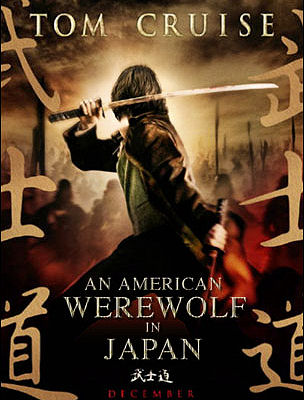
The other issue, of course, is that “[an] American Civil War veteran who helps modernize the Japanese Imperial Army and fights against the samurai” is just the starting seed in the Zwick-Cruise film. The key story element, apparently not written or pitched by the Benay brothers, is the fact that Cruise’s Samurai character, Nathan Algren, is a werewolf.

I explained my theory about this in the same column that contained by 12.03 review.

“I have a theory as to why Tom Cruise’s Nathan Algren character survives the big battle at the conclusion of The Last Samurai,” I wrote. “It makes no sense at all that he would, you see, even under the dubious rules of physics enforced by Hollywood filmmakers. Some explanation is required.

“Cruise’s survival in this scene is more outlandish than Owen Wilson‘s during the finale of Behind Enemy Lines, and that’s saying something.

“I can’t think of any way to be vague about this, so here goes. You’re on horseback and bravely charging the enemy’s front lines, armed only with samurai swords and bows and arrows. And your opponents, unfair as this may sound, are firing straight into your midst with howitzers and Gatling guns.

“What are the chances you’re not going to take a bullet right in your face, or in your chest, and go straight into some ectoplasmic realm? None. A fly who happened to wander into this hot-lead firestorm would get ripped in half.

“I was troubled by Captain Algren’s feat as I left the theatre, but the answer hit me like a slap as I was driving home, and suddenly those wild rumors I was hearing last summer about a discarded Last Samurai sub-plot fell into place.

“Algren, I suddenly realized, doesn’t avoid getting hit by bullets. He probably absorbs several. But he’s a werewolf, and you can only kill a werewolf with a silver bullet, and the soldiers firing the machine guns are unaware of this — nobody knows, not even Goldwyn’s Colonel Bagley — and so the bullets are quite useless.

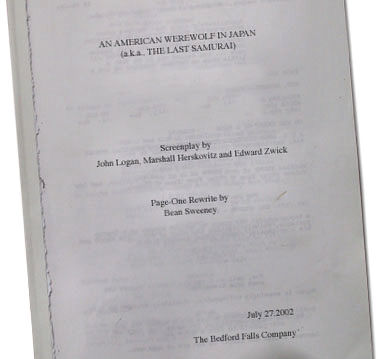
“I never paid the rumors any mind, but I heard two last summer. One was that a rewrite of the Samurai script by Bean Sweeney had introduced the werewolf angle (something about Algren getting bitten by a half-dead Japanese werewolf during his visit to the samurai village in Act One). The other was that Zwick used Sweeney’s rewrite during shooting, but decided to cut the werewolf sub-plot after test audiences found it absurd.

“Cruise’s survival at the conclusion was locked in, however (a proposed re-shoot wasn’t possible due to a tight post-production schedule), and so Zwick was forced to stay with the existing finale minus the werewolf explanation. The thinking, apparently, was that audiences wouldn’t find it too implausible (the Behind Enemy Lines finale had gone down without a peep during the test-screening process, apparently), and so Zwick and his producers decided to roll the dice.

“Sweeney’s sub-plot was apparently inspired — ‘suggested’ is probably a better word — by Cruise’s lip-synching of Warren Zevon‘s ‘Werewolves of London’ during a scene in Martin Scorsese’s The Color of Money.

“Zwick was said by sources to have encouraged Cruise to wear his hair long and grow a beard prior to shooting Samurai so that his periodic transitions into a wolfish appearance would blend in with the film’s naturalistic scheme. The idea was for Cruise to segue into wolf mode without makeup, a la John Barrymore‘s transformation in Dr. Jekyll and Mr. Hyde.

“You know the drill about rumors in this town, so take all this stuff with a grain of salt. But at least it carries a whiff of credulity.”