Beyond The Plugs

I was nodding at Bilge Ebiri‘s 9.2 “Vulture” piece about Steven Seagal‘s bad guy performance in Machete, which inspired thoughts of a comeback and “hey, he almost seems cool again.” I was thinking the same thing too, except I got hung up on Seagal’s hair. The guy’s 58 years oid and he’s dying it inky black, and he seems to have at least 50% more hair today than he did in the late ’80s.
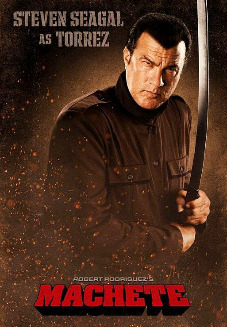
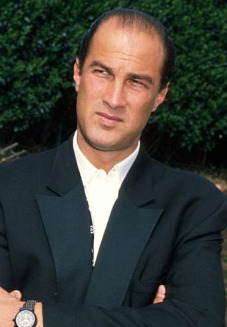
I’m not saying Segal has to pull the hair plugs out, but if you don’t let a little bit of your age in when you get older you look like a putz. Smart guys tell their hairdressers to let the natural gray grow in around the temples and sideburns. And they don’t color their hair the same shade of black that Elvis Presley started going for in 1957. They let it get a little bit lighter. The basic idea is not to look like you’re dying your hair, or that you’ve got plugs that are denser than a piece of rubber off a Michelin steel-belted radial. And why do older guys’ fake hairlines get lower as they get older? They should recede a bit, no? For realism’s sake, I mean.

Set stills are one thing, but Seagal’s hair looks like a solid helmet in the film, all colored and gunked down with hairspray.

Local Color

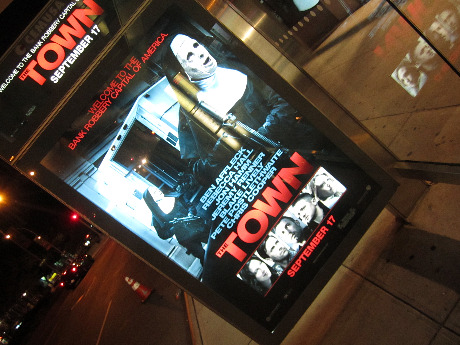
Warner Bros. will stage a Boston premiere of Ben Affleck‘s The Town at Fenway Park on 8 pm on Tuesday, 9.14. A 50-foot-tall screen out in center field, one presumes, plus digital projection and sound that can be heard as far as Revere. Affleck and costars Jon Hamm, Jeremy Renner, Rebecca Hall, Blake Lively and Chris Cooper will walk out on the diamond and take bows like the Beatles at Shea Stadium.

Remains of the Film

The 70mm Todd AO version of Oklahoma! (top) was shot separately from the 35 mm version, which is what most general audiences saw when it was released in 1955. The Todd AO version, shot in 30 frames per second, looked pretty good on the old laser disc, but the elements had gone south by the time the 2005 DVD came out. For some reason a DVD rendering of this version was included, and it looks like hell.

The responsibility for this long-gone loss is with 20th Century Fox home video, although it wasn’t Shawn Belston‘s fault. (He wasn’t running the show back then.) The elements of 30-frame Todd AO version of Around the World in 80 Days are also deteriorated and shot to hell. Therefore the only two films in mainstream Hollywood history that were shot in 30 frame Todd AO are complete toast. Congratulations to those responsible.

Habits


Ben Affleck’s The Town is about to screen in Venice and then Toronto, and, one presumes, in select private screenings. Not that I’ve heard anything from Warner Bros. publicity.

Restaurant on First Avenue between 2nd and 3rd streets — Wednesday, 9.1, 8:20 pm..

Forbidden Purchase

The menu for the new Forbidden Planet Bluray is the most stirring thing about it. I’ve seen never actually seen this sci-fi cult classic start to finish, only portions here and there, but to go the distance is to tap your fingers and roll your eyes. Okay, it’s mildly arresting now and then. The docs and extras pick up the slack to some extent.

Telluride Announcement

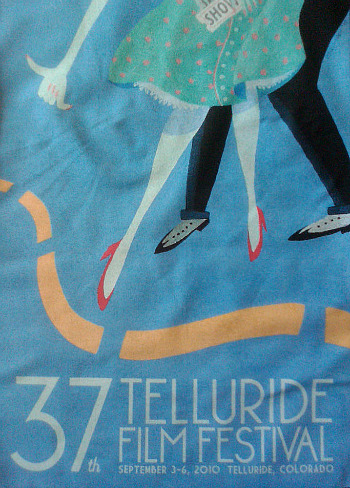
No big wows or mild surprises, even, at this year’s Telluride Film Festival, which announced its slate about an hour ago. The title that has my interest most of all, frankly, is Martin Scorsese and Kent JonesLetter to Elia , a documentary about Elia Kazan that will be discussed in a panel consisting of Todd McCarthy, Michael Barker (whose presence presumably confirms that Sony Classics will distribute?) and Jones.


Photos by HE correspondent Glenn Zoller.

The selections include Mike Leigh‘s Another Year (played at Cannes), Alejandro Gonzalez Inarritu‘s Biutiful (ditto), Cameraman: The Life and Work of Jack Cardiff, Olivier Assayas‘ 330-minutes Carlos (Cannes), a doc called Happy People: A Year in the Taiga (narrated by Werner Herzog, directed by Dimitry Vasyukov), Charles Ferguson‘s Inside Job, Peter Weir‘s The Way Back (allegedly problematic but the basis for a Weir tribute), Mark Romanek‘s Never Let Me Go, Lee Chang Dong‘s Poetry, Errol Morris‘s Tabloid, Stephen FrearsTamare Drewe (why on earthy would Tom and Gary they invite this film to Telluride?), Ken BurnsThe Tenth Inning, Tom Hooper‘s The King’s Speech and Danny Boyle‘s 127 Hours.

Another One

Variety‘s Justin Chang is throwing the same intifada stones as Indiewire‘s Anne Thompson at Julian Schnabel‘s Miral. Who’s standing up for this film? How about the British critics? These reviews are fairly brutal.

The thrust of Chang’s criticism is that while Schnabel is obviously drawn to and engaged by a militant Palestinian perspective on this decades-old conflict, he lacks the stones and conviction to really go to town with it and risk giving offense in some quarters.

“While any film addressing the Israeli-Palestinian divide can expect a measure of controversy, few hearts or minds are likely to be stirred by Schnabel’s inoffensive, well-intentioned Miral,” Chang writes. “Schnabel’s signature blend of splintered storytelling and sobering humanism feels misapplied to this sweeping multigenerational saga of four Arab women living under Israeli occupation, the youngest of which, Miral, emerges a bland totem of hope rather than a compelling movie subject.

“Set to open this month in Europe, Miral will go out in the U.S. on 12.3 through the Weinstein Co., making it the rare film to favor a Palestinian p.o.v. and also be presented under the auspices of Harvey Weinstein, a vocal supporter of Israel.

“But while the film doesn’t shy away from portraying everyday Israeli abuses of authority, its approach to the conflict is calculated to offend as little as possible; the predictable, can’t-we-all-just-get-along coda would be easier to swallow were it preceded by a more politically engaged or personally engaging narrative.”

Miral Slapdown

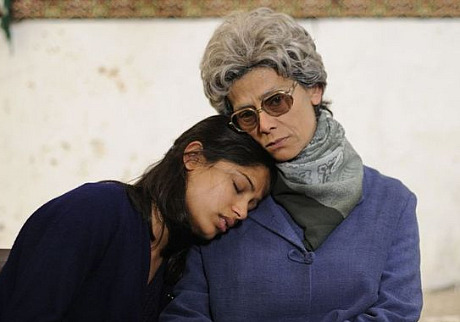
Who would’ve expected Indiewire columnist Anne Thompson, a sage industry reporter not exactly known for dispensing blunt or blistering film reviews, to bitchslap Julian Schnabel‘s Miral (Weinstein Co., 12.3), a pro-Palestinian drama about compassion for orphans and growing anti-Israeli militancy?

While calling Miralheartfelt” and confessing to crying during the film’s bookend sections, Thompson, filing from Venice Film Festival, says that Schnabel “tells the wrong story,” that the film is “earnest agit-prop” with a likely “narrow art-house niche,” and that star Freida Pinto, playing the title role of an orphan who grows into a militant, is “not an expressive actress.” Opaque, she means. Fetching but lacking the necessary chops.

What exactly could the term “the wrong story” mean? I understand that agit-prop films can feel like a lecturing harangue. But could Thompson be alluding to a suspicion that a pro-Palestinian drama is a politically untenable thing as far as award-season politics are concerned?

“The harshness of the Israeli occupation — and continued mutual hatred and distrust — make the rise of the Intifada, which Miral joins, inevitable. She is arrested at 17, brutally caned and released after 24 hours. The movie ends in 1994, a year after the signing of the Oslo Middle East Peace Accord creating two separate states, which the film points out, has still never been honored. Miral goes on to become a reputable journalist working in Italy.

“Her story remains expositional and flat, filled with long debates with her boyfriend Hani (Omar Metwally) about alternative routes to a Middle East solution. ‘What they really want is all of Palestine without Palestinians,’ says Hani. ‘With them here there is no future for us.’

“Schnabel needed a more proficient dramatist to pull this off,” Thompson writes. “He’s an elegant, visual director — he and cinematographer Eric Gautier adopt an unusual blurry technique for the more intense scenes — but this movie, while filmed on authentic Jerusalem locations, too often devolves into dull talking heads.”

She notes that “it’s possible” — i.e., dead certain — “that the Weinsteins will fan flames of controversy around this film’s highly-charged subject. Nonetheless Miral — which will also play Telluride and Toronto — will likely remain within a narrow art-house niche.”

“Rip It In Half”

Okay, now I want to see this. I finally realized it’s Son of Planes, Trains and AutomobilesRobert Downey, Jr. as Steve Martin and Zach Galifianakis as John Candy. Which may be doubly enjoyable as I’ve never liked Galifianakis (he turned me off in The Hangover…bearded anal retard) and will enjoy seeing him get treated like a bad dog.

Northern Offense

There’s been a bit of an upstate rumble about my 8.20 “Gulag Archipelago” piece, which criticized Rochester, N.Y., as being a strange place for a film director to reside. I was interviewed about this twice today. Here’s the result of a chat with Jim Stinson, business reporter for the Rochester Democrat and Chronicle.

Here’s another chat with WNEC’s Pat McGonigle.

Rochester-area resident to yours truly (direct quote): “Your [sic] a complete douche. Rochester rules and Hollywood is for phoney dick-wads such as yourself.” Another one: “You are wrong, Mr. Wells, for trashing Rochester. Perhaps your impressions of our wonderful city is [sic] colored by your obviously failed (ex) marriage.”

Droids and White Tunics

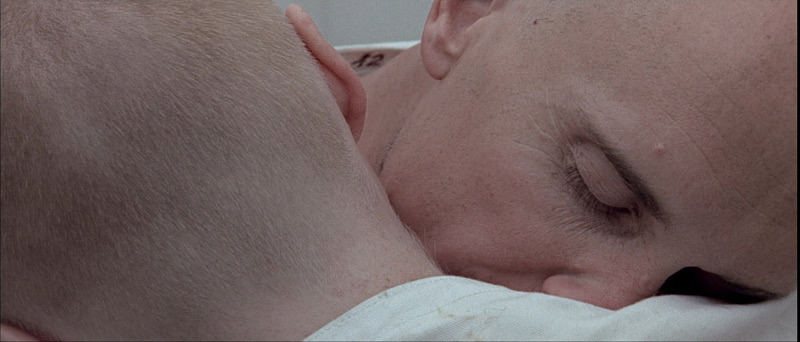
There’s a bit in George Lucas‘s THX-1138 that makes me chuckle every time. A group of social undesirables — shaved-head baldies, dressed in white — have been put into an asylum of some sort, and while one of them (Donald Pleasance) rants on about some political or philosophical issue, a fellow misfit a few feet away begins assaulting a droid robocop, and then beats his skull in.

Pleasance turns around, notices, stops talking for three or four seconds, doesn’t know how to process it (“Oh…someone is destroying a droid”) and continues to rant as if very little has just happened.

DVD Beaver‘s Gary W. Tooze says the following about Warner Home Video’s THX 1138 Blu-ray, which comes out early next week: “The film has a grandness of scale that is never overwhelming, but I often felt like I was in a ‘cinema’ as I progressed through my viewing. This 1080p transfer exports the film’s incredible visual power, and seems to get the absolute most out of antiseptic aura of snow-driven, impersonal whiteness.

“Despite the early 70’s stock, the film is clean, precise and the HD rendering still retains the underlying depressed ‘feel’. It has grain and some infrequent noise, but this Bluray has captured so much of what makes this a great viewing experience. Lucas digitally restored THX 1138 at his own Industrial Light & Magic facility and he also included the roughly five minutes of footage that Warner removed for its brief, initial theatrical run.”