No Orphan Movies

It’s time to acknowledge a fundamental truth (and okay, perhaps a prejudice) in the wake of yesterday’s news about Paramount’s decision to release Martin Scorsese‘s Hugo Cabret on 11.23. The forthcoming 3D drama has been described as basically another orphan story in the tradition of Oliver Twist, Annie and the Harry Potter films, and I’m telling you right now that movies about orphans have never reached me, much less melted me down.


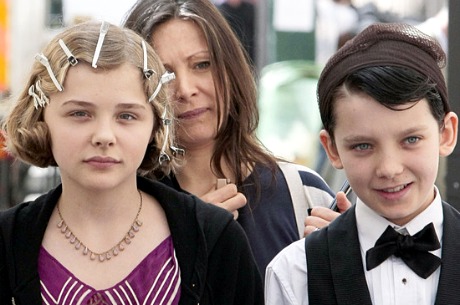
Hugo Cabret costars Chloe Moretz (l.) and Asa Butterfield (r.)

Growing up young and vulnerable without parental support is painful and wounding, but it also toughens and demands invention, adaptation and resourcefulness. I just don’t see it as being that much different than being raised by abusive or alcoholic parents, and it may not be as bad.

Bottom line: Each and every orphan film I can think of has left me cold or not especially moved because orphan movies (except for the Batman‘ pics) are inherently cloying and emotionally manipulative. You could call The Girl With The Dragon Tattoo an orphan film, and that didn’t put the hook in either.

On top of which is a standard Scorsese assessment: the more earnestly emotional the subject matter, the less successful the film. Scorsese is much, much better when he’s dealing in oblique or understated or, best of all, suppressed feeling. Over the last 38 years he’s made exactly two films that have really delivered in terms of upfront emotion — Alice Doesn’t Live Here Any More and The Last Temptation of Christ. He also runs into trouble when he does anything fanciful (like Kundun) or period (The Age of Innocence, The Aviator, Gangs of New York). Protest and stamp your feet all you want, but Scorsese’s home turf has always been (and always will be) contemporary northeastern urban crime movies and/or goombah relationship films. By this assessment his next effort, Silence, is going to be agony.

I’m not dumping on Hugo Cabret (the 3D aspect alone has my interest) but let’s keep expectations in check — that’s all I’m saying. Because (a) orphan movies are, boiled down, the cinematic equivalent of those children-with-big-eyes paintings and (b) Scorsese doesn’t really get “heartfelt.”

Eddie Omen?

Kirk Baxter and Angus Wall‘s editing of The Social Network is so clean, swift and seamless that you could almost overlook it. But of course, the American Cinema Editors didn’t. Last night they gave their big Eddie award to the TSN guys instead of to The King’s Speech‘s Tariq Anwar. Does this mean the Best Picture Oscar tide may be shifting? Doubt it. I think that the editors simply decided that they liked the cutting of The Social Network better than that of The King’s Speech. Nothing beyond that.

At 1:02 am this morning Deadline‘s Pete Hammond ran one of his “did we just feel a small earthquake tremor?” analysis pieces. On the heels of last weekend’s BAFTA editing award win, the Eddie win reps “a big psychological boost” for Team Network, he says. The use of the term “psychological boost” obviously implies a presumption on Hammond’s part that the TSN guys were in a state of psychological slumber and/or resignation prior to the Eddie Win. If Anwar had won last night would Hammond have called this a psychological boost for The King’s Speech?

Hammond then mentions that any film favored to win Best Director, Best Adapted Screenplay and Best Editing Oscars (which Network is almost certain to do) almost always indicates a Best Picture winner unless — this is me talking here — it’s an exceptionally good film that doesn’t deliver in lump-in-the-throat, comfort-blanket terms. (Sample sentiment: “We can’t give an Oscar to a movie about a brilliant but chilly computer dweeb who screws over his best friend.”) Traffic, for example, won Oscars for direction, adapted screenplay and editing 11 years ago but lost the Best Picture Oscar to Gladiator because Traffic didn’t provide huggy-bear assurances.

Oft stated, can’t hurt to repeat: the huggy-bear requirement was apparently set aside over the last four years when The Departed, No Country for Old Men, Slumdog Millionaire and The Hurt Locker won the Best Picture Oscar, but the recent King’s Speech surge indicates that it’s now back in force. Traffic, for example, won Oscars for direction, adapted screenplay and editing 11 years ago but lost the Best Picture Oscar to Gladiator.

On top of which, Hammond reminds, is the tendency of the Academy’s preferential voting system to “favor a consensus film like The King’s Speech,” making it “entirely possible” that “this weird split could be the scenario next Sunday at the Kodak.”

I Get The Willies

I went completely blank — no posts or tweets — yesterday. Mainly due to final packing for today’s 3 pm flight to Los Angeles plus the usual dark-gray-hole effect that accompanies any visit to my mother’s assisted-living-facility in Connecticut. (Don’t ask.) Plus the generally traumatic mindset that always kicks in prior to a cross-country move involving three suitcases. The whole HE operation is shifting back to Los Angeles (cats included) for four to six to eight months, depending on the breaks. Just in time for the last seven days of the 2010/2011 Oscar season. Escaping New York’s winter weather will be very nice, but you have to wonder about the wisdom of a big move in which the only real upside is meteorological.

Settled

Yesterday The Digital Bits’ Bill Hunt reported that Bluray singles of Barry Lyndon and Lolita will be on sale in France, Germany and Denmark in May. If they’re not region-locked, I’ll be buying both in Paris after the Cannes Film Festival.

Hall Pass Redband

I guy I know who’s seen the Farrelly brothers’ Hall Pass (Warner Bros., 2.25) says it has four or five really big raunchy laughs. To judge by the conflicted look on his face as he described them, they’re the kind of laughs that will make decent people hang their heads in shame.

Overheard

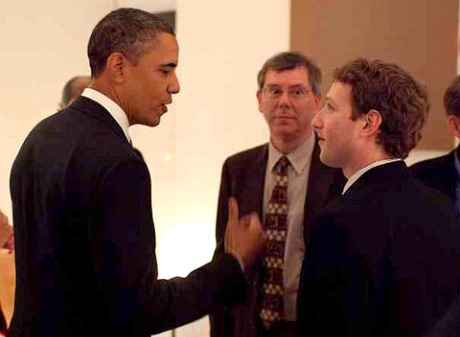
Obama: “Uhm…Google Trending…you read this?…is saying The Social Network has been upticking for five weeks, and is therefore the most likely Best Picture Oscar winner.” Zuckerberg: “No, I didn’t. But honestly? That movie cost me $100 million bucks, Mr. President. I wouldn’t mind if it lost.” Obama: “Aw, come on! It’s your film! Made you a star!”

Silvery Midtown Sheen

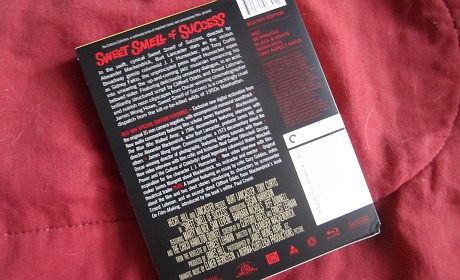
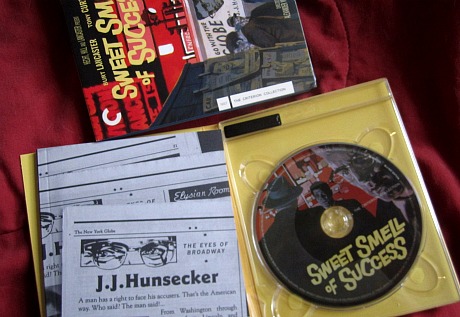
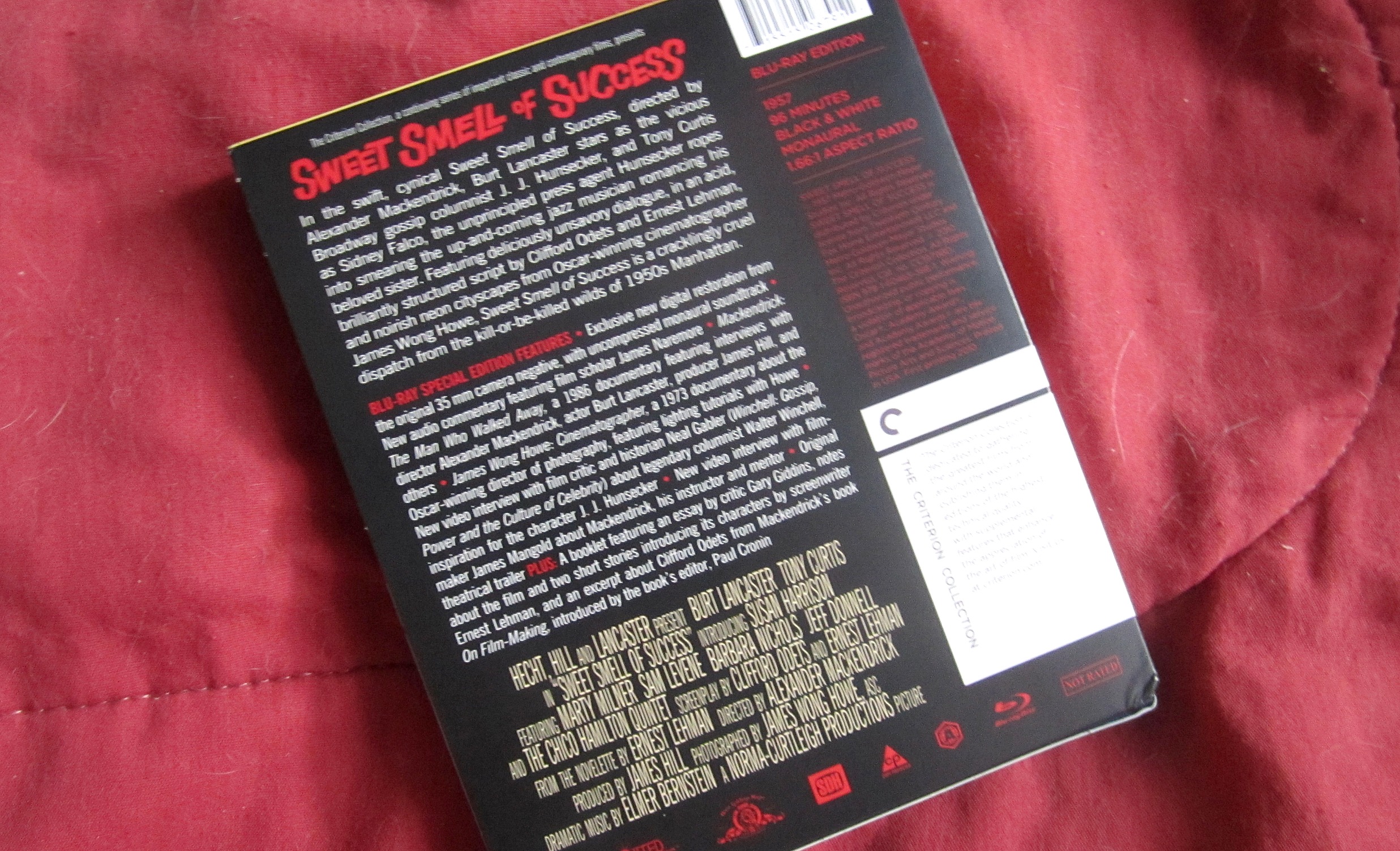
Criterion’s Bluray of Sweet Smell of Success (2.22) is one of the most beautiful black-and-white films these eyes have ever witnessed in high definition, and is all the more luscious for looking like a lot like real film. 70% film and 30% digital, I’d say. It has my kind of grain (i.e., tolerable). Thank God Criterion didn’t bring their Stagecoach aesthetic to this one! It’s so clean and crisp and beautifully captured it’ll bring tears to your eyes.

In my book this is way, way up there with Warner Home Video’s Casablanca and The Treasure of Sierra Madre, Criterion’s own Repulsion, Universal Home Video’s Psycho and Criterion’s DVD of The Spy Whom Came In From The Cold. (Why isn’t there a Bluray of this, I wonder?) The Sweet Smell of Success tones are so varied and delicate and delicious it’s a marvel just to stare at them — all the other elements aside.

"Purity of Mood"

Nine months after debuting in Cannes, Abbas Kiarostami‘s Certified Copy (IFC Films, 3.11) is finally about to open stateside. It’s understood by most big-city critics and columnists that slamming a Kiarostami film will lead to slings and arrows, so they tend not to. I got beat up pretty badly when I posted my Cannes review, which was mostly negative. Here’s a portion of it:

Certified Copy is a two-character endless dialogue movie set in and around San Gimignano, Italy — one of the worst places in the world, incidentally, because of the busloads of horribly-dressed Middle-American tourists who flood this city during spring and summer.

“The characters are James (William Shimell), a self-centered, snooty-fuck writer with carefully cut gray hair who has a little free time after discussing his new book before a small book-store group, and an attractive French-speaking woman (Juliette Binoche) with a 12 year-old, self-absorbed, pain-in-the-ass son who needs to be taken out behind the woodshed, have his pants and underwear pulled down and whipped with a leather strap.

“James and whatsername meet and decide they half-like each other, and about 30 or 35 minutes later decide to start pretending they’re husband and wife. The game gradually becomes darker and darker, and before you know it you’re not entirely convinced they weren’t playing a game to begin with. But the idea — one created by dweebs, aimed at dweebs and certain to be endlessly discussed by dweebs — has something to do with determining the natures of games vs. reality, originality vs. forgeries, truth vs. imagination and so on.

“I didn’t hate every minute of it. It is informed by a certain purity of mood and technique and mise en scene — always the mark of exceptional high-end filmmaking. I was half-engaged at first, but common sense disengaged me within 45 or 50 minutes. And yet I stuck it out to the end. I stood, I sat, I leaned against a wooden panel. And people were booing as the end credits appeared.”

Sex Detective

Another reason why I didn’t much care for Monogamy (Oscilloscope, 3.11) is that it passes along negative judgments about an engaged photographer (Chris Messina) because he succumbs to a form of voyeurism. He’s a photographer who’s developed a business in which clients pay him to snap candids of them leading their day-to-day lives. The plot is about Messina getting involved in the life of a hot blonde client. We all know voyeurism is “wrong,” but that it’s also a guilty pleasure. Alfred Hitchcock knew that when he made Rear Window. But Monogamy is a drag, I feel, because it frowns and goes “tut-tut.”

I once wrote a script that had a similar idea. I called it Sex Detective, and I think the story was better than Monogamy‘s. It’s a little bit like The Conversation. It’s about a matchmaker-slash-shamus whom people go to in order to investigate someone that they’ve spotted in some public place and are enormously attracted to, but with whom they haven’t yet had a conversation, or a chance to strike one up even.

80% of the time someone you think you might want to know or possibly date based on looks or mutual interests or associations (or because he/she might be rich) turns out to be crazy or dull or even repulsive beyond measure, but we only find this out, of course, through the step-by-step dating process, which can eat up weeks or months and lead to all kinds of trouble. The protagonist of Sex Detective has made a business out of investigating prospective romantic partners by looking into more than just their career and family backgrounds but also, as much as possible, their emotional and sexual history. At the end of the search he/she provides a decent-sized dossier on the prospective “mark” (i.e., whether they’re known to be especially good in bed or not, or whether they’ve revealed themselves to be persons of character and are not just fair-weather friends when push comes to shove), and then the client can decide to pursue the matter or not.

Do friends not pass along precisely this kind of information to each other when they know (or have heard) something about a person their friend is interested in? So what’s wrong with paying for this info?

If and when the client is still interested after reading up on the prospective partner, the Sex Detective then offers Phase 2 of his/her service. He/she helps the interested party participate in some kind of “chance” meeting in which they can chat with the mark in some relaxed and unthreatening atmosphere, and perhaps, if things go well, really talk to the mark and (who knows?) possibly make the next move.

Everyone has experienced odd moments in which they’ve felt suddenly and intensely attracted to some super-hot stranger at a supermarket or a Starbucks, but they’ve never struck up a conversation because you can’t just go up to somebody and say “excuse me but I’m feeling this enormous chemical attraction to you and all I’m thinking about is sex.” That never works, and it’s always hard to think up the right clever line that might break the ice and lead to a possibly meaningful conversation. So most people just let it go and they never see that person again and that’s that. (This has happened to me dozens of times.) So the Sex Detective, entrepeneur that he/she is, helps facilitate this. Anyone can be approached and engaged. You just have to do it in the right way.

The Sex Detective service sounds a little weird, yes, but it does save time. Ultimately the client and the mark are left to their own devices. Either they click or they don’t. But by looking into prospective partners through our detective in advance, a client can at least eliminate the wackos and the losers plus save mess and stress, and the “mark” is never the wiser.

The story, of course, is about a male client who hires the Sex Detective to investigate a woman he says he doesn’t know. The client, of course, is interested in finding out about her personal background for reasons that have nothing to do with wanting to explore a relationship. And the Sex Detective, of course, develops a thing for the female stranger himself and steps in and takes her side when the male client makes his dastardly move. There are all kinds of ways to animate this side of the story, but the film would mainly be about exploring what people are really like and/or really want, and how they behave in order to hide themselves or attain their goals or whatever.

Tell me that’s not at least a Sundance movie, or perhaps an HBO series.

Brownish, Slightly Bleachy

The reason I saw only the last half of Meet Monica Velour yesterday was because I was watching Dana Adam Shapiro‘s Monogamy in a tiny screening room right next to Velour‘s. (Both showings began at 4 pm). After about 45 or 50 minutes of Monogamy I was feeling so dispirited that I decided to jump ship. It’s not that Monogamy is awful — it has two or three interesting elements — but I just couldn’t stand the dysentery-like color scheme.

The color in this trailer is much more robust than the color projected during yesterday’s screening. All I know is that after a half-hour or so it began to make me feel ill. At first it made everyone and everything in the film look drab and drained. That was bad enough. But then it started to irritate me personally, and then it took over my mood, and then my soul.

Using bleachy color has become an accepted way of conveying artiness or heavy-osity. I get that. But brownish bleachy color makes a film look like it’s been lying in a cesspool, or has been processed in coffee grounds. Filmmakers would be well advised to avoid it from here on. Whatever you think you’re getting from this visual scheme in terms of edgy hipster cred will be more than counter-balanced by the feelings of nausea in the seats.

I haven’t felt such an acute visceral response to a color scheme since David Fincher‘s Fight Club, which I also dislike for its drab color, which I thought was kind of a cross between muted greenish guacamole and two-day-old coffee grounds lying at the bottom of a plastic garbage bag.

Cheapshot

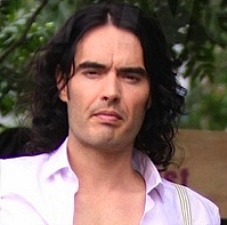
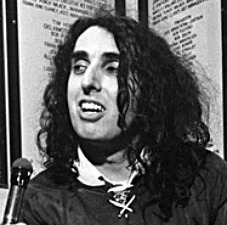
The similarities between the clean-shaven Russell Brand (as he appears in Arthur) and the late Tiny Tim are there, obviously. The eyes, the height and the long curly blank hair are very close, okay. But Brand is thinner and flashier than Tim — a kind of semi-studly, square-jawed, randy movie star-with-a-sense-of-humor thing going on — whereas Tim was hook-nosed, pear-shaped and girly-boyish. And yet he had more intrigue than Brand. Tiny Tim pretended to be an effeminate hippyish carnival freak, but was actually a serious devotee of old tinny music.