No Mea Culpa

Late yesterday afternoon I saw the second half of Keith Bearden‘s Meet Monica Velour (Anchor Bay, 4.8), and I have to admit that Scott Feinberg’s admiring review (filed during last spring’s Tribeca Film Festival) was more correct than not. I obviously need to see the whole thing, but the part that I saw persuaded absolutely that Velour is a mildly decent, in some ways very affecting little film. I’m giving it a B-plus for effort.
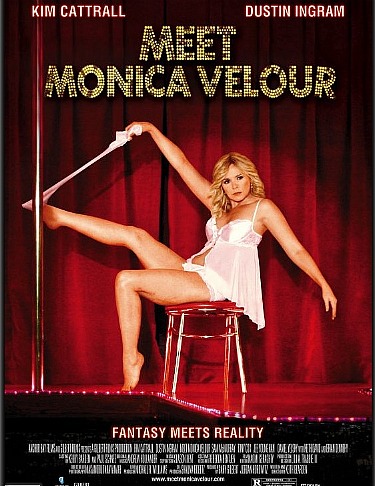
Velour actually has a clear theme — a kid growing up by way of dispensing with illusion. And it offers a genuinely strong and ballsy performance from Kim Cattrall as an aging ex-erotic actress on the skids and heading further down — alcoholic, lumpy-bodied, living in a trailer park. And a relatively steady and affecting one from Dustin Ingram (Glee), who’s 20 or 21 now but plays 17 in the film. (Velour was shot in ’07, it appears.)

The story is relatively well-shaped and believable as far as it goes, and you can tell right away that Bearden knows how to direct and cut as opposed to just adequately shoot a script. There’s a slight problem in his dialogue having a kind of “written” quality, and some of the scenes feeling a little too “acted,” but both are of a somewhat higher (or at least above-average) order so there’s not much interference

This is not, however, a turnabout from Wednesday morning’s negative-attitude post which, don’t forget, was about Velour‘s marketing materials and not the film itself. Almost everything I said in that article is still valid. Anchor Bay’s poster does physically misrepresent Cattrall to the point of the image not even resembling her. The trailer, which focuses mainly on Ingram gaping at Cattrall as she performs a half-hearted striptease inside an Indiana strip club, is slack and one-note. Director-writer Bearden does look somewhat like Bilbo Baggins, and the general rule of thumb is that geeky-looking directors are better with “off” subject matter, or subjects, I mean to say, that don’t involve sex and hormones and formerly hot MILFs.

Bearden persuading Cattrall to gain weight and look extra over-the-hill wasn’t, it turns out, such a bad idea. There’s always an impulse to applaud an attractive actress when she appears in a physically unflattering way, and I’m doing that here, but Cattrall goes the extra distance, I feel, in portraying what it is to not just feel despair but to actually be that, so to speak. She shows chops in this film that I’ve honestly never seen before. I’m almost ready to forgive her for Sex and the City 2.

Either way Movieline‘s Luis Virtel was on the wrong jag when he posted a story about the possibility of Meet Monica Velour possibly being a “hilariously bad” Cattrall film. Nope. Not al all.
Juxtapose

I have three nights left in Manhattan before flying back Sunday to Los Angeles for four or five months. Taking a video of a Fifth Avenue video-screen display (which a couple of hundred Middle American tourists have probably already done today) means I’m getting sentimental in anticipation of the homesickness. I shall return.

Blondie

Is Natalie Portman ever going to make another good movie, or is it going to be like this from here on? The formula used to be “make one for them, and then one for yourself.” Portman’s formula, apparently, is make a single great Darren Aronofsky film and then completely trash your hardcore, super-devoted, high-rent actress image by appearing in three or four shit flicks in a row.

Didn't Believe It

I’m sorry, but as “well done” at Clint Eastwood‘s (or Scanline VFX‘s) tsunami sequence in Hereafter may have seemed to some, to me it looked fake. The wave was much more furious and caused more devastation than anything I saw in the various videos that played after the real thing happened in 2004. Hereafter‘s version was obviously cool, but also a hard-drive thing — a tragedy intensified to ratchet up the gasp levels.

Union Wakeup

A 2.17 N.Y. Post story says that the 1000-plus-member Newspaper Guild is moaning over a proposal by the New York Times Co. to freeze pay over the next two years while adding an extra 5.5 hours onto the standard work week that is currently set at 34.5 hours a week. “That is an effective 16 percent pay cut,” whined NG president Bill O’Meara. He said the Times‘ proposals were “draconian” and “as they stand now would ruin the paper.”

HE reaction: Wake up and smell the 21st Century news business, dead-tree and fossil-fuel-delivery man. You’re lucky to have a job. And anyone lazy enough to bitch about working a mere 40 hours a week needs to be spanked. I work 10 to 12 hours a day and 7 days a week — a minimum of 70 hours a week. And I’m grateful as hell to have a job that I love. Due respect but I’ve nothing but contempt for jowly middle-aged slackers complaining about a 40-hour work week for a decent payday with medical, dental and retirement.

Another Chain-Pull

How long have the various trailers for Insidious (Film District, 4.1) been playing? Four, five months? I feel like I’ve seen it already. Enough tease — it’s time for the beef. The participation of Rose Byrne, Patrick Wilson and Barbara Hershey implies a cut-above thing, but still.

Right Stuff

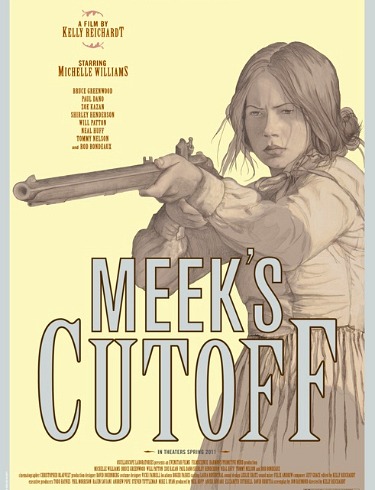
I’d like to know who designed this poster for Kelly Reichardt‘s Meek’s Cutoff (Oscilloscope, 4.8) because it works. It has a certain authenticity, a yesteryear quality. It suggests the look of a poster for…I don’t know, some Lillian Gish or Gloria Swanson film from the 1920s, Queen Kelly or Orphans of the Storm or something in that vein.

I managed to miss this film at last year’s Toronto and New York film festivals, and also at Sundance 2011. The truth? I didn’t want to see it because of the bonnets. Here’s how I explained it on 9.29.10:

“Here comes another immensely shallow but entirely honest statement from yours truly,” I wrote. “The instant I clapped eyes on those mid-1800s women’s bonnets in those stills from Meek’s Cutoff, I said to myself, ‘I’m going to figure some way of avoiding this film for as long as I can.’

“I suspected it would be a quality-level thing because Reichardt’s Wendy and Lucy proved she’s a talented, dead-serious director. Attracted to downer-type women-facing-tough-odds stories, okay, and not exactly into narrative propulsion, but Reichardt’s films require respect and attention.

“And I didn’t care. I was going to avoid Meek’s Cutoff any way I could for as long as I could because I don’t like the gloomy symbolism of floppy bonnets on pioneer women’s heads. To me bonnets spell sexual repression and constipation and tight facial muscles. They suggest the existence of a strict social code (i.e., the film takes place in 1845) that I don’t want to sample or get close to because I know it’s all about men with awful face-whiskers and the wearing of starched collars and keeping everything buried and smothered and buttoned-up among the wimmin folk.”

Meek’s Cutoff is basically a western in which “a braggart, Stephen Meek (Bruce Greenwood), meets his match in a courageous woman (Michelle Williams) after he is hired by three families to lead them through Oregon’s Cascade Mountains so that they may start new lives on the other side. As their water dwindles and they disagree over the treatment of a captured Native American, the group questions Meek’s dependability and cracks under pressure.”

For what it’s worth I’ve moved past my initial feelings and am now ready to experience Meek’s Cutoff, in large part because of this poster.

Again

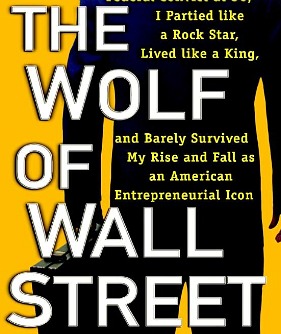
As a follow-up to yesterday’s announcement about Martin Scorsese, Leonardo DiCaprio and Alexandra Milchan intending to finally produce, after years of delay, a film version of Jordan Belfort‘s “The Wolf of Wall Street,” here’s something I wrote about this project nearly four years ago:

Boiler Room and Wall Street are both about young, lean, hungry-for-money guys (a) gaining entry to the world of high finance, (b) learning the ropes, making big bucks and getting a little drunk on the juice of it all, and (c) eventually going too far, getting busted and crashing into a hole of shame and disrepute.

“Now we have a third one to process — a big-screen adaptation of Jordan Belfort’s ‘The Wolf of Wall Street’ (Bantam, 9.25.07) with Martin Scorsese directing, Leonardo DiCaprio starring and Terence Winter writing the script.

“Belfort’s book is about how he became one of Wall Street’s most predatory film-flam artists, plying the trade of ‘penny stock’ trading.

“A Page Six summary says that Belfort’s Stratton Oakmont group “pulled off pump and dump schemes in which fast-talking boiler-room brokers ran up the prices of shares with fraudulent phone pitches.” The item says that whatever money Belfort makes off the book and the film ‘would immediately be seized,’ that ‘he still owes a fortune to investors, [having] made $13 million in restitution with $75 million or more in claims.’

“Question is, what is there to say about another high-hormone blue-chip cautionary tale? We know all about greedy young guys in suspenders who will do anything to get to the top, and we know what happens to most of them sooner or later, so…what’s new?”

Elbowed Aside

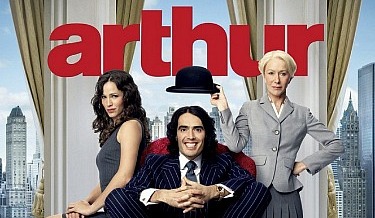
Since writing Wednesday’s story about whether Arthur‘s teaser poster misleads by omitting Greta Gerwig, the ostensible female lead (i.e., she plays the same role that Liza Minnelli had in the 1981 original), a friend sent me a 10.17.09 draft of Peter Baynham‘s 117-page script. I read it right away, and without being too specific I can confirm that Gerwig does indeed have the “Minnelli role” in this draft, which is to say the dominant one as far as a third-act resolution is concerned.

To repeat, a Warner Bros. spokesperson said yesterday that the current poster is a teaser, and that another piece of Arthur art (possibly to feature Gerwig) will be seen down the road. But the fact remains that for the time being, Warner Bros. marketing has (a) kept the romantic female lead off the poster and (b) shown the secondary female lead (i.e., Jennifer Garner) instead, obviously because her name means something to Eloi ticket buyers while Gerwig’s means zip. Unless Jared Stern’s rewrite of Baynham’s script has switched things around entirely (which is highly unlikely), this is a deliberate hoodwink maneuver as far as your average ticket-buyer is concerned. I’m not saying a major studio hasn’t done this before, but I can’t think of any examples.

The teaser trailer pretty much eliminates Gerwig also. She’s seen in two brief cuts early on, and has one line (“Who are you people?”). The basic impression is that Arthur is a three-way relationship story between Russell Brand, Helen Mirren and Garner.

Gerwig will almost certainly benefit from Arthur, as any lead actress in any half-decent, studio-funded romantic comedy would. (For what it’s worth, Baynham’s script is spirited and funny-dopey — not a half-bad “read.”) But marketing-wise she’s definitely being shafted as we speak.

The Arthur poster is analagous, to use a fictitious example, to a poster of Warren Beatty‘s Heaven Can Wait showing Beatty (i.e., Joe Pendleton/Leo Farnsworth), Charles Grodin (as Tony Abbott, Farnsworth’s administrative assistant) and Dyan Cannon (as Farnsworth’s scheming and unfaithful wife)…but not Julie Christie‘s Betty Logan, the romantic female lead.

Or, if you need a parallel for a young actress just breaking in (as Gerwig is into the big-studio realm), it’s like a poster for Billy Wilder‘s Sabrina (’54) showing Humphrey Bogart, William Holden and Martha Hyer (who plays a romantic also-ran)…but not Audrey Hepburn.

"Just A Tiny Little Bit…"

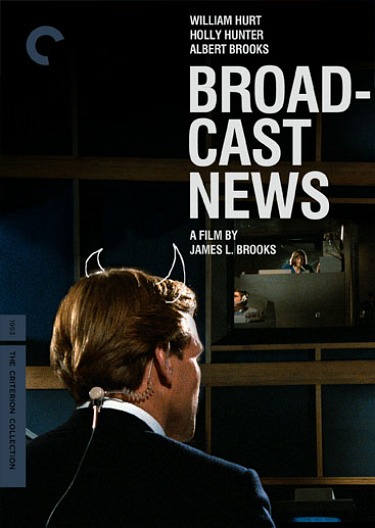
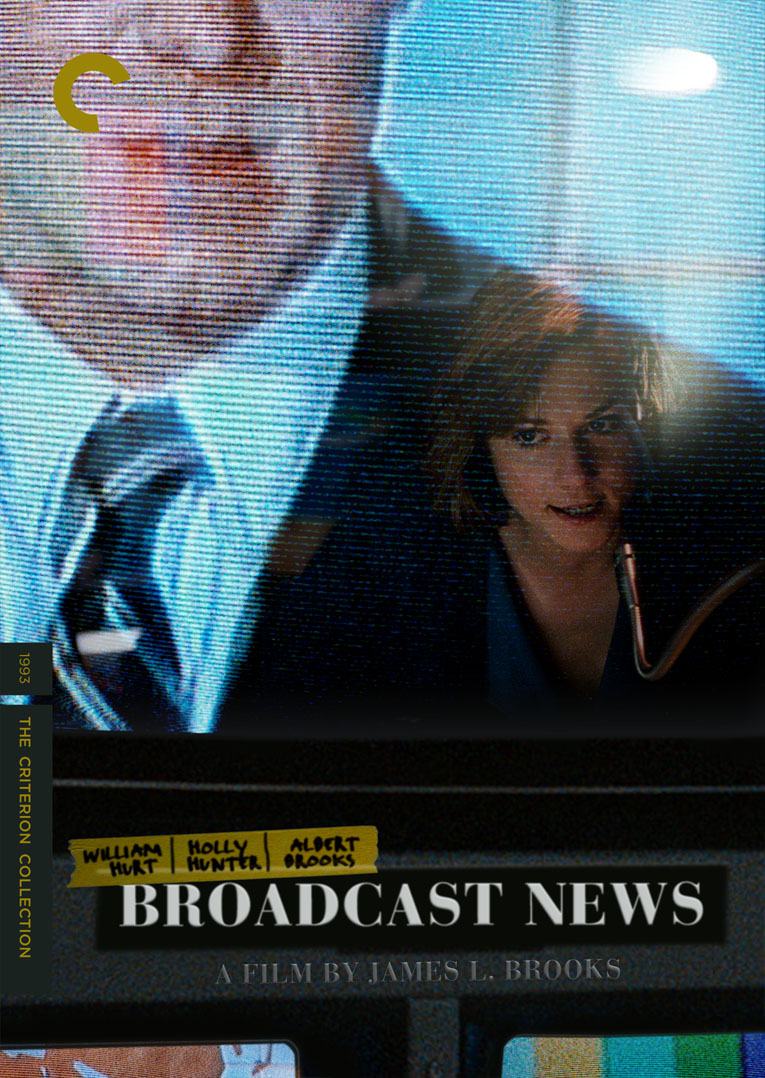
According to designer Eric Stillman, Broadcast News director-writer James L. Brooks didn’t like this suggested cover idea [below] for Criterion’s BN Bluray. And yet it’s quite obviously the best of all the options. “I like it because you can read it as an indictment of William Hurt,” Stillman writes, “or you can read it as Albert Brooks‘ character off to the side, childishly scribbling over his rival’s head.”

Due respect, but Brooks having turned this one down tells you something about how sharp his instincts are these days. Here, by the way, is the second-best option, which Brooks also blew off.

Can't Go There

I’ve just sent in my final, final, double-final Gold Derby Oscar ballot, and I titled my email as follows: “I’d Rather Be Wrong About Best Picture Than Side With The King’s Speech Crowd.”

BEST PICTURE: The Social Network

BEST DIRECTOR: David Fincher (The Social Network)

BEST ACTOR: Colin Firth (The King’s Speech)

BEST ACTRESS: Natalie Portman (Black Swan)

BEST SUPPORTING ACTOR: Christian Bale (The Fighter)

BEST SUPPORTING ACTRESS: Melissa Leo (The Fighter)

BEST ADAPTED SCREENPLAY: The Social Network (Aaron Sorkin)

BEST ORIGINAL SCREENPLAY: The King’s Speech (David Seidler)

BEST ANIMATED FILM (FEATURE): Toy Story 3 (Disney, 6/18, G, trailer)

BEST DOCUMENTARY FILM (FEATURE): Inside Job (Sony Pictures Classics)

BEST FOREIGN LANGUAGE FILM: Biutiful (Mexico).

BEST ART DIRECTION: Inception.

BEST CINEMATOGRAPHY: True Grit, Roger Deakins.

BEST COSTUME DESIGN: Alice in Wonderland

BEST FILM EDITING: The Social Network

BEST MAKEUP: The Way Back

BEST ORIGINAL SCORE: The Social Network

BEST ORIGINAL SONG: “We Belong Together” (Toy Story 3)

BEST SOUND EDITING: Inception

BEST SOUND MIXING: The Social Network

BEST VISUAL EFFECTS: Inception

Oh, Hooey!

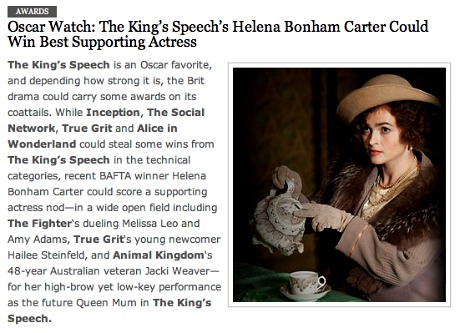
Indiewire‘s Anne Thompson is pushing (or half-pushing) a “Helena Bonham Carter could win the Best Supporting Actress Oscar” scenario. Reason #1: HBC is due. Reason #2: HBC was charming at the recent Oscar Nominee Luncheon. Reason #3: HBC is riding the King’s Speech coattails. If Thompson had briefly addressed or even mentioned the over-and-done-with Melissa Leo ad issue I might have given this some thought, but she’s just indulging in whimsy, methinks.