Who They Are

I wrote something two years ago that sheds some light, I feel, on the arch-conversative mentality driving the Tea Party-kowtowing righties like Rep. Eric Cantor, and which also gives some perspective on the seemingly insurmountable dispute between the rabid Republican fringe and President Obama over the debt ceiling, cutting spending and raising revenue. The piece was called “Clarity.” It’s one of the most cleanly expressed pieces of political analysis I’ve ever written. Here it is:

“The essence of right-wing conservatism is an opportunistic social Darwinism. All righties believe, to quote an old barstool homily, that ‘the world is for the few.’ It follows in their philosophy that capitalism — God’s chosen economic system — is hallowed and sacrosanct because it allows for society’s hungriest go-getters (i.e., the brightest entrepeneurs and most aggressive ladder-climbers) to live rich and abundant lives — to profit handsomely from the fruit of their talent, vision, inititative and opportunism.

“This, many righties believe, is the natural order of things, which is why many of them (certainly the political righties) profess an affinity with God and Christianity. They see the Christian faith as a kind of moral/philosophical support system for free-market determinism, objectivism, laissez-faire capitalism, and constitutionally-limited government.

“For them it’s all about the goodies that God in His wisdom wants them to have — about their right to live flush and get richer and to help like-minded homies do the same. This is the view that binds Ayn Rand and Joe the Plumber and Sarah Palin and all the other buccaneers out there who believe in “me first and applications of socially progressive and compassionate policies second.”

“And if anything gets in the way of this God-sanctified entitlement — anything, say, like the need to face economic budget reality or deal with global warming or develop green or non-polluting energy sources — conservatives will always stall, dispute, denounce, block, argue against, and generally do everything in their power to deny the communal reality of life on this planet. Because they don’t care about the communal reality of life on this planet, or not that much. Because dealing with same tends to bring about regulations which, they believe, tend to mess with their freedom to romp around and profit handsomely and live lavishly.

“Conservatives care about their own world and their own opportunities. They believe in their right to mine, exploit and profit from the backyard minerals that have always been and always will be ‘for the few.’ That is who and what they are.”


Push Comes To Shove

Yesterday I read and heard that the debt ceiling impasse would be more or less resolved by Sen. Mitch McConnell‘s suggestion that the responsibility for raising it be transferred entirely to the White House with the Republicans voting on nothing either way. A 7.12 Washington Post story concurrently explained that McConnell folded due to “a sprawling coalition of Wall Street and Main Street business leaders sent an unmistakable message to [Republicans] on Tuesday — enough squabbling, get the debt ceiling raised.”

Then came today’s story, partly supplied by Republican House leader Rep. Eric Cantor, about President Obama walking out of a tense meeting in frustration with Cantor and other Republican hardliners after dressing Cantor down and saying “don’t call my bluff” or words to that effect. (“Don’t push it, Callaway.”) This drew praise among lefty blogger types for Obama showing cojones by way of honest fuck-you anger, which has never been his strong suit.

The came a HuffPost report that Cantor’s walk-out story “is completely overblown…Cantor rudely interrupted the President three times to advocate for short-term debt ceiling increases while the President was wrapping the meeting…this is just more juvenile behavior from him and Boehner needs to rein him in, and let the grown-ups get to work.”

Cantor and his ilk are Tea Party-fellating fiends who need to be roughly grabbed by the lapels and taken out behind a building and repeatedly bitch-slapped and beaten to the ground.

That's The Title?

Lionsgate marketing maestro Tim Palen has snapped an obviously provocative concept photo of Paz de la Huerta (Boardwalk Empire) to promote Douglas Aarniokoski‘s Nurse 3D, a “psycho-sexual thriller” about “a beautiful nurse who uses her sexuality to very severe ends.” The pic will begin shooting in Toronto on 9.6, or just before the start of the Toronto Film Festival.

As a title, Nurse 3D sounds a little bit simplistic. I would have come up with something allusive, double-layered, with an echo…something.

"Don't Touch Anyone"

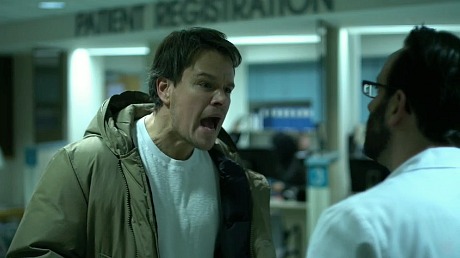
A chilling, unnerving trailer for Steven Soderbergh‘s Contagion (Warner Bros./New Line, 9.9), a high-end horror film about a lethal one-touch plague, is up. Here’s an Apple 480, 720 and 1080. The costars are Matt Damon, Gwyneth Paltrow, Jude Law, Kate Winslet, Marion Cotillard, Bryan Cranston, Jennifer Ehle, Laurence Fishburne, Elliott Gould, John Hawkes and Demetri Martin.

A guy who makes films as good as this one probably is will be retiring next year? Not good.


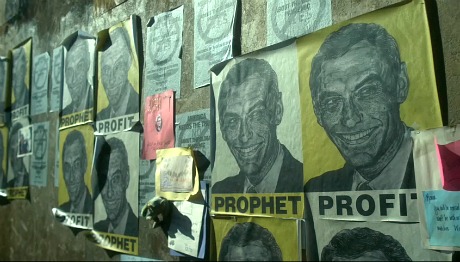
Obviously a Robbie Conal portrait of a politician character played by Jude Law.

What Is

There’s something oddly trustworthy about B. Fatt & Lazy’s film reviews. They’re obviously averse to James Agee-, Karina Longworth- or LexG-level discourse, but at least they’re straight about who and what they are, and the grown-up Beevis & Butthead realm they live in.

For what it’s worth and take it with a grain, but B. Fatt has expressed surprise in an early Friends with Benefits review “how funny it turned out to be.

Justin Timberlake and Mila Kunis are both really funny” — hey, he said “funny” twice in subsequent sentences! — “and play off each other easily. Woody Harrelson is hilarious as an aggressive gay sports editor. Patricia Clarkson is great as Kunis’ hypersexual gypsy mother. Even the cameos by Emma Stone, Andy Samberg and especially Shaun White playing himself are inspired.

Plus, he says, the film understands and accepts the eff-buddy concept.

“Timberlake and Kunis get it the fuck on over and over again. Hair-pulling, sheet-ruining, swinging-from the chandelier, acrobatic, dirty sex. For pretty much the whole movie. It’s a great premise for a film.”

Something tells me there might be values and aesthetics contained in Friends With Benefits that these guys aren’t perceiving or discussing. But maybe not.

Pastime

I’m alluding, of course, to a very contained and non-expressive form of airport-terminal loathing. No “looks,” no rolling of the eyes. Nobody knows what I’m thinking except me. LQTM. Update: 9 am SFO-to-Burbank flight now expected to leave around 11 am. Missing crew, gate switched. Greetings & salutations, United Airlines!

When Schrader Was Really Good

This two-day-old Jack and Jill-despising mashup reminds that I haven’t seen Paul Schrader‘s Hardcore (’79) for a decade or so, and that I wouldn’t mind catching it again. Scott’s performance as a tight-assed Midwestern Calvinist looking for his runaway daughter is one of his all-time best. Peter Boyle and especially Season Hubley delivered excellent backup. A solid ’70s film about square America going mano e mano with urban decrepitude. The violent ending is jusitified.

Formerly I'm With Cancer

I haven’t seen Jonathan Levine‘s 50/50 (Summit, 9.30) and don’t know anyone who has, but the apparent marketing plan, to go by the one-sheet, is to basically reveal — i.e., spoil — the third-act resolution in order not to discourage business. Unless they’re flimflamming and/or someone knows something I don’t.

Get With It

I’ve been somehow managing to not see James Marsh‘s Project Nim, which someone called “the monkey movie” during Sundance ’11, but that will soon change as it opens in Los Angeles the day after tomorrow. Here’s A.O. Scott‘s 7.7 N.Y. Times review.

Thanks, Guys!

The San Francisco Dolby team said farewell tonight to visiting journos and tecchies with a 9 pm dinner at the Mark Hopkins hotel. I have lots of notes, riffs and impressions to file after returning to Los Angeles tomorrow morning, but thanks to Joshua Gershman, Joan Levy, Kelli Havlik, Daniel Schneider and Julie Mathis for being thorough, thoughtful and tireless in taking care of their visitors.


The San Franciso Dolby p.r. team (l. to r.): Joan Levy, Josh Gershman, Kelli Havlik, Julie Mathis and Daniel Schneider.

Bounty Bluray

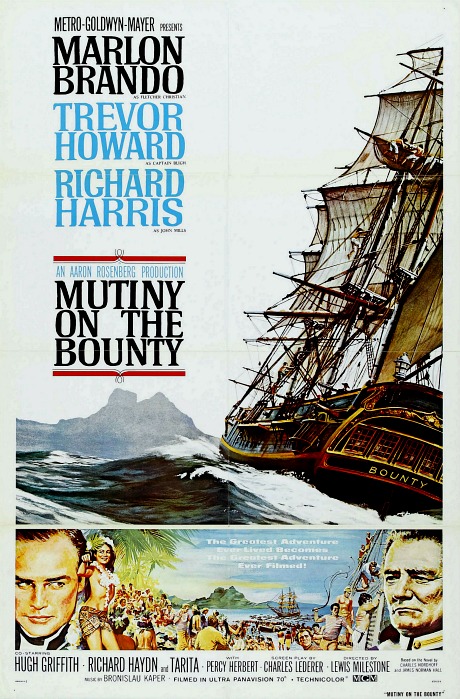
It was announced today that four months hence Warner Home Video will release a Mutiny on the Bounty Bluray. (The ’62 version, I mean.) This is a major deal for me because this half-good, half-problematic sea epic was shot in Ultra Panavision 70, meaning it will look exceptionally vibrant and detailed in high-def. Perhaps not as sharp and gleaming as WHV’s forthcoming Ben-Hur Bluray, which was scanned in 8K, but both were shot in the same 70mm anamorphic process, and will be presented in an aspect ratio of 2.76 to 1.

A little less than five years ago I wrote the following about the ’06 DVD version:

“Say what you will about the ’62 Bounty — historical inaccuracies and inventions, Marlon Brando‘s affected performance as Fletcher Christian, the floundering final act. The fact remains that this viscerally enjoyable, critically-dissed costumer is one of the the most handsome, lavishly-produced and beautifully scored films made during Hollywood’s fabled 70mm era, which lasted from the mid ’50s to the late ’60s.

Roger Donaldson‘s The Bounty (’84) is probably a better Bounty flick (certainly in terms of presenting the historical facts), but the ’62 version has more oompah swagger. It has a flamboyant ‘look at all the money we’re pissing away’ quality that’s half-overbaked and half-absorbing. It’s pushing a kind of toney, big-studio vulgarity that insists upon your attention.

“And the ’62 Bounty definitely has first-rate dialogue and editing, and three or four scenes that absolutely get the pulse going (leaving Portsmouth, rounding Cape Horn, the mutiny, the burning ship).

“You could argue that this Bounty is only nominally about what happened in 1789 aboard a British cargo ship in the South Seas. And you could also say it’s more about early ’60s Hollywood than anything written by Nordhoff & Hall. It’s mainly a portrait of colliding egos and mentalities — a couple of big-dick producers (Aaron Rosenberg was one), several screenwriters, at least two directors (Lewis Milestone, Carol Reed) and one full-of-himself movie star (Brando) — trying to serve the Bounty tale in ’60, ’61 and ’62, and throwing all kinds of money and time and conflicting ideas at it, and half-failing and half-succeeding.

“Seen in this context, I think it’s a trip.”