Oscars Being Rattner-ized

Brett Ratner and Don Mischer will co-produce the 2012 Oscar telecast, it was announced earlier today. Ratner has promised an emphasis on laughs. Something tells me he doesn’t mean the brainy Steve Martin or Bill Maher kind…no offense. I’m guessing he’ll coarsen things up and take the show in a kind of drop-your-pants Animal House direction. I’m just guessing. It’s probably safe to say that the show will also be a little less gay, by which I mean it’ll have less of a song-and-dance Las Vegas glitter vibe.

Movieline‘s Christopher Rosen nailed it when he wrote that “the only way Tom Sherak and Dawn Hudson could have enraged the online community further with the selection of an Oscar co-producer for 2012 is if they’d hired Michael Bay.”

Vernacular

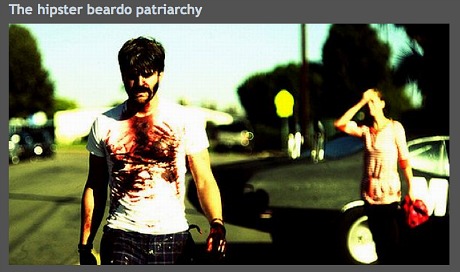
My first reaction to Glenn Kenny‘s Some Came Running pan of Evan Glodell‘s Bellflower was, “Hey, he likes using the term ‘beardo’ as much as I do!” I don’t know when it began to catch on, but I’ve used “beardo” a lot over the last two or three years (and twice in Bellflower riffs). It basically means “pretentious or self-centered jerkoff who wears a beard.”

“In his review of the inventive enfant-terrible indie Bellflower for The A/V Club,” Kenny writes, “Keith Phipps hits on something crucial about the film that I’ve yet to see any other reviewer mention. He says that ‘after a point’ it becomes ‘a film about men who hate women, and it comes awfully close to endorsing that point of view.’

“Well, screw that, I’ll go even further: it doesn’t ‘come close’ to endorsing that point of view, it absolutely embodies that point of view, it can see no other possibility but that point of view, it is that point of view.”

Scared Greedheads

“Dow’s 512 point drop [earlier today] underscores the state of unreality in DC.,” Howard Kurtz more or less tweeted about a half-hour ago. “Pundits felt crisis was over when a deal, however lousy, was reached.” If you consider the perspective offered by a ten-year graph, what happened today doesn’t seem quite as bad.

Ben-Hur at Lincoln Center

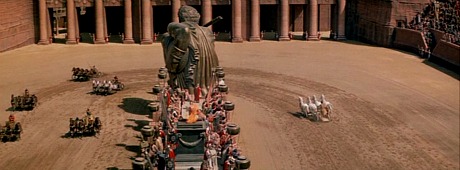
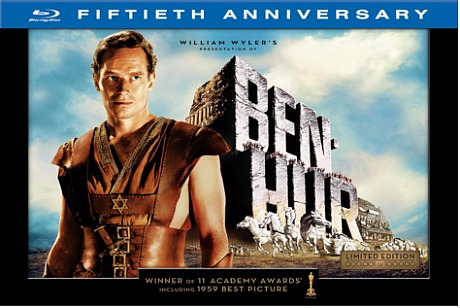
This morning the Film Society of Lincoln Center announced a special New York Film Festival showing of William Wyler‘s Ben-Hur (’59), or more specifically a digitally restored 8K version that is the source of the upcoming Warner Home Video Bluray that streets on 9.27. I’m told that the NYFF showing will probably happen on Saturday, 10.1, starting sometime in the morning.

The interesting angle is that the NYFF will be showing the Biblical epic at the full Camera 65 aspect ratio of 2.76 to 1, which may (emphasis on that word) be the very first time it’s been commercially projected on a big screen in this particular format. Maybe.

According to James Bond, president of the Chicago-based Full Aperture Systems, Inc., as well as a respected film expert and historian who asked not to be identified, the 1959 reserved-seat roadshow versions of Ben-Hur in New York and Los Angeles were probably projected at 2.55 to 1. That’s still pretty damn wide (2.55 was the aspect ratio of Fox CinemaScope films from The Robe, which opened in 1953, until sometime in the mid to late ’50s), although not as wide as Cinerama presentations.

“2.55 was the more common way to show [a film of this type],” says Bond. “The original wide screens of the mid 1950s were set up to handle 2.55 to 1.”

The other guy, hedging his bets, says Ben-Hurmay have opened in New York and Los Angeles at 2.76 to 1…I was too young to have noticed.”

The only way 70mm prints of Ben-Hur could have been seen in their full 2.76 to 1 widescreen splendor would have been to project the epic onto an extra-wide Cinerama screen, or like the one that was built for L.A.’s Cinerama Dome in 1963. New York’s Loew’s State, where Ben-Hur premiered in late ’59, never had a Cinerama screen, and I don’t think that the old Egyptian, which is where Ben-Hur opened in Los Angeles, did either.

Why, then, did 70mm prints of Ben-Hur allow for a 2.76 to 1 aspect ratio if no big-time theatres actually showed it this way? Beats me. I’m only passing along what Bond and the other guy have told me, which is that 2.55 to 1 was probably the format.

If Bond and the other guy are wrong and Ben-Hur did show at 2.76 to 1 in 1959, then at least the New York Film Festival showing at Alice Tully Hall will mark the first time the classic will be presented in a super-duper-wide format on a big screen in roughly 52 years.

Unless, you know, HE reader Cadavra is correct when he writes that Ben-Hur “screened at the Cinerama Dome about 15 or 20 years ago at 2.76:1 (and in 70mm, of course).”

Yes, the 2.76 to 1 version has been viewable on DVD versions in the past, but minus the big-screen pizazz. Even if you watch the Ben-Hur DVD or the forthcoming Bluray on a 50″ or 60″ screen, you’ll be looking at an image that isn’t very high (i.e., really thick black croppings on the top and bottom) and is clearly diminished compared to what Wyler and his cinematographer, Robert L. Surtees, wanted audiences to see. And watching the film at this aspect ratio on 40something- or 30something-inch screens is pretty close to ridiculous. Don’t even go there.

FSLC/NYFF co-honcho Scott Foundas says the widescreen image at Alice Tully (and at the earlier press screening at the Walter Reade) will obviously be less high than standard 2.35 to 1 widescreen projections, but only slightly.

The other thing that needs to be cleared up is that while Warner Bros. archivists have digitallly remastered the restored Ben-Hur at 8K, the NYFF projection (via a Barco) will be shown at 4K. But that will still deliver loads of incredible clarity and detail, probably more than the naked eye can fully detect or appreciate.

Dry Cleaning Costs

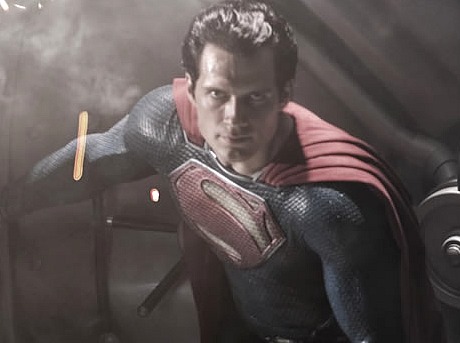
The most distinctive things about Henry Cavill‘s appearance in Zack Snyder‘s Man of Steel are (a) the subdued rosey-pinkish tone of red in the cape and chest logo, (b) the gray body suit with the criss-cross texture, and (c) the knife pleats fanning out from the shoulder-origin section of the cape. There’s no point in wearing knife pleats unless you drop the suit off at the cleaners each and every time after wearing it. Christopher Reeve and George Reeves‘ Superman capes were more natural looking…they just hung loose.

Enough With The Lunches

I read a riff the other day that said the American Dream used to include a nice home in the suburbs with a white picket fence, but that today’s big dream is just to survive (i.e., keep up with the payments) with maybe a little mad money on the side. Like it or not, that’s the 2011 reality that the best and the brightest are looking to fulfill. Eat healthy, stay in place, no falling off the treadmill.

Another thing that needs to change is people who work at offices always going to lunch. I just tried to reach three of four people at the Film Society of Lincoln Center and they’re all at lunch, networking and texting and yaddah-yaddah. Between lunches and arriving at work at 9:30 or 10 am and water cooler chit-chat and interminable staff meetings and personal calls there’s only…what, three or four hours to actually do the job and deal with the public (i.e., people like me)? Less?

I hardly ever “do lunch” and I’m fine. Lunch is just (a) a time-out tension reliever, (b) focused yoga time, (c) a 60-minute sensual rest-stop and (d) a daydream. I’m all for slacking…don’t get me wrong. But I have a 24/7 column to write.

Branagh vs. Serkis in Supporting?

With this morning’s announcement about Simon CurtisMy Week With Marilyn (Weinstein Co., 11.4) having been chosen as the Centerpiece for the 2011 New York Film Festival, Manhattanites will get an early look at what I’ve been told is an extraordinary, highly enjoyable Kenneth Branagh performance as Laurence Olivier.


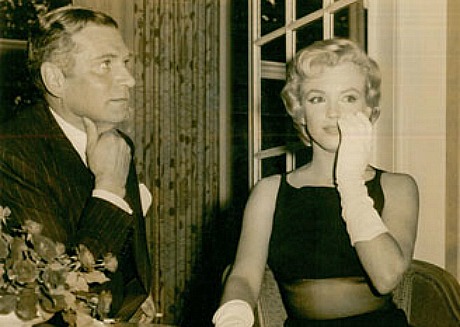
Laurence Oliver, Marilyn Monroe sometime during the moderately hellish ordeal that was the making of The Prince and the Showgirl.

Last April an HE reader attended a New York research screening of Curtis’s film, which stars Michelle Williams as Marilyn Monroe, and had this to report:

“Branagh is the surprise of this,” the guy wrote. “He’s wonderful as Laurence Olivier — just brilliant. Like Williams, he doesn’t look much like his real-life character but unlike her, he’s aided by superior writing. He also perfectly mimics Olivier’s facial mannerisms and voice and hamminess to the extent that you forget you’re looking at Branagh. He steals every scene he’s in and is the reason to see this movie.”

So in the Best Supporting Actor race, it beginning to seem probable if not likely that it’ll be Branagh vs. Rise of the Planet of the ApesAndy Serkis.

Why can’t I find a decent shot of Branagh-as-Olivier in this film? It wrapped last winter and not a single JPEG has turned up online. What’s that about, Sarah or Pantea?

My Week With Marilyn is based on two books by the late Colin Clark about Clark’s relationship with Ms. Monroe during the making of The Prince and the Showgirl, which was released in 1956.

Died With His Helmet On

“I had three reactions to Asif Kapadia‘s Senna, an absorbing, somewhat affecting doc about the late Ayrton Senna, the legendary Brazilian race-car driver and Formula One champion who was killed during a race in 1994 at the age of 34. They were (a) ‘very well-made film, stirring story,’ (b) ‘Senna’s death was very sad’ and (c) ‘shit sometimes happens when you drive at exceptionally high speeds in the pursuit of beating others to the finish line.”

“A race-car driver who dies in a pile-up is like a mountain climber who falls into a crevasse or a combat soldier who catches a bullet or a wild-animal tamer who gets clawed to death.

“I realize Senna is regarded as perhaps the finest driver who ever lived, and that he was religiously adored in Brazil and by racing fans the world over, and that his death (due to a mechanical malfunction in the race car he was driving) was tragic. He was a hard-core athlete and very competitive and technically savvy, but — let’s be frank — he was also a bit of a hot dog and a guy who banged into other race-cars a lot. He often spoke about God helping him with his driving and steering him to victory — a common enough feeling that’s analogous to musicians talking about being ‘in the groove,’ but a bit weird all the same. Plus he came from a fairly rich family and was apparently a major hound who never got married or even spoke about having kids.

“You want a really tragic sports figure? Consider the tale of Columbian soccer player Andres Escobar, whose story is quite movingly told in Jeff and Michael Zimbalist‘s The Two Escobars. Now, that’s a sad story plus one that looks beyond the perimeters of the sport realm.” — from my 3.12.11 SXSW review.

"A Triple? I'm At Least a Quadruple"

The line is from Tom Stoppard‘s Hapgood, a 1988 play about double and triple agents and quantum physics and making audiences feel lost and clueless. Aaah, for the simplicity of a story about the uncovering of a mere double! A popcorn movie in relative terms. TTSS being set in the ’70s is like extra butter.