To Deny Logic, Know Bliss

James Toback‘s autobiographical script of The Gambler, a fine 1974 Paramount film directed by Karel Reisz, is one of the most perfectly written, jewel-cut character studies to ever reach the American screen. Its portrayal of the typical gambler’s risk-junkie mentality, partially borrowed from Fyodor Dostoevsky’s “The Gambler” and partly from Toback’s own compulsive past, is close to flawless.

James Caan ‘s first-act speech to his students, lifted directly from Dostoevsky, about how “sometimes a man knows, just knows without rhyme or reason but with poetic certainty, that two and two make five” is one of my all-time favorite dialogue passages.

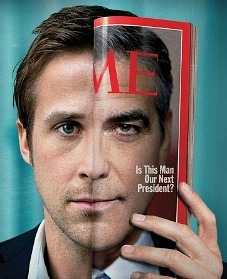
Today Deadline‘s Michael Fleming reported that William Monahan (The Departed) is rewriting Toback’s script for a potential Gambler remake with Leonardo DiCaprio atached to play Caan’s character and (who else?) Martin Scorsese directing. Monahan is too good of a writer to just update or do touch-ups, so I’m wondering does Paramount, which will produce, want to make The Gambler into a somewhat different thing? Maybe they don’t, but the hiring of Monahan suggests that they do.

Maybe they want a different ending. Toback’s, however true to Caan’s character, is a bit downish and masochistic.

Paul Sorvino (playing a loan shark named Lips): “Listen, I’m gonna tell you something I never told a customer before. Personally, I never made a bet in my life. You know why? Because I’ve observed firsthand what with seeing the different kinds of people that are addicted to gambling, what we would call degenerates. I’ve noticed there’s one thing that makes all of them the same. You know what that is?”

Caan (as inveterate gambler and college professor Axel Freed): “Yes. They’re all looking to lose.

Sorvino: “You mean you know that?”
A Little Help Here

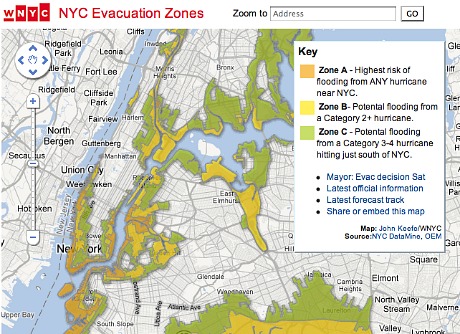
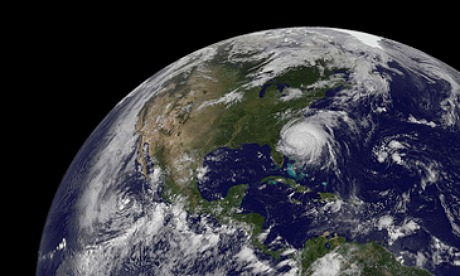
Why does it take so long to figure out when Hurricane Irene will actually hit Manhattan? I know it’s supposed to arrive Saturday around midnight or so, possibly an hour or two later (which would make it Sunday)…but why do you have to search around for this info? Why are news reports so averse to simply stating this likelihood in plain, standing-around-in- front-of-the-neighborhood-pizza-parlor dumb-guy language?

So it’s travelling around 15 mph, and it’s been downgraded to a level 2 from a level 3, and is expected to hit the general, all-spread-out New York City area by the end of Saturday Night Live? And it’ll be gone and on its way to New England by dawn or thereabouts? And that’s it?

So if you want to adopt a Hollywood Elsewhere “you only live once” attitude and experience the damn thing you’re going to have to forego sleep? And if you want to shoot video of Irene’s arrival you probably won’t get a damn thing because it’ll be pitch black? And the NY subway system is going to shut down at noon tomorrow, or roughly 12 hours before it hits? Why not shut down at 4 pm or 6 pm? And movie theatres will be closed?

If Roland Emmerich was handling the logistics for this thing you can be damn sure it would play out differently. I hope the flooding isn’t going to be too bad and all that, and I hope to God no one loses their life or gets badly hurt, but I can feel a little bit of an inkling of a letdown coming. Hurricane Irene is real, all right, and it might be awful, but I suspect it might be a little bit ike Carmageddon when all is said and done. Okay, maybe not quite that much of a shortfall. But a good portion of it, I suspect, is just going to be driving rain and howling winds and tree branches snapping off and electric power lines down and news reporters doing their best to scare the shit out of alert people to the dangers. It will come and it will pass, and the biggest dividend will be “cause for the pause that we all should be taking anyway.”

"We Are The Mods!"

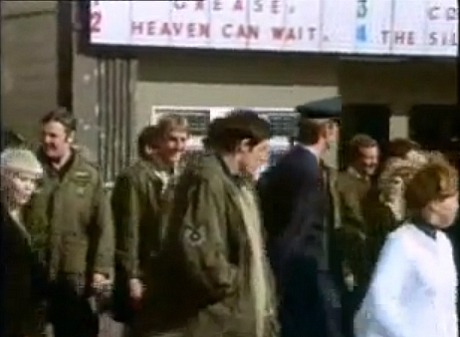
The young-gangster-falls-for-nice-girl story in Rowan Joffe‘s Brighton Rock (IFC Films, opening today) has nothing — repeat, nothing — to do with the 1964 mod-vs.-rocker riots that happened in Brighton, England, in the summer of 1964. Joffe simply decided to mesh the original Grahame Greene story, set in 1938, with this tumultuous occurence, the mid ’60s being a hipper backdrop than the late ’30s, etc.

More than anything else my recent viewing of Brighton Rock recalled Franc Roddam‘s Quadrophenia (1979), which peaked with a rousing, contact-high recreation of the Brighton riots that is much more thrilling (and far more realistic and chaotic-feeling) than the one in Joffe’s film…no offense. I first saw Quadropehnia at Manhattan’s 8th Street Playhouse, and then I showed it to the kids about ten years ago. The older I’ve gotten the more I’ve come to realize that this film — loosely based on the Who rock opera and basically the story of Jimmy Cooper (Phil Daniels) and his identity, friendship and girlfriend issues — belongs in the near-great category.

But what a shock to see this clip and realize that Roddam forgot to change the letters on a movie marquee while shooting a crowd scene, and so we read, however briefly, that Warren Beatty‘s Heaven Can Wait and Randal Kleiser‘s Grease — both released in the summer of ’78, when Quadrophenia was shooting — are the current attractions. What an embarassment for production designer Simon Holland (who’s now dead). I mean, it’s so easy to change the letters on a marquee. It’s not like it costs anything.

Nature's Wrath

I regret having missed out on the Washington, D.C./New York City earthquake, and I’m also sorry about missing Hurricane Irene this Sunday. If I was still in Manhattan I would put on a parka that morning and take the A train to Rockaway so I could see the big waves and feel the full force of the winds. I know people whose entire lives are about living in climate-controlled safety vacuums and avoiding the aliveness of nature at all costs.

If Anything, Stronger

During last night’s Thelma and Louise screening at the Academy I fell in love all over again with Callie Khouri‘s dialogue. Especially that scene when Geena Davis‘s Thelma is explaining to Susan Sarandon‘s Louise that things just aren’t the same any more, that something deep and transforming has taken hold of her.

Thelma: “But, uhmm, I don’t know…you know? Something’s, like, crossed over in me and I can’t go back. I mean, I just couldn’t live.”

And I love this back-and-forth as they’re driving through Monument Valley:

Thelma: “You awake?”

Louise: “Guess you could call it that, my eyes are open.”

Thelma: “I’m awake too. I feel awake.”

Louise: “Good.”

Thelma: “I feel really awake. I don’t recall ever feeling this awake. You know? Everything looks different now. You feel like that? You feel like you got something to live for now?”

Louise: “We’ll be drinking margaritas by the sea, mamacita.”

Thelma: “You know we could change our names.”

Louise: “To live in a hacienda.”

Thelma: “I want to get a job, I’ll work at Club Med.”

Louise: “Yeah, what kind of deal is that cop gonna come up with to top that?”

Thelma: “Have to be pretty good.”

Louise: “Have to be pretty damn good.”

Thelma and Louise wasn’t just an important expression of rage and refusal and sisterhood among women who’d had it with predatory male bullshit, but something seminal and primal, and on some level even eternal, if you consider that it’s as strong a film now as it ever was, and perhaps even stronger.

I was surprised by how fresh and vital it still seems. And funny — it has more than a few big laughs.

Yes, there were three male characters who were repulsive, sadistic brutes, and Brad Pitt‘s character was no prize in the end, but there was also Harvey Keitel‘s compassionate detective and Michael Madsen ‘s sympathetic boyfriend, and that cop who started crying when he was about to be put into the trunk.

And there was also the rasta man on the bicycle who blew pot smoke into the trunk.

I think the above alternate ending (i.e., the one that tested poorly, thereby causing its removal) needed different music, but otherwise it was strong and sad and penetrating.


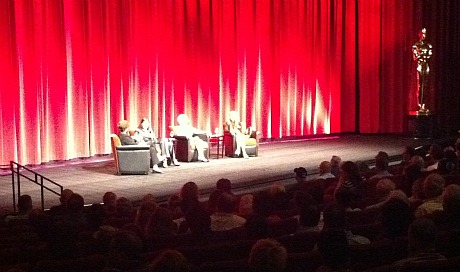
During last night’s post-screening q & a with moderator Anne Thompson, Thelma and Louise costar Geena Davis, screenwriter Callie Khouri and producer Mimi Polk.

Incidentally: There was no air-conditioning during the pre-screening dinner event, and the theatre itself had no circulating air either…until later during the film, when it finally seemed to kick in. It was pretty awful at first. The Academy fathers need to get someone to come in and make sure the a.c. is operational.