
Dead Flowers

Today’s first Palm Springs Film Festival screening was Zhang Yimou‘s The Flowers of War — a mistake all around. Set amid the chaos and brutality of the 1937 “Nanking massacre” by Japanese troops, it’s mostly a schmaltzy cornball thing with leaden dialogue and a truly atrocious performance by Christian Bale, who was apparently in some kind of leftover “Dickie” mood from The Fighter during filming.
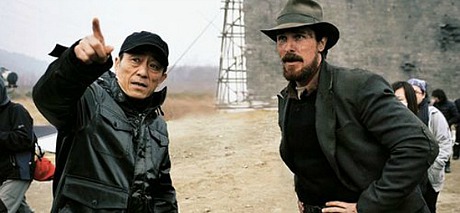

Flowers of War director Zhang Yimou, Christan Bale during filming.

Bale plays an asshole, you see. A bearded alcoholic low-life who’s somehow landed work as a funeral director in Nanking despite speaking no Chinese (a ridiculous conceit), and who winds up inside a walled-in religious sanctuary in Act One to hide out from the marauding Japanese troops. Once inside in the company of schoolgirls and prostitutes, his only thoughts are (a) to get paid for his burial services, (b) to find booze to get drunk on, (c) to smoke cigarettes and (d) to have sex with the prettiest prostitute.

He eventually dons the tunic of a dead priest, mans up and becomes a kind of hero, but I wanted Bale dead early on. I don’t know what went wrong between he and Yimou, but it appears that he improvised his way through this thing and Yimou said “Whatever, Christian…I trust you!” It might be the worst performance of Bale’s career.

Yes, agreed — Flowers of War has some reasonably good battle scenes, some of which resemble (but don’t match) the get-the-sniper sequence in Full Metal Jacket. But it’s a B-grade thing through and through, and I knew this early on. It’s a kind of whorey soap opera with occasional rape and battle sequences thrown in for excitement’s sake. After the first 40 minutes or so it’s torture.

The first thing I did when I escaped was e-mail a friend who had seen it last November. All he had told me is that it has some “rough” scenes involving rape and killings. “Why weren’t you honest with me about this thing?,” I asked. “All you said was that it was too brutal and violent here and there. Why didn’t you just say it basically sucks?”

“I gather you found it unsatisfactory,” he replied. “I’m driving out to the festival sometime tomorrow. We can have it out there.”

“‘Unsatisfactory’? It has a 33% disapproval rating on Rotten Tomatoes!”

The best capsule pan so far is from the Village Voice‘s Tim Grierson: “Human suffering reduced to visual showmanship.”
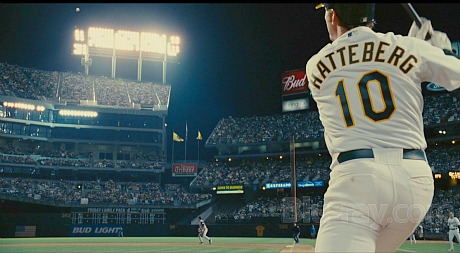

Sublime Greens and Yellows

Moneyball‘s 1080p transfer is another brilliant effort from Sony — flawless from top to bottom,” writes Bluray.com’s Martin Liebman. “The transfer delivers fantastic, deep blacks that remain true but abstain from crush, and colors are phenomenal and very well balanced. An opening scene of Beane sitting alone in a darkened stadium with the only light reflecting off the glossy stadium seats is marvelous.

“Whether the green grasses; the yellow and green A’s color scheme; or the many less brilliant but no less accomplished shades in every day objects around the office, in the clubhouse, or present on clothing, Sony’s transfer delivers a steady, handsome array of hues that are as natural as they would be in the real world.

“Likewise, flesh tones are consistent and accurate throughout, with no push towards an unnaturally warm shade. Clarity is unbeatable, which aids in the transfer’s ability to deliver stunning detailing. Clothing textures — notably mesh caps and the stitching on baseball uniforms — are phenomenal, while faces are intricately detailed and odds and ends around the frame in the ballpark, in the clubhouse, and elsewhere, sparkle. A rather heavy layer of grain only accentuates the transfer’s positives and enhances its welcome cinematic texture. The image is free of banding, blocking, and other eyesores.

Moneyball‘s transfer is everything that Bluray fans demand from a new release.”

Liebman worships the film in al the other departments, but let’s not get off-track.

Favors and Grudges

In a forcefully written, well-researched piece about “How Two Oscar Op-Eds Rocked the Academy Years Ago and Still Impact Campaigning Today,” Hollywood Reporter Oscar columnist Scott Feinberg argues that negative campaigning (whispered or otherwise) has no place, but personal endorsement campaigning is way too common to put a lid on.

“Why shouldn’t an Academy member be able to publicly express his or her affection for a film or performance like anyone else can?,” Feinberg asks. “And why shouldn’t a studio be permitted to quote them if they wish to?

“While endorsements might sometimes be used to call attention to big movies that already have a large following, they might also be used to call attention to little movies that do not, like Biutiful, a low-budget Spanish movie for which Javier Bardem wound up scoring a Best Actor Oscar nomination, in no small part because Julia Roberts promoted it to her friends.

“Does the Academy take issue with the behavior of members such as writer/director Paul Mazursky, a five-time Oscar nominee and member of their Board of Governors since 2006, who has been sharing his opinions about films and filmmakers as a film critic for Vanity Fair since November?

“Or Oscar-winning director James Cameron, the master of the 3D format, who recorded a video with Hugo director Martin Scorsese, apparently with the sole goal of publicly championing Scorsese’s entr√©e into the medium (;It was absolutely the best 3D photography that I’ve seen’)?

“Or Oscar-nominted actress Oprah Winfrey, who offered a big shout-out to The Help as she accepted the Jean Hersholt Humanitarian Award in front of all of the Academy brass at November’s Academy Governors Awards?

“Or the many who tweet their reactions to movies? Or the actors who participate in the annual ‘Actors on Actors’ feature that appears in Variety‘s SAG preview edition, for which the trade paper ‘invites thesps to applaud their colleagues’?”

One minor complaint: One of Feinberg’s “two oscar Op-Eds that rocked the Academy” is the infamous 2003 Robert Wise letter that praised Gangs of New York. It was written in part to refute the other legendary Op-Ed piece, an anti-Gangs, anti-Scorsese editorial written by screenwriter William Goldman. Feinberg reports that it was actually a “publicist” who wrote the letter for Wise. Feinberg chose not to name the author, but everyone knows it was Murray Weissman. I don’t want to pick at any scabs, but if you’re going to re-review the situation behind Wise’s Gangs letter you might as well state the facts.

Sidenote: Here’s a piece I did in late ’02 that compared the the infal theatrical release version of Gangs of New York with a 20-minute-longer version that came off Marty and Thelma Schoonmaker‘s Avid that dated back to October ’01 or thereabouts.

Straight Observation

In Drew McWeeny‘s 1.6 review of The Devil Inside, an early paragraph reads as follows:

“In the car, on the 101, all the way to Coldwater and then straight up. No traffic. The theater is a madhouse when I arrive at 11:30. People everywhere. And there was a definite demographic being served, too. I was the 1% tonight. Pretty much every other patron I saw in the eventually-sold-out auditorium tonight was Los Angeles Latino, and if nothing else, at least I saw the movie with a crowd that came ready to enjoy it.”

This is just straight reporting. McWeeny came, he saw, he wrote it down. But I got beat up pretty badly a few weeks ago when I wrote a somewhat similar paragraph, to wit:

“Early this evening a young Latino couple was looking at the digital lobby board inside Hollywood’s Arclight plex. The guy walked forward, got into line and turned to the girl. ‘You wanna comedy? Or…what, action? A comedy?’ The girl half-shrugged, seemed a bit bored. ‘I dunno…whatever,’ she said. He shrugged also, turned back to the board. Those clayheads, I thought to myself. Forget glancing at Rotten Tomatoes. Forget wanting to see The Immortals or Breaking Dawn. They hadn’t even talked about the kind of film they might want to see. Empty Coke bottles.”

The difference is that McWeeny’s report implies a certain judgment while I was blatant about mine.

He reported that an almost-all-Latino crowd had come out in droves to see an astonishingly bad exorcism film because they’re invested in Catholic dogma — an act that indicates (to put it charitably) a lack of aesthetic discernment on their part, or at the least an indifference to choosing wisely or smartly. I reported that a Latino couple couldn’t have been less engaged or more thoughtless in their choice of a film to see at the Arclight. If I had described them as “Swedish” or “Australian” nobody would have said boo, or if I’d just called them “a young couple.” But using the adjective “Latino” made me a racist, in the view of some. Forget honest observation. The p.c. brownshirts have only one agenda.

Wakey Wakey

I was so rushed and scattered as I left yesterday for Palm Springs that I forgot to take my Canon Powershot. I take it with me when I go to the market so this makes no sense. The iPhone 4S has an excellent camera, at least, so that’ll have to do.


From the balcony outside room #275 at the Palm Springs Travelodge on East Palm Canyon Drive — Friday, 1.6, 6:25 am.

BAFTA Longlist

I sighed this morning as I scanned the BAFTA longlist. I don’t want to do this any more, I muttered. I understand and respect the award-season process, but I’m feeling dismayed and uninspired. I don’t want it to end — I can roll with it, and am fine with seeing it to the end — but I’d much rather jump into 2012 and experience the new. I thought 2011 was a stirring year for the most part, but I’m mainly feeling like a sore loser because the “wrong” films are at the top of too many lists.

Yes, I say roughly the same thing every year just before Sundance, but it’s different this year. Last year I had a dog in the fight (i.e., The Social Network). An awful feeling in the pit of my stomach told me that The King’s Speech was gaining the upper hand as of mid December 2010, but at least there was anger about that. This year only one of “my” films — i.e., The Descendants — has even an outside chance of winning Best Picture. Mostly there’s a feeling of resignation about the likely Best Picture triumph of this or that mediocrity. I don’t have to name them. I’m tired of doing even that.

Nothing depresses me as much as Variety‘s Jeff Sneider and others telling me that The Artist‘s Jean Dujardin is a more likely Best Actor winner than Brad Pitt or George Clooney . I just want to step in front of a moving bus when I hear that.

Two Approvals

“I saw both Haywire and The Grey yesterday,” a New York-based critic wrote this morning. “Haywire (1.20) knocked me out — lean, stripped-down, intelligent and exciting. And The Grey (1.27) surprised me for being as harrowing as a Jack London story. There’s a formula at work, for sure, but there’s also surprising depth to the characters. If you think this is another paycheck movie for Liam Neeson, think again — if only because the conditions look so brutal.”

Defining Social Harm

Republican bigot Rick Santorum spoke last night to youthful pro-gay questioners in New Hampshire about “decent rational thought” in regard to differing notions of personal domestic happiness, but he was essentially talking about his own fundamental repulsion regarding gay relationships.

Unpopular Endings, Okay…But With Integrity

The universal consensus is that William Brent Bell‘s The Devil Inside (Paramount, opening today) not only stinks, but delivers one of the most contemptibly awful endings of all time — cheap, stupid, audience-insulting.

“I can’t remember any time in my career as a movie critic when the crowd around me, winners of free tickets to see the movie before it was released, all started to boo,” writes Willie Waffle. “The ending for The Devil Inside was so bad and people were jeering so loudly you would have thought Mel Gibson just walked into the synagogue on Saturday.”

The Devil Inside is an insidious kind of terrible movie, a movie that is simply low-grade bad for most of its thankfully brief running time before offering up an ending so openly contemptuous of the audience as to feel like a prank,” writes Hitfix‘s Drew McWeeny.

“You can blame Satan for a lot of bad things, but not The Devil Inside,” writes Toronto Star critic Peter Howell.

It’s the spitting-on-the-audience aspect that seems to have hit the biggest nerve. This raises a question: what movies have ended “badly” (i.e., in ways that audiences have generally condemned) but which at least had integrity? They may have pissed people off but made some kind of thematic or artistic sense.

One of the most unpopular endings along these lines was the ending of Alfred Hitchcock‘s The Birds. I remember hearing about audiences groaning and howling when they realized that the final shot — a static view of Rod Taylor‘s green sports car driving into the hazy distance while thousands of birds sat around, waiting for the next impulse to attack — was the final shot. I get what 1963 audiences were pissed about, but from my 2012 perspective this might have been the coolest and most haunting ending of a Hitchcock movie ever.

What other films qualify in this regard? Deeply unpopular with Joe Popcorn, but on one level or another deserving of respect.