Zombie Cat

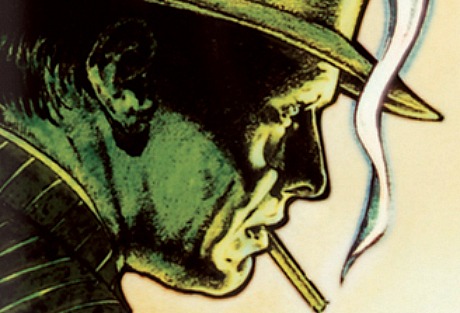
I happened to glance earlier today at a blowup of jacket art for Paramount Home Video’s forthcoming Chinatown Bluray, and for the first time in my life I noticed that the artist gave Jack Nicholson‘s J.J. Gittes the face of a zombie. Look at those ice-cold cat eyes. He could be an alien looking to feast on flesh. All the artist had to do was insert dark green where Nicholson’s pupils are, but he deliberately went for a night-vision predator look. I’ll never be able to look at this famous image the same way again.

The Bluray’s principal commentary track sounds like a humdinger — Chinatown screenwriter Robert Towne and director David Fincher.

Spirit Awards BOA Luncheon

Film Independent, the non-profit arts organization that produces the Spirit Awards and the Los Angeles Film Festival, announced the winners of its four Spirit Awards filmmaker grants earlier today at its annual Spirit Awards Nominee Brunch held at BOA Steakhouse in West Hollywood. What does BOA stand for? Nobody knows. Best guesses: “Best of Argentina” or the initials of the restaurant chain’s secret owner whose name could be “Benicio Oscar Alvarez.”


Focus Features’ James Schamus, who at this very moment was reminding myself, Deadline‘s Pete Hammond and In Contention‘s Kris Tapley that there’s a major romantic triangle at the core of Tinker Tailor Solider Spy — Gary Oldman’s Smiley, Smiley’s wife Anne and Karla, who has urged the “mole” to have an affair with Anne in order to misdirect Smiley’s attentions.

Artist helmer Michel Hazanavicius, the presumptive winner of the 2012 Best Director Oscar, at today’s Spirit Awards event, whom interviewed in Manhattan a little more than three months ago.

Mark Duplass (whose performance I recently enjoyed in Larry Kasdan‘s Darling Companion) and Sarah Paulson hosted the event and handed out the honors.


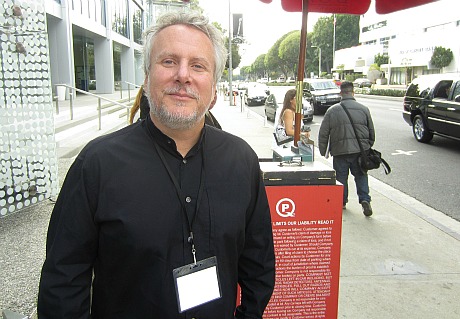
Director-screenwriter Larry Karaszewksi, who on Thursday, 1.19, will be hosting an American Cinematheque screening of Frank Perry’s Last Summer, with Barbara Hershey dropping by for a post-screening q & a.

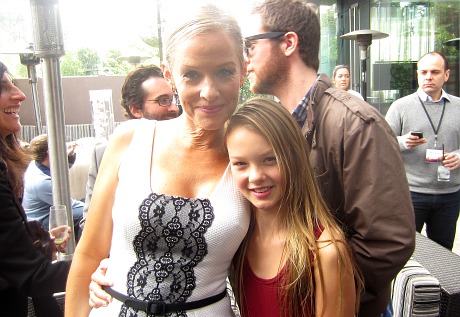
The Artist costar Penelope Ann Miller, her 11 year-old daughter Eloisa May. I know this shot would be bad and that I should have activated the flash to compensate for the overhead sunlight, but I didn’t. I slacked off and look what happened. Entirely my fault and not cool. Apologies.

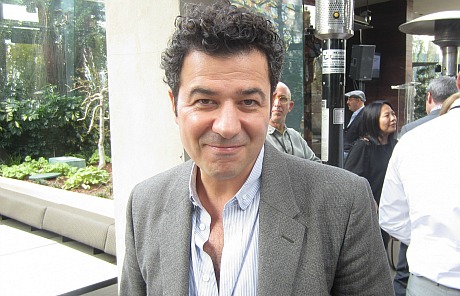
Artist composer Ludovic Bource, who composed a good 90 minutes worth of original music vs. the six minutes of Bernard Herrmann music that Kim Novak was so pissed off about.

Winners for the remaining categories will be revealed at the 2012 Film Independent Spirit Awards, which Seth Rogen will serve as emcee. The event will happen under the big white tent on a parking lot at the beach in Santa Monica on Saturday, 2.25.12. The awards ceremony will premiere later that evening at 10:00 p.m. ET/PT on IFC.

Paramount Globes Bash

I was hoping to get Paramount chairman and CEO Brad Grey‘s attention at last night’s Golden Globes party on the Paramount lot. I wanted to shake his hand and say “thanks” for approving funding for the Shane Bluray, which, as I reported the other day, is about two-thirds of the way through to completion. But I wasn’t aggressive enough. It’s a push-push-push world out there, and you can’t just enjoy the vibe and talk to friends if you want to get things done. You have to be Johnny-on-the-spot.

The best line of the evening was from The Hollywood Reporter‘s Kim Masters, who was watching Grey and his homies as they sat on a couple of couches and chit-chatted. And then suddenly they all got up and left “as one,” Masters said. A group doing things in unison is standard corporate behavior if a Top Dog is among them. He/she gestures every so slightly, and everyone in his/her peer group instantly “apes” this gesture in order to show obeisance.

I’m not judging this or being in any way snide here. I’m just as ready to follow or imitate the behavior of those who are more powerful than I and whose favor I curry as much as anyone else. As evidenced by my 11.13 food court post, I understand and concur with jungle law.


I was loving the lighting at this event. Kevin Costner was there, and I was told Jack Nicholson showed up also but I didn’t personally see him.

Osage Is Okay But…

So my 12.23 post about the Weinstein Co.’s planned adaptation of Tracy LettsAugust Osage County possibly being in limbo with presumed costars Meryl Streep and Julia Roberts having flown the coop does not reflect how things really are, I’m pleased to report.

Deadline‘s Pete Hammond wrote a day or so ago that “the Weinstein Company’s David Glasser [says that] the long-awaited screen version of August, Osage County should be getting underway around September as both Streep’s and Roberts’ schedules seem to be clearing for then. John Wells is going to direct and Glasser said the script by playwright Tracy Letts is fantastic. Another Weinstein Oscar contender for 2013?”

So a 2007 play is going to finally hit screens in 2013…maybe. But a little voice is telling me that the Weinsteiners might have waited too long.

Because of the delicate and always volatile shifting of the zeitgeist and the general reordering of things that happens on a continuing cosmic basis, the right kind of film adaptation of a Broadway play always hits screens within three to four years (like Mike Nichols‘ 1966 Who’s Afraid of Virginia Wolff arriving four years after the original Broadway play). If the movie version arrives five or six or seven years later something is always lost on some vague level. The things in the cultural ether that led to the writing of the original play have dissipated and floated away like pollen, or have otherwise been transformed.

I was sitting in an an orchestra seat on opening night of the 1984 Broadway production of David Mamet‘s Glengarry Glen Ross, and I can tell you it was electric and vital as blood — a play about rapacious greed just as the Reagan era Wall Street boom was kicking in. It had no fucking steak knives and it was fucking perfect. But the Al Pacino-Jack Lemmon-Alec Baldwin movie adaptation didn’t come out until 1992, at the dawn of the Clinton era. It’s a fairly good film and will always be an excellent play, but too many years had passed. The sands had shifted and it just wasn’t the same. You should’ve been there with me for that 1984 Glengarry debut. People were levitating out of their seats.

Regettable Omission

I’ve never forgotten a quote that Moneyball star Brad Pitt gave to the L.A. Times last May (and which reporter Steven Zeitchik referenced in a 9.9.11 article), to wit: “I think the making of [Moneyball] is just as interesting as the movie itself.”

He was referring to the project’s prolonged and at times traumatic development, beginning with the purchasing of the rights to Michael Lewis’s book in 2003 by producer Rachael Horovitz to the shooting that finally happened seven years later under director Bennett Miller. But Pitt was mainly alluding, surely, to Sony’s June 2009 decision to abruptly pull the plug on a somewhat different version of Moneyball that Steven Soderbergh was about to direct, and how the project had to assemble all over again with Scott Rudin producing and Aaron Sorkin rewriting versions by the previously hired Steve Zallian (and then vice versa), and then Miller pulling it all together.

It’s always been a complex and challenging task to assemble a first-rate film, and some productions are more arduous or volatile than others but that’s what make a good “making of” story, right? Moneyball wasn’t easy and at times the creative principals didn’t know if it would come together or fall apart, but the various components finally kicked in and now everyone’s really proud of how it turned out, etc.

But you’d never know this angle from watching the “making of” documentary on the Moneyball Bluray, which I finally took a look at a couple of days ago. There’s no mention of Soderbergh’s name or input whatsoever — he’s the Man Who Never Was. And on some level I’m scratching my head about that.

I totally understood why no one wanted to talk about the Soderbergh chapter when Moneyball opened last fall. They wanted to sell the film they’d made and not get into the film that might have been but never was…fine. But “making of” docs on a Bluray/DVD are for posterity and history to a certain extent, and it seems strange that the Bluray Moneyball doc doesn’t just ease up and relax and just say “okay, this is how it happened…Soderbergh was on this project for a while and it didn’t pan out but he’s okay and we’re okay and everything probably turned out for the best. But it’s an interesting story.”

For all I know Soderbergh’s attorney might have told Sony that he doesn’t want his client’s involvement in Moneyball to be mentioned in the doc because it might make him look bad on some level…who knows? I just know it feels weird and incomplete to try and tell the story of the film’s production and not even mention the Soderbergh chapter.

I’ve heard that if the real story of how Moneyball came together was to be told in a documentary (or in an Indecent Exposure or Final Cut-type book) that it would be a good deal more than something “just as interesting as the movie,” as Pitt says. It would be, one insider says, “something you could go to school on…a case study in the Bonfire of the Vanities…something that only Eugene Ionesco or Paddy Chayefsky could do justice to.”

“Oh, Dear…Dear God”

From an 8.18.11 post: “Truly primal laughter is never about any one event or mishap or whatever. It’s usually about the release of tension and frustration, and it’s completely unsuppressable if you feel you’re exposing some careless, thoughtless or callous part of yourself.”

This out-take is from the Moneyball Bluray, which I received a couple of days ago.

Read more

Arkansas Redemption

My first impression from this trailer is that Peter Jackson and director Amy Berg‘s West of Memphis, a doc that will screen at Sundance 2012, is slicker and artier looking than Joe Berlinger and Bruce Sinofsky‘s three docs on the exact same Arkansas-murder-case subject. Which indicates than West of Memphis has more money behind it. Which isn’t surprising with Jackson producing.

Berlinger and Sinofsky docs are titled Paradise Lost: The Murders at Robin Hood Hills (’96), Paradise Lost 2: Revelations (’00) and Paradise Lost 3: Purgatory (playing this month on HBO). They’re all about the wrongly convicted Damien Echols, Jason Baldwin and Jessie Misskelley Jr., a.k.a., the “West Memphis Three”, who were convicted of the 1994 murders of three 8-year-old boys in West Memphis, Arkansas.

Unshaven, Hard-Boiled

In France it was once called MS ONE: Maximum Security. It was also called Lockout at one time or another. But now this Luc Besson-y sci-fi machismo thriller is called Escape From M.S. One…I guess. Does anyone have a favorite? Open Road is releasing it stateside in mid-April. “A man (Guy Pearce) wrongly convicted of espionage is offered his freedom if he can rescue the president’s daughter (Maggie Grace) from an outer space prison taken over by violent inmates”…thud.

Read more

Stab Me With A Sewing Needle

You can sense the less-than-full-throttle energy levels in the opening moments of Kris Tapley and Anne Thompson‘s latest Oscar Talk podcast. It’s the faint aroma of lethargy and “the fix is in” boredom of the Oscar season made vocal. Don’t we all feel this? “The favorite is clearly The Artist…I don’t even remember what the nominees for the Golden Globes are”…zzzz.

Tapley says he hears that A Separation “might not even get nominated” by the Oscar committee. WHAT?

Didn’t Know Nothin’

I was in Telluride four and a half months ago, and here’s what I wrote: “Rank-and-file festivalgoers are creaming over The Artist…every Telluride viewer I’ve spoken to loves it…and I think it’s just a clever, assured, highly diverting curio — a tribute to the lore of black-and-white silent cinema and the divergent-Hollywood-career plot used by Singin’ in the Rain and A Star Is Born.

“And women of all shapes and sizes and social classes love The Help, and we all know the name of that tune.

“So what am I to do? Do a flip-flop and say I was wrong but now I’ve seen the light? Twist my neck 180 degrees like Linda Blair in The Exorcist?

“I don’t think so. I know precisely how good these films are, and they’re both con jobs. They aren’t Illuminating Truth-Tellers. They aren’t addressing the deep bedrock stuff. They’re highly accomplished entertainments, but don’t tell me they’re serious Best Picture contenders. Neither one dramatizes or illuminates some aspect of our common experience all that primally or skillfully or meaningfully.

“They’re about their own realms and realities — the racist South of the early ’60s, the movie business in the late 1920s. You come out the theatre saying, ‘Well, that was good but it wasn’t about any place I live in…later.’

“If they become Best Picture nominees, fine. If Hollywood Elsewhere gets to run ads supporting these films, great. And if one of them wins….naah, won’t happen.”

Wrong!