Worry Bomb From Harvard

Ben Zauzmer is a Harvard freshman interested in movies and math, and the creator of Oscarforecast, which presents Oscar predictions based solely on rigorous and dispassionate mathematical analysis. Ben’s calculations include “previous Oscar results, other awards shows, current nominations, critic scores, and guild awards,” he explains. “All of these numbers — over 5,000 data points! — were plugged into a bit of matrix algebra.”


Ben Zauzmer

And his system is predicting a Meryl Streep win for Best Actress. By a nosehair (0.7%), but still…Viola Davis gets the shaft? Everyone was sensing the closeness of this race, but I thought everything shifted in Davis’s favor two or three weeks ago. I’m not sure I buy it (or if anyone will), but Davis’s supporters now have a little something to fret about.

Ben ducked out of four categories (Best Makeup, Best Doc Short Subject, Best Animated Short, Best Live Action Short), because, he says, “there wasn’t enough data or indicators to create a reliable percentage score for each movie.”

In any event, here’s his rundown.

Again

“We need to stop glorifying the past and learn how to change for the future, and no film from last year — nominated for Best Picture or not — does that better than Moneyball,” writes Cinemablend’s Eric Eisenberg. “No movie released in 2011 better represents the era in which we are living, and the magnitude of that fact is why Bennett Miller‘s baseball drama should take home the Best Picture prize at this year’s Academy Awards.

“At the end of Moneyball, Billy Beane (Brad Pitt) takes a meeting with John W. Henry, the owner of the Boston Red Sox, who offers the A’s manager a $12.5 million salary to run Boston’s organization. During their conversation, Henry (Arliss Howard), dispenses this bit of wisdom:

“The first guy through the wall…he always gets bloody…always. This is threatening not just a way of doing business…but in their minds, it’s threatening the game. Really what it’s threatening is their livelihood, their jobs. It’s threatening the way they do things…and every time that happens, whether it’s the government, a way of doing business, whatever, the people who are holding the reins – they have their hands on the switch – they go batshit crazy.”

“We, as a nation, are covered in blood. In the last three years we have seen health care reform that could eventually help us reach the standards set by other first-world nations, troop withdrawal from Iraq, and economic reform that has seen the unemployment rate finally start to drop. And every change has been met with debate, dispute, denunciations, and disparagement.

“But then you have the 2004 Red Sox. Embracing the methodology propagated by Beane, the organization won its first championship in 86 years. Change turned into triumph, and that social message is displayed perfectly in Moneyball. And that not only deserves to be celebrated, but needs to be rewarded.”

Perspective

“I am willing to bet that a huge number of [Academy Award] ballots are cast for pictures and performances purely on hearsay. That is why pictures that make money are preferred to pictures that make history. Industry people have to see the money makers for instruction in ‘new trends.’ Mere merit is no particular inducement.” — A 1970s quote from esteemed film critic Andrew Sarris, as quoted by Paste Magazine‘s Braxton Pope in a 2.22 Oscar assessment piece.

Forgotten Sword-Fight Flick

The cheesy Ranker.com sent me a piece called “The Top 7 Manliest Sword-fights on Film.” Before even looking at it, I made a bet with myself that they wouldn’t include any of the sword fights in Ridley Scott‘s The Duellist (’77). And of course, they haven’t. Either they’ve never seen it, or they don’t think Scott’s duels are adrenalized enough. In my book The Duellists is on par with Barry Lyndon.

Move The Eff On

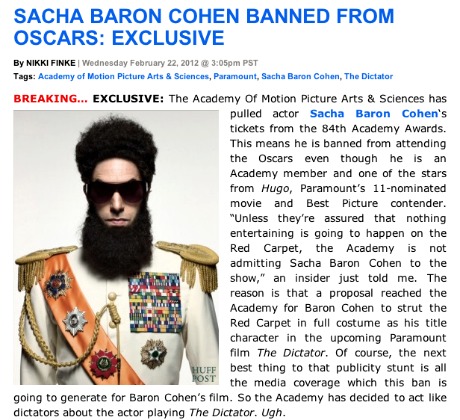
This is not what concerns Mr. and Mrs. America and all the ships at sea about Sacha Baron Cohen. The issue is that he’s played out his string as a put-on absurdist who goes all outlandish and orifrice-y with unsuspecting chumps, etc. It peaked with Borat, began winding down with Bruno and now it’s over with the upcoming The Dictator. (The trailer suggests it’s more of the same.) It’s been 18 months since the Freddy Mercury project was announced — what’s up with that?

Timing

This would have been funny (or at least funnier) if it had been posted three weeks ago, or just after Jean Dujardin won the 2012 SAG award for Best Actor. But today even grandmothers living in assisted living facilities in Southbury, Connecticut know Clooney won’t win so where’s the edge? Plus the pool guy (i.e, Gold Derby‘s Matt Noble) should have been more dry and reserved while delivering the bad news.

Offensive?

The point of displaying a corpse in a church or funeral home is to soothe the bereaved by conveying an impression that the deceased is (a) sleeping peacefully and (b) well groomed and well taken care of, not just in this realm but perhaps in the one beyond. It’s a ritual meant to allay fears about death. It can be jarring to look at a loved one lying in a casket, obviously, but it also brings mourners to an acceptance of what’s happened.

So if the point of displaying a body is to help the living cope with the inevitable, what’s so ghastly about a photo of a deceased celebrity in a casket being circulated to the general public, which obviously includes thousands of stricken fans? Is this an exclusivity thing? As in “it’s totally cool for people invited to the private memorial service in Newark to contemplate the physical remains of the departed for the last time, but it’s not cool and in fact tasteless and revolting for tens of thousands who bought the celebrity’s music over the past 20-odd years to be given a glimpse of same”?

We all know what the National Enquirer was up to in publishing this photo, but there’s nothing inherently terrible about it being shown and seen. People want to see proof of the finality of things, to irrevocably face the fact that a person’s life has ended. There was the Elvis Presley casket photo, the John Lennon lying-on-a-hospital gurney photo, the JFK autopsy photos, etc.

Incidentally: Kevin Costner‘s eulogy for Whitney Houston was touching and quite eloquent. But there was one passage at the end that made me go “whoa.” Costner refererred to “all the young girls who are dreaming that dream” of performing and fame, and said “I think Whitney would tell you [to] guard your bodies and guard the precious miracle of your own life, and then sing your hearts out.” Costner surely intended irony. And yet the sincere tone with which he delivered these words didn’t convey this. Not to me, at least.

John Carter Must Die

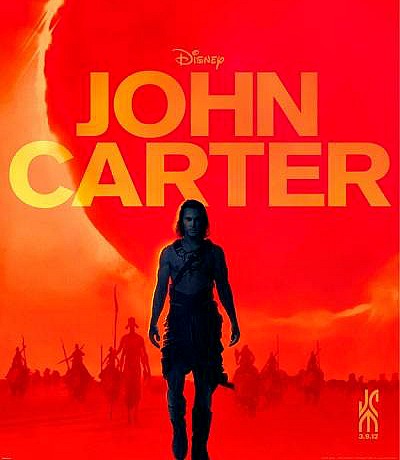
In the wake of Nikki Finke‘s 2.16 article about “shockingly soft” tracking for Disney’s John Carter (3.9), The Daily Beast‘s Chris Lee has written a hit piece (“John Carter: Disney’s Quarter-Billion-Dollar Movie Fiasco“, 2.21) that focuses on possible repercussions if and when the $250 million Carter does indeed tank.

Lee mainly foresees trouble for Disney chairman Rich Ross, even though he states that Carter “is a problem [Ross] inherited from his predecessor” — i.e., former Disney honcho Dick Cook — “and that has provided him a certain level of insulation from the slings of his detractors.”

Lee’s recounts the bizarre thinking on Cook’s part when he approved the hiring of Finding Nemo and Wall-E director Andrew Stanton to helm a monstrously expensive Avatar-like fantasy adventure without stars. “Unless you’re Peter Jackson or Jim Cameron, it’s unheard of,” a rival studio exec tells Lee.

But the biggest forehead-slapper was the decision by Disney marketers to remove “of Mars” from the title. I understand the thinking that one needn’t show loyalty to Edgar Rice Burrough‘s John Carter of Mars, which began as a magazine serial in 1912. But why make a film set on Mars if you’re afraid to use the words “of Mars” in the title? How wimpy can you get?

“Although the character has been known as ‘John Carter of Mars’ and was envisioned as a movie trilogy under that name, Disney marketers dropped the ‘of Mars’ part because of industry-think holding that female movie fans are more likely to be turned off by such overtly sci-fi elements,” Lee writes. “And after the big-budget failure of last year’s Cowboys & Aliens seemingly confirmed that modern audiences are uninterested in Westerns — or, by extension, vintage Americana — Carter’s Civil War connection has been all but excised from the marketing.

“‘You take out ‘of Mars,’ you don’t tell where he came from? That’s what makes it unique!’ a former Disney executive is quoted as saying. ‘They choose to ignore that, and the whole campaign ends up meaning nothing. It’s boiled down to something no one wants to see.”

“After seeing several John Carter trailers, a rival studio executive agreed. ‘You don’t know what it is,’ the source said. ‘The geek generation isn’t responding. It’s too weird for the family audience. Then it has the Disney brand and PG-13? I’m not sure who it’s for.'”

The best that can be hoped for, it seems, is that John Carter will become the Heaven’s Gate of sci-fi actioners. No, not the most ruinously expensive and financially disastrous film of this genre, but the most ruinously expensive or financially disastrous film of this genre that will eventually a become a cult favorite, as Heaven’s Gate has gradually managed to become with the help of guys like F.X. Feeney.

John Carter‘s principal photography went from January to July 2010, so it’s been in post-production for 20 months, which might as well be two years.

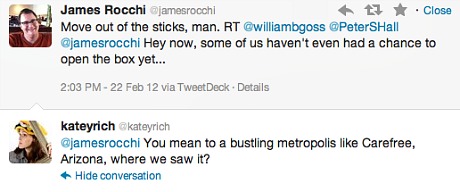
And there’s still no spillage from the John Carter junketeers who recently basked in the Arizona sun on Disney’s dime. A John Carter fansite found some tweets that indicated positive reactions. Here’s another tweet-based summary that suggests positive responses to come.