Evening with Bernie

If a film says something about human nature that’s widely recognized as true, that film will find an audience. Richard Linklater‘s Bernie, a dark small-town comedy that is tight and clean and well-sculpted, is such a film. It says that feelings and likability rule, that Americans trust beliefs more than facts, and that we’re governed less by laws than emotions. Bernie is based a true story. My review will be up sometime tomorrow.


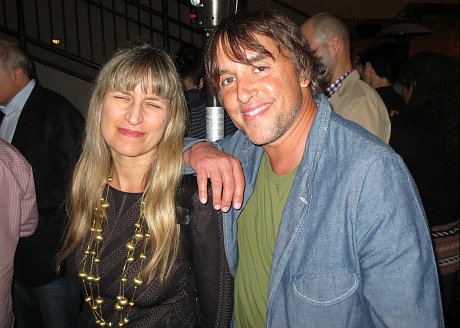
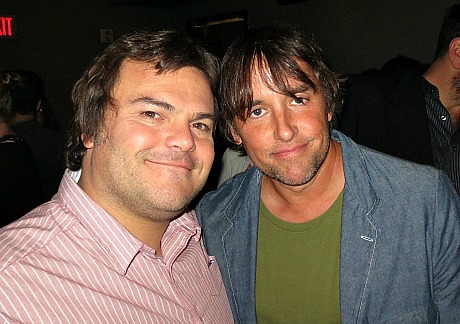
Bernie star Jack Black, director-writer Richard Linklater at Wednesday night’s after-party at Wood and Vine, on Hollywood Blvd. just east of Vine. Black said I look like Jimmy Page. “Naah, Chris Walken,” I said. “Page has the white hair and all.”

Twilight director Catherine Hardwicke, Linklater at Wood and Vine.

“Women, Money and a Good Time”

If Steven Soderbergh wasn’t the director and dp of Magic Mike, I would be wary. But because it’s a Sodergeek film, I know it’s going to be good. Based on Channing Tatum‘s experience as a stripper, etc. I’ve watched videos of male strippers performing before a roomful of women on YouPorn, and I suspect that Sodbergh, who’s never been and never will be Radley Metzger, is going to hold back on what really happens.

South Texas Cornish

I can’t make the Tribeca Film Festival this year, sorry, but I’d love to somehow see David Riker‘s The Girl, which features the always pronounced and out-there Abbie Cornish giving what Deadline‘s Pete Hammond is describing as “her most challenging performance to date and the real selling point of the film.”

“With Strategy PR firm (led by Oscar maven Cynthia Swartz) behind them,” the Girl producers “are hoping to make a big impact with a small film, get a good distributor and set up a late fall release that would also include an Oscar campaign for Cornish,” Hammond writes. “The story revolves around the plight of a single South Texas mother who has lost her son to Social Services and winds up trying to make some easy money smuggling Mexican immigrants across the border. The plan goes awry and she finds herself stuck with a young girl separated from her mother in the disastrous crossing.”

Hitchhop

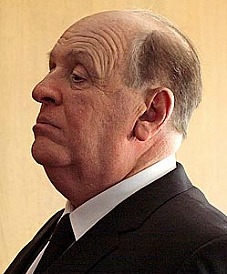
Early this afternoon People‘s Stephen M. Silverman delivered the first-anywhere image of Anthony Hopkins as Alfred Hitchcock from the currently shooting Hitchcock, which used to be titled “Alfred Hitchcock and the Making of Psycho” when I read the script…what, four or five years ago?


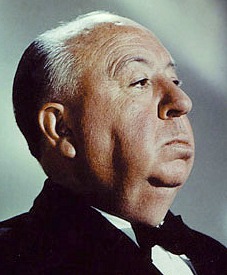
Anthony Hopkins (r.) as Alfred Hitchcock (l.). I’ve already spotted a problem — Hitch’s hair grew only on the sides but it was thicker and clearly longer than Hopkins’ hair, which is quite thin and too closely cropped. Why do they let this stuff happen? How hard can it be to match hairstyles?

Hitchcock began shooting late last week under director Sacha Gervasi (Anvil!). It costars Helen Mirren as Alma Reville, Scarlett Johansson as Janet Leigh (bad casting), Jessica Biel as era Miles and James D’Arcy as Anthony Perkins.

The credited screenwriters are John J. McLaughlin and Stephen Rebello. Rebello’s 1999 book is the seed of the thing.

More Snobbery

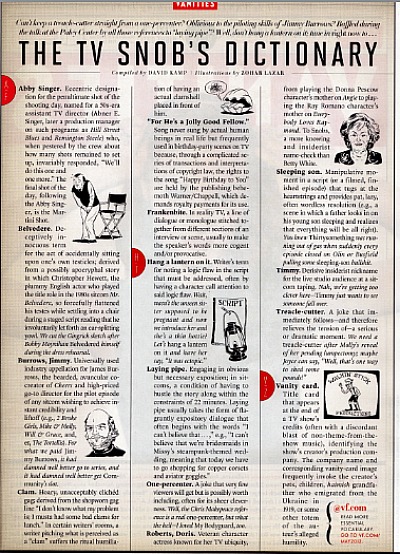
For the last seven years of so I’ve been a huge fan of the Snob dictionary books (film, rock music, food, wine) that David Kamp and collaborators have written. There’s a new one excerpted in the current Vanity Fair called “The TV Snob’s Dictionary.” A tip of the hat to Zohar Lazar‘s illustrations.

Like the previous Snob books, the latest is exquisitely written. Every sentence is a Hope diamond, chiseled and honed and phrased to perfection with just the right seasoning of know-it-all attitude.

My favorite passage from the Film Snob Dictionary: “The Film Snob’s stance is one of proprietary knowingness — the pleasure he takes in movies derives not only from the sensory experience of watching them, but also from knowing more about them than you do, and from zealously guarding this knowledge. The Film Snob fairly revels, in fact, in the notion that The Public Is Stupid and Ineducable, which is what sets him apart from the more benevolent Film Buff — the effervescent, Scorsese-style enthusiast who delights in introducing novitiates to The Bicycle Thief and Powell-Pressburger films.”

Adieu, Mr. Bandstand

American Bandstand host and rock music-promoting smoothie Dick Clark has left the earth. He died earlier today of a heart attack at age 82. Clark’s peak influence period was from the mid ’50s to early ’60s. In Eisenhower-era America early rock music (i.e., “Hound Dog” Elvis, Little Richard, Jerry Lee Lewis, etc.) had a slightly racy and raunchy vibe. Clark came along and basically sold watered-down rock to middle-class America (kids, parents, advertisers) by making it seem safe and unthreatening. Which wasn’t hard.

Clark’s hottest period, then, was the late ’50s to pre-British Invasion early ’60s when pop and early Motown and “wop rock” and teen bubblegum tunes ran the hit parade — Ricky Nelson, Fabian, Danny and the Juniors, Frankie Avalon, Dion and the Belmonts, the Four Seasons, etc.

Clark loved ’50s and ’60s music, for sure, but he was first and foremost (in my eyes, at least) a hustler and a businessman whose eye was always on the dollar. I mean, the man’s name was all but synonymous with Beech-nut spearmint gum and the term “flavorific.” Beech-nut spearmint gum, Beech-nut spearmint gum, Beech-nut spearmint gum, Beech-nut spearmint gum, Beech-nut spearmint gum, Beech-nut spearmint gum…until they’re repeating it in their sleep and it’s coming out of their ears. Hammer it, hammer it!

Clark was always so handsome and young-looking and constantly active — the very model of a guy who seemed to live right, eat right, always stay trim and never age that much. But sooner or later the natural process starts weakening and taking you down and then your number comes up and that’s it.

Refresher

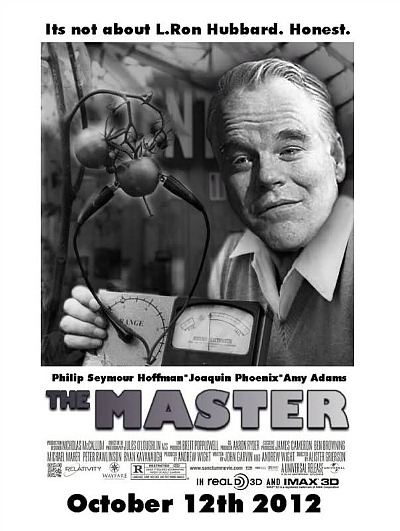
Michael Cieply has tapped out a 4.18 N.Y. Times article (which will appear in Sunday’s print edition) about Paul Thomas Anderson‘s The Master (Weinstein Co., 10.12). The piece is titled “Filmmaker’s Newest Work Is About…Something” and is subtitled “Paul Thomas Anderson Film May Be About Scientology.” The basic “tell” is that PTA’s film is partly about a figure who could be L. Ron Hubbard (played by Phillip Seymour Hoffman) and is largely about the beginnings of Scientology, at least in broad historical spitball terms.

So the article, no offense, doesn’t exactly advance the narrative since people have been batting around the Scientology connection angle for quite some time.

Anderson wouldn’t talk to Cieply but Cieply spoke to a Scientology spokesperson, and he quotes from a short piece I wrote last September when I spoke to Hoffman at a party for The Ides of March. Plus the article has some cool black-and-white location photos of actors hired to perform in a period scene from the film.

Key passage #1: “Anderson has declined to speak publicly about the movie…but the details suggest a story inspired by the founding of Scientology, and that has provoked industry whispers. With that church’s complicated Hollywood ties and high-profile adherents like Tom Cruise, a film even loosely based on it will guarantee discussion upon its release.”

Key passage #2: “With The Master Mr. Anderson will tell a dual tale. The first is that of a boozy Navy veteran, played by Joacquin Phoenix, who shares what Mr. Anderson’s associates say are accidental similarities with the filmmaker’s father, who died in 1997. The elder Anderson was a Navy vet who served in the Pacific during World War II, and, like [Pheonix’s character], was born about 90 years ago.

“The second story is that of Lancaster Dodd, who is eerily referred to in a screenplay Mr. Anderson initially wrote for Universal Pictures only as ‘The Master’ or ‘Master of Ceremonies.’ Played by Mr. Hoffman, he is the red-haired, round-faced, charismatic founder of that most Californian of phenomena, a psychologically sophisticated, and manipulative, cult.

“Dodd was inspired by — though not entirely modeled on — Scientology’s L. Ron Hubbard,” Cieply writes.

Here’s what I wrote about my chat with Hoffman last September:

“At last night’s Ides of March party Phillip Seymour Hoffman — a.k.a. ‘Philly’ — insisted that Paul Thomas Anderson’s The Master, which he just finished filming, is ‘not a Scientology film.’ But I’ve read an early draft and it seems to be about a Scientology-like cult, I said to him. And I’ve read about the parallels. “I don’t know what you’ve heard and what script you’ve read,” Hoffman replied. “Trust me, it’s not about Scientology.”

“Maybe not specifically or literally, but there are just too many proofs and indications that The Master (or whatever it’s eventually going to be called) is at least about a cult with a charismatic L. Ron Hubbard-type leader that could be seen as a metaphor for Scientology. At least that.”

Long Haul

There’s a 4.18 Variety story from Nick Vivarelli in Rome about a new “redux” version of Sergio Leone‘s Once Upon A Time in America (’84) that will screen next month in Cannes. Halfway through the piece is the following: “Redux adds 40 minutes of original footage to the 229-minute running time.” In other words, it will run 269 minutes, or a minute shy of four and a half hours.

So why didn’t Vivarelli or his editors simply say that? Declaring that Once Upon A Time Redux adds 40 minutes of footage to the 229-minute running time is like describing the 44 year-old Judd Apatow as a guy who’s kept a grip on mortality for 12 years since turning 32.

No journalist covering Cannes 2012 is going to sit through a 269-minute time machine zone-out…nobody except for fringe Leone fanatics and sentimentalists who go to older films to weep about their lost youth. There’s too much to cover at Cannes and too little time as it is. That said, I would love to see the Redux version some other time. Maybe it’ll play at the American Cinematheque or LACMA later this year.

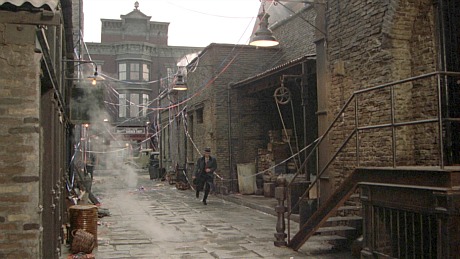
Excerpts from OUATIA‘s Wikipage: (a) “The original shooting-script, completed in October 1981 after many delays and a writers’ strike that happened between April and July of that year, was 317 pages in length” (b) “At the end of filming, Leone had about 8 to 10 hours‘ worth of footage. With his editor, Nino Baragli, Leone trimmed this down to about almost 6 hours, and he originally wanted to release the film in two movies with three-hour parts” (c) “The producers refused (partly due to the commercial and critical failure ofBertolucci’s two-part Novecento) and Leone was forced to further shorten the length of his film, resulting in a completed (i.e. scored, dubbed, edited, etc.) film of 229 minutes.” And then the Ladd Co. ogres cut it down even further to 139 minutes, and it was this version that went out to theatres in the initial general release.

So there are now three versions of the film: the 269-minute Redux version, the 229-minute version and the all-but-disappeared 139-minute version, which Encore reportedly aired in 2009.