
Una Noche in Manhattan

My second and final Tribeca Film Festival screening was Lucy Mulloy‘s Una Noche, which played last night at 9 pm. It’s a little raggedy at times, but always straight, fast, urgent and honed down. It’s not on the level of Fernando Meirelles‘ brilliant City of God but is a contender in that urban realm, for sure. It’s a fine first film, and Mulloy is definitely a director with passion, intelligence and promise. Approval also for her good-looking lead costar Dariel Arrechaga.
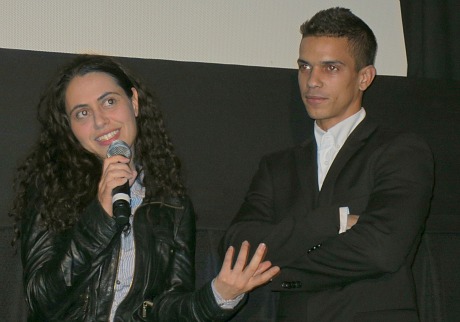

Una Noche director-writer Lucy Mulloy, star Dariel Arrechaga during q & a following Sunday night’s screening at Chelsea Clearview Cinemas.

The reason I saw it was largely because of a lady I met on the A train who told me she was going and that she’d heard it worked, etc. And she was right. I hadn’t read up or done any research to speak of (I had a lazy Sunday), so it was a lucky break.

Shot in a darting, scattershot fashion by Trevor Stuart Forrest and Shlomo Godder (who won a TFF Best Cinematography award a couple of night ago), Una Noche is a story of three dirt-poor Havana teens (Arrechada, Javier Nunez Florian and Anailin de la Rua de la Torre) planning an escape to Miami on a raft.

Just before the festival began life echoed art when Nunez and Florian “disappeared” — i.e., apparently defected — in Miami on their way to New York from Havana.

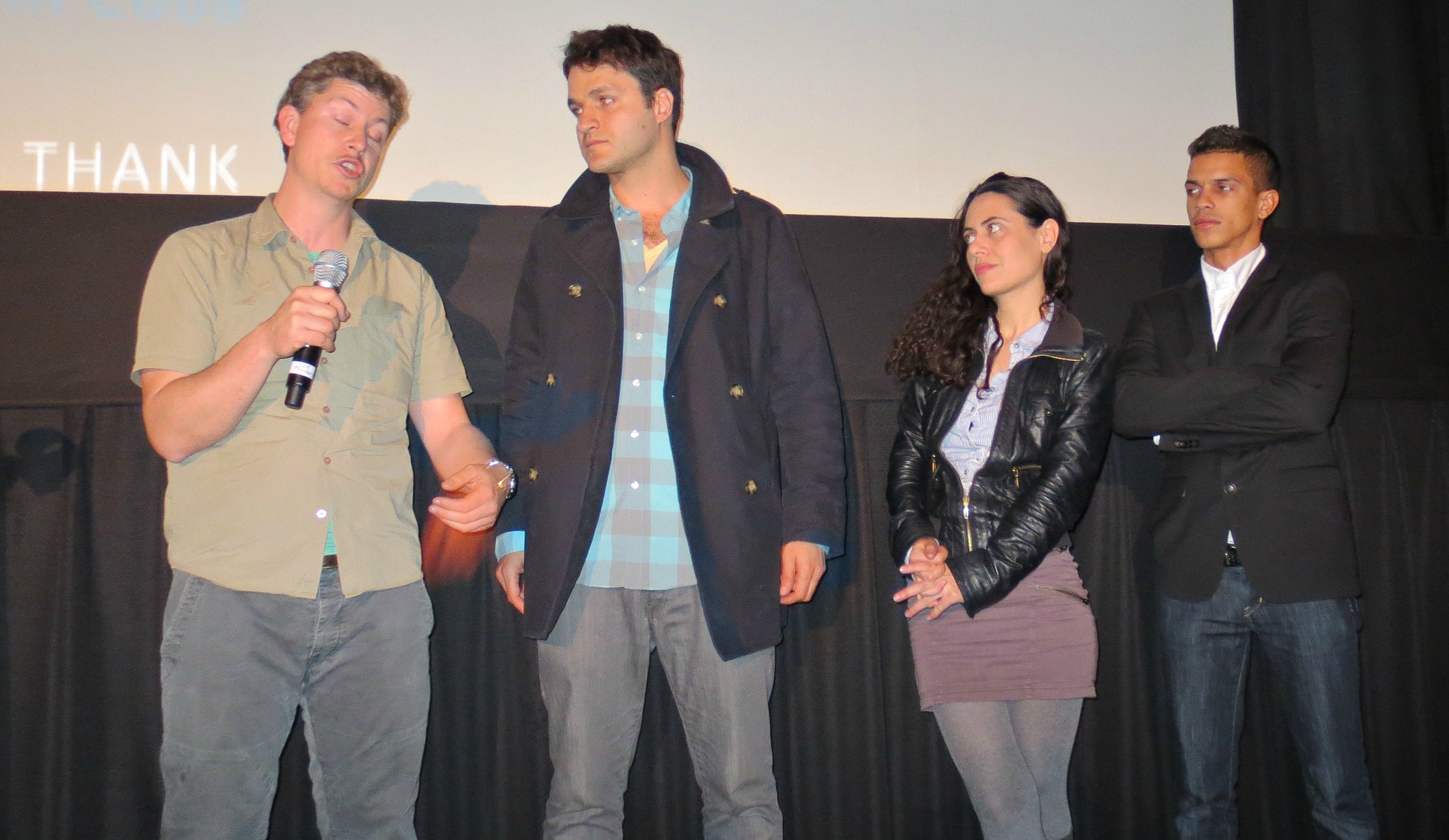
Arrechada and Florian won TFF Best Actor prizes the other night besides. Arrechada attended last night’s screening with Mulloy and participated in the post-screening q & a along with Forrest and Godder.

Una Noche feels almost too on-the-nose at times, but at the same time it plays naturally and organically. It gets right down to it and doesn’t crap around. There’s a restless urgency and exuberance in its depiction of hand-to-mouth Havana lifestyles, and a certain sexual current that always weaving in and out.
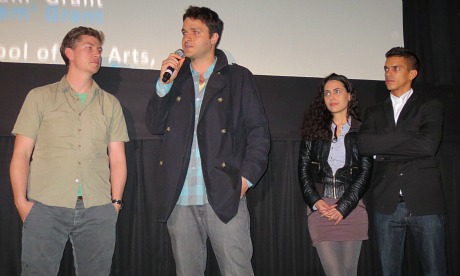
Lila (Torre) and Elio (Florian) are twins, although not exactly mirror images of each other. Elio has the repressed hots for the good-looking Raul (Arrechaga), who’s determined to leave Havana. Elio wants to join Raul in the perilous 90-mile journey but is ambivalent about leaving his family and especially his sister.

Una Noche‘s first two thirds define the chaotic lives of these three. If it’s not one thing it’s another. Raul gets into trouble with the law after injuring a Western tourist who’s had an altercation with his prostitute mom. Elio recklessly steals goods from the kitchen where he works to help Raul. It’s all about dodging the cops as Raul prepares a rubber-tire raft while wrestling with despair, and with Elio not quite able to make his feelings for Raul known.

The hustle-bustle of Havana life isn’t just “colorful” but cruel and scrappy and desperately hand-to-mouth. Everybody has big worries and is living on the knife’s edge. Nobody’s at peace.

And then the journey finally begins with Lila deciding to join her brother and Raul at the last minute. She and Raul are attracted to each other right away, and the usual sexual-tension fighting results. The irony is that Lila’s presence (or more particularly her body) creates a threat and then a tragedy at sea. I won’t get any more specific than that. Mulloy said during the q & a that she based her script on true story that had a much darker ending than her own.

The economy of Una Noche is born out by its running time — a mere 89 minutes. Everybody looks good at the end of it. This is one of those little films that came together just right. Not perfectly or exquisitely but memorably, and that’s what counts.
Flawed But Great

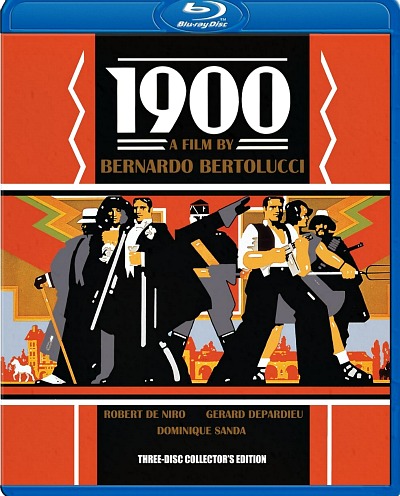
Olive Films’ forthcoming Bluray of the 315-minute cut of Bernardo Bertolucci’s 1900 (called Novacento in Europe) is an absolute essential. It’s a sprawling big-canvas movie in spades, a Marxist-erotic epic with several colorful performances from a big international cast (Robert De Niro, Gerard Depardieu, Dominique Sanda, Donald Sutherland, Burt Lancaster, Sterling Hayden), and abundant with painterly passion and political feeling. It’s a helluva grand-scale history pageant.

1900 is too pedantic and lecture-y at the end (or so I’ve always felt), but Vittorio Storaro‘s cinematography includes several complex extended tracking shots delivering special heavenly highs, and it has a couple of very upfront sex scenes and an unforgettable presentation of Italy’s old-world class division scheme and the horrors of 1920s and ’30 Italian fascism (vividly represented by Sutherland’s Attila character, a demonic perv for the ages). Ennio Morricone‘s score is a rapture in itself.

The five-hour version is a bear, but those great scenes are necessary to have and hold.

I’ve never forgotten a scene depicting a high-class party in Rome, set in the 1920s or ’30s, in which a white horse named Cocaine — a birthday gift, as I recall — is led right into the middle of the main room. That’s Bertolucci’s sensualism for you, as well as the drug culture of the mid ’70s.

I remember interviewing Hayden in 1978 at the Plaza hotel, and his telling me about his death scene in 1900 and how he wrote his final line — “I’ve always loved the wind.” But I knew it from memory and repeated it before Hayden had a chance to, and I remember his delight and his patting my knee in appreciation.

Novacento streets on 5.15, or a little more than two weeks hence.

Jeffrey Kaufman‘s 4.28 Bluray.com review is a good read, but I was immediately brought down by the announcement that Olive, a respectable boutique outfit, is presenting 1900/Novacento with a 1.78 to 1 aspect ratio. Not only are there many sources and indications that the film was shot and presented at 1.66 to 1, but I saw 1900 at the N.Y. Film Festival in September 1976 and can all but conclusively state that it was projected at 1.66. So bad on Olive for bending to the fascists on this point.

Olive is bringing out a High Noon Bluray on 7.17.

48 Frame Staying Power + Jackson Turnaround

It’s a curious thing to have harbored mostly negative reactions to all things Peter Jackson for many years (aside from Heavenly Creatures and a fair-sized portion of The Lovely Bones), and then experience an abrupt turnaround within a four-month period due to (a) his funding, producing and promoting of Amy Berg‘s brilliant West of Memphis, and (b) his using 48 frames per second photography in The Hobbit and advocating for this new technology, which is altogether stunning.

Jackson’s reactions to the 48 fps hoo-hah out of Cinemacon appeared yesterday.

“Nobody is going to stop,” he told Entertainment Weekly. “This technology is going to keep evolving. At first it’s unusual because you’ve never seen a movie like this before. It’s literally a new experience, but you know, that doesn’t last the entire experience of the film; not by any stretch, after 10 minutes or so. You settle into it.”

The post-demonstration rumble, I was told, was that Warner Bros. execs have confided that perhaps the 48 fps image could be roughed up a bit so as to look a bit more “cinematic” and less high-def video-ish. (This was seemingly alluded to in Jackson’s remark about how 48 fps technology is going to “keep evolving.”)

The bottom line is that once younger audiences get a taste of it, 48 frames per second will be here to stay. I’m dead certain there won’t be any going back to 24 fps when it comes to CG fantasy and action and heavily immersive atmosphere-spectacle films. I knew in an instant during the Cinemacon screening that it would soon be the only game in town for those genres. Action sequences are incredibly affecting at 48 fps, and I was knocked out by the realism of Jackson (and Andy Serkis’s) CG Gollum character in 48 fps. You know it’s CG, of course, but it’s hard to dismiss it out of hand, as I do regularly with 24 fps, because it looks so real.

Remember Dean Goodhill‘s Maxivision, the 48 fps 35mm process that Roger Ebert has been passionately promoting for the last twelve or thirteen years? It never took off, and it’s certainly dead now that Jackson’s digital 48 fps process has the spotlight, but there’s no way that 48 fps will recede. Not a chance.

Straight character- and dialogue-driven dramas can and probably will remain in the 24 fps mode without any issues or complaints, although I would advocate an industry-wide acceptance of at least 30 frames per second overall. 30 fps is cleaner and more fluid with reduced pan blur during motion shots. Only two mainstream films have been shot and exhibited at 30 fps — the original Todd AO roadshow presentation of Fred Zinneman‘s Oklahoma! (’55) (a restored version of which was screened in Hollywood in ’84 or thereabouts) and Michael Todd‘s Around The World in Eighty Days (’56). Exhibitor complaints about cost resulted in a downgrading of Todd AO to 24 frames with the release of South Pacific (’58).

“Yeah, Pretty Much”

Significantly, the audience laughed and clapped after Mel Gibson said the above words — an admission that he’d done a lot of screaming on that Joe Eszterhaus audio tape — during a chat with Jay Leno the night before last. People will forgive you for almost anything as long as you speak calmly in their presence and turn on the charm, etc.

Great Frame Rate Debate

Ignore Part One and start with Part Two of this six-part WGBH discussion (which isn’t a “debate” but a power-point lecture or class) of frame rates, which of course is very timely with the very recent unveiling of Peter Jackson‘s The Hobbitt at 48 frames per second. The participants were moderator Bruce Jacobs, the renowned frame-rate pioneer Douglas Trumbull (who got things going with Super 70, later known as Showscan, back in the late ’70s), Mark Schubin and Larry Thorpe.

This discussion, which happened in Boston (or Cambridge) in early November 2010, has just been uploaded. It actually took place over two days (11.3 and 11.4).