Cannes Keepers

I know how the Cannes Film Festival tends to go. If I’m lucky I’ll fit in maybe 23 or 24 films over a nine-day period. Nonetheless I’m choosing 26 and hoping for the best. I’m not listing the discards but the ones I definitely intend to see. As explained before, N means neutral, HE means special interest and M = meh.

Competition (17): Moonrise Kingdom, dir: Wes Anderson (N), Rust & Bone, dir: Jacques Audiard (HE), Holly Motors, dir: Leos Carax (N); Cosmopolis, dir: David Cronenberg (HE); The Paperboy, dir: Lee Daniels (N); Killing Them Softly, dir: Andrew Dominik (HE); Reality, dir: Matteo Garrone (HE); Amour, dir: Michael Haneke (N); Lawless, dir: John Hillcoat (HE); Like Someone In Love, dir: Abbas Kiarostami (M); The Angel’s Share, dir: Ken Loach (N); Mud, dir: Jeff Nichols (HE); Post Tenebras Lux, dir: Carlos Reygadas (M); On The Road, dir: Walter Salles (HE); Paradis: Amour, dir: Ulrich Seidl (N); The Hunt, dir: Thomas Vinterberg (M); Beyond The Hills, dir: Cristian Mungiu (HE).

Un Certain Regard (1): 7 Days In Havana, dirs: Benicio Del Toro, Pablo Trapero, Julio Medem, Elia Suleiman, Juan Carlos Tabio, Gaspard Noe, Laurent Cantet (HE)

Out of Competition (2) Io E Te, dir: Bernardo Bertolucci (HE); Hemingway & Gelhorn, dir: Philip Kaufman (N).

Special Screenings (4): Polluting Paradise, dir: Fatih Akin (HE); Roman Polanski: A Film Memoir, dir: Laurent Bouzereau (HE); The Central Park Five, dirs: Ken Burns, Sarah Burns, David McMahon; Les Invisibles, Sebastien Lifshitz.

Restored Revivals (2): Once Upon A Time in America, Lawrence of Arabia.

Why Not a U.S. Pirate Party?

Founded in 2006, the German Pirate Party (or Piratenpartei Deutschland) is some kind of digitally minded younger person’s political party that might (or at least could) bear a tangential relationship on some level with the Occupy-ers if you wanted to creatively merge their manifestos or mission statements. Imagine how exciting it would be if there was a comparable party in the U.S. — an under-40, fuck-you-boomers-and-your-economic-enslavement-of-our-generation party. You can’t say it wouldn’t feel like or in fact be a healthy thing.

Piratenpartei Deutschland “states general agreement with the Swedish Piratpartiet as a party of the information society, [and] is part of the international movement of pirate parties and is also a member of the Pirate Parties International,” the Wiki page says. “Since 2011 the party has succeeded in attaining a high enough vote share to enter three German state parliaments (Berlin, Saarland and Schleswig-Holstein).

“According to political theorist Oskar Niedermayer, the party sees itself as part of an international movement to shape with their term of ‘digital revolution’ which is a circumscription for the transition into information society. With their focus on freedom in the net and their fight against government regulations of this sphere, they hit the nerve especially of the younger generation.

“Even if the network policy is the core identity of the party, it is now more than just an advocacy party of ‘digital natives’ and characterizes itself as a social-liberal-progressive. Former federal chairman Sebastian Nerz sees the party as social-liberal party of fundamental rights which among other things wants to advocate for political transparency.”

End Of Watch

As noted on 3.2.12: David Ayer‘s End of Watch (9.28.12), a young-LA-cops drama costarring Jake Gyllenhaal, Michael Pena, Anna Kendrick, Frank Grillo and America Ferrera, “unfolds entirely through footage from the handheld HD cameras of the police officers, gang members, surveillance cameras, and citizens caught in the line of fire.”

It’s A Wonderful Death

Yesterday afternoon I walked over to Cinemania, a Berlin DVD store, and rented Nicole Kassell‘s A Little Bit of Heaven, the Kate Hudson ass-cancer love story that opened last Friday and got creamed by critics. I was expecting something grotesque, but was surprised to discover it isn’t all that painful.

It’s a fundamentally dishonest and treacly movie about making the most out of the fact that you’re about to die. The life-embracing “up” attitude that it’s selling is synthetic and calculated, and about as phony as a three-dollar bill. But once you get past that (or digest that), it’s watchable.

Hudson performs reasonably well as Marley, a New Orleans advertising exec who experiences emotional and spiritual growth when she learns that she’s got advanced colon cancer and has only a few weeks to love. Gael Garcia Bernal‘s oncologist character, who becomes Marley’s lover starting in Act Two, looks trapped but not entirely miserable. He mans up and does the job. Kathy Bates and Treat Williams play her anxious and conflicted parents with at least a semblance of dignity. And Whoopi Goldberg plays a mind’s-eye version of God…don’t ask.

Hudson‘s success is based on her roles and acting style reflecting the lives and attitudes of shallow, not terribly perceptive girls everywhere (the ones who used to read Cosmopolitan in the ’60s, ’70s and ’80s), and this is a shallow, not terribly perceptive film that tries to turn a story about a young woman’s premature death into a transformative turn-on — a movie that, as Hudson’s Marley character puts it, tries to “put the FUN back in funeral.”

As I watched it hit me that Hudson, now 33, has moved past that pristine youth-glow look and is now squarely in her 30s. Her face is a bit heavier. She’s no longer Penny Lane, looking a wee bit older than her years.

Red Rasta

Before seeing Christopher Kenneally and Keanu ReevesSide By Side, a clean, disciplined and highly intelligent doc about the industry’s ongoing transition from film to digital, I had never seen live sound footage of Lana (formerly Larry) Wachowski. No biggie. Just saying. All in, Kenneally has given her about two minutes of screen time.

Read more

Nine or Ten Days

I searched and searched for information about exactly when Socialist Francois Hollande will officially take over as President of France, having defeated Nicolas Sarkozy in yesterday’s election. Story after story refused to provide the takeover date, but I finally found it in an AP report that states the following: “Hollande has virtually no foreign policy experience but he will face his first tests right after his inauguration, which must happen no later than May 16th.”

Ticket Stub Tells Tale?

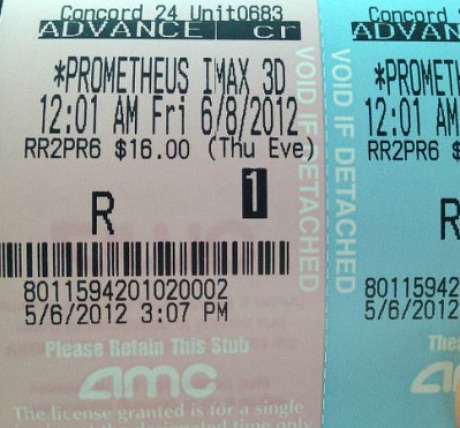
An apparently legit photo of an advance-purchase IMAX ticket at an AMC theatre in Concord, North Carolina indicates that Ridley Scott‘s Prometheus has been rated R. Pic was reportedly posted by an IMDB user named “dvonnesoneek” and initially pointed out by comicbook movie.com’s “nailbiter 111.” Ladies, it’s okay with me.

Update: Collider‘s Steve Weintraub reported around 9 pm Monday night that 20th Century Fox “has confirmed Prometheus will be rated R for ‘sci-fi violence including some intense images, and brief language.'”

Read more

An Exception For Fritz Lang?

In my latest piece about 1.85 aspect-ratio fascism (“Will Dial M For Murder Be Mauled By Fascists?”, 4.28), aspect ratio know-it-all Bob Furmanek contended that Elia Kazan‘s On The Waterfront was initially projected and was intended to be seen in a 1.85 to 1 aspect ratio — a truly sickening notion given the compositional balance and perfect framing contained in the 1.37 to 1 version of this 1954 classic.

Waterfront in 1.37 is all anyone has ever seen on the tube, VHS, laser disc and DVD. But if guys like Furmanek have their way…

To explain the correctness of his Waterfront position, Furmanek reported the following sequence of events: (a) April 7, 1953 — Columbia announces their new ratio of 1.85:1; (b) April 28, 1953 — Columbia announces 100% widescreen; (c) November 17, 1953 — On The Waterfront commences with principal photography; (d) July 14, 1954 – Variety review, 1.85:1; (e) July 14, 1954 — Exhibitor review, 1.85:1; (f) July 24, 1954 — Boxoffice review, 1.85:1.

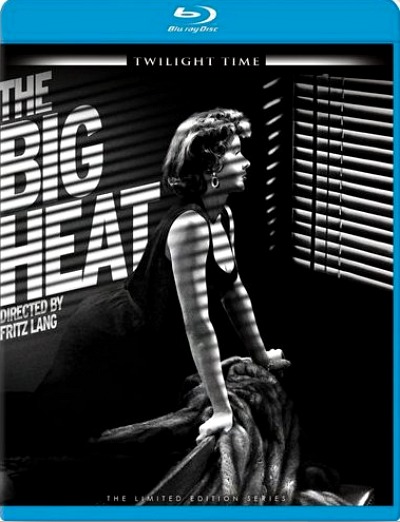
I’m not disputing Furmanek’s Waterfront reporting, however repellent his aspect-ratio aesthetics may be. But how does he explain a new Bluray of Fritz Lang‘s The Big Heat, a Columbia release, being presented on the Twilight Time Bluray at 1.34 to 1, given that Lang’s film opened in October 1953 — a full six months after Columbia laid down the 1.85 law? According to a Bluray.com review, the Big Heat Bluray was “culled from HD masters provided to Twilight Time by Sony-Columbia” — in other words by Grover Crisp.

Lang was an esteemed, old-time director who’d begun in Germany in the 1920s, so you can bet he composed The Big Heat and intended to have it seen at 1.33. But if everything had to be 1.85, why didn’t Columbia just give orders to projectionists to show The Big Heat within a 1.85 to 1 aspect ratio and to hell with Lang’s 1.33 compositions?

I don’t know for a fact that The Big Heat began shooting in April 1953 — it might have begun a bit earlier, or in late 1952 even. But an edict is an edict. Did Cohn have a soft spot for Lang? Was Cohn a tough guy or wasn’t he? Cohn ran Columbia with a bullwhip and typical big-studio shooting schedules were tight, and a five- or six-month turnaround (the beginning of principal photography to theatrical release) would have fit within the norm.

Somehow or some way a person in control of the shape of The Big Heat wimped out — Cohn, Crisp, somebody in the food chain.

If Crisp’s intention is to make good on Cohn’s meat-cleaver aesthetic then Blurays of all April 1953-and-beyond non-Scope films have to be 1.78 or 1.85, and fascists like Furmanek should support Crisp in this effort. In fact, if Crisp and Fuhrmann were truly committed to chopping off the tops and bottoms of 1.33 films they would cleaver Sony Home Video’s endlessly delayed From Here To Eternity Bluray to 1.85. Why Not? Don’t fudge it, guys. You have to be hard.

Let It Happen

Four or five days ago a critic friend told me that Dark Shadows is a no-go. So I asked another guy who’s seen it and generally liked it, and he said this: “It’s getting a polarizing response as there are many positives about it. If you’re looking for career growth, forget it. But it’s entertaining — better than Burton’s last couple of work-for-hire gigs.”

History

The Avengers has hit $200.3 million for the biggest three-day U.S. weekend of all time. Add the int’l cume of $441.4 million and you’re talking…hold on…$641.8 million for the domestic three-day plus the 12 days since it opened on the 26th or thereabouts.