Criterion Cleavers Baby

7.17 Update: My assertion in this piece, which posted on Monday, 7.16, that a previous DVD of Rosemary’s Baby was issued at an aspect ratio of 1.66 to 1 is incorrect. The rest of this article is fine. I’ve addressed the wrongo in a piece that ran Tuesday, 7.17, called “Limited Mea Culpa.”
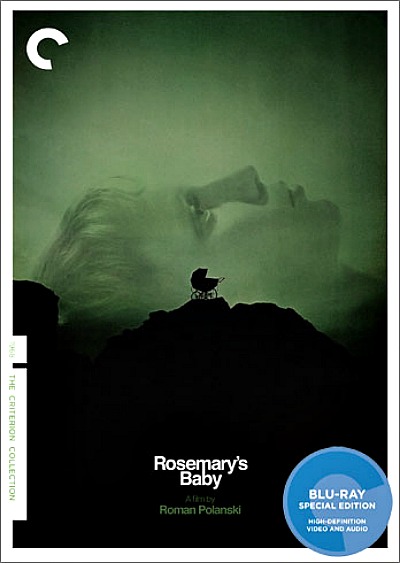
Original 7.16 article: Today the Criterion Collection announced that, as rumored, they’ll be releasing a new Bluray/DVD of Rosemary’s Baby (’68), based on a high-definition digital restoration approved by director Roman Polanski. And the aspect ratio — hold on to your hats — will be 1.85Jesus! I feel like I’m Rosemary Woodhouse on my bed with a scaly Satan lying on top of me, and I’m going “this isn’t a dream…this is really happening!”

The Rosemary’s Baby Bluray won’t be masked at 1.66, which has been the reigning aspect ratio for decades, certainly on the last DVD and on the laser disc before that. And not 1.78, which would perfectly fit the 16 x 9 screen. No — Criterion had to go full-fascist and adhere to the 1.85 aspect ratio that all films have been “officially” screened at commercially in the U.S. since April 1953.

If Rosemary’s Baby had been released in Great Britain, we would today be looking forward to a 1.66 version from Criterion next October. John Schlesinger‘s Sunday Bloody Sunday (’71) was also announced today as a Criterion Bluray release, and it will be masked at 1.66.

I’m horrified that Polanski, who shot 1965’s Repulsion at 1.66 (and was presented at that a.r on Criterion’s Bluray) and clearly shot Rosemary’s Baby with a 1.66 a.r. in mind — the DVD shows that each and every frame is exquisitely composed at that particular shape — has apparently approved the meat-cleavering of his own film! Criterion’s statement that he “approved” this new Bluray obviously indicates that Polanski has told Criterion “sure, go ahead, whack off the tops and bottoms…fine with me!”

I’m purple-faced with rage. I’ve got stomach acid. I’m spitting saliva on the rug. Why am I, sitting at a desk in West Hollywood, trying to protect and defend Rosemary’s Baby as it ought to be seen while its director sits in Paris, shrugging his shoulders and saying “whatever”?

On 3.21.12 I wrote that Polanski “is a European traditionalist at heart, and while he knew that the film would be projected at 1.85 by U.S. exhibitors, per the standard, I strongly suspect that he composed it for 1.66. Look at the 1.66 version of the film that William A. Fraker shot. There are no acres of space above anyone’e head. It’s perfect at 1.66. It’s just right.

It’s not just me claiming that 1.66 is the preferred aspect ratio, and that precedents have been established. 12 years ago DVD Talk‘s Geoffrey Kleinman noted that a 2000 DVD version presented the film at 1.66 to 1. Some wingnut at Turner Classic Movies declared a few years back that Rosemary’s Baby‘s aspect ratio is 1.66. And a commenter at Velocity Reviews asked a while back why Polanski’s film was completely occupying a 16 x 9 screen when a 1.66 a.r. would dictate windowbox bars on the side.

I know how this one is going to go. The fascists are going to carpet-bomb me with their usual goose-stepping crap and I’m going to respond with my usual counter-accusations, etc. It’s an old hymn. I’m no fan of Roman Polanski today, let me tell you. How could he do this to his own film?

The clip below is seemingly cropped at 1.85. It’s not catastrophic, but it’s obviously a bit too cramped. It doesn’t breathe. The framing feels confining.

Don’t Bother Me

This popped through in late April. I only paid attention for the first time today. A friend tells me it’s really popular with her daughter and her friends. If it’s popular in a bigger way (and I’ve seen no proof that it is) then Shia LaBeouf might be in some kind of trouble. This video may be a hint of an indication of popular currents in the way that a defaced subway poster tends to mean a little something.

Familiar

It appears that Douglas Aarniokoski‘s The Day (Anchor Bay, 8.29), a post-apocalyptic actioner with a fresh young cast, has been shot in either extremely desaturated color or plain black-and-white. That in itself makes we want to see it. The color in John Hillcoat‘s The Road, which was the same bowl of gruel, was gray-ash…but this seems totally monochrome. If it’s not, and if it has at least some color, why indicate otherwise in the trailer?

Some IMDB guy called “JeffersMornngToYou” who caught The Day at a “Midnight Madness” screening at September’s Toronto Film Festival called it “spectacular…not just violence but an in-depth look at the depravity that would come from an apocalypse…really character driven, this movie definitely makes you think.”

Liberal Support Issue

For whatever reason Josh Radnor‘s Liberal Arts (IFC Films, 9.14), one of the surprises of the Sundance Film Festival (for me at least), has no website up. Isn’t that odd for a film that’s coming out two months hence? And it’s a very decent dramedy — mature, intelligent, well-written, non-cloying, well-acted.

The indication, obviously, is that IFC Films isn’t feeling that enthusiastic, but the film, directed and written by Radnor, played really well at the Eccles screening I attended last January. People were levitating.

Update: IFC Films bigwig Ryan Werner says “everything is coming momentarily on Liberal Arts. We’ve been working with Josh this summer on the materials, etc. And we just did a NYC screening and party at BAM Cinemafest and the film played huge. We remain super enthusiastic.”

Liberal Arts “is a step up in somewhat (but not quite) the same way Annie Hall was a step up for Woody Allen…almost” I wrote on 1.23.12. “Mature, at times melancholy, dialogue and character-driven, not overtly ‘comedic’ (and thank God for that). I really didn’t care for Radnor’s happythankyoumoreplease, so I went expecting not too much and was pleasantly surprised.”

Radnor plays a bright, neurotic, 30-something Manhattanite who’s in a kind of dead-end place, career- and relationship-wise. He’s invited back to his university (somewhere in lower Vermont or New Hampshire, as I recall**) and slips into a really nice platonic thing with a 19-year-old sophomore (Elizabeth Olsen). It naturally occurs to both to take things to the next level, and at this juncture Radnor starts getting all glum and guilt-trippy himself about the wrongness of doing a little 19 year-old lamb. But hold on. When Radnor’s character turns 41 or 42 Olsen’s character will be 29 or 30 or thereabouts — what’s the problem with that? Life is short. It can’t last? Maybe not, but what in life is guaranteed to be a long-term thing?

42 year-old Woody Allen had no problem doing 17 year-old Mariel Hemingway in Manhattan, and in some ways she was more emotionally mature than he. I myself had a really rich and moving thing with a 19 year-old when I was 28, and I never had a moment’s concern and neither did she. Well, I did have a concern when she wound up dumping me after 18 months or so. I was devastated but that’s life. All’s fair, rough and tumble, no assurances.

Liberal Arts costars Richard Jenkins, Allison Janney, John Magaro and Elizabeth Reaser.

** Liberal Arts was actually shot in Columbus and Gambier, Ohio — no Manhattan, no New England.

Lizard Tongue

This is poorly shot but I’m curious about a cat issue. You’ll notice around the eight-second mark that Aura is responding to her lower back being scratched by sticking her tongue in and out. I’ve owned six or seven cats in my life (two run over by cars, one dead from pancreatic cancer) and I’ve never seen this before. They usually arch their back, raise their head, close their eyes and purr.

Newsroom Pleasure

Some of the bitch-slappy critics have gotten it wrong about Aaron Sorkin‘s The Newsroom. I’ve watched all four episodes (last night’s being a comedy of tabloid embarassment called “I’ll Try to Fix You”) and I’m convinced that the messy personal relationship aspects are not the most problematic or irksome stuff but possibly the best so far.

Jeff Daniels‘ Will McAvoy isn’t just a mouthpiece for Sorkin’s views about journalism and politics — he’s almost certainly a projection of Sorkin’s snappy, mouthy personality and (probably) his own messy, lurching tendencies in the personal realm, past or present. I know guys like Will McAvoy — guys who know what they know and should stay away from alcohol. I’ve never been into bimbos, but a friend told me last night that in my drinking days she could imagine me over-emphasizing a point in a party chat with a lady and getting a drink thrown in my face (which is what happened last night to McAvoy when he insulted Hope Davis‘s Page Six-y gossip reporter).

For all their anger and awkwardness, these scenes are real and riveting and sometimes funny. Perhaps not all that substantial or even necessary at the end of the day, okay, but “fun” and entertaining.

I’m also persuaded that The Newsroom‘s high-minded, speechy argument scenes about journalistically manning up and speaking truth to Tea Party idiocy and Republican loons (and with dialogue, yes, that is unrealistically eloquent and incisive) have never been fair-minded attempts to portray real-world, real-deal journalism as it’s actually experienced and struggled with out there. The characters, we all realize, are at best incidentally related to actual, sometimes fretting, constantly pressured journalists as they exist at CNN or MSNBC or wherever. And I’m fine with that.

The Newsroom is about what Sorkin thinks and feels about everything in the political news reporting realm that offends and agitates him — simple. He’s got this show and this HBO forum and this power to say all this stuff (most of which I agree with 100%) to tens of millions, and he’s letting go like a man possessed. What’s not to like? The Newsroom is a truthful playtime series for angry lefties and people who are sick of absurd, delusional rightwing views and contentions being reported about in a fair, mild-mannered, business-as-usual way by the MSM reporters, anchors and commentators. You can’t say Sorkin isn’t making a necessary point here.

There was a sequence last night about how rightwing shriekers (Palin, Beck, Limbaugh, Bachmann, NRA exec vp Wayne LaPierre) went on a tear in 2010 about Barack Obama being anti-gun — a virtually baseless, bullshit, non-factual contention. But they did it anyway because it excites the base and attracts political contributions. These people aren’t wrong — they need to be put on trial and if possible penalized as strictly as possible.

And you can’t tell me, by the way, that the mano e mano face-off between station owner Jane Fonda and Newsroom editor-boss Sam Waterston wasn’t damn good and reflective of what many, many owners have said (or certainly meant to say) to many, many journalism vets over the decades.

Hope Davis‘s Page Six reporter: “Are we going to go back to flirting, or are you going to keep putting me down?”

Jeff Daniels: “I’m not putting you down. I’m just saying that what you do is a really bad form of pollution that makes us dumber and meaner and is destroying civilization. I’m saying with all possible respect that I would have more respect for you if you were a heroin dealer. I’m speaking professionally, not personally.”

Davis: “Ok, well, I’m speaking personally when I say fuck you — and you just passed up a sure thing.”

It’s my non-alcoholic view that rudeness should be avoided, but it also means something to politely call a genuine monster a monster to his/her face. In a genial roundabout way, I mean. If you decide to do that, it’s usually because of brass and intemperance or that last drink. If you get a drink thrown into your face as a response, you just have to take it. Say “okay, I get it,” get out a handkerchief, withdraw and move on.

Two Stood Together

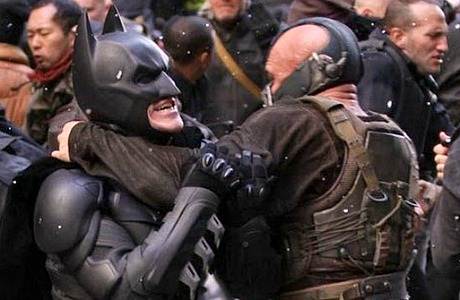
Except for the reaction of Marshall Fine and to a lesser extent Variety‘s Justin Chang, The Dark Knight Rises is knocking ’em dead over at Rotten Tomatoes and Metacritic so far. All the bowling pins are toppling over and going “baaahhllkk!”

In a review that echoes the (d) comment in this 7.11 reaction riff, Variety‘s Justin Chang has, make no mistake, gone mostly thumbs up on Christopher Nolan‘s nearly three-hour epic, but he also states that The Dark Knight (’08) was better.

“While The Dark Knight Rises raises the dramatic stakes considerably, at least in terms of its potential body count, it doesn’t have its predecessor’s breathless sense of menace or its demonic showmanship, and with the exception of one audacious sleight-of-hand twist, the story can at times seem more complicated than intricate, especially in its reliance on portentous exposition and geographically far-flung flashbacks.

“Perhaps inevitably, one also feels the absence of a villain as indelible as Heath Ledger‘s Joker, although Hardy does make Bane a creature of distinct malevolence with his baroque speech patterns and rumbling bass tones, provoking a sort of lower-register duet when pitted against Batman’s own voice-distorted growl (the sound mix rendered their dialogue mostly if not entirely intelligible at the screening attended).

So, yes, The Dark Knight Rises never quite matches the brilliance of The Dark Knight, and yet “this hugely ambitious action-drama nonetheless retains the moral urgency and serious-minded pulp instincts that have made the Warners franchise a beacon of integrity in an increasingly comicbook-driven Hollywood universe,” Chang concludes.

In Fine’s view, The Dark Knight Rises is the “weakest” Batman film in Nolan’s trilogy.

“Where Batman Begins (’05) had a mythic feel that remade the origin story in an exciting new way (away from the flat-footed cartoonishness of the Tim Burton/Joel Schumacher entries), The Dark Knight felt like an overreach — an attempt to tell too many stories in one long movie. But it won over the critics, mostly because of a sizzling performance by Heath Ledger, who died before the movie was released (and who was given a posthumous Oscar).

“Now comes The Dark Knight Rises, bringing in the Bane character (played, with my condolences, by Tom Hardy) and Catwoman (Anne Hathaway, one of the movie’s few highlights). Nolan gets so caught up in creating an epic adventure that he hammers the ‘epic’ and neglects a crucial component: adventure.”

I won’t be seeing The Dark Knight Rises until tomorrow night, but at least I’ll be seeing it in IMAX, which is more than you can say for the critics who saw it Friday or the ones seeing it this afternoon. This time I’m glad to be at the end of the train, in the caboose. Which is where Warner Bros. always puts me when it comes to screenings.