Never Just About The Work

I’m not going to defend Bret Easton Ellis for stupidly tweeting that Zero Dark Thirty/Hurt Locker helmer Kathryn Bigelow is “overrated” because she’s “hot,” nor am I condoning his view that “if The Hurt Locker had been directed by a man it would not have won the Oscar for best director.” He said a dumb thing that made him sound like a sexist pig. (Which he may in fact be.) But boil his words down and sand down the edges and all he’s really saying is that the attractive or unattractive appearance of a would-be Oscar winner can be a factor in whether or not people vote for him/her.

Bigelow is a gifted, tenacious, sharp-eyed director who knows exactly what she’s doing, and The Hurt Locker has always been and always will be a superbly made film no matter how good-looking she is. But imagine, say, if the highly refined, affable, Britishy and very pleasant-looking Tom Hooper had been a moderately obese Samoan who was 5 ‘ 7″ tall and wore tribal skirts and sandals and spoke in heavily accented English. Would he have won the Best Director Oscar for The King’s Speech? Perhaps not. You can’t say for sure that his Samoan skirts wouldn’t have rubbed at least some voters the wrong way.

I just don’t think you can separate your personal presentation from your work and say to your colleagues, “Look, you guys — forget whether I’m well-groomed or stylishly dressed or overweight or if I look like the Elephant Man or Charles Laughton or Paul McCartney, okay? Because my looks don’t matter, only my work does.” People will smile and say “fine, agreed” but you’ll always be judged to some extent by how attractive you seem to them.

There’s also the observation that Gold Derby‘s Tom O’Neil has passed about Academy geezers tending to vote for hot female Oscar contenders. This applies to actresses for the most part (if I understand O’Neil’s observation), but it wouldn’t be too much of a stretch if the same voting tendency worked to Bigelow’s advantage two years ago.

Heaving Seas

I guess it’s true about Les Miserables not being a critic’s film — it currently has a 63% Rotten Tomatoes grade, which means it’s flunking. (Anything below 80% means trouble, but below 70% means get out the life jackets.) But the real bellwether is the fact that MCN’s David Poland, who seems to have a special place in his heart for musicals as he has befriended more than a few of them, has panned Les Miz rather harshly.

“I am not a moron,” Poland states. “I can deal with building the factual reality in my head when the style of the film decides against being literal. But that is what is so much the failure of Les Miserablesit wants it both ways. It wants to be profoundly intimate, suffering in extreme close-up, the singing-on-the-set choice (the endless hype about which has turned it from ‘choice’ to ‘stunt’), and shooting almost completely in singles and tight doubles. Edit. Edit. Edit.

“But the material is huge and epic and melodramatic. So the effect of Tom Hooper’s direction is like looking at Mount Everest through the wrong side of the binoculars.”

Cornish and The Girl

Abbie Cornish is about to finish work on Jose Padilha‘s Robocop, which has been filming in Toronto. (She’s playing Ellen Murphy, wife of Joel Kinnaman‘s Alex Murphy, the street cop who becomes a cyborg enforcer.) But two days ago she was
speaking from her L.A. home about her work in David Riker‘s The Girl, which attracted some heat at last April’s Tribeca Film Festival. I slightly know Cornish socially (we have a mutual friend) and so we had an
easy chat.


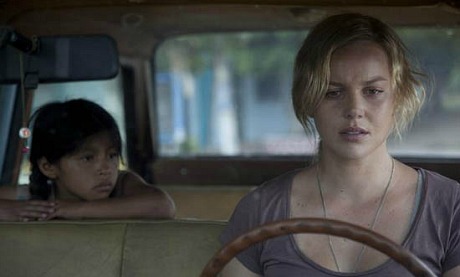
Abbie Cornish (r.), Maritza Santiago Hernandez in David Riker‘s The Girl.

Cornish’s performance as Ashley, a somewhat irresponsible San Antonio mom looking out for a young Mexican girl (Maritza Santiago Hernandez) whose mother has recently drowned, “is Cornish’s best part since Candy,” I wrote on 4.30. “She’s a solid actress trying to do the right career thing, and she’s definitely scored here.

“Ashley doesn’t act in a way that exactly elicits sympathy or identification,” I explained. “She’s always a beat or two behind the audience in figuring out her next move. She gradually wakes up and flies right, but a lot of stumbling happens along the way.

“Riker begins with Ashley losing her low-rent job at an Austin (or is it San Antonio?) super store due to pissing off her boss. Ashley is pretty and bilingual, but right away you’re noticing she’s not all that together. She’s trying to get her son back through the courts but is emotionally impulsive and undisciplined and seething about everything. Right away you’re saying ‘I don’t know if she’s going to make it through all the hoops.’

“And then along comes Ashley’s boozing, bewhiskered truck-driver dad (Will Patton) with an offer to join him at his Mexican home for a night of tequila and celebration. Ashley knows that she has to fly straight if she wants her son back, and that child services will be paying unexpected visits to her trailer home to check on her habits…and she drives down to ole Mexico to throw down some tequila with her grungy loser dad?

“Patton tells her the next day that he’s making good dough by smuggling illegal aliens across the border into the U.S.in his truck. This plants a seed. Ashley needs money badly, and eventually decides to bring four or five illegals across on her own. But she hasn’t thought things through and is rather stupidly presumptuous about the conditions of a river that the illegals will have to cross, and tragedy strikes a mother in the group, leaving her young daughter (Maritza Santiago Hernandez) alone and destitute.

“The movie kicks in when Ashley realizes that she’s responsible for this tragedy, and that she’s obliged to help this little girl in some way.

“We realize, of course, that this is the point of the film — for Ashley to woman up and get past her resentments and weaknesses by helping this little girl. And of course, it’s the young girl who ends up helping her. It takes a while but Ashley eventually sets things right, and is presumably in a better frame of mind as far as getting her son back and being a good mom, etc. And Riker lets her off the hook by having the young girl’s grandmother tell Ashley that the river killed the mom, and that it wasn’t Ashley’s fault. But it was, obviously, to a large extent.

“All in all The Girl is a nicely subdued humanistic tale, but I can’t honestly say that I felt all that much support for Ashley, although Cornish does a fine job of portraying her as far as she goes, warts and all. Hernandez registers as the more forceful and clear-headed of the two, truth be told.”

Chin Up

My compassionate ex-boss Kevin Smith tweeted this morning that he’ll be retiring from theatrical filmmaking after he directs Hit Somebody, a hockey flick reportedly spanning 30 years, and Clerks III. Smith is one of those guys who clearly has (and is constantly reformulating) the whole cultural equation in his head — just listen to him riff during one of his talking-tour appearances — but has never quite made a film that delivers on his full potential.

Kevin has always waved me off when I’ve told him what I think he should do, but this is what I wrote this morning after I read the news.

“Who retires at 42, Kevin? You started out as a filmmaker 18 years ago with Clerks, and just because distribution systems are oppressive and weighted against your kind of material…I know it’s unpleasant and a grind, but you can’t not work in films, man. Not as a hard and fast prohibition, I mean. That’s like an ambitious writer saying he’s decided not to write any more books. Even if you’re totally convinced that you don’t want to work in films, never say never. To anything. You should at least try some theatre.

“I don’t care (and you shouldn’t either) how unhappy or unfulfilled filmmaking has made you. Like it or not, you’e here on the planet to do what you can do to brighten or make rich or at least decorate the world as best you can, and I don’t see how that effort doesn’t include at least the occasional film when the material and the time seem right. You don’t have a choice. You have to carry the weight. You’re 42, man, which is when the juices start to really uncork for most writers.

“I presume you’re going to focus on TV and online efforts plus the usual speaking tours, but I wrote years ago that you have a major work in you — a Who’s Afraid of Virginia Wolff for the slacker generation. I still believe this. Maybe on the stage and maybe as a theatrical film or maybe as an online or VOD thing. I’m thinking of some kind of balls-out, drag-out husband-and-wife-and-their-friends whiplash-dialogue thing with few if any laughs, and lasting two or three hours. You’ve been married long enough to write it — you know all about this shit. You have to write & direct this, Kevin. You could be a funnier Neil Labute.”

Night of On The Road, Promised Land

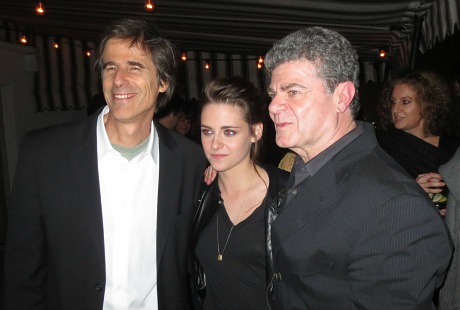
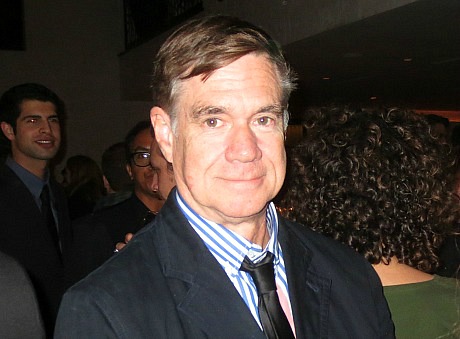
Last night was split between premiere screenings of (and after-parties for) Gus Van Sant, Matt Damon and John Krasinski‘s Promised Land (which I gave a thumbs-up to yesterday) and Walter Salle‘s On The Road, which I’ve been friending since my initial viewing in Cannes last May. The after-events were at West Hollywood’s Fig and Olive and a sixth-floor balcony suite at the Chateau Marmont, respectively.


(l. to r.) On The Road director Walter Salles, costar Kristen Stewart and composer Gustavo Santaolalla — Thursday, 12.6, 11:40 pm.

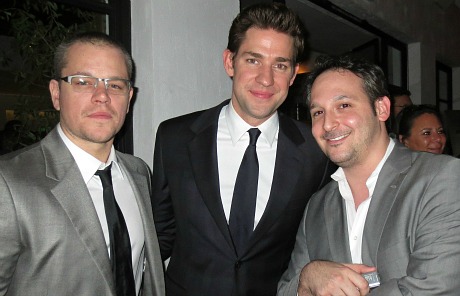
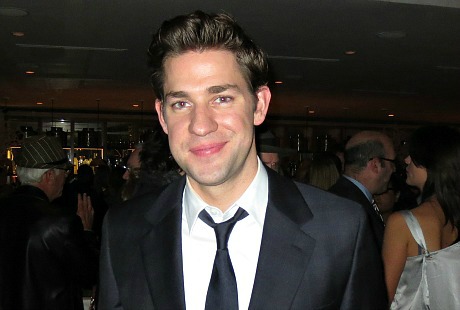
Kristen Stewart and Francis Coppola received most of the attention at the latter event. I spoke briefly with Robert Pattinson about his costarring role in Maps To The Stars, a David Cronenberg film that will shoot in LA in the spring, he said. Previous brief chatter at the Promised Land party happened with Van Sant and Krasinki, who co-wrote Promised Land. The latter spoke enthusiastically about the scriptwriting side of things and mentioned that he’s been speaking with Cameron Crowe about possibly teaming on a project.


(l. to r.) Promised Land star, co-writer Matt Damon, costar & co-writer John Krasinki, Variety‘s Jeff Sneider at Fig and Olive — Thursday, 12.6, 10:05 pm.

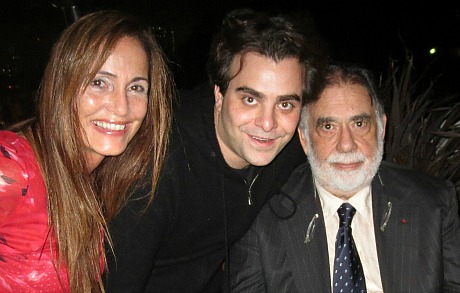
(l. to r.) Graemm McGavin, Arbitrage director-writer Nic Jarecki, Francis Coppola at On The Road Chateau Marmont after-event — Friday, 12.7, 12:20 am.

Promised Land director Gus Van Sant.

Promised Land costar & cowriter John Krasinki at Fig and Olive — Thursday, 12.6, 9:45 pm.

Main culinary event at Promised Land after-party, which was funded by the good folks at Focus Features, the film’s distributor.

Graemm McGavin — Friday, 12.7, 12:50 am.

Church of Cimino-Ford

Michael Cimino‘s relatively new Twitter account (it’s really him) is moderately exciting. But I can’t lie down for anyone attempting to mythologize John Ford beyond (my idea of) realistic proportion. Ford is the greatest artist, a timeless poet, etc.? Sorry but I had to take issue, as I have nmerous times before.

John Martin Feeney’s sense of pictorial balance was rarely matched, but he peaked from The Informer to My Darling Clementine, and then resurged with 1962’s The Man Who Shot Liberty Valance. And even that had problems (starting with the fact that Stewart and Wayne were way too old for their characters). Ford’s iconic Monument Valley films of the ’50s and early ’60s have gotten all the attention because they’re simple to digest, but they lack the shaded complexity and the unpretentious straight-deal naturalism of his best films (like The Grapes of Wrath and Drums Along The Mohawk) and they’re way too sentimental.

The over-praising of The Searchers in particular (which began 33 years ago with Stuart Byron‘s New York article “The Searchers: The Super-Cult Movie of the New Hollywood“) has gone on long enough. It’s a noteworthy western but take it easy.