Schenectady, Dads, Cigarettes, etc.

Derek Cianfrance‘s The Place Beyond The Pines (Focus, 3.29) “is basically an upstate New York crime story about fathers and sons,” I wrote on 9.8. “It’s also about cigarettes and bank hold-ups and motorcycles and travelling carnivals and nobody having enough money and anger and bullheadedness and the general malaise that comes from living in the pure hell and suffocation of Schenectady and those Siberian environs…I’ve been up there and it’s awful so don’t tell me.

“It’s also about men and their lame cock-of-the-walk issues in Cianfranceville, or the Land of the Constant Macho Strut and the Eternally Burning Cigarette, and if you can swallow or suck this in, fine…but I couldn’t.

“Boiled down, Pines is about the conflicted, problematic, sociopathic or otherwise questionable tendencies of two fathers (Ryan Gosling, Bradley Cooper) and how their sons (Dane DeHaan and Emory Cohen, respectively) are all but doomed to inherit and melodramatically carry on that legacy and that burden, so finally and irrevocably that their mothers (respectively played by Eva Mendes and Rose Byrne) might as well be living-room furniture, and the influence of schools, community values and/or stepfathers matter not.

“If you can roll with this world-of-Cianfrance view — i.e., wives and mothers are good for sex and breeding and cleaning and making meals and running errands and occasional guilt-tripping but when it comes to the issue of a son’s character and destiny, it’s almost entirely about dad — you might be able to roll with The Place Beyond The Pines. But I wasn’t able to. I respect Cianfrance’s ambition in telling an epic, three-act, multi-generational tale that spans 15-plus years, but I don’t respect or believe what he’s selling.

“Except for the bank-robbing and road-chase sequences I didn’t believe a single moment in this film. Okay, I bought some of it but only in fits and starts.

“You can’t have Gosling play a simple-dick man of few words who entertains audiences with his talent as a motorcycle rider and then turns to bank-robbing on the side — that’s way too close to his stunt-driving, getaway-car character in Drive.

“Plus I don’t respond well to movies with female-voiced choral music (a device that suggests that a caring, all-seeing God is watching over us) on the soundtrack plus other musical implications of doom and heavyosity.


(l. to r.) De Haan, Cooper, Mendes, Gosling and Cianfrance before Toronto Fiim Festival screening.

“Plus I hate movies about blue-collar knockabouts and greasy low-lifes and teenage louts who constantly smoke cigarettes. The more a character smokes cigarettes the dumber and more doomed and less engaging he or she is — that’s the rule. If you’re writing or directing a film and you want the audience to believe that a character is an all-but-completely worthless scoundrel or sociopath whom they should not care shit about, have that character smoke cigarettes in every damn scene.

“The principal theme of The Place Beyond The Pines is the following: “Dads Are Just About Everything and Mothers Don’t Matter Much, but Cigarettes Sure Run A Close Second!”

“In short, I thought the movie was unreal, oppressive, dramatically forced bullshit, although it receives a shot in the arm from Dane DeHaan (In Treatment), who looks like a mixed reincarnation of Leonardo DiCaprio and Benicio del Toro as they were in the mid ’90s, although he’s a lot shorter (5’7″).

“I also felt that Mendes and Byrne are too hot to live in Schenectady. Beauty almost always migrates to the big cities where the power and the security lie, and in my experience the women who reside in blue-collar hell holes like Schenectady are far less attractive as a rule. There’s a certain genetic look to the men and women of Upper New York State, and they aren’t the kind of people who pose for magazine covers or star in reality shows.


No Big Gorilla

N.Y. Times columnist David Carr gave me hope this morning that the lazy-default voters might not go for the slow, talky, rotely portentous aspects of Steven Spielberg‘s Lincoln, and that something else might take the Best Picture Oscar. I really love that there is no one dominant favorite this year. Whatever wins, much howling and gnashing of teeth are assured when the Big Moment comes.


Why did Feinberg ignore the SLP hate brigade when he tapped this out? One presumes that Glenn Kenny and others in his camp would like an answer.

The absolute best film of 2012 is Zero Dark Thirty, I feel, but my emotional favorite is Silver Linings Playbook (which is in no small measure beautifully written, acted, timed and sculpted). The bravest, ballsiest contender of the year is Anna Karenina. Lincoln is dutiful and dreary and a paper tiger. Argo is well-crafted and widely admired but it lacks a thematic undertow. Les Miserables has an extremely passionate fan base, but it has also worn a lot of people down. Life of Pi has attracted huzzahs and respect, but not that much elation. The Master will live on, but it’s a film for critics and cineastes (i.e., guys like myself) and it has a vague, inconclusive and (be honest) somewhat frustrating finish.

No Orchestrated Smears

I took part in a Huffington Post discussion yesterday (me and five other guys) about what is essentially the myth of Oscar smear campaigns. Nobody starts bad buzz, but they fan it all to hell once it’s out there — that’s the worst you can say, I think. Thanks to HuffPosters for inviting me to participate, and thanks in particular to host Ricky Camilleri, who extended a nice pat-on-the-back by saying he’s an HE reader.

Make My Day

N.Y. Times columnist David Carr on Lincoln: “I spent a week watching Lincoln last night…[it’s] unfaithful to the job of entertaining a movie audience…everybody gets into a room and just starts talking, for the whole movie…it ticks off all the boxes, a lot of great performances about an important story…it was 2 and 1/2 hours…it ended five times, or four…I lost count.”

“I’ve got a Spielberg issue because he’s a bit of a gasbag…[the fllm] sounds so exciting…but any time he gets involved in history, the portend overwhelms everything….Saving Private Ryan, Amistad, all this endless signalling…for crying out loud.”

Cine-Fashion Violence

I partially agree with the fiendish Wayne La Pierre in one respect: I am personally sick to death of movies that revel in style-violence. Or, put another way, of filmmakers (like Django Unchained director Quentin Tarantino) who delight in decorative blood, bullets and death for what is essentially decoration sake or the momentary surge of a cheap popcorn “guy high”.

Violence obviously can’t be excluded from any realistic impression or distillation of life on this planet, but there’s a difference between honesty and “wheee!” presentations of “ecstatic” cruelty and savagery. If you’ve witnessed real-life violence you know what it feels like (i.e., chilling, godawful), and if you understand this you know that movies almost never go there.

I say this having fully enjoyed great violent gun battles in dozens of great films. They’re too numerous to count but the downtown L.A. shootout in Heat, the shootout out in that small El Paso hotel in The Getaway, the climactic gun battle in The Wild Bunch, and Tony Montana‘s final moments of life in Scarface are at the top of the list. I could name 100 such favorites. But I hate violence that feels glib, cruel in an indulged-auteurist sense, cynical and festishy. I especially hate films that wallow in this while claiming at the same time that they’re against social evils like slavery.

Obsessive Fetishist

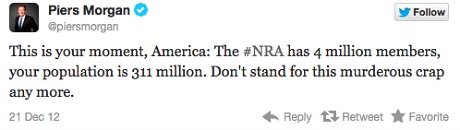
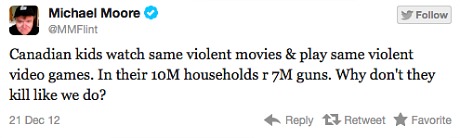
This morning the NRA’s chief propagandist Wayne LaPierre said that the best way to stop nutters like Adam Lanza would be to put armed guards in schools. “The only thing that stops a bad guy with a gun is a good guy with a gun,” LaPierre said. The only way to stop monsters like La Pierre is to ignore them and follow the lead of other countries that have passed sensible gun-control laws.

A 12.20 N.Y. Times editorial pointed out the following: (a) “The N.R.A. presents itself as a grass-roots organization, but it has become increasingly clear in recent years that it represents gun makers. Its chief aim has been to help their businesses by increasing the spread of firearms throughout American society”; (b) “The clearest beneficiary [of the N.R.A.’s political-legislative effort] has been the gun industry — sales of firearms and ammunition have grown 5.7 percent a year since 2007, to nearly $12 billion this year, according to IBISWorld, a market research firm”; (c) “The industry has, in turn, been a big supporter of the N.R.A. It has contributed between $14.7 million and $38.9 million to an N.R.A.-corporate-giving campaign since 2005, according to a report published last year by the Violence Policy Center, a nonprofit group that advocates greater gun control”; (d) “Officials from the N.R.A. have repeatedly said their main goal is to protect the Second Amendment rights of rank-and-file members who like to hunt or want guns for protection. But that claim is at odds with surveys that show a majority of N.R.A. members and a majority of American gun owners often support restrictions on gun sales and ownership that the N.R.A. has bitterly fought.”

Foreign Pic Shortlist

It’s fine to riff about the Academy’s foreign language committee shortlist but the race is over. The 2012 Foreign Language Feature Oscar is going to go to Michael Haneke‘s Amour. Locked, forget about it. (Right?) The only thing that pops out is the wholly unwarranted exclusion of Christian Petzold‘s Barbara, which I saw and greatly admired at Telluride.

Leos Carax‘s Holy Motors wasn’t France’s official submission so that was that, but this is unquestionably one of the great 2012 films, foreign-made or not. Jacques Audiard‘s Rust and Bone suffered the same fate.

The Barbara snub isn’t on the level of the committee’s blow-off of 4 Months, 3 Weeks and 2 Days and/or Olivier Assayas‘s Carlos (can’t recall if it was shortlisted or not but it wasn’t nominated) but it’s a glaring omission all the same. It’s at least encouraging that the latest film from 4,3,2 helmer Cristian Mungiu, the somber and austere and entirely satisfying Beyond The Hills, did make the shortlist.

Nine films out of 71 entries were chosen. I’ve listed them in order of my own personal preference:

1. No (Chile), d: Pablo Larraín (if Amour weren’t in the running, No would be the frontrunner).
2. Amour (Austria) — d: Michael Haneke (guaranteed winner).
3. Beyond the Hills (Romania), d: Cristian Mungiu (brilliant — Mungiu is a Bresson-level auteur)
4. A Royal Affair (Denmark), d: Nikolaj Arcel (a strong, well-written, well produced historical drama — intelligent and compelling).
5. Sister (Switzerland), d: Ursula Meier (saw it in Cannes — a skillful, penetrating, honestly assembled character piece).
6. The Intouchables (France), d: Olivier Nakache and Eric Toledano (will almost certainly be one of the final five nominees).
7. The Deep (Iceland), d: Baltasar Kormakur.
8. Kon-Tiki (Norway), d: Joachim Ronning and Espen Sandberg (watched the screener, was underwhelmed)
9. War Witch (Canada),d: Kim Nguyen (haven’t watched screener).

The shortlist will be pruned to five nominees during a marathon session lasting from Friday, 1.4 through Sunday, 1.6, during which the Academy’s foreign-branch voters will watch three of the shortlisted films each day, etc. Oscar nominations will be announced on Thursday, 1.10, in the early ayem.

Holiday Slumber Vibe

It began sometime last night. I can feel it all the more this morning. Nothing you can point your finger at but it’s here, and it won’t leave for another 13 days. It’s that Xmas feeling of enervation. Today will be just fine and the weekend will be cool, but all next week and Monday and Tuesday of the following week it’ll be a kind of power-down for those who live for the hum of commerce. It’s not “bah, humbug.” It’s “bah, I miss the action.”

I’ll be enduring my holiday coma with a little 2012 summing-up time, extra-exercise time, too-much-food time, screener-watching time, Bluray time (particularly those two Twilight Zone Bluray sets I own), Sundance-list-compiling time.

Holiday slumbers are fine for most people (it’s good for the soul to feel irritated by in-laws), but they always bring me down a bit and I always feel terrific when they recede. Honestly? If I could fast-forward through January 2nd I almost would.

I’m not drawing an analogy between Xmas stoppage and that thick green fog that crawls through the streets in The Ten Commandments — this isn’t a death scenario — but that hazy mist that floats in from the sea in The Incredible Shrinking Man or the poppy field that puts Dorothy, the Tin Man and the Cowardly Lion to sleep on their way to Emerald City. Next week I’ll be the Scarecrow yelling “help! help!”