
“I don’t understand why [Lincoln] didn’t just end when Lincoln is walking down the hall and the butler gives him his hat,” Samuel L. Jackson recently told L.A. Times reporter Steven Zeitchik. “Why did I need to see him dying on the bed? I have no idea what Spielberg was trying to do. I didn’t need the assassination at all. Unless he’s going to show Lincoln getting his brains blown out. And even then, why am I watching it? The movie had a better ending 10 minutes before.”
Year: 2013
Slippage
Vanity Fair‘s Marnie Hanel reported today that an article on Oscar.go, the official website of the Academy of Motion Pictures Arts & Sciences, accidentally and prematurely disclosed that Django Unchained costume designer Sharen Davis has nabbed a Best Costume Design nomination. The page in question has since been taken down, and the person responsible is taking Diazepam as we speak.
If only a similar-type mistake had revealed something big, like the Best Picture or Best Director nominees! The Oscars nominations will be revealed six days hence, or at 5:30 am on Thursday, 1.10.
Untouchables For Simpletons?
Speaking to N.Y. Times reporter Michael Cieply about Gangster Squad (Warner Bros., 1.11), director Ruben Fleischer‘s period melodrama (i.e., set in the late ’40s and early ’50s), producer Dan Lin says “if we do this right, it’s a contemporary gangster movie.”
The instant I read those ten words, I went “Jesus Christ, game over.”
Because I’m guessing that doing it “right,” in Lin’s view, means re-tailoring Harry Truman-era L.A. so it feels like a cool walk-through exhibit at Universal Citywalk. You know…synthetic slick, flash in the fucking pan, dumbing things down for the 21st Century primitives. It means re-styling, filling in the grooves and re-attitudinizing 20th Century Los Angeles so under-40s are in no way challenged, and so they can slide right into it.
I wrote last May that Gangster Squad is a kind of “get Mickey Cohen melodrama” in the vein of Brian De Palma‘s The Untouchables. But after that I speculated that Fleischer’s film will be a “make a lot of noise and look cool and sexy and studly while making a lot of noise and looking cool and sexy and studly” movie. Now I’m thinking it’s going to be that only a little dumber and more primitive. (I won’t see it until Tuesday evening, 1.8.)
Cieply says that the film contains “moral ambiguities ,” but Fleischer and company “have also tried for something new. Their Mickey Cohen is not the historical gangster who inflated his celebrity by displaying his pet’s doggy bed in Life magazine and ran a pathetic racket that involved raising money for a planned movie (never shot) about his own life.
“In Gangster Squad Cohen becomes mythic evil, a Batman villain. His victim is Los Angeles, a glamour doll of a metropolis that is being strangled, like Gotham City in The Dark Knight series. And it is saved, but also sullied, by tommy-gun-wielding cops,” blah blah.
How is this “something new”?
In other words, as Robert Downey, Jr.’s version of Sherlock Holmes is to the older, more traditional versions played by Basil Rathbone, Robert Stephens or Nicol Wiliamson, Gangster Squad is to The Untouchables, Public Enemies, L.A. Confidential and Mulholland Falls. A romp through a semblance of old times, but “rebooted with contemporary cool,” as Cieply puts it.
Enthusiasm Crash
So Tina Fey and Amy Poehler‘s Golden Globes material is still taking shape, but the basic idea, apparently, is to go with a generic 21st Century approach to humor — dry, casual, ironic, referenced — and pretty much stay away from being Ricky Gervais-y or funny. Unless the purpose of this clip is to lower expectations so everyone will be pleasantly surprised when the 1.13 show happens.
Little Pink Pill
It would be nice to catch Steven Soderbergh‘s Side Effects (Open Road, 2.5) before I leave for Park City on Tuesday, 1.15, as I’ll be swamped with Sundance and then the Santa Barbara Film Festival through Saturday, 2.2. Yes, I could see it during the five-day run-up to 2.8, but Soderbergh’s films are always special enough to warrant early viewings. So next week (1.7 through 1.11) would be good. Take back tomorrow, etc.
2012 WGA Finalists
Oh, my God…the 2012 Writers Guild nominations were announced around 10:05 am and here it is 10:29 am and I haven’t posted anything yet. What was I doing the last 24 minutes? Staring into space? You have to re-post breaking news within 10 or 15 minutes, tops. If you don’t you lose cred, and if you keep this up you’ll eventually be panhandling in Palm Springs. This is serious.
With a high percentage of the WGA’s 12,000 members having presumably voted, nominees for the WGA’s Best Original Screenplay award are (1) John Gatins, Flight (2) HE’s own Rian Johnson, Looper, (3) Paul Thomas Anderson, The Master, (4) Wes Anderson & Roman Coppola, Moonrise Kingdom and (5) Mark Boal, Zero Dark Thirty. SHOULD WIN: Boal for Zero Dark Thirty. LIKELY WIN BASED ON TEA LEAF READINGS & PREMONITION: Boal for Zero Dark Thirty.
WGA Nominees for Best Adapted Screenplay are (1) Chris Terrio, Argo, (2) David Magee, Life of Pi, (3) Tony Kushner‘s Lincoln, (4) David O. Russell, Silver Linings Playbook and (5) Stephen Chbosky, Perks of Being a Wallflower. SHOULD WIN: Russell for Silver Linings Playbook. LIKELY WIN BASED ON TEA LEAF READINGS & PREMONITION: Sleepy defaulters will give it to Kushner for Lincoln, middle-of-the-road mentalities with go for Terrio’s Argo, and those who appreciate swift narratives and tight construction and the necessary acts of cutting stuff that doesn’t work and making up stuff that does will go for Russell and Silver Linings.
The WGA Award Ceremony will happen on Sunday, 2.17.
To Have And Hold
In 1972 a man spoke to a woman in a bathroom and said, “You want some man you love to protect and take care of you. You want this golden, shining, powerful warrior to build a fortress where you can hide so you don’t have to ever be afraid. You don’t have to feel lonely or empty. Well, you’ll never find him. You’re alone. You’re all alone. And you won’t be free of that feeling of being alone until you look death right in the face. I mean, that sounds like bullshit, some romantic crap. Until you go right up into the ass of death. Right up in his ass. Until you find the womb of fear. And then…maybe…maybe then, you’ll be able to find him.”
Two years later a woman asked a professional man, “Are you alone?” And the professional man said, “Aren’t we all?” The issue was settled.
Why Do I Even Bother?
I say this every year and people rarely listen, but here goes anyway. There are at least 56 or 57 intriguing films playing at the 2013 Sundance Film Festival (which starts in two weeks). I’m there for nine days so if I really kill myself I might see 27 or 28. That’s 28 or 29 films I probably won’t see. Why aren’t p.r. reps offering to let folks like me see their entries in advance? Because they think it devalues a film to show it early.
A friend, by the way, has heard “very very good things” about Richard Linklater‘s Before Midnight (costarring and co-written by Julie Delpy and Ethan Hawke, directed & co-written by Linklater). He’s also heard that David Lowery‘s Ain’t Them Bodies Saints (Rooney Mara, Casey Affleck, Ben Foster, Nate Parker, Keith Carradine) “is the film people are touting as this year’s Beasts of the Southern Wild.”
Sounder
The idea is to identify the mystery soundtrack music within 10 or 15 seconds. It’s easy if you listen to the end.
Gossip Central
I love this Movie City News admonishment of N.Y. Times contributor Karen Schwartz for having mentioned in her 1.2.13 story about wardrobe choices for HBO’s Girls that star-writer Lena Dunham‘s boyfriend is Jack Antonoff, a member of the Grammy-nominated band Fun. Us broke the Dunham-Atonoff story (if you want to call it that) last September, and then they ran a photo of the couple on 12.9.
Another Anti-Stalinist Pushback
A wise and authoritative pro-Zero Dark Thirty piece has been posted today by Atlantic national correspondent Mark Bowden, who definitely knows his stuff, I’m told. The boiled-down quote to hold on to: ‘Torture may be morally wrong, and it may not be the best way to obtain information from detainees, but it played a role in America’s messy, decade-long pursuit of Osama bin Laden, and Zero Dark Thirty is right to portray that fact.”
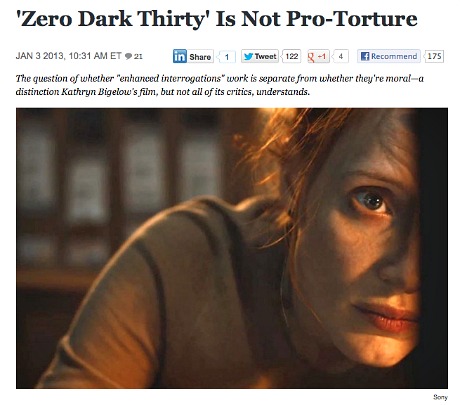
Zero Dark Thirty “is remarkably accurate, and certainly well within what we all understand by the Hollywood label, ‘based on a true story,’ which works as both a boast and a disclaimer,” Bowden writes.
“There apparently was a female CIA field officer who performed heroic service in the 10-year hunt for bin Laden, and whose fixation on ‘Ahmed from Kuwait’ helped steer the effort to success. In the film she is seen butting heads with an intelligence bureaucracy that regards her fixation on Ahmed as wishful thinking. This makes for some dramatic scenes, and gives Jessica Chastain a great many chances to brood with ethereal intensity. The real life ‘Maya’ may have been even more lovely and tenacious, but she was just one of many officers and analysts focused on “Ahmed,” in an agency that never stopped regarding him as an important lead.
“The Saudi attacks in the beginning of the film, identified as the Khobar Towers incident, actually occurred in 1996, six years prior to the action in the film. The raid itself involved four helicopters, two Chinooks and two Black Hawks, not the three Black Hawks shown.” Note: I’m informed by a reliable source that the attack shown in the film is not the 1996 Khobar attack but a 2004 incident. 22 people were shot and killed in the ’04 attack. The CIA actively tried to prevent that attack and failed, as depicted in the film.
“Key planning sessions that happened in the White House Situation Room, chaired by President Obama, are depicted as having happened at Langley with CIA director Leon Panetta. Indeed, those who have accused the current administration of rolling out the red carpet for Bigelow and Boal in the hopes of hyping its role may be surprised to find that the president, whose participation was central throughout, has been almost completed edited out.
“The list could go on, but so could the list of fudged details for any film ‘based on a true story,’ whether it’s the Jerry Bruckheimer/Ridley Scott version of my book Black Hawk Down or Stephen Spielberg‘s Lincoln.
“Everyone understands the rules of this game. Theater is theater, not a scrupulous presentation of fact. We ought to feel betrayed only when filmmakers depart egregiously and deliberately from the record, as Oliver Stone so often has done, substituting what he thinks might be true or perhaps would like to be true for what is known. Reality, after all, is messy and only rarely lines up neatly enough for a two-hour script. Hollywood’s ‘true story’ aims only to color safely inside the lines of history.
“In this broader sense, Zero Dark Thirty is remarkably true. The hunt for bin Laden and other al-Qaeda leaders began with efforts that were clumsy, costly, and cruel. We wrongly invaded Iraq, for instance. We stupidly embraced a regime of torture in our military prisons. Some of the steps we took were tragic and are likely to endure as national embarrassments. But tactics, priorities, personnel, and even administrations changed over those years. The nation learned how to fight this new enemy intelligently.
“Through it all, the search for bin Laden proceeded with bureaucracy’s unique talent for obduracy. This isn’t as sexy or dramatic as watching Jessica Chastain paling before the stink and blood of rough interrogation, a red-tressed Ahab pursuing her white whale through bullets, bombs, and boneheaded bosses…but it stays within the lines.
As for the real story, the question of what role torture played is more difficult. The word ‘torture’ itself is pejorative, in that it equates keeping a prisoner awake with the most sordid practices of The Inquisition. But even mild pressure does tend to lead rapidly to severe mistreatment, as we saw during the Bush administration, which made the mistake of authorizing it, a step that predictably led to tragic and widespread abuses. These have been ably documented by, for one, Alex Gibney (a prominent critic of Zero Dark Thirty) in his stirring documentary Taxi to the Dark Side, and by tenacious journalists like Seymour Hersh and Jane Mayer, not to mention by the candid and devastating snapshots of depraved American military jailors.
“Dick Cheney and others have argued that this coercive regimen produced vital information that prevented terror attacks. So far we have only their word for it, and plenty of other informed voices that contradict it. I do not know the answer, although the reluctance of the current professedly anti-torture administration to explore and punish past abuses may suggest such practices were not altogether useless. The one thing that is certain is that they happened, and on a large scale. The abuses became such a scandal that the Bush administration itself halted the use of coercive methods in 2004. But by then the early interrogations that put ‘Ahmed from Kuwait’ on the CIA’s radar had all happened, and nearly all had involved torture.
“These are facts. Critics of these practices, and of the film, now find themselves in the curious position of arguing that torture played no role in the intelligence-gathering that led to Abbottabad. This is presumably because if the opposite were true, then the hunt’s successful outcome might lead weak minds to conclude that torture has been proved effective.
“Their logic has become, forgive the word, tortured. The key interrogation that focused the CIA’s attention on ‘Ahmed’ concerned Mohammed al-Qhatani. Those who now say that torture played no role in Qhatani’s revelations argue that he offered the information before the rough stuff started. I don’t know if that’s true, but I’ll accept it for argument’s sake. It hardly removes torture from the mix. The essential ingredient in any coercive interrogation is not the actual infliction of pain or discomfort, but fear.
“There can be little doubt that far before Qhatani was actually tortured, he knew damn well that he was in trouble. In Zero Dark Thirty, ‘Ammar,’ who is a fictional amalgam, gives up the name after, not during, his torture sessions. Does this mean that the prior pain and discomfort played no role? In either case, real or fictional, torture creates a context. It creates fear. The only way to know if Qhatani would have been cooperative without being pressured is to have conducted a torture-free interrogation, which did not happen.”