First Apparent Dismissal Of A Possibly Interesting 2015 Film

You’d think that a drama directed by the widely respected Jonathan Demme, written by Diablo Cody and starring Meryl Streep and Kevin Kline would at least theoretically warrant an award-season release. Except TriStar, which is not exactly known as a distributor of prestige-level, award-worthy cinema, is opening Demme’s Ricki and the Flash, on Friday, August 7th — a date that more or less confirms that Ricki is not an awards conversation-type deal. TriStar would surely give it a post-Labor Day release, or better yet one in October or November, if it was. In a 2.4 post, In Contention‘s Kris Tapley notes that the 8.7.15 release date “is a little bit odd“, adding that “sometimes early August releases work out for awards season, sometimes not.” Mostly not, he means. Wells to Tapley: If you were TriStar and you had a Jonathan Demme movie that you suspect will attract award-season acclaim, would you release it on August 7th? Wouldn’t you at least open it in Venice or Telluride or Toronto? TriStar obviously has a different kind of game plan. Ricki and the Flash is the first high-pedigree, seemingly interesting 2015 film to be…I don’t want to say dumped but that release date has certainly lowered expectations all around.


Meryl Streep as a long-of-tooth rock star in Jonathan Deme’s Ricki and the Flash.
It’s Up To Feinberg

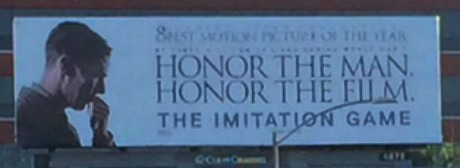
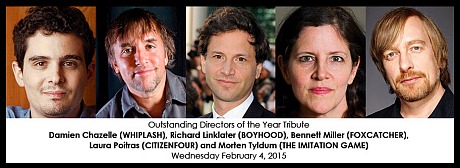
Tonight the Santa Barbara Film Festival will honor five outstanding directors — Whiplash‘s Damian Chazelle, Boyhood‘s Richard Linklater, Foxcatcher‘s Bennett Miller, Citizenfour‘s Laura Poitras and The Imitation Game‘s Morten Tyldum. Moderator Scott Feinberg will, of course, be expected to avoid any questions that won’t be kissy-face in nature, but if he wanted to conduct a Mike Wallace-style interview, what would his questions be? Tyldum would be asked for his opinion on the Weinstein Co.’s “Honor The Man, Honor The Film” Phase Two campaign. Miller would be asked if his next film will be another creepy downer. Poitras would be asked to comment about some people’s opinion that it would have been somehow more noble for Edward Snowden to surrender to U.S. authorities and do a couple of decades in jail. Advance warning: I’m going to ask Chazelle to put on Ed Douglas’s “Yo, Whiplash!” hat so I can snap a photo.

The White Side

Niki Caro‘s McFarland USA (Disney, 2.20), which screens this Saturday at the Santa Barbara Film Festival, has been given a mixed-respectful review by Variety‘s Justin Chang. In keeping with the politically correct view that white guys are a drag and ethnics are more planted and soulful, Chang complains that the film, a Hoosiers-like tale of a downmarket Latino track team winning big, “is treated as a Kevin Costner vehicle first and foremost.” Pic “earns points for its big-hearted portrait of life in an impoverished California farming town, but with its overriding emphasis on how Coach Costner fits into that world, it never sheds its outsider perspective, ultimately emerging a well-intentioned mix of compassion and condescension.

“Not unlike The Blind Side, McFarland, USA is likely to generate some criticism for being the umpteenth film about a white guy productively intervening in the lives of underprivileged minority youth — a charge that has less to do with the facts of Jim White’s genuinely inspiring legacy than with the particular dramatic emphasis that Caro has given them here. Pic “feels at once mildly progressive and unavoidably retrograde. It presents brief, obligatory snapshots of how the other half lives without ever seeming deeply invested, or even particularly interested, in what it’s showing us.

Read more

Knight of Cups Peek-Out on Sunday

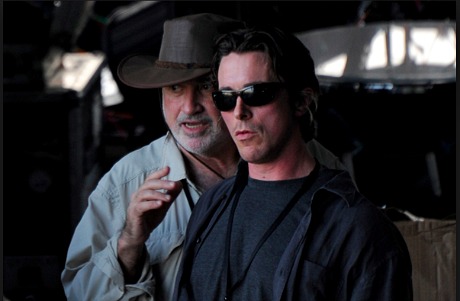
The first screening of Terrence Malick‘s Knight of Cups, apparently another “stream-of-consciousness”, tossing-high-the-lettuce-leaves experience with a dessicated Hollywood slant, will happen at the Berlinale this Sunday at 7 pm, or 10 am Los Angeles time. The first tweets should begin to circulate in the early afternoon. Knight of Cups is a kind of time-capsule film as it was mainly shot in 2012. Last year Malick’s editor Billy Weber told The Playlist that Cups is “less experimental and less dialogue-free than To The Wonder“…okay. On 1.29 producer-financier Ken Kao offered a brief synopsis to the Hollywood Reporter‘s Pamela McClintock: “Christian Bale plays Rick, who is a screenwriter and filmmaker living in California. From the outside, it looks like he has everything. Inside, he’s empty in a lot of ways, and this is his journey of figuring out a way to fill the void.” Or, in other words, a plot-free, head-trippy variation on the well-worn theme about vacant or corroded Hollywood — an idea first hatched by Budd Schulberg in What Makes Sammy Run? (’41) and then in Robert Aldrich and Clifford OdetsThe Big Knife (’55).


Terrence Malick, Christian Bale during the 2012 filming of Knight of Cups.

Fuck Is This?

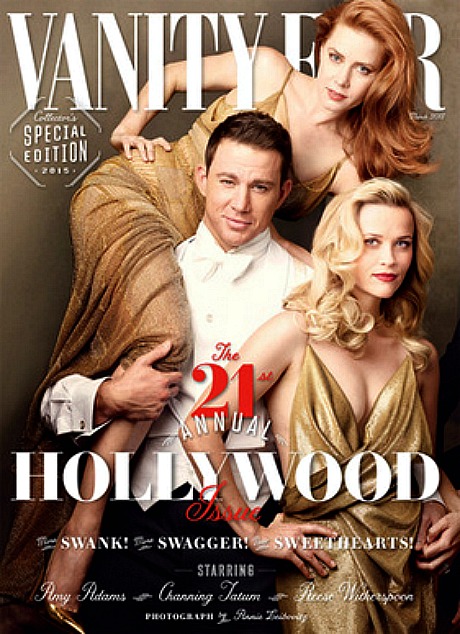
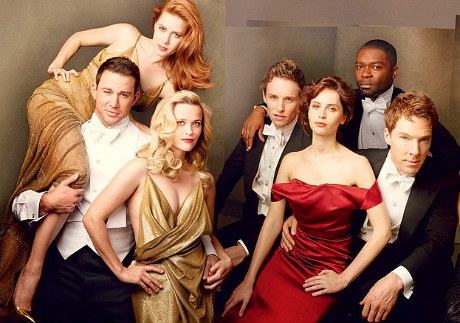
I wanted to watch Keira Knightley do the When Harry Met Sally orgasm scene, but I had to sit through a lot of bullshit besides. It’s part of Jason Bell’s “British Invasion” short film in Vanity Fair‘s Hollywood issue. Tom Hiddleston and Felicity Jones doing Beatty and Dunaway in Bonnie and Clyde…not good enough. James Corden doing Bill Clinton…nope. And Judi Dench, no offense, doesn’t really nail “I’ll have what she’s having.” Basically a bust.

Mild Letdown

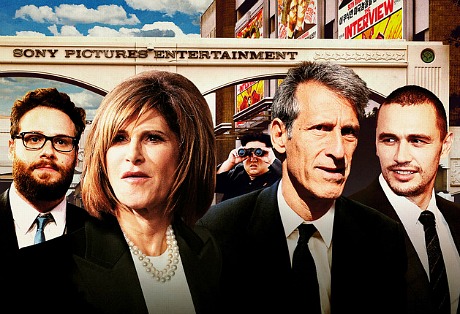
The coolest…okay, the most striking aspect of Mark Seal‘s Vanity Fair piece about the Sony hack is Sean McCabe‘s Photoshopped image of Seth Rogen, Amy Pascal, Michael Lynton and James Franco outside the Sony gates. The article includes a few intriguing quotes and anecdotes, but it’s essentially a boilerplate recap of a story that everyone followed as it happened, and it doesn’t really deliver anything new or fresh or wowser. Seal went out there and did some good dutiful reporting, and the piece is smoothly written. But when I came to the end I went, “Wait…that’s it?”

Refuses To Grow, Doomed To Repeat

The opening solo bit (which you could process as a tribute to steel-welder Jennifer Beals in Flashdance) is terrific, but then it shifts back into the same old whoo-whoo, hedonistic, male-stripping realm that Channing Tatum inhabited in Steven Soderbergh‘s original Magic Mike, and which he grew out of by the end because he’d fallen in love with Cody Horn and realized where the stripper lifestyle was leading. So Magic Mike XXL (Warner Bros., 7.3) is about (a) relapse! and (b) “forget all that growing into maturity and building on your future in furniture design” stuff.

Oldsters, I’m Sure, Are Fine With Sexless Game

The Imitation Game is far from a brave movie in any way when it comes to Alan Turing’s personal life,” says The Daily Beast‘s Tim Teeman in 2.3 article called “The Imitation Game‘s Big Gay Lie.” “It backtracks on his sexuality, and for [the film to] to now wear its gay-pride badge to get liberals on side for Oscars votes is laughable and ludicrous.

“To boil it down: fantastic campaign, but the most cowardly, wrong-headed film to hang it on.”

The Weinstein Company release “focuses on the cornerstone of Turing’s work, cracking the German Enigma Code of World War II,” Teeman notes, “[but it] barely addresses Turing’s sexuality. We see no relationships, no trysts, no sex — and this from a film that now wants the repeal of convictions of men like Turing persecuted under a law based around gay sex.”

Read more

Minority Opinion

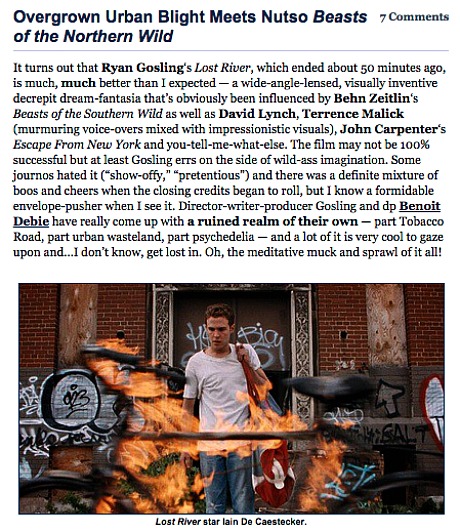
“Set in some kind of verdant, overgrown, foreclosed-upon urban shithole pockmarked with abandoned homes and scuzzy buildings, Lost River is really out there and a lot of it (okay, most of it) is driven by what could politely be called dream logic. That’s a nice way of saying some of it doesn’t make a lot of basic sense. There are mentions of a collapsed economy and a woman having taken out a home loan that she shouldn’t have so it’s obviously a post-2008 realm. There are predatory creeps roaming around like the feral bad guys in Robocop, and there are little pockets of normality and decency and respect for life and property. There are things that happen every so often without apparent motivation but with films like this you have to roll with the imaginative flow.” — from my 5.20.14 Cannes Film Festival review.

Jean-Paul Sartre’s No Exit

No Exit “is a depiction of the afterlife in which three deceased characters are punished by being locked into a room together for eternity. It is the source of Sartre’s especially famous and often misinterpreted quotation ‘L’enfer, c’est les autres’ or ‘Hell is other people’, a reference to Sartre’s ideas about the perpetual ontological struggle of being caused to see oneself as an object in the world of another’s consciousness.”