Tomorrowland In Trouble?

From Justin Chang‘s Variety review: “In his Pixar triumphs The Incredibles and Ratatouille, writer-director Brad Bird proved himself not just a wizardly storyteller but also an ardent champion of excellence — of intelligence, creativity and nonconformity — in every arena of human (and rodent) accomplishment. All the more disappointing, then, that the forces of mediocrity have largely prevailed over Tomorrowland, a kid-skewing adventure saga that, for all its initial narrative intrigue and visual splendor, winds up feeling like a hollow, hucksterish Trojan horse of a movie — the shiny product of some smiling yet sinister dimension where save-the-world impulses and Disney mass-branding strategies collide. A sort of Interstellar Jr. in which the fate of humanity hinges on our ability to nurture young hearts and minds, the picture runs heavier on canned inspirationalism than on actual inspiration.”

From Todd McCarthy‘s Hollywood Reporter review: “How many sci-fi/fantasy films of recent years have climaxed with anything other than massive conflict and conflagration? Whatever the number, Tomorrowland is one of the few to place far more emphasis on talk than action, which is what will probably contribute to what, for some, will make for a softer experience than the genre norm. The film’s general coolness and vision of a potentially serene future reminds more of Spike Jonze’s Her than of anything in the Marvel, George Lucas or James Cameron-derived worlds, not to mention other far more violent ones. As thoughtful and sympathetic as the intentions are here, perhaps it all goes back to the point often made about Dante; what do people read and remember, Paradiso, Purgatorio or Inferno?”
The Lessening

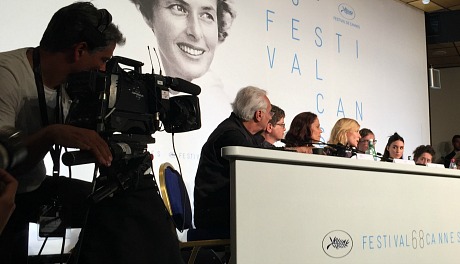
In terms of definite default must-sees, the Cannes Film Festival has suddenly turned into a one-movie-per-day event. On Monday, 5.18 (or technically today as it’s now 1:20 am) the essential is Pete Docter‘s Inside Out, screening at 11 am with a 9 pm party. Tuesday, 5.19 is the big day for Denis Villeneuve‘s Sicario, also hosting an evening party. The biggie on Wednesday, 5.20 is Paolo Sorrentino‘s Youth, but I’ll also need to see Brad Bird‘s Tomorrowland as it opens commercially in France that day. The hottie on Thursday, 5.21 is Gaspar Noe‘s Love with Valley of Love, the Guillame Nicoloux film, running a close second. Mark Osborne‘s The Little Prince is the centerpiece film on Friday, 5.22, but I’ve already mentioned my reluctance to come within 100 yards, much less sit down with it. I’ll catch others besides these, of course, but after four intense days (Thursday, 5.14 to Sunday, 5.15) the festival is in downshift mode.


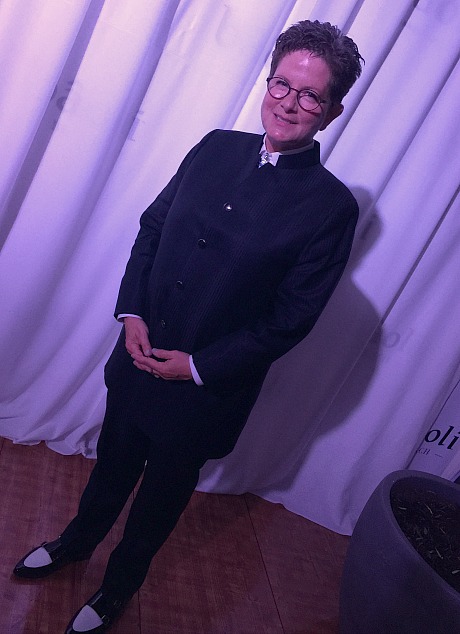
Carol screenwriter Phyllis Nagy has earned a placemark as a strong if not likely candidate for a Best Adapted Screenplay Oscar. The film doesn’t open until December and that’s a long way off, but if spareness and subtlety mean anything…just saying. Nagy (rhymes with “Taj” as in Taj Mahal) is bright, exacting and clear of focus. She also has superb taste in evening wear, as the exquisite non-lapelled, specially-designed suit she was wearing at the Carol after-party proved.

McQueen Icarus

Yesterday afternoon I caught Gabriel Clarke & John McKenna‘s Steve McQueen: The Man & Le Mans — in part a fascinating time trip but mostly a sad, bittersweet mood piece about failure and a movie star swallowing his own tail. Which I found affecting as hell. Clarke and McKenna have certainly made something that’s heads and shoulders above what you usually get from this kind of inside-Hollywood documentary. Heretofore unshared insight, a lamenting tone, an emotional arc. Plus loads of never-seen-before footage (behind-the-camera stuff, unused outtakes) plus first-hand recollections and audio recordings. A trove.

Steve McQueen: The Man & Le Mans may seem at first glance like a standard nostalgia piece about the making of McQueen’s 1971 race-car pic, which flopped critically and commercially. (I own the Bluray but I’ve barely watched it — the racing footage is authentic but the movie underwhelms.) Yes, in some ways the doc feels like one of those DVD/Bluray “making of” supplements, but it soon becomes evident that Clarke and McKenna are up to something more ambitious.

What their film is about, in fact, is the deflating of McQueen the ’60s superstar — about the spiritual drainage caused by the argumentative, chaotic shoot during the summer and early fall of ’70, and by McQueen’s stubborn determination to make a classic race-car movie that didn’t resort to the usual Hollywood tropes, and how this creative tunnel-vision led to the rupturing of relationships both personal (his wife Neile) and professional (McQueen’s producing partner Robert Relyea, director John Sturges), and how McQueen was never quite the same zeitgeist-defining hotshot in its wake.

Read more