Bygone Sensibilities

A few days ago and for no timely reason at all A.V. Club‘s Mike Vanderbilt posted a piece about original reactions to William Friedkin‘s The Exorcist, which opened in December ’73. It reminds you how jaded and cynical the culture has since become. The Exorcist gobsmacked Average Joes like nothing that they’d seen before, but you couldn’t possibly “get” audiences today in the same way. Sensibilities have coarsened. The horror “bar” is so much higher.

But there’s one thing that 21st Century scary movies almost never do, and that’s laying the basic groundwork and hinting at what’s to come, step by step and measure by measure. Audiences are too impatient and ADD to tolerate slow build-ups these days, but Friedkin spent a good 50 to 60 minutes investing in the reality of the Exorcist characters, showing you their decency and values and moments of stress and occasional losses of temper, as well a serious investment in mood, milieu and portents. It had the trappings of class — a genuinely eerie score, flush production values and the subdued, autumnal tones in Owen Roizman‘s cinematography. It was only in the second hour that the shock-and-awe stuff began.

The best parts of The Exorcist don’t involve spinning heads or pea-soup vomit. I’m talking about moments in which scary stuff is suggested rather than shown. The stuff you imagine might happen is always spookier.

Such as (1) that prologue moment in Iraq when Father Merrin (Max Von Sydow) is nearly run over by a galloping horse and carriage, and a glimpse of an older woman riding in the carriage suggests a demonic presence; (2) a moment three or four minutes later when Merrin watches two dogs snarling and fighting near an archeological dig; (3) that Washington, D.C. detective (Lee J. Cobb) telling Father Karras (Jason Miller) that the head of the recently deceased director Burke Dennings (Jack McGowran) “was turned completely around”; (4) Karras’s dream sequence about his mother calling for him, and then disappearing into a subway; (5) that moment when Regan MacNeil (Linda Blair) mimics the voice and repeats the exact words of a bum that Karras has recently encountered — “Can you help an old altar boy, father?” My favorite bit in the whole film is that eerie whoosh-slingshot sound coming from the attic.

Read more

Will Weinsteiners Downplay Rooney Mara’s Cannes Triumph By Running Her As Supporting Actress?

One of my early reactions after seeing Todd HaynesCarol was that costars Cate Blanchett and Rooney Mara, who play closeted lovers in this 1952 Manhattan-based tale, are evenly matched in every sense of the term — neither dominates the other in terms of passion or screen time, and both parts are equally important.  But conventional thinking says that the Weinstein Co. campaigning Blanchett vs. Mara in the Best Actress category would be self-cancelling (how could it not be?), and so a theoretical narrative seemed to emerge over the last few days that Blanchett, who’s already won two acting Oscars (Best Supporting for portraying Katharine Hepburn in The Aviator, Best Actress for her lead perfofmrance in 2013’s Blue Jasmine), would be pushed for Best Actress with Mara presented as a Best Supporting Actress contender — even though that idea makes no sense if you’ve seen the film. The argument that Blanchett’s titular character drives the narrative is not an open-and-shut proposition — one could easily argue that Rooney’s character is in fact the lead protagonist. In any event the Blanchett-first scenario has now been upended with Mara having won a Best Actress prize during last night’s Cannes Film Festival awards. Yes, the Weinsteiners can wave this off and still insist that Blanchett is their Best Actress pony with Mara campaigning in a supporting capacity, and that might work if everyone agrees to wear blinders. I only know that after last night there’s a strong argument against running Mara in supporting. There’s no way to kick this around without seeing Carol first, but any way you slice it Harvey Weinstein and his marketers are looking at a tricky situation.


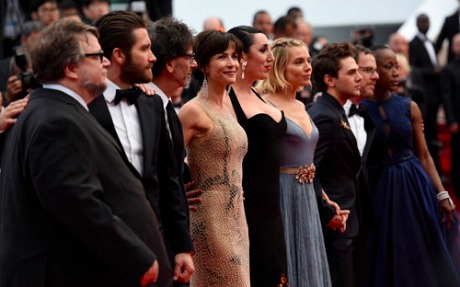
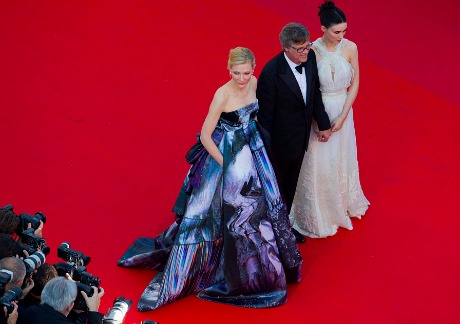
“Pool photo” by Yves Herman accompanied a 5.24 Manohla Dargis N.Y. Times interview with Haynes.

Usually Averse But Not This Time

“In 2013, the parents of a five year-old recovering from leukemia asked the Greater Bay Area Make-A-Wish Foundation to help him become a superhero for a day. The event’s announcement went viral, thousands of volunteers and well-wishers flooded the streets of San Francisco, and millions more tuned in online — all recounted in Dana Nachman‘s documentary Batkid Begins: The Wish Heard Around the World. Prior to the film’s Slamdance world premiere, Julia Roberts‘ representatives announced that she’s attached to produce and star as one of the event’s key organizers in a feature film version of Batkid’s story. Whether that development will drive theatrical response for this documentary or simply seal the deal for small-screen opportunities, this project might not be the last we’ll hear of the young boy’s heroic exploits.” — from Justin Lowe‘s THR review, dated 1.30.15. The New Line release opens on 6.26.

Read more

Less Is Fine, Thanks

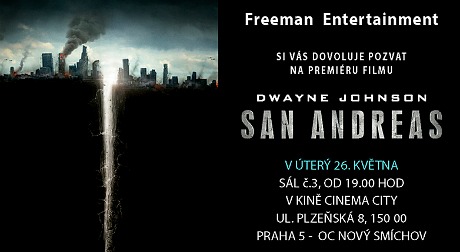
The basic point is to recover from Cannes by doing almost nothing. Okay, very little. Filing, reading, naps, a nightly two-hour roam-around, screenings (San Andreas, Spy), Tunnel Bear movies on the Macboook Pro. No aggressive sightseeing, definitely no big meals. The temperature is barely 70 now, dropping to 60 or below this evening…curious. Sweaters, jackets, scarves.

Read more

Selected Cannes Press Conferences

These end-to-end capturings of press conferences offer a sense of the vibe and decorum, in large part due to moderator Henri Behar, who’s always been a good friend (and who allowed me to sublet his apartment in Cannes way back in ’92, which was my first time here). Among these five I attended the conferences for George Miller‘s Mad Max: Fury Road and Todd HaynesCarol. (I’m visible taking iPhone video before the start of both, at least as far as the back of my head is concerned.) Having to be at a major screening prevented my attending the Son of Saul conference, which I wanted to witness. I decided against attending the conferences for Sicario and Sea of Trees, no offense, in order to file and also, frankly, because neither film did it for me.

Read more

Those Confounding Decisions By Cannes Jury

Last night’s Cannes Film Festival awards weren’t just curious in some respects, but almost bizarre. The jury will never cop to their deep-down motives or to the complete political picture, but I know that Cannes topper Thierry Fremaux chose a fair amount of French films to show competitively, some regarded as disappointing or mezzo-mezzo, and the decision to give three of the top awards — the Palme d’Or, Best Actor and Best Actress (or half of it) — to French recipients was, whether the jury admits it or not (or was conscious of it or not), some kind of political gesture of support. A friend wrote last night that this “had the effect of making what was a very bad showing for the French all around, as almost all of their many entries were average at best and sometimes far worse, look pretty good.”

Giving the Palme d’Or to Jacques Audiard‘s respectable but far-from-stellar Dheepan was a huge forehead-slapper. Laszlo NemesSon of Saul, which won the second-place Grand Prix award, would have been a far more deserving recipient; ditto Todd HaynesCarol, which many fell to their knees over. (A producer pal: “Every year the Cannes critics rave about a film like Carol, so then the Jury goes out of its way to not to give it a prize. It’s as if they have to defy the pure merit of it all just so as to not appear ‘populist.'”)

I’m telling you that nobody and I mean nobody expected Dheepan to win anything, much less the Palme d’Or. In this sense it’s fair to say that the Cannes Jury (chaired by Joel and Ethan Coen) was completely divorced from a perceptual reality shared by nearly every journalist I talked to during the festival. Nobody even fantasized about Dheepan emerging as the Big Winner…nobody.

Journalists: “Dheepan is easily the least distinguished of Audiard’s last three films — a good or even a pretty good film but far from exceptional. At best a modest achievement.” Ethan Coen: “[The jury’s reaction to Dheepan] was swift…everybody had an enthusiasm for it. To some degree or another we all thought it was a very beautiful movie. We’re different people, some people had greater enthusiasms for other things or lesser, but in terms of this movie, everybody had some level of excitement, some high level of excitement and enthusiasm for it.” There was no overlap here. Cannes journalists were on one planet, the jury was on another.

Read more

John Nash, Original Beautiful Mind Mathematician…Just Like That

Yesterday afternoon famed mathematician and Nobel Prize winner John Forbes Nash, 86, and his wife Alicia, 82, had just returned from Norway and were riding in a cab on the New Jersey Turnpike their way to back to their Princeton home. A familiar situation, perhaps one that led to daydreams as Nash gazed at the mid-afternoon highway traffic, but then a wild card hit the table and in a flash, Nash and his wife were dead, “killed” in a sense by 46 year-old cab driver Tarek Giris, who apparently made some kind of judgment error in trying to pass a car and wound up slamming into a guard rail with the Nashes getting thrown from the cab.


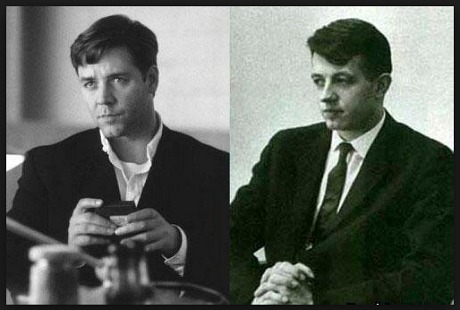
(l.) Russell Crowe; (r.) the young John Nash

It’s conceivable that 14 years ago Girgis, then 32 or 33, saw Ron Howard‘s A Beautiful Mind, the 2001 film that was inspired by Nash’s life, and in which Russell Crowe played Nash and Jennifer Connelly played Alicia. And if he did it’s entirely possible that Girgis was moved by it, perhaps profoundly. Or perhaps he felt special stirrings from James Horner’s score (as I did) or the third-act “pens” scene or whatever. The fact that many were touched by A Beautiful Mind is why it overcame the dissenters and quibblers and won the Best Picture Oscar. I knew from the get-go that it wasn’t about the full Nash equation, of course, and that certain aspects of his life had been omitted, but I always felt a curious kinship, rooted in dreams and that music and that look of childlike sadness in Crowe’s eyes and that spazzy hand gesture he used to suggest the flight of thought.

Read more

Cannes Crescendo: Hooray for Dheepan, Son of Saul, Hou Hsiao-hsien, Rooney Mara, Vincent Lindon

8:17 pm (Prague): Palme d’Or: Dheepan, dir: Jacques Audiard. Wells reaction: Kind of an odd call. Except for the shoot-out ending Dheepan is a very decent film — touching, honestly told, nicely shaded. But it’s far from Audiard’s best. The Palme d’Or should have gone to Son of Saul and Carol should have won the Grand Prix.

8:11 pm (Prague): Grand Prix award: Son Of Saul, dir: Laszlo Nemes. Wells reaction: Justified, complete agreement, good call…but it should have won the top prize.

8:05 pm (Prague): Best Director: Hou Hsiao-hsien, The Assassin. Wells reaction: Didn’t see it.


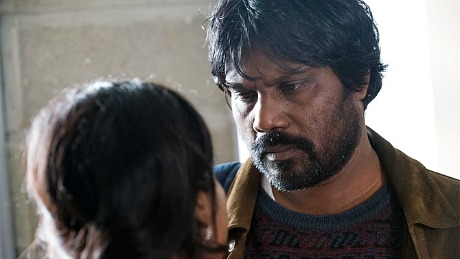
Antonythasan Jesuthasan in Jacaues Audiard’s Dheepan.

7:55 pm (Prague): Best Actor: Vincent Lindon, The Measure Of A Man. Wells reaction: Didn’t see it but good for Lindon, a solid, subtle actor who’s been inhaling cigarettes for decades.

7:52 pm (Prague): Jury Prize: The Lobster, dir: Yorgos Lanthimos. Wells reaction: What is this, the attaboy award for an interesting first hour? I respected The Lobster during the initial stages and then gradually came to despise it the longer it went on, and they’re giving it a fucking Jury Prize?

7:49 pm (Prague): Best Actress: Rooney Mara, Carol and Emmanuelle Bercot, Mon Roi. Wells reaction: Rooney won over Cate Blanchett! I thought the two of them should split the Best Actress award. This means the Weinstein Co. can’t run Rooney for the Best Supporting Actress Oscar…right? Well, they can but I wouldn’t agree. Bercot was sufficient in the okay-but-nothing-to-get-excited-about Mon Roi so I don’t know what this is about.

7:47 pm (Prague time): Best Screenplay: Chronic, written by Michel Franco. Wells reaction: Uhhm…okay. If you guys say so. But what about that ending? You can’t just have a car come along and do something that cars sometimes do…that’s cheating. Definitely not good writing. I thought that the pacing of Chronic was way too slow, but that’s not a comment on the writing. Keep in mind that Leviathan‘s screenplay won this award last year so this may be, in the jury’s eyes, a consolation prize.

Throne of Blood, Grime and Gunk

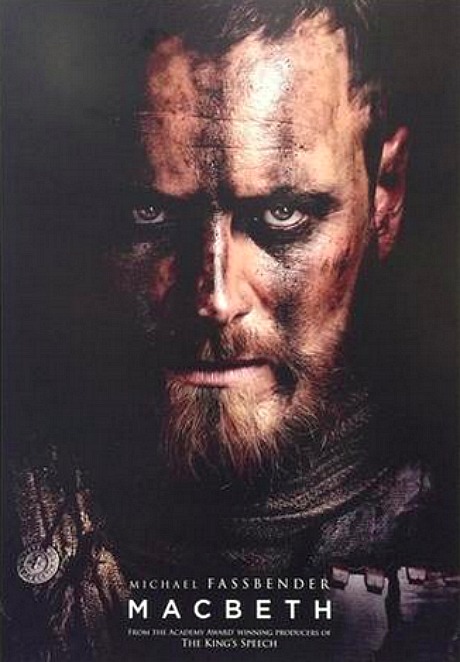
I can’t understand how anyone who attended yesterday morning’s Cannes Film Festival screening of Justin Kurzel‘s Macbeth could emerge singing its praises. You could call it a tolerable adaptation of William Shakespeare‘s classic tragedy if you want. I didn’t hate it and might have half-liked it if I could hear it…but I couldn’t. Partly because of the mix but mainly due to the Grand Lumiere’s indisputably atrocious sound system (way too much bass and echo, not enough middle). I couldn’t hear a good 80% to 90% of the dialogue, and anyone who was there and claims to have heard all or most of it is a flat-out liar. For me it was basically about reading the French subtitles plus catching an occasional verb or noun. If you can’t hear the Shakespeare then why watch it? To savor the smoke and the chill and the dampness, the treeless typography, the ash-smeared faces and gooey blood drippings and Michael Fassbender‘s dirty fingernails?

The emphasis, no question, is on blood, venality, gray skies, gunk, grime, authentic Scottish locations and general grimness — the basic Game of Thrones-meets-300 elements that, for me, always result in two reactions: (a) “This again?” and (b) “Let me outta here.”

Read more

Destructo-Porn Theory

I have this sense that the two Sharknado films ignited what I’m calling the third phase of destructo-porn — disaster as distantly-contemplated deadpan humor. Urban wreckage has become ubiquitous in big-budget FX films over the last decade. Pretty much every superhero film has left major areas of great American cities in rubble. So straight-ahead destructo porn had to come up with a new approach or theme, and ironic laughter might be it. Yes, hipper audiences have been chuckling since the original ’70s cycle of disaster films (a decade’s worth from 1970’s Airport to ’80’s When Time Ran Out) but the films nonetheless pushed a sober-minded apocalypse metaphor about…you tell me, civilization falling from grace? Then came the Roland Emmerich destructo-porn cycle (1996’s Independence Day, Mimi Leder‘s Deep Impact, ’04’s The Day After Tomorrow and ’09’s 2012) that was basically about improved FX blended with scary climate-change scenarios (“This is what’s coming, people, if we don’t do something!”). The post-Sharknado cycle assumes a general fuck-it attitude out there, fueled by general cynicism about the willingness of governments to do anything to stem trends that will hasten the planet’s actual destruction. Above and beyond the cynicism that would kick in anyway, I mean, with Dwayne Johnson in a starring role.

Resignation

I’m not saying it matters a great deal, but I can’t catch a Tomorrowland break to save my life. I left the country too early to catch domestic press screenings, and then no English-language versions were playing in Cannes when it opened four days ago, and only Czech-dubbed versions are currently playing in Prague. The other night a critic friend told me not to worry, that it wasn’t worth my concern. The Metacritic and Rotten Tomatoes ratings are at 60% and 50%, respectively. And the Sunday consensus among HE regulars, if one exists, is…?

No Fan of Stanwyck’s Butchy Phase, Especially in Westerns

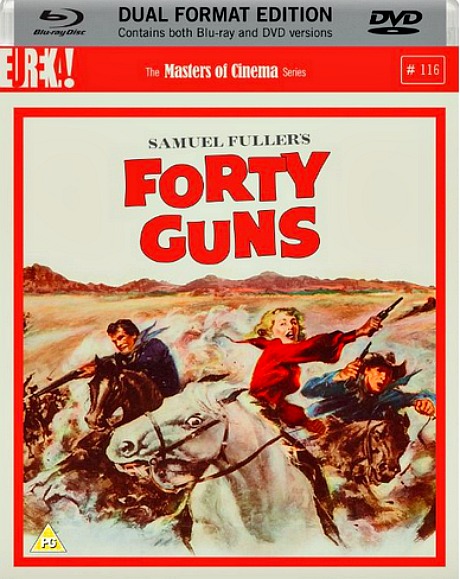
Barbara Stanwyck‘s pre-code roles are interesting in a socially nervy context (she often played sexually brazen tough cookies who didn’t let guys push her around) but her flush period was between ’37 and ’44 — an era that began with Stella Dallas (’37) and ended with Double Indemnity (’44) but peaked, really, in ’41 when she was her crisp and feisty best in The Lady Eve, Meet John Doe and Ball of Fire. Stanny lost me when she cut her hair shorter (somewhere around 1948’s Sorry, Wrong Number) and began to play tough butch-boss types, especially in westerns like Alan Dwan‘s Cattle Queen of Montana and Samuel Fuller‘s Forty Guns (which pops on Bluray on 6.22.15 via Masters of Cinema). With a Brooklyn accent! On top of which Stanwyck was a right-winger who admired Ayn Rand and supported HUAC witch-hunting.

Read more