Cusack + Dano = “Woodstein” — A Single Great Performance

Last night a friend asked how I might play my Love & Mercy cards if I was Roadside Attractions and looking for a little award-season traction. Specifically who would I push for Best Actor — Paul Dano, who plays the genius-exploding Brian Wilson in the mid ’60, or John Cusack, who plays the 40ish, somewhat unsteady Wilson in a kind of health-recovery mode but suffering under a harsh psychological regimen imposed by Dr. Eugene Landy (Paul Giamatti) but is then gradually saved from this by his future wife, Linda Ledbetter (Elizabeth Banks).
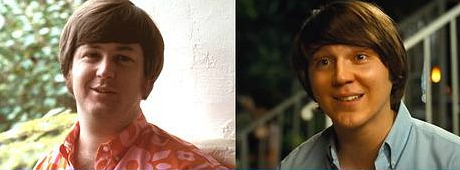

young Brian Wilson, Paul Dano in Love & Mercy.
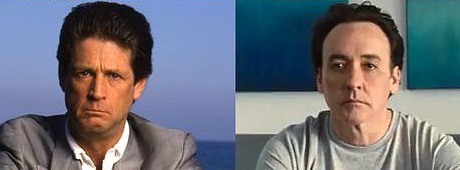

40ish Brian, John Cusack.

My basic response was that Cusack and Dano give a single astonishing performance comprised of two parts — it’s not a question of one over the other but a unified effort…a complementary twosome with equal screen time, equal weight, equal value. Brothers.

Here’s how I put it this morning: “Dano vs. Cusack? Does it have to be an either/or? It’s a tough one, almost as tough as how to campaign the two completely equal leads of Carol. The truth is that Rooney Mara‘s performance is completely equal to Cate Blanchett‘s and is arguably more central and a bit more commanding and plot-driving, even though you’re inclined to believe at the beginning that Blanchett is the lead because she’s playing the titular character and all.

“Determining the answer to the Dano-Cusack problem is no less thorny.
Read more

The Only Way is Forward

“What are you gonna do? Lock us all up? We’re in every home. We’re half the human race. You can’t stop us all.” Do you love Carey Mulligan‘s working-class accent or what? She’s playing Maud, a working mother who becomes a convert to the women’s suffrage cause with Meryl Streep playing what looks to be a distinctive supporting role as “outlaw fugitive” Emmeline Pankhurst. But to really rate with the cool kidz Suffragette has to do more than just tell “the story of a movement.” It has to achieve a little more than what last year’s voting rights struggle film (i.e., Selma) did.

Read more

Easy Didn’t Do It

Is it okay if I post my review of Doug Ellin‘s Entourage (Warner Bros., 6.3) tomorrow morning? It’s a total throwaway — a theatrical release that behaves like an Entourage episode with a few more boobs and famous-face cameos. Obviously nobody cared when they made it. Well, they wanted the film to make money, of course, but there’s so much in this thing that feels surface-skimmy and smug and lightweight. I didn’t hate it but it’s lazy and diddly and too delighted with material abundance, and I have no room in my life for a movie that can’t be bothered to sweat out the difficulty of being good or at least interesting. At no time was I under the impression that anyone involved in the making had sweated or given any kind of serious thought to anything. I just sat there with my luggage in the row ahead of me (I’d come right from JFK on the A train — 50 minutes from Howard Beach to 8th Avenue and 34th Street) and waited for it to end. The boobs are healthy and bouncy like only early 20something boobs can be, but they didn’t do anything for me because their carriers (i.e., the women) lacked intrigue and complexity…sorry. Hooray for Ellin and producer Mark Wahlberg and Adrian Grenier and the other cast members making more dough off this thing, and to everyone else who collected a nice paycheck during production or in post. I’ll get into it a bit more tomorrow morning. My flight to Los Angeles leaves in the late afternoon so there’s plenty of time.

“Curl of the Wave”

I’ll be celebrating Bill Pohlad‘s Love & Mercy (Roadside, 6.5) for the third time today at a 6 pm screening at Manhattan’s Dolby 88. My first viewing was at the Toronto Film Festival (here’s my 9.8.14 review) and the second time was in late April at L.A.’s Wilshire Screening Room.

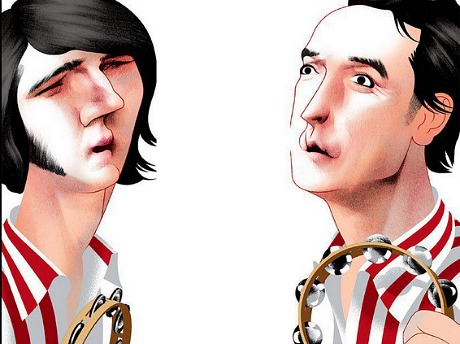
Anyway today I read a superbly written review by Los Angeles magazine’s Steve Erickson, and I was struck by two sentences in particular. One in which Erickson describes Brian Wilson‘s post-Pet Sounds, Smile-era comedown in which “the celestial sounds in his head turned on him, and became the screams of angels falling from heaven.” The second alludes to Wilson’s music-creating process: “Great artists create in circles, not lines, in the ever-bending curl of the wave rather than in its rush to the shore’s conclusion.”

vs. “Screams of Angels Falling From Heaven”


Los Angeles magazine illustration by Andre Carrilho.

Read more

Trying Again

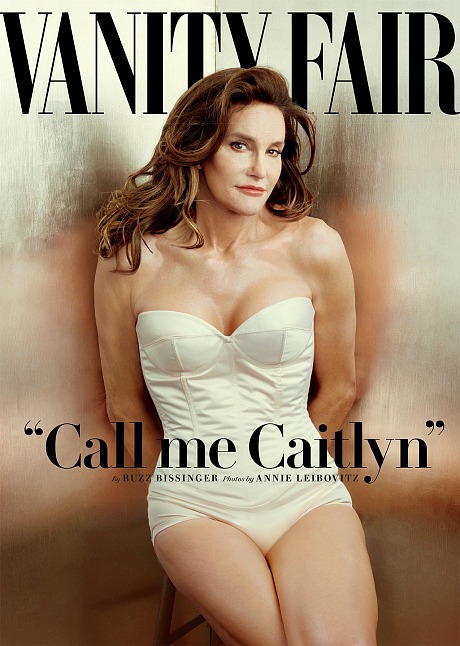
Yes, Caitlyn Jenner looks a little like Jessica Lange. But again, why the effort? Why the big, attention-seeking Vanity Fair projection of a glammy, sexy woman? She told Diane Sawyer during that 4.24.15 interview that she’s “not gay…I’ve never been with a guy” and that while he/she’s been attracted to women all his/her life, that’s no longer the case — “I’m asexual.” And yet she’s obviously projecting a sexual aura. If she’s decided to be sexual, fine, but what’s the point of the VF cover if sexuality isn’t on the table? Why can’t Caitlyn just be womanly, nurturing and compassionate and let it go at that? That aside, a question that all hetero males (including Eddie Murphy types) are probably asking themselves is “would you hit that?” Answer: No, I wouldn’t because her shoulders are too broad, her feet are way too big and Jenner is 6′ 2″.

Read more

Everyone Needs To Pack Heat to Guard Against School Shooters, Government Baddies

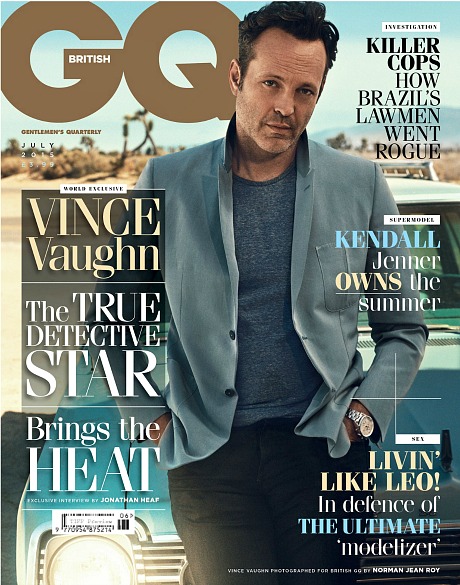
In a just-published interview in British GQ, slimmed-down True Detective star Vince Vaughn says that anyone and everyone should arm themselves (including elementary school teachers and administrators) to prevent the next school slaughter. Which would at least allow for the potential of daily Sam Peckinpah gunfights at the O.K. Corral. Vaughn also wants everybody to have a pistol or rifle in order to “resist the supreme power of a corrupt and abusive government.” So if the government gets too pushy or malevolent Vaughn and his pallies are going to disappear into the forest and become Wolverine-like guerillas? Guns are a fetishy appendage for right-wingers — fantasy metaphors for individual strength and the potential to resist born of wild-west machismo. On top of which everyone walking around with a weapon would mean a lot more people getting plugged, not less.

Read more

Hillary Losing Independent Males Over Egazhi, Trust Issues, Perceived Greed, Snitty Granny Vibes

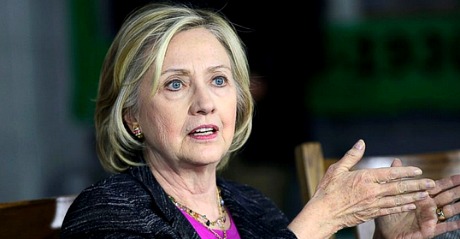
It appears that on some level my mixed feelings about Hillary Clinton (i.e., not much of a fan but will vote for her in the general election to save the country from Marco Rubio) are being shared to some extent. A new Quinnipiac poll shows that her support among independent males is sinking and that right now she’s nearly even with Rubio…good God! All along I’ve been operating on an assumption that none of the Republican stooge wannabes are strong enough to beat her and that she’ll win the general one way or the other. For the first time it’s hitting me that Rubio, a pandering climate-change denier, could conceivably win. Rubio!

Clinton’s problems are mainly due to a slippage among independent male voters, say pollsters, and are more particularly due to Eghazi fallout, a feeling that she’s greedy (ridiculous speaking fees, Clinton Foundation razmatazz), an inability to inspire trust, a sense that she lacks empathy for working schmoes, those puffy eye bags (go ahead and laugh but all aspects of a person’s physical appearance are metaphors) and her natural, God-given ability to generate strong negatives.

I swear to God that a good third of Clinton’s problems would disappear if she would just drop a few pounds and have a little “work” done. Perhaps more than a third. Getting a personality transplant would also help. I know this sounds lame or superficial but hear me out.

Hillary obviously has nothing to worry about with women voters — her problem is with guys. As much as I hate to say this (and please understand I’m in no way respecting or winking at this attitude) Clinton’s problems are at least partly due to the fact she has this crabby neghead vibe, that she doesn’t seem to be all that mellow or kindly. She looks like a vaguely snitty, pissed-off granny who possibly sips a little too much wine. Guys are visually guided and like to vote for semi-attractive women, or at the very least women who don’t give off contentious ex-wife vibes. Elizabeth Warren has a far more genteel, agreeable manner than Clinton, which is one reason why I wanted her to run.

Read more

The Times They Were Derangin’

If you’ve read one or two books about the malignant visions of Charles Manson and the murders he caused in the late summer of ’69, this podcast by essayist and author Karina Longworth doesn’t deliver anything new, but she re-tells the saga in such a way that the bizarre particulars of those days seem as vivid and striking as recent news. Not just the activities of the Manson Family but the whole late ’60s youthquake zeitgeist (particularly from the perspective of the film industry), the effect of hallucinogens upon people who were too dumb or deranged to derive any profound spiritual benefit, the us-vs.-them mentality that had begun to manifest three or four years earlier. This is Episode #44 of Longworth’s You Must Remember This series. The title is “Charles Manson’s Hollywood, Part 1: What We Talk About When We Talk About The Manson Murders.” It runs an all-too-brief 35 minutes.

Easy On The Eye

From Vashi Nedomansky’s explanation of a short about Mad Max: Fury Road, George Miller and John Seale‘s crosshairs cinematography and the editing of Margaret Sixel: “The most popular editing tendency for action scenes and films over the last ten years has been the ‘Chaos Cinema’ approach — a barrage of non-congruent and seemingly random shots that overwhelm the viewer with a false sense of kinetic energy and power. It follows, by contrast, that one of the many reasons Mad Max: Fury Road works as an action film is the almost soothing shooting and editing style. By using ‘eye trace‘ and ‘crosshair framing‘ techniques during the shooting, Sixel could keep the important visual information vital in the center of the frame. Because almost every shot was center-framed, comprehending the action requires no hunting of each new shot for the point of interest. The viewer doesn’t need three or four frames to figure out where to look. It’s like watching an old hand-drawn flip book whiz by. The focus is always in the same spot.”

Mad Max: Center Framed from Vashi Nedomansky on Vimeo.

Read more

Tyler Durden Would Approve

We all have our notions about what’s been happening with Shia LaBeouf over the last year or two (i.e., “I’m not famous anymore“), but this extreme motivational video he’s made is very Tyler Durden, and therefore cool in my book. How many guys did Durden save from a life of muddling along and zoning out in Fight Club? LaBeouf is trying to do the same thing. I know how it feels to be stuck in a hole. I was there in my mid 20s, that place of “yeah, I really gotta make some serious moves and if I don’t…I don’t want to think about it.” What prods you along is a quiet, nagging voice that says “you’re still not doing what you need to do…you’re still procrastinating…how can I get through to you, man?” That voice doesn’t go away but it never gets loud. It never insists. LaBeouf is saying “enough…enough of your bullshit…get going or else.” [Thanks to friend-of-HE Jon Rahoi for bringing this to my attention.]

If Reese and Hillary Say So

Yesterday morning Reese Witherspoon spoke to a crowd at the Producers Guild of America’s 7th annual “Produced By” conference on the Paramount lot. Variety‘s Dave McNary reports that Witherspoon “addressed the question of whether she’d ever portray Hillary Clinton. She responded by saying that she’s been asked to do so several times and wryly pointed out that she portrayed a young version of Clinton as Tracy Flick in 1998’s Election.” The actress-producer added that when she met the former Secretary of State and current presidential candidate, Clinton said, “Everybody talks to me about Tracy Flick in Election.” One, I’ve seen Election six or seven times and have never flashed upon any similarities between Flick and Clinton. If Flick reminds me of any politician it’s Richard Nixon. (I’ve also always suspected that on some level Flick is Witherspoon.) And two, take away Alexander Payne‘s satiric, dryly humorous attitude and Tracy Flick is a virus — one of the most screwed-down, demonically calculating female characters in the history of American cinema. Clinton/Flick is almost like Clinton/Cruella de Vil or Clinton/Phyllis Dietrichson in Double Indemnity. Obviously not flattering, and yet Clinton good-naturedly went up to Witherspoon and more or less said, “So I was the inspiration for Tracy Flick, eh? Imagine!”

Read more