McBride’s Way

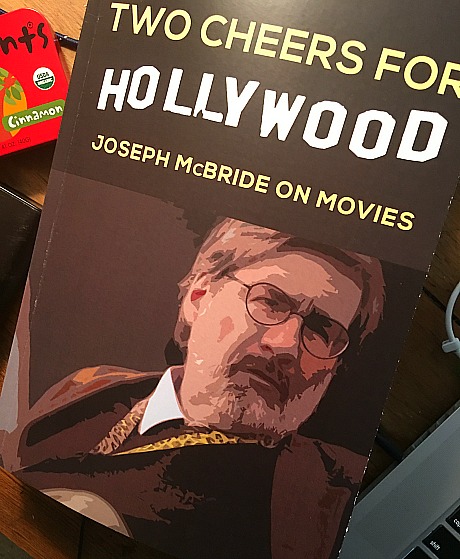
From Joseph McBride‘s just-released “Two Cheers For Hollywood,” and more particularly an introductory essay titled “I Loved Movies But…”:

“In recent decades we’ve had to deal with the generally awful state American mainstream movies have fallen into, and with the overall collapse of film culture and what used to be called cinephilia. This has led to widespread discussion by film critics and others about whether or not cinema is dead, merely moribund, or in the process of evolution into something innovative but as yet uncertain. We have to face the fact that we longer live in an age of cinephilia. I wouldn’t be honest if I didn’t admit that makes me terribly sad, [but] I haven’t yet reached the final stage of the grieving process — acceptance.
“Yet we who write about film history and have done so for decades persist in our quixotic quest. We go on because the love of film has become so ingrained in us that it can never be eradicated by time or circumstance. You make your choices early in life, and you do so because of what you need most early in life. Some of these needs linger forever.

“Writer and filmmaker Susan Sontag wrote in a much-discussed 1995-96 essay, ‘The Decay of Cinema,’ that the cinema had become ‘a decadent art’ mired in “an ignominious, irreversible decline. It’s not that you can’t look forward anymore to new films that you can admire. But such films not only have to be exceptions — that’s true of great achievements in any art. They have to be violations of the norms and practices that now govern movie-making everywhere in the capitalist and would-be capitalist word — which is to say everywhere.’


Read more

If It’s A Socially Reflective Genre Thriller, It Must Be Oscar Material

Invitation sent by mail on 10.12.56: “Please join Allied Artists, filmmakers and cast for a cocktail party in celebration of Don Siegel‘s Invasion of the Body Snatchers — ‘A triumph…a terrifying reflection of Eisenhower-era conformity and complacency’ — Manny Farber.” Invitation sent by mail on 11.24.88: “Please join Universal Pictures, filmmakers and cast for a buffet luncheon celebrating John Carpenter‘s They Live — “The horror of rampant yuppie greed and materialism delivered within the realm of a sci-fi thriller…social-exposure dramas are rarely this gripping or penetrating.” — Peter Rainer, American Film.

Between Takes of Sabrina

The baggy, dark-gray trousers (dress pants were extra spacious in the mid ’50s) are bad enough, but to wear them with casual sneakers? Appalling. I’d like to be gracious and say that Humphrey Bogart is so cool on his own terms that he pulls it off, but he doesn’t. You might assume from his late-1953 photo that Audrey Hepburn, 24 and fresh off Roman Holiday, is the same size as Bogart. He stood about five-foot-eight — Hepburn was roughly five-seven.

People of Character and Breeding (a) Live in Mid-Sized Homes, (b) Avoid Scenic Restaurants

During last month’s Cinemacon I realized that the working-class Joes who flock to Las Vegas are in love with the massive scale of the place. 75% of the buildings in the Vegas tourist district are five, ten or twenty times bigger than similar establishments in Wichita Falls or Cranford. 

These same culturally-challenged types are quite impressed by super-sized homes. If I was handed a gratis deed to a McMansion I would sell it and buy a regular people-sized home…you know, the kind of place that Americans and Europeans lived in for several centuries before the oversized aesthetic crept into the culture.

If you were loaded and could live anywhere you want, would you have the character and the taste to live in a home of sensible proportions? Two or three bedrooms and bathrooms instead of six or seven? Cozy dens, fireplaces, kitchens built for a family of four or five? The kind of homes that Joan Crawford, Kim Novak, Charles K. Feldman, Ronald Colman, Rod Serling and Cary Grant used to live in? Or the kind that Bob Evans, George Clooney and Jack Nicholson live in now?

I loathe gargantuan as a design concept. Giant-sized homes smell of arrogance and entitlement. Or insecurity. An architectural blight.

Another thing you want to avoid are restaurants and bars with a beautiful view, and especially people who love to patronize such places. Does this mean I don’t like the view from WeHo’s Soho House (9200 Sunset Blvd.)? No — I love it as much as the next guy, but I don’t want the company of people who flock there every night because of the view. I prefer to hang with people who think like me, who patronize a place because they’re down with the special vibe or atmosphere. Great-view restaurants on the penthouse floors of buildings are always a must-to-avoid — always jammed, always too pricey. If you’re out with a girl and she says “let’s go to that hot rooftop place,” drop her like a bad habit.

Read more

The Wrong Man

I was initially intrigued by Rodrigo Perez‘s review of Nathan Silver’s Thirst Street — “A wry and disturbed look at lust and longing…a terrific vintage homage…a deliciously arch little treat.” Set in Paris, it’s about an emotionally traumatized flight attendant (A Teacher‘s Lindsay Burdge), reeling from a fiance’s suicide, who has a one-night stand with a moustachioed French guy (Damien Bonnard). She falls obsessively, and from this a Polanski-like “European-flavored psychodrama” results. But look at Bonnard. He’s almost Quasimodo. Who obsesses over homely guys? Guys who would be lucky to have sex with someone like Burdge in the real world? What kind of flight attendant goes nuts over a guy who looks like a peripheral drug dealer from John Frankenheimer‘s The French Connection II? I’m sorry but this movie lost me at Bonnard.

What Is Our Life?

The Rotten Tomatoes and Metacritic communities are more or less claiming that The Circle stinks. (The Rotten/Meta average is around 30%.) I’ve been following director James Ponsoldt through thick and thin, and I didn’t even get invited to see this thing. This has become increasingly common. Publicists will wave me into screenings if I write and politely ask, but when it comes to stinkers some aren’t exactly reaching out.

The final line from Glenn Kenny’s N.Y. Times review: “The movie is dedicated to Bill Paxton, who died in February and is quite fine in the small role of [Emma Watson]’s father, who’s dealing with multiple sclerosis. The dedication is a kind and considerate touch. Still, if you’d like to enjoy a movie featuring both Mr. Paxton and [Tom] Hanks, I’d recommend Apollo 13.”

Nobody invited me to see Ken Marino‘s How To Be A Latin Lover either. The general view is that it doesn’t suck as badly as The Circle — a 40% Rotten Tomato and 52% Metacritic rating. I could’ve made the effort, but it’s obviously a Latino Adam Sandler film. The trailers have made that clear.

Honestly? The most interesting newbie is April Mullen and Stephanie Fabrizi‘s Below Her Mouth. (Great title!) From 4.27 NBCnews.com review by Trish Bendix: “Below Her Mouth is essentially a fantasy…a fairy tale for a subgroup of people who rarely to get to see the kinds of things that they dream played out on screen…a romance-fueled intimacy and passion that is too often relegated to a scene directed by a man and played by two straight women.”

Read more

Not This, Not Me

The first thought that occured when I glanced at this poster of ScarJo in Rough Night (Columbia, 6.17) was “whoa…what happened?”  She’s only 34 but looks 44 if a day…that curvy-blonde-with-full-lips thing she had going around the time of Match Point is totally out the window. She looks unsettled, starved, brittle, PTA-ish. Everyone transitions and evolves into the next phase, but ScarJo could be auditioning for Rosalind Russell‘s part in Picnic (’55). This is honestly what came to mind.

Read more

Cannes Add-Ons

Competition: Ruben Ostlund‘s The Square. Cast: Elisabeth Moss, Dominic West. Wiki synopsis: “The film tells about a manager of the museum who is responsible for an exhibition space that houses a new installation which provides people with a symbolic space. He hires a PR firm to create buzz around the installation, but the publicity produces a public racket.” Wells comment: The title is a stiff — it drains the sand.

Out of Competition: Roman Polanski‘s Based on a True Story (D’après une histoire vraie). IMDB synopsis: “A writer goes through a tough period after the release of her latest book, as she gets involved with an obsessive admirer.” Cast: Eva Green, Emmanuelle Seigner, Vincent Perez, Alexia Seferoglou. Wells comment: Polanski!

Un Certain Regard: Santiago Mitre‘s La Cordillera; Li Ruijun‘s Walking Past The Future.

Special Screening: Barbet Schroeder‘s Le Vénérable W.. IMDB synopsis: The third film in Schroeder’s “trilogy of evil”, following General Idi Amin Dada (’74) and Terror’s Advocate (’07). Wells comment: Schroeder!

Don’t Be Cruel

Two days ago Brigade’s Rob Scheer asked his Facebook followers to vote for the least deserving Oscar-nominated performance of the last 15 years. Scheer failed to note that two of the following nominated performances resulted in wins, but I’ve clarified that:

(a) Alan Arkin, Argo; (b) Alan Arkin, Little Miss Sunshine (won); (c) Christian Bale, The Big Short; (d) Ruby Dee, American Gangster; (e) Johnny Depp, Finding Neverland; (f) Jonah Hill, Moneyball; (g) Stanley Tucci, The Lovely Bones; (h) Jacki Weaver, Silver Linings Playbook; (i) Renee Zellweger, Cold Mountain (won).

I don’t know what “deserving” means in this context. Academy Award nominations are almost always handed out for reasons that are half political and half emotional, and rarely on merit alone. That said, the three least deserving among this group were Bale’s, Tucci’s and Zellweger’s.

All I remember clearly about Bale’s Big Short character, based on the real-life Michael Burry, was how completely insulated he was in the realm of his own genius (which the film kept pushing in your face), and what an anti-social dweeb he was. I hated looking at Bale’s bare feet.

I was amazed that people found Tucci’s creepy murderer the least bit fascinating, much less award-worthy. I was far more satisfied and pleased by his sure-to-be-nominated performance as Jack L. Warner in Feud: Bette and Joan.

Zellweger’s Ruby Thewes was basically a yeehaw thing — deep-country accent, bold behavior, blunt opinions.

Read more

La Strada Again

Studiocanal has financed a 2k digital restoration of Federico Fellini‘s La Strada (’54). Opening in a few UK theaters on 5.19, a Bluray sure to follow. An appropriately boxy aspect ratio. God protect this little classic from anyone who would advocate a 1.66:1 slicing. Criterion’s DVD version looks pretty great. I’m wondering how much of a Bluray “bump” can be expected.

The older I get, the more difficult Giuletta Massina‘s performance is to take. Yes, I understand that the film depends upon her character being child-like and extremely vulnerable. Yes, I understand that you can’t apply realism standards to her style of acting, and that it can only be processed as Chaplinesque mixed with Italy’s commedia dell’arte. It just requires a certain effort to get past all that.

Read more

Three To Tango

A day late, a dollar short: Just when a certain film snob was resentfully accommodating himself to the idea of two hot lesbo nun movies, along comes Paul Verhoeven to rub a third into his face. Blessed Virgin, which Verhoeven is currently shooting, will dramatize the life of 17th Century Italian nun Benedetta Carlini (Elle‘s Virginie Efira). The script is based on Judith C. Brown‘s “Immodest Acts: The Life of a Lesbian Nun in Renaissance Italy.” Are hot lesbo nun movies becoming a “thing” in the vein of ’70s women-behind-bars exploitation flicks (including Jonathan Demme‘s Caged Heat)? Back in the ’90s there was an understanding among Entertainment Weekly freelancers that that three of anything (Blessed Virgin + Novitiate + The Little Hours) constitutes a trend.


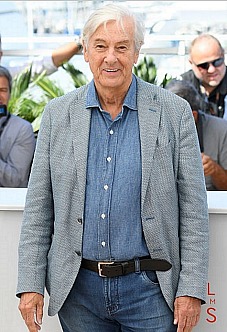
(l.) Blessed Virgin director Paul Verhoeven, (r.) star Virginie Efira during Elle photo at 2016 Cannes Film Festival.