Hurricane Harvey FOMO

Posted on 10.6.16: “Hurricane Gloria came roaring across lower Fairfield County in the wee hours of 9.28.85, and I was there, man, standing in my parents’ front yard in Wilton, Connecticut, sometime around 1:30 or 2 am. That howling sound, 90 mph winds, huge trees bending. The full force of it ebbed after ten minutes or so, but I’ve never forgotten that feeling, that energy.” Posted this morning: Call me a hurricane junkie if you want, but if I’d been in Rockport, Texas last night I would’ve been looking to safely absorb what I could of Harvey’s raw ferocity.


What makes this shot great? The red light is on and glowing.
 

Read more

Codependent Bad Guys

President Trump had no moral authority or credibility after his off-the-cuff Charlottesville comments, but now he’s in the minus realm after paroling former Maricopa County Sheriff Joe “pink underwear” Arpaio. The Arizona Republic called Trump’s pardon “a sign of pure contempt for every American who believes in justice, human dignity and the rule of law.” The pardon is a message, of course, to others who may be facing prosecution for Trump-associated crimes or misdemeanors down the road: “Man up, zip it, don’t roll over on me when prosecutors start applying pressure. Do this and I’ll pardon you if you get sentenced.”

From Arpaio’s Wikipage: “Arpaio claimed that his requirement that inmates wear pink underwear…saved the county $70,000 in the first year the rule was in effect. Arpaio subsequently sold customized pink boxers (with the Maricopa County Sheriff’s logo and ‘Go Joe’) as a fund-raiser for Sheriff’s Posse Association. Despite allegations of misuse of funds received from these sales, Arpaio declined to provide an accounting for the money. Arpaio’s success in gaining press coverage with the pink underwear resulted in his extending the use of the color. He introduced pink handcuffs, using the event to promote his book, ‘Joe’s Law: America’s Toughest Sheriff Takes on Illegal Immigration, Drugs and Everything Else That Threatens America.’ Arpaio has said ‘I can get elected on pink underwear… I’ve done it five times.'”

Spielberg’s Pentagon Papers Drama Going With No-Bounce Title — The Post

Initially Steven Spielberg and Amy Pascal‘s Pentagon Papers flick was known as The Post, and then as The Papers.  Today it officially went back to being called The Post.  A good enough title, I guess, but a bit sleepy.  No echoes or undercurrents.  We all know the logline — Washington Post publisher Katharine Graham gradually takes the bull by the horns when the Nixon administration attempts to suppress the printing of a once-secret history of governmental lying about the Vietnam War. What are the two greatest sounding award-season titles? Phantom Thread and Call Me By Your Name.

Josh Safdie Has It Right

I’m no fan of Good Time, but the following statement by co-director Josh Safdie is exactly on-target as far as understanding where people are at in terms wanting or not wanting exposition and back-stories in movies.

“There’s zero exposition in [Dunkirk], to the point where you don’t even know who the characters are at times. But that adds to the element of the mass of people, of the experience of being one of 400,000. I think people are ready to move on from the idea of exposition, of ‘Let’s set it up and spoon-feed you information.’ I think, on an everyday basis, people do a lot of deduction in real life, especially when no one knows what’s real and what’s fake, and fake news this and that. I think people like to do their own detective work.” — Safdie speaking to Austin Chronicle‘s Richard Whittaker in an 8.18 interview.

“There are NO backstories or character fill-ins of any kind in Chris Nolan‘s Dunkirk, and it’s utterly wonderful for that.” — from “Origin Stories Can Kiss My Ass,” posted on 8.1.17.

Don’t Let Hudson Hawk In Your Head

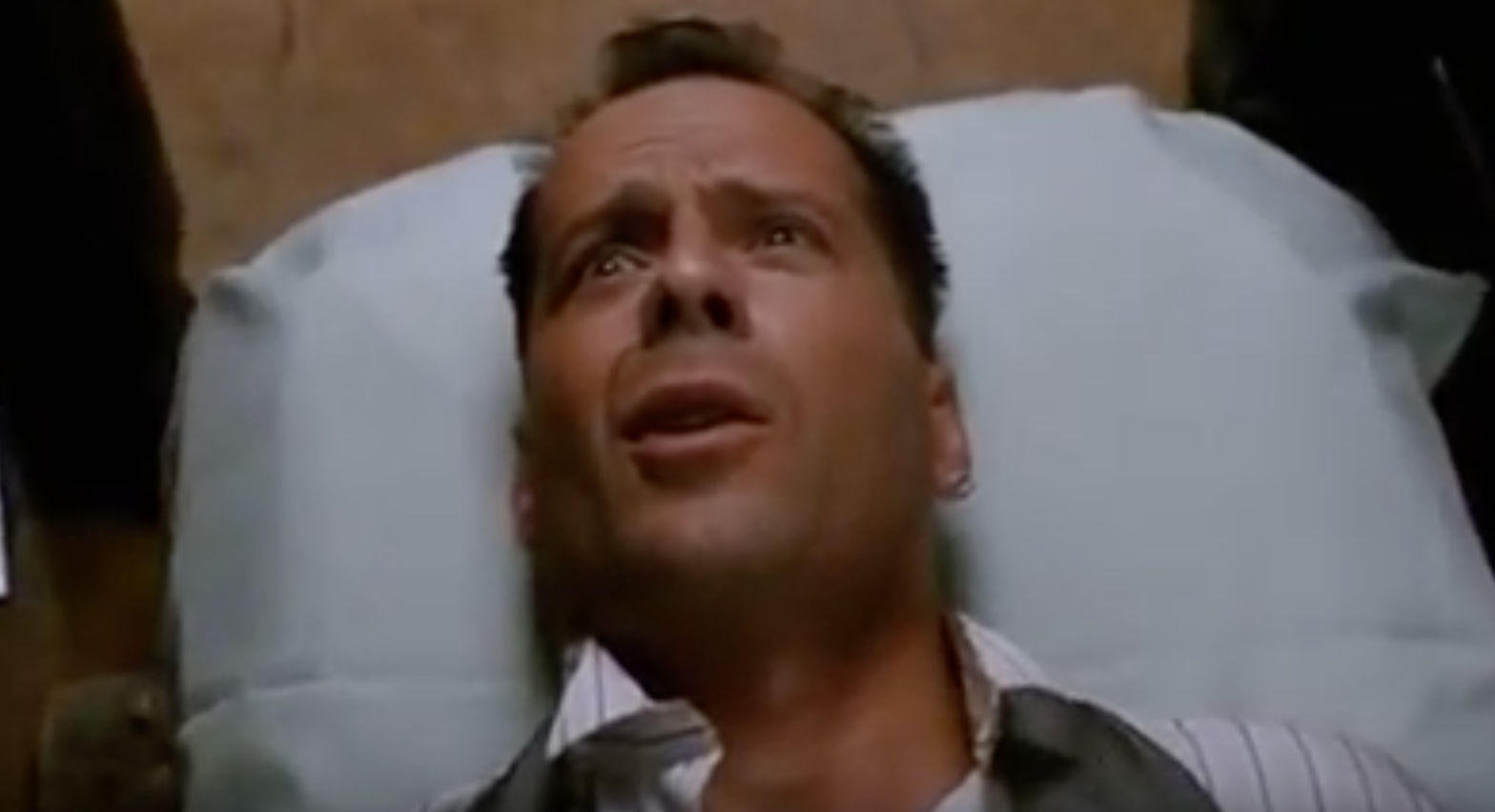
It’s been 26 years since I suffered through Micheal Lehman‘s Hudson Hawk. I’d kinda forgotten the particulars, although it all came rushing back when I began watching clips. The only thing I liked about it was James Coburn playing George Kaplan. Not Coburn’s performance, mind, but screenwriters Steven de Souza and Daniel Waters‘ decision to pay tribute to North by Northwest‘s “non-existent decoy.”

No, I didn’t decide to hate Hudson Hawk because just about everyone trashed it or because it cost $65 million and earned $17.2 million or any of the other lynch-mob rationales. I hated it all on my lonesome because it struck me as smug and arrogant and unfunny, and because watching it was like being held down on the pavement as Bruce Willis and producer Joel Silver strolled over, bent down and farted in my face.

Go ahead — open your mind to Richard Brody’s revisionist assessment (“The Misunderstood Ambition of Hudson Hawk”) in the current New Yorker. It’s an intriguing argument, if unpersuasive. Because those YouTube clips don’t lie. Sink into that haughty attitude, those frosty vibes, that rot and corrosion.

And remember that Brody led the charge in that strangely successful campaign to elevate (resuscitate?) the reputation of Alfred Hitchcock‘s disastrous Marnie, which was verified when a 2015 BBC Culture poll ranked Marnie as #47 among the 100 Greatest American Films of all time. This led to one of the all-time greatest HE comments (“brenkilco” remarking that this Brody-led fraternity is “insidious and frightening…they’re just like ISIS except instead of beheading people they like Marnie“) but also to a 7.23.15 HE piece called “O Come All Ye Marnie Haters!

Now Brody is trying to restore Hudson Hawk to respectability. Hey, why not? Larry Karaszewksi agrees with him. By all means read the piece, but also watch the below clip. In the space of 164 seconds it will start to drive you insane.

Case Closed

HE to Last Flag Flying and The Last Detail author Darryl Ponicsan: “How do you pronounce your last name anyway? I’ve been asking myself this for over four decades. Is it like moccasin? Is it PONNICKsahn? Is it POHN-nih-son?” Ponicsan to HE: “I sometimes regret not changing it. No one can spell it or pronounce it. It’s pronounced PAWN-ah-son. It’s Hungarian and has an accent, which I adopted a few years ago after having met a Ponicsán family in Budapest. Anyone with that name is related to me.” HE to Ponicsan: “Forget the accent mark. Pronouncing it correctly is difficult enough. How the hell the Hungarians decided on PAWN-ah-son is beyond me. It should obviously be pronounced POHN-nih-son.”

27 Reasons Why Films Are Worse Now Than In The ’90s

A couple of months ago Collective Learning‘s Rob Ager laid out 27 reasons why too many post-millenial movies have sucked (and are currently sucking) eggs. I’ve just listened to the whole 56-minute thing, and I swear to God that 90% to 95% of what Ager says is right on the money. Ager dismisses too many films and filmmakers, but I don’t seriously disagree with any of his points. (He hilariously states that he hasn’t really liked a single Chris Nolan film.) I have a quibble here and there, but he’s really addressing the Big Picture here. Here’s a written-out version of what he says, and here’s a timecode breakdown of his various points:

1:16 Lack of economic pacing / 2:10 Over-editing / 3:19 OCD cinematography / 5:14 OCD lighting / 7:12 Over-choreographed action / 9:10 Improper use of CGI / 11:41 Boring musical scores / 14:03 Over-compartmentalization of personnel / 15:27 Terrible casting / 16:23 Recycled symbols and metaphors / 19:13 Dumb heroes / 22:03 Mumbled dialogue / 23:26 Ever-increasing spectacle / 26:11 Blank canvas “art” movies / 29:04 The uncinematic world of I.T. communication / 31:49 Over-reliance on exposition / 34:23 Illegal downloading / 35:35 Blitz marketing instead of word-of-mouth / 36:52 Dependence on commercial and political advertising / 39:03 Brand-based filmmaking / 39:53 Fake reviews / 41:37 Expensive technical standards / 44:33 Ideological conformity / 47:05 Socially motivated viewing / 48:22 Redundancy of art in the face of mass communication / 51:35 Lack of visionary filmmakers.

117 Films That’ve Made The 21st Century Worth Living

8.26 update: I tapped out a similar list in April 2016, but here’s a refresh anyway. If you start with 1.1.00, the 21st Century is now 18 and 1/2 years old. By my count there are 117 films from this period that made a significant dent in the zeitgeist. If you haven’t seen the vast majority of these, you need to get cracking.

Since the beginning of 2010, or the start of the 21st Century’s second decade, at least 73 films that were and are really good opened commercially. 73 films within eight and a half years, or roughly nine per year. Add to these HE’s best of the first decade, which number 44, and you have 117. By the end of this year the tally will probably be at 122 or thereabouts.

Best of 2017 so far: Dunkirk, Call Me By Your Name, Graduation, Baby Driver (except for the last 15 minutes), Get Out, Personal Shopper (long-delayed commercial release), Logan (excessive violence excepted) (7)

Best of 2016: Manchester By The Sea, La La Land, Personal Shopper (Cannes/Toronto screenings), Elle, A Bigger Splash, The Witch, Eye in the Sky, Moonlight, Hell or High Water, The Confirmation, The Invitation. (11)

Best of 2015: Spotlight, The Revenant; Mad Max: Fury Road; Beasts of No Nation; Love & Mercy, Son of Saul; Brooklyn; Carol, Everest, Ant-Man; The Big Short. (12)

Best of 2014: Birdman, Citizen Four, Leviathan, Gone Girl, Boyhood, Locke, Whiplash, Wild Tales, Nightcrawler, Grand Budapest Hotel, It Follows. (11)

Best of 2013: The Wolf of Wall Street, 12 Years A Slave, Inside Llewyn Davis, Her, Dallas Buyers Club, Before Midnight, The Past, Frances Ha (8).

Best of 2012: Zero Dark Thirty, Silver Linings Playbook, Amour, Beasts of the Southern Wild, Barbara, The Grey, Moonrise Kingdom (7).

Best of 2011 (ditto): A Separation, Moneyball, Drive, Midnight in Paris, Contagion, X-Men: First Class, Attack the Block (7).

Best of 2010: The Social Network, The Fighter, Black Swan, Inside Job, Let Me In, A Prophet, Animal Kingdom, Rabbit Hole, The Tillman Story, Winter’s Bone (10).

Read more

Jenkins vs. Cameron with HE Referee

James Cameron‘s argument with Wonder Woman, as explained in an 8.24 Guardian interview, was basically that Gal Gadot looked too dishy, too made up, too objectified. Which was basically a shot at director Patty Jenkins for catering to traditional male-appetite Hollywood fantasies. Cameron would have preferred a butchier, more bad-ass Wonder Woman in a kind of mid-’90s Linda Hamilton mode.

Jenkins’s Twitter reply: “Cameron’s inability to understand what Wonder Woman is, or stands for, to women all over the world is unsurprising as, though he is a great filmmaker, he is not a woman. Strong women are great, [but] if women have to always be hard, tough and troubled to be strong, and we aren’t free to be multidimensional or celebrate an icon of women everywhere because she is attractive and loving, then we haven’t come very far, have we?”

HE verdict: Cameron is right — Jenkins was catering to traditional Hollywood standards by making Gadot’s Amazon warrior a super fox as well as loving and maternal. But that’s cool. As I was watching it in a Paris plex last June I told myself, “This is different, this is good…Wonder Woman has a fuller, more caring heart than her male counterparts in the Marvel or D.C realm. And therefore she has her own identify, her own piece of superhero turf. Plus she has great eyes, hot legs and a really warm smile. I don’t have a problem with that.”

Can’t Help But Feel Badly About It

N.Y. Times critics A.O. Scott and Manohla Dargis were recently asked to choose the five best New York movies for a special project called “One Film, One New York.” The winners were Spike Lee‘s Crooklyn, Gene Kelly and Stanley Donen‘s On the Town, Susan Seidelman‘s Desperately Seeking Susan, Ang Lee‘s The Wedding Banquet and Martin Scorsese‘s New York, New York.

Scott and Dargis were somewhat restricted by having to choose films that are more or less family-friendly or, you know, not too coarse or graphic or profane. Which is sorta like being asked to choose the best westerns in which gunslingers don’t wear six-shooter holsters around their waist.

On top of which New York, New York was regarded at the time of its release as a notorious cocaine movie. A whole lotta tootin’ goin’ on, and yet 40 years later a pair of top-tier critics…forget it.

I haven’t re-watched any of their picks since their original release, and that goes double for New York, New York. I caught it a little more than 40 years ago, and only once at that. It’s basically a ’40s and ’50s period piece about a singer and a saxophone player (Liza Minelli, Robert DeNiro) who discover that they’re incompatible after getting hitched in a hurry and having a kid, largely because the sax player has a temperamental nature.

I’ve written a couple of times that it has one terrific scene — i.e., when De Niro is thrown out of a club that Minelli is performing in, and he kicks out several light bulbs adorning the entrance way as he’s manhandled out by the manager and a bouncer. If I could only find that scene on YouTube, but there’s no trace of it.

You still can’t stream New York, New York, and for people with limited search abilities (like myself) the only way to catch a high-def version is to buy a 2013 English import Bluray.  

Stiller, For Sure, But Austin Abrams Is A Find

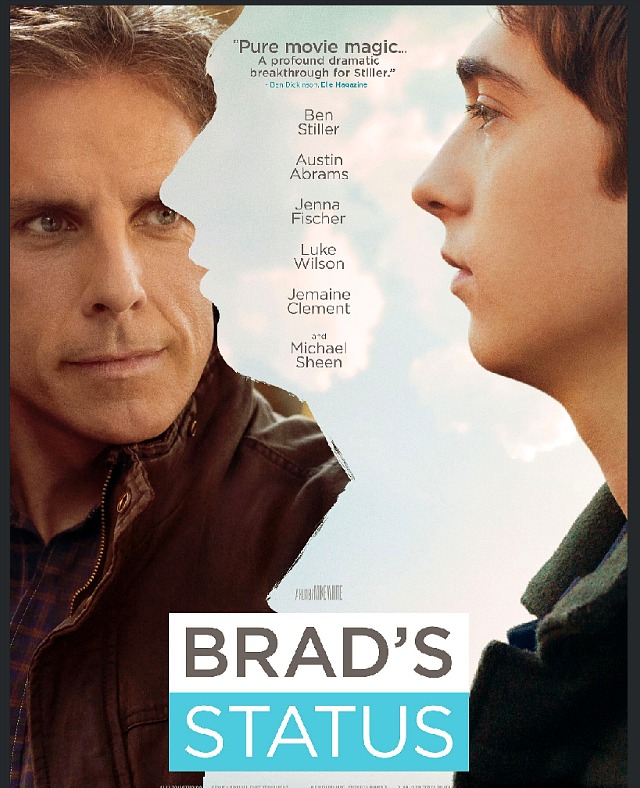
On 7.31 I wrote that Ben Stiller‘s lead performance in Brad’s Status (Amazon/Annapurna, 9.15) is easily his best-written role and finest performance since Greenberg. But the second-best thing in Mike White‘s father-son dramedy is Austin Abrams, who plays Stiller’s college-bound son. Abrams had small parts in Gangster Squad, The Kings of Summer and We Don’t Belong Here, but I never noticed him until Brad’s Status. He’ll turn 21 next weekend, and I swear he’s got some kind of dead-center, no-bullshit essence that seeps out with every line, looks and gesture. I said in my review that Abrams has this young Bob Dylan quality. One of these days he’ll land the right role.

Read more