In A Theatre Near You

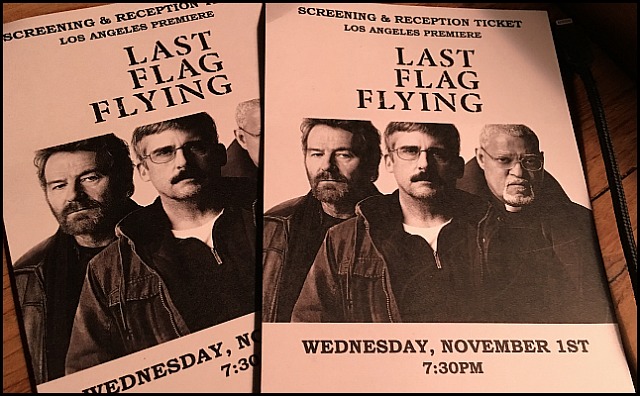
From “Seen Better Days,” posted on 9.28.17: Directed and co-written by Richard Linklater, Last Flag Flying (Amazon / Lionsgate, 11.3) is a moderately passable older-guy road movie — a doleful, episode-by-episode thing about three ex-servicemen and former buddies — Larry “Doc” Shepherd (Steve Carell), Sal Nealon (Bryan Cranston) and Richard Mueller (Laurence Fishburne) — assessing their lives and the world around them as they escort the casket of Shepherd’s soldier son, recently killed in Iraq, from some city in Virginia to some other city in New Hampshire.
This is roughly the same path, of course, that the original film followed when Badass Buddusky (Jack Nicholson) and Richard “Mule” Mulhall (Otis Young) escorted Larry Meadows (Randy Quaid) to the Portsmouth brig for the crime of having stolen $40 from a polio donation box. 

For whatever tangled reasons Linklater and original novel author and screenplay co-writer Daryl Ponicsan chose to re-name Buddusky as Nealon, Mulhall as Mueller and Meadows as Shepherd. This led to ignoring the Last Detail origin story and making the trio into Vietnam vets with a shared history.

The difference is that (a) Nealon-Buddusky, as played by Cranston, is now an intemperate, pot-bellied drunk, (b) Fishburne’s Mueller-Mulhall has become a testy, sanctimonious prig with white hair, and (c) Carell’s Shepherd-Meadows has gotten shorter with age and become a quiet, bespectacled grief monkey (and who can blame the poor guy?)

The film mopes along in a resigned, overcast-skies sort of way, and after about 30 or 40 minutes you start saying to yourself, ‘Jesus, this thing is going to stay on this level all the way through to the end, and I’m stuck with it.’

There are two performances that merit special praise — J. Quinton Johnson‘s as a young Marine escort, disciplined but observant, who travels with the trio to Portsmouth, and Deanna-Reed Foster‘s as Mueller’s compassionate wife.

The Last Detail was based on Ponicsan’s 1970 novel. Last Flag Flying is based on Ponicsan’s same-titled 2005 novel, the main difference being that the book used the names and history of the original characters.

Frank Underwood Is Dead

7:30 pm Update: Netflix has whacked House of Cards star Kevin Spacey over numerous sexual assault and harassment claims. Does this mean they’re killing the show or what? They’d be crazy not to keep it going. All they have to do is rewrite the script so they can kill off Underwood, leaving Robin Wright to take over.

“Netflix will not be involved with any further production of House of Cards that includes Kevin Spacey,” a spokesman for Netflix said in a statement. “We will continue to work with MRC during this hiatus time to evaluate our path forward as it relates to the show.”

Earlier: I don’t know how far along the sixth and final season of Netflix’s House of Cards might be (on 10.31.17 it was reported that production has been suspended indefinitely), but Stephen Whitty‘s suggestion for how to deal with the Kevin Spacey matter makes sense. I would love to see Claire Underwood (Robin Wright) occupy the Oval Office. I don’t think I’m the only one.

You’d Never Know

This is a lively, engaging, well-cut trailer — congrats to the ad agency or in-house Paramount guys who cut it. I would go so far as to call it a knockout, which is ironic considering that Alexander Payne‘s Downsizing didn’t exactly knock ’em dead when it played two months ago at the Telluride Film Festival. It currently has a 65% and 74% rating with Rotten Tomatoes and Metacritic, respectively.

Because it’s Friday afternoon and I’ve just woken from a nap and the world could use a little warmth and kindness, I’m posting the following from my 9.2.17 Telluride review: “I am not ‘panning’ Downsizing. It’s definitely a major, highly original, award-season release that everyone will have to see. It will be a huge topic of conversation during the late fall and holiday period. I am in no way saying ‘don’t see this’ or ‘wait for streaming’ or anything along those lines. It’s smartly written, well acted, conceptually daring and certainly an awesome technical achievement.”

Read more

Crusader

From 10.4.17 HE review: “Fatih Akin‘s In The Fade (Magnolia, 12.27) is a traumatic-loss-and-revenge drama starring Diane Kruger, whose performance won the Cannes Film Festival’s Best Actress award last May. It dispenses chilly, carefully measured hardball realism, and in a gripping, emotionally jarring way that I believed top to bottom. Taken on its own terms, it’s close to unassailable.

“Set mostly in Hamburg, Fade starts with Katja (Kruger), her clean-living Kurdish/Turkish husband Nuri (Numan Acar) with a drug-dealing past, and their young son Rocco in happy-family mode. That lasts less than ten minutes. A home-made nail bomb outside Nuri’s office explodes, and Katja is suddenly a child-less widow. She wilts under agonizing pain and a near-total emotional meltdown, and understandably decides to temporarily medicate with drugs, and then nearly ends it all by slitting her wrists.

“But a suspicion she’d shared with her attorney, Danilo (Denis Moschitto), about anti-immigrant Nazis having planted the bomb turns out to be accurate. Katja learns that evidence she had given the police has led to the arrest of Andre and Edda Moller (Ulrich Brandhoff, Hanna Hilsdorf), a pair of young neo-Nazis with international connections. There’s no doubt these two are the culprits — Katja had seen Edda leave a bicycle near her husband’s office two or three hours before the blast.

“Then comes a second-act portion dealing with a trial of the accused that doesn’t end satisfactorily, and finally a third act in which the acutely frustrated Katja travels to Greece to carry out her own form of revenge-justice.

Read more

Dying Animal

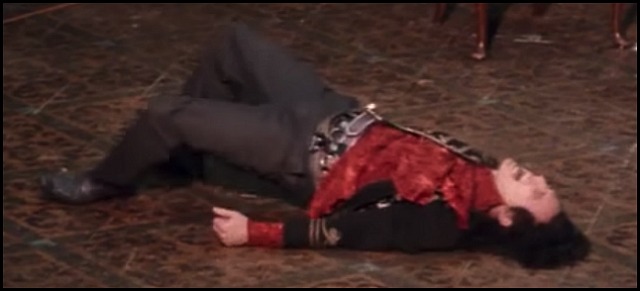
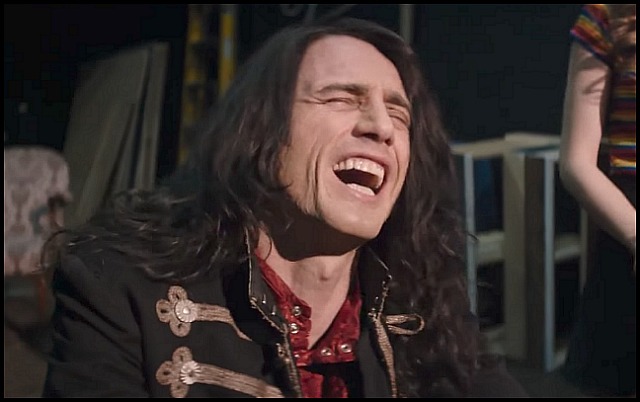
I approved of James Franco‘s The Disaster Artist (A24, 12.1) in my 10.25 review, but at the same time I called it a curio — a decent stab at conceptual humor that generates a kind of chuckly vibe on a scene-by-scene basis.  Watching a clueless asshole (i.e., Franco’s Tommy Wiseau) behave like a clueless asshole isn’t all that funny if you’re watching what that’s like on a line-by-line, incident-by-incident, humiliation-by-humiliation basis.

Then something happened two or three days later. I began recalling a seriously weird moment from the film, and then it became an ear bug — playing over and over in my head. I’m speaking of a moment when Wiseau performs a spazzy, primal-scream thing during a San Francisco acting class. “Aagghhhh! Aaagghhhh! Aaaggghhhhh! For some reason I can’t get this screaming out of my head, which is probably an indication that Franco has done something right. Now I’m thinking it might be a classic bit.

Distressed, Grainy, “Like A Memory”

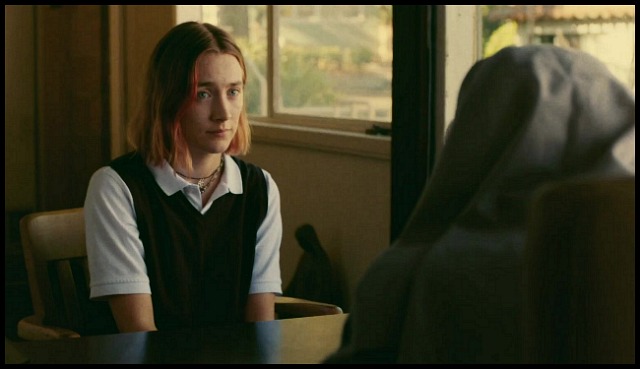
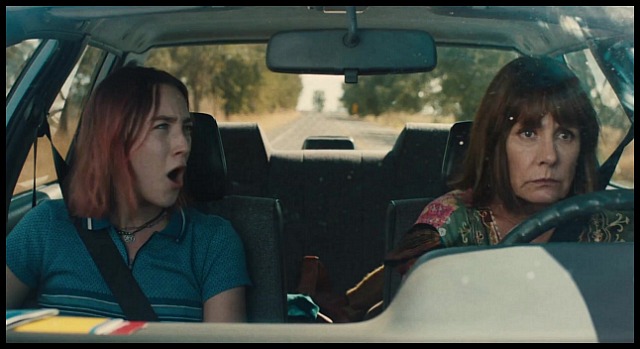
I was reminded of the soft, grainy, slightly darker look of Lady Bird after catching it last night for the second time. I had assumed after seeing it in Telluride that it’d been shot on 35mm or super 16mm, but then I read this morning that it was actually shot digitally. So I asked to speak with dp Sam Levy sometime today. Luckily and unexpectedly, we were chatting less than an hour later.

Levy shot Lady Bird with Arri Alexa Minis, he said, but with “old lenses.’ The soft, grainy look began to be formulated when Gerwig said she wanted Lady Bird “to look like a memory.”


“A distressed, restrained muted palette”

“When she said that I knew what she meant,” Levy recalls. “Not too digital or clean or super-clear. The aesthetic of memory. Not too saturated or contrasty or electronic looking. We had an instinct to shoot it digitally but employ techniques that would result in a distressed, hand-made, xerox-copies-of-color-photos feeling…we always always trying to get this generation-removed aesthetic.”

I mentioned the grainy textures, which pretty much leap out at you. “Grain is an element, part of the distressed quality of the image,” Levy said, “but it’s not the whole story. The idea was to make it look not too resolved, not too sharp.

“We were looking for a restrained, muted color palette. We shot in 2K, which has a softer, more mellow quality. But even with 2K as opposed to 4K the colors are fairly saturated and robust, and so we were looking for ways to distress the image in an organic way…reminiscent of super 16mm, but the intent was to create something of our own. It isn’t clean and correct and super-clear but is slightly removed.”

Read more