Another Weak Year? Don’t Ask.

I’ve heard some grousing about 2018 being another weak Oscar year. Too much talent and creativity has gone over to cable/streaming, they say. The serious heft and weight that manifests in Best Picture contenders now and then is therefore less likely to occur. And so the pickings are a bit slim. To be perfectly candid, it does kinda seem that way. Maybe.

What do I actually know? Next to nothing but my insect antennae are humming. I can feel stuff happening. Faint electric signals from just over the horizon…beedee-beep-beep.

I still think it’s way too early to be feeling pessimistic about anything. Mid June, for God’s sake. At least wait until Venice, Telluride and Toronto have unspooled.

Okay, yes…I’ve been picking up hints and signals and indications here and there, and the only film that even begins to sound like serious Best Picture rocket fuel (as in allegedly “beyond great”) is Alfonso Cuaron‘s Roma. A Spanish-language film, yes, and shot in radiant black-and-white, but the Academy has nominated subtitled films before. Michael Haneke‘s Amour (’12) was the last foreign-language film to be so honored.

I don’t know enough about Martin Scorsese‘s The Irishman — I haven’t read it — but if it was slated for a late fall release, it would be in an excellent position to at least land a Best Picture nomination. Probably. Depending on the usual factors, of course. A shame it’s a 2019 film. It should open this year. A bit less than seven months between now and December 31st and they can’t get the CG together?

The only Oscar season flick that I know is a keeper for sure (because I fell for it at last year’s Toronto Film Festival) is Bjorn Runge‘s The Wife (Sony Pictures Classics, 8.17). A tight, smartly written, well-honed film. Glenn Close is a lock for a Best Actress nom. I said that last year, I know, but it still goes.

I’m not saying why or dropping any hints, but there may be reasons to feel a degree of caution or uncertainty about some of the fall releases.

That trailer for Damien Chazelle‘s First Man, a space drama about Neil Armstrong and the first landing on the moon (Ryan Gosling, Claire Foy, Corey Stoll, Kyle Chandler, Jason Clarke). seemed to give some a feeling of pause. I thought it was fine. The script is disciplined, steady and straight.

I’ve been told “not so fast” on Bradley Cooper‘s A Star Is Born.

Felix von Groeningen‘s Beautiful Boy is mainly a performance thing, or so “they” say.
Read more

Stick A Fork In It

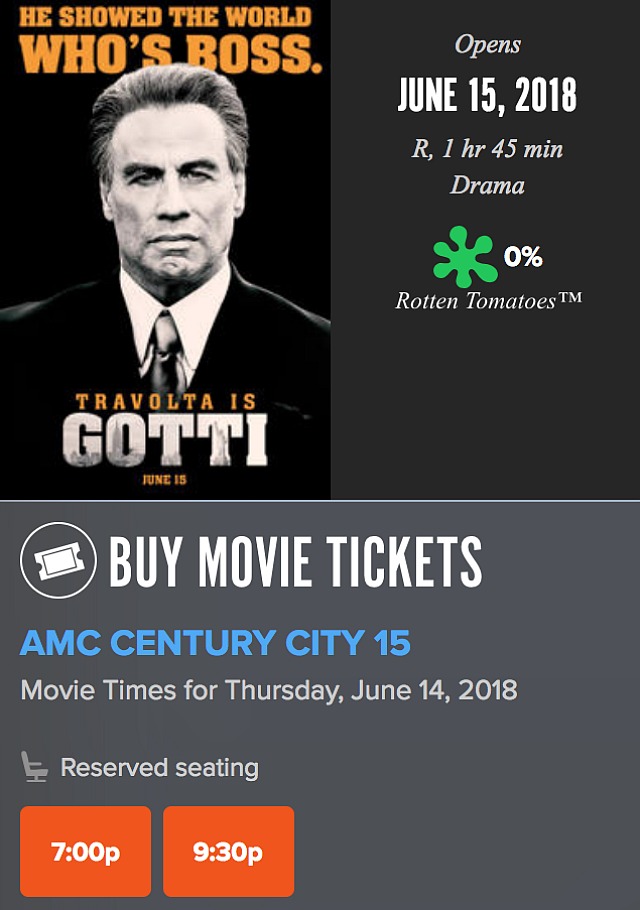
Kevin Connolly and John Travolta‘s Gotti (Vertical, 6.14) has a zero rating on Rotten Tomatoes. Three of the five critics who’ve posted reviews (Indiewire‘s David Ehrlich, Hollywood Reporter‘s Jordan Mintzer, Variety‘s Peter Debruge) filed in mid-May from the Cannes Film Festival, where the gangster pic had its world premiere. I wrote Gotti publicist Dennis Rice about attending the Cote d’Azur screening. “Hang tight, Jeffrey,” he replied. “We’ll invite you to some screenings in Los Angeles closer to the opening…nothing personal.”

Nobody invited anyone to any L.A. or N.Y. screenings, it seems, or there would be more than five RT reviews. Metacritic only has three (Ehrlich, Mintzer, Debruge). Now I have to pay to see the damn thing at the AMC Century City. The 7pm show. Waste of coin. Maybe catch TAG instead?

Seminal Sword-and-Sandal Flick

Italy’s sword-and-sandal (or “peplum“) genre was more or less launched by the success of Ulysses (’54), a piece-of-shit Kirk Douglas actioner that went on to make a handsome profit. (It cost $500K to produce, earned $2.2 million in the U.S. alone.) This action-climax scene, in which Douglas basically kills everyone, is a standout; ditto the one in which Douglas and his shipmates are captured by a one-eyed cyclops, whom they eventually manage to defeat by stabbing him in the eye as he sleeps.

Ulysses is based in part, of course, on Homer‘s Odyssey. The moral of the story is “if you stay away from home too long, guys will eventually move in and your wife or longtime girlfriend will wind up submitting to one of them…it’s only natural so don’t go on years-long voyages or else…if you do, you’ll most likely have to deal with some degree of disloyalty and perhaps infidelity…law of the jungle.”

I never knew that respected Austrian helmer G.W. Pabst almost directed Ulysses — he bailed at the last minute.

Hector and Achilles,” posted on 3.20.18: “The once formidable ancient spectacle genre (Quo Vadis, Samson and Delilah, Land of the Pharoahs, Alexander The Great, Ben-Hur, Spartacus, King of Kings) was a Hollywood thing, but when the Italians got involved matters took a sudden downward turn. The Italian knockoffs, known mostly as “sword and sandal” pics, really lowered the real-estate values. Sets and visual effects were cheaper, the crowd scenes smaller, the cinematography less awesome, the lead actors second- or third-tier.

Read more

Appalling Bedfellow

I’ve been obsessively watching Anthony Bourdain videos recently. Yesterday I discovered a decade-old conversation he had with Ted Nugent about obesity. I never thought I’d ever feel the slightest respect for, much less allegiance with, anything Nugent has to say. But I don’t have that much of a problem with this. I realize, of course, that a video like this is verboten by today’s standards because it encourages fat-shaming. Nugent’s words may sound cruel in a certain light, but he isn’t wrong. Also: This morning I discovered Bourdain’s “vegans are like hezbollah” riff…funny.

Read more

New Rules, New Realm

A decade ago a consensus began to emerge that cable and streaming were delivering much better material than mainstream commercial cinema, for reasons we’re all familiar with. That understanding is doctrine now. Exceptions aside, megaplex fare is mostly for the downmarket masses and the family trade, and cable and streaming is mostly for 25-plus, settled-in types who’ve booked some life experience and are saddled with a smidgen of taste.

One of my most satisfying viewing experiences of 2017 was David Fincher’s Mindhunter series on Netflix, and this year one of my hands-down favorites was David Hare and Carey Mulligan‘s Collateral, a British miniseries that’s also on Netflix. The only 2018 theatrical features that’ve measured up to these have been Paul Schrader‘s First Reformed, Ari Aster‘s Hereditary, Pawel Pawlikowski‘s Cold War, Lynne Ramsay‘s You Were Never Really Here and John Krasinski‘s A Quiet Place.

The thing about cable and streaming fare, of course, is that much most much of it is longform. Obviously HBO, Netflix, Showtime and Hulu are continuing to invest in stand-alone features, but longform appears to be gaining significant ground, certainly among Millennials, GenYs and younger GenXers. Meanwhile the art of delivering a powerful, well-honed one-off — strong characters, a thought-out story, a resonant theme and a satisfying resolution within 90 to 150 minutes — seems to be falling away, certainly in terms of theatrical and to an increasing extent in the cable-streaming arena. Things have changed a helluva lot since The Sopranos popped 19 years ago.

But what about the one-off? It was the only game in town in live-performance theatres for over 2500 years, going back to the days of ancient Greek classics. It was the only game in town in cinemas during the 20th Century. It was mostly the only game in town for the first eight to ten years of the 21st Century. But within the last decade it’s been losing ground, and now — only since 2008 or 2010 or thereabouts — it’s actually starting to be spoken of as a form that’s losing its grip on the culture and may one day be relegated to second-tier status. Less essential, losing ground, pushed aside…maybe.

HE to Younger, Present-Day Viewers: How does it feel to be the first generation, and I mean after 2500 years of serious dramatic endeavor (Sophocles, Billy Wilder, Euripides, Harold Pinter, Shakespeare, Jane Campion, Eugene O’Neill, Oscar Wilde, Diablo Cody, Arthur Miller, Tony Kushner, Paul Schrader, Tom Stoppard, Elaine May, Quentin Tarantino, David Hare, Christophe Marlowe, Aristophanes, August Strindberg, Woody Allen, Paddy Chayefsky, Greta Gerwig)…how does it feel to be the first generation to say “ehhh, maybe not so much” to the concept of the stand-alone drama or comedy?

It’s a lot harder to deliver the goods within a condensed two-hours-and-out format than if you have, say, eight or ten or twelve hours to fiddle with. I would also argue that it’s much more satisfying to experience a seismic two-hour film or play than a “whoa!”-level longform. But that’s me.

Larson vs. Old White Critic Dominance

During last night’s Crystal + Lucy Awards in Manhattan, Brie Larson doubled down on those USC Annenberg Inclusion Initiative findings about 63.9% of critics being white guys with women and POCs comprising a too-small minority.

Her basic thought was that Ava DuVernay‘s A Wrinkle in Time, “a love letter to women of color,” acquired an unfair negative rep because it was reviewed by too many older white dudes, whom it “wasn’t made for.”

“Am I saying I hate white dudes?” Larson asked. “No, I’m not, [but if] you make a movie that is a love letter to women of color, there is an insanely low chance [that] a woman of color will have a chance to see your movie and review your movie.”


Brie Larson during Wednesday night’s Crystal + Lucy Awards.

“[Audiences] are not allowed enough chances to read public discourse on these films by the people that the films were made for,” Larson went on. “I do not need a 70-year-old white dude to tell me what didn’t work for him about A Wrinkle in Time. It wasn’t made for him. I want to know what it meant to women of color, to biracial women, to teen women of color, to teens that are biracial.”

Obviously there’s nothing wrong and everything right about non-white-dude critics seeing and reviewing this or that movie. Everyone should be heard. On the other hand A Wrinkle in Timeallegedly sucked eggs. Larson seems to be saying that Wrinkle‘s 40% Rotten Tomatoes rating was partly a result of an older-white-critic conspiracy and partly due to insufficient numbers of younger POC female critics reviewing it.

Larson is basically saying there’s no such thing as a fair, accurate, comprehensive consensus of truth about a film’s quality. Everything is subjective. And that if you’re not among the target audience, you may be missing something that means a lot to people whom the film was “made for.”

Who was Lawrence of Arabia “made for”? Who was The Piano “made for”? Who was A Separation “made for”? Who was North by Northwest “made for”? Who was The Insider “made for”?

If a movie stinks or isn’t very good, the word will get out — period. If it makes people suffer, people will talk about that suffering and the result will usually manifest in a decisive box-office death. Not always but usually. This is pretty much what happened with A Wrinkle In Time.

Comcast Owning Fox Is Better Than Disney…Right?

Speaking as the business affairs simpleton that I basically am, wouldn’t it be better for Comcast to buy 20th Century Fox rather than Disney? Because then Fox, a studio that had a fairly grand history from the 1920s until a decade or so ago, would continue to exist and generate its own material instead of being folded into Disney. That would be preferable, no? At the very least from a spiritual standpoint. Keep blaring that Fox fanfare!

People Are No Damn Good

David Edelstein in Paris, posted sometime this morning: “It was thrilling to be in the Musee d’Orsay and in the presence of so many Impressionist and Post-Impressionist paintings I thought I knew well. But I’d never stood close enough to examine their brush strokes. Alas, you can’t get too close. It’s not the guards — they weren’t much in evidence, and many of the paintings had some sort of glass over them so no one seemed worried. I mean all the MOTHERFUCKING ASSHOLES WITH THEIR iPHONES AND CAMERAS telling you to move so they could take a photo and move on to the next painting and take a photo.

“I saw few people gazing on paintings unmediated. And how upsetting it was to be looking at Van Gogh’s self-portrait or ‘The Card Players’ or ‘Blue Dancer’ and have to crane my neck to see over the cameras held aloft with images of the paintings on their tiny screens. Lucy decided to photograph people photographing — an interesting project, for sure. But it’s not why we were there. Sometimes I hate people so much.”

Cheap Date,” posted on 6.6.13: “I’ve been staring at Van Gogh paintings for decades, first at the Jeu de Paume and more recently at the Musee D’Orsay. And each new time I get a little more emotional. Tears almost well up. The guy was so unrespected, so unloved, so unknown, so broke his entire life. Anyway, yesterday I re-experienced the usual-usual in front of ‘Le Nuit Etoile’ (Starry Night). I put my face right up to it and it looked so vivid and shiny and fresh and alive with dozens of little micro-globs or oil paint sticking out a millimeter or two from the canvas, like little micro-sculptures or micro-moldings. It was as if Van Gogh himself was alive in the next room.”

Read more

Arguments & Convictions

Posted by Stephen Farber, 9.9.17: “In Ian McEwan‘s The Children Act (A24, sometime this fall), Emma Thompson plays a High Court judge who specializes in family law cases. And she delivers what has to be one of the most nuanced and moving performances of her entire career. The film is also notable for showcasing another superb performance, by up-and-coming actor Fionn Whitehead (Dunkirk). But his is essentially a strong supporting role, whereas Thompson appears in virtually every scene.

“Adam Henry (Whitehead) is suffering from leukemia. Doctors believe that a blood transfusion will save his life, but Adam and his parents are Jehovah’s Witnesses, and their religion prohibits the mixing of blood. Since Adam is only 17, he is not deemed an adult, so he cannot decide for himself what he wants to do, though he claims to share his parents’ religious beliefs. Fiona hears the opinions of doctors as well as Adam’s parents, but then she makes the unconventional decision to visit Adam in the hospital, where she discovers an extraordinarily intelligent boy who happens to share her own love of music.

“Weighing the medical and religious issues, she ultimately decides to save Adam’s life by ordering the transfusion.

“That is far from the end of the story, however. After his release from the hospital, Adam seeks out Fiona, eager to become much closer to the woman who saved his life. Needless to say, this provokes turmoil for both of them. Fiona has chosen not to have children, so the relationship with Adam awakens some deeply buried regrets about her own life choices.”

Little Wolverines

I’m trying to imagine some kind of professional acrimonious situation in which I would actually try to harm another journalist’s livelihood — his or her access to screenings or festivals, let’s say — or diminish his or her advertising revenue. I’m trying to imagine even considering this kind of ugly behavior, but I can’t. It’s not in me. I’ve never tried to interfere with a fellow journalist trying to find work or generate this or that form of income. I’ve never whispered in an editor’s ear, “Don’t hire this or that critic”…ever.

Are there a few journalist-critics whom I don’t personally like all that much? Sure, a few, but I’ve never tried to harm them professionally. Ever.

This is how I was in high school, actually. I would never put anyone down, or at least no one who hadn’t put me down first. I would never huddle with the weasels in my clique and sneer at some other kid because we didn’t like cut of his jeans. People do this in high school all the time, of course, and then they go on to do it in the workplace. People talking shit about others is a national pastime. Some people can be real vipers when they put their minds to it.

Have I ever acted in an ugly or unbecoming fashion? Yes, I’ve slipped a few times, and I sincerely apologize for this. But I’ve never tried to hurt a fellow journo in the pocketbook. Ever.

I’m mentioning this because a couple of critics tried to do this to me last weekend. They actually called or wrote this or that publicist or film festival or distributor and said, “Please help us snuff this guy out…we don’t like him and we want him dead.” They actually did this. Because they dislike me personally. Which, in and of itself, is fine with me. I don’t like them either, but that’s where it stays.

Worse, there’s one distributor whose ad director, based on my correspondence, may have actually said to one of these would-be assassins, “Sure thing, we hear you, we’ll join your cause.” Words fail.

Read more

Chainsaw Misery

Aahh, the pleasure of being awakened at 7 am by a grotesque, sputtering, hornet-buzzing chainsaw….some baseball-cap-wearing dude strapped into a nearby palm tree, vigorously and relentlessly slicing off dead palm fronds….eeeyowwawwoowwwaaagghhh! Thanks, guys. Why didn’t Randy Newman mention this aspect?

If you’re unlucky enough to have a grunt-level job of any kind, you sometimes have to get up at 5 or 5:30 am…agony! Which means if you need seven or eight hours you have to crash at 9 or 10 pm…Jimmy Kimmel on YouTube! To bed at 10 pm, up at 5 am, start trimming palm trees at 7 am, lunch at 11:30 am, back to work at noon, back to the garage at 3 pm or so. Take a shower, chill, have dinner at 6:30 or 7 pm, watch some TV, start to droop around 8 or 8:30 pm. Rinse, wash, repeat…over and over with the years dissolving until you’re too old to hack it. It’s a wonderful life. I would be looking into painless forms of suicide before my 40th birthday. Hell, my 30th.

“The Horror, The Horror!”, posted on 9.17.17: “I suffered through a few recurring-theme nightmares in my early childhood. Gorillas, drowning in quicksand, boxer dog chefs walking around on their hind legs and wielding carving knives, frying in the electric chair. But none of these generated the feelings of dread and terror that I developed in my teens and 20s over the prospect of a blue-collar, wage-earning life.

“For many years I was absolutely horrified by the idea of having to get up at 6 am and report to work by 8 am or earlier, and being stuck with a physically demanding manual-labor job, especially in cold weather. My father was an advertising guy who always wore a suit. He commuted on a train and was never expected at the office before 9 or 9:30 am. That, to me, was a civilized, managable approach to work and earning a salary. Grunt-level blue-collar work always struck me as a brutal, punishing activity — the kind of work that was guaranteed to make you feel miserable and frustrated and drive you to drink in your off-hours.

Read more