
Opening Night Reminder

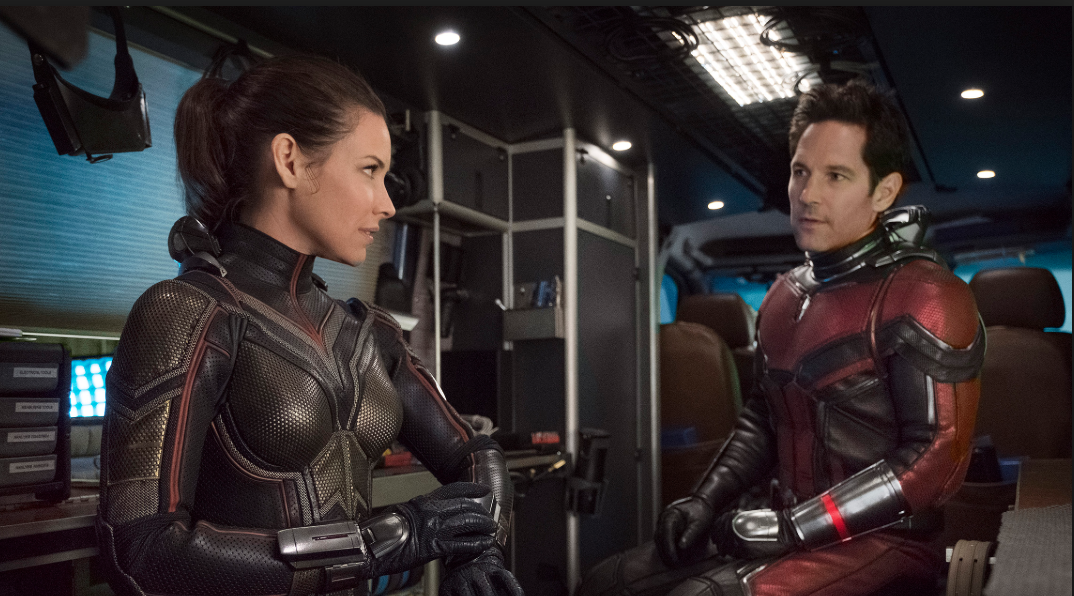
Posted on 6.27: Peyton Reed‘s Ant-Man and the Wasp (Disney, 7.6) isn’t a problem unless you’re determined to complain about it not being as good as the original Ant-Man (’15). Which it’s not.

It nonetheless has good, occasionally amusing work by Paul Rudd, Evangeline Lilly (Hope van Dyne / Wasp), Michael Douglas, Michael Pena, Walton Goggins (fated to play pain-in-the-ass, low-rent villains for the rest of his life), Bobby Cannavale, Judy Greer, Hannah John-Kamen (Ghost), Abby Ryder Fortson (Rudd and Greer’s daughter Cassie), Randall Park, Michelle Pfeiffer (Janet van Dyne — rescued in Act Three from the sub-atomic, micro-quantum realm or whatever you want to call it), Laurence Fishburne (punching the clock), etc.

Ant-Man and the Wasp is fleet, funny, disciplined, carefully honed, occasionally dazzling, light-hearted, pleasingly absurd…112 minutes worth of cool cruisin’. And those 112 minutes feel like 80 or 85, by the way. There are no significant downshiftings or speed bumps, or none that bothered me.

Please don’t let any other sourpusss types stop you from seeing it, but I’m telling you straight and true that Ant-Man and the Wasp is not quite as affecting, highly charged and/or sink-in good as I wanted it be. You may feel the same way when you see it, but you’ll probably survive.

Why should anyone care if Ant-Man and the Wasp registers as a slight letdown that’s nonetheless entertaining? There are bigger fish to fry and meditate upon. See it or don’t see it. But don’t weep for the Marvel and Disney empires — they’re fine. On top of which the Rotten Tomatoes whores have given it a 96% approval rating.

The dopey subversive humor in Reed’s three-year-old original felt fresher, for one thing. And the story was more emotionally affecting as far as Paul Rudd‘s Scott Lang was concerned. He was in a fairly dark and despairing place as it began — ex-con, low-rent loser, not much of a role model for his daughter — so morphing into Ant-Man by way of Michael Douglas‘s (i.e., Hank Pym’s) brilliance and reluctant largesse really meant something.

Read more

Hip-Hop Phase…Fog, I Mean

Now this — this! — is truly great television. A performance that felt like something else. Nine years and change. I was living in New York at the time, and I don’t think I was even watching as it happened. Letterman to Phoenix: “Joaquin, I’m sorry you couldn’t be here tonight. We’ll certainly keep you in our rolodex.” Phoenix looks like his 2009 self in Garth Davis‘s Mary Magdelene, which got caught in the Weinstein collapse and may or may not open in this country.

18 months later (9.22.10):

Uhm…I Already Knew This?

Six days ago a video clip surfaced of Stanley Kubrick explaining the ending of 2001: A Space Odyssey.

The footage was recorded 38 years ago by filmmaker Jun’ichi Yaoi. It was part of a documentary about paranormal experiences, blah blah. Yaoi’s doc was never released but a VHS of the raw footage was reportedly sold two years ago on eBay. Somebody evidently decided to upload the video to YouTube. Why did they wait two years? Why didn’t they upload it immediately? Or why didn’t they wait until 2001‘s 60th anniversary in 2028? Or the 70th in 2038? Who cares?

The Great Stanley K., in his own words: “I’ve tried to avoid doing this ever since the picture came out. When you just say the ideas they sound foolish, whereas if they’re dramatized one feels it. But I’ll try.

“The idea was supposed to be that [Keir Dullea‘s Dave Bowman] is taken in by god-like entities, creatures of pure energy and intelligence with no shape or form. They put him in what I suppose you could describe as a human zoo to study him, and his whole life passes from that point on in that room. And he has no sense of time. It just seems to happen as it does in the film.

“They choose this room, which is a very inaccurate replica of French architecture….deliberately so, inaccurate…because one was suggesting that they had some idea of something that he might think was pretty, but weren’t quite sure. Just as we’re not quite sure what do in zoos with animals to try to give them what we think is their natural environment.

Read more

Scandal-Ridden EPA Honcho Goes Down

Scott Pruitt, the most malignant Environmental Protection Agency chief ever, has resigned. EPA deputy Andrew Wheeler, almost certainly another anti-environmentalist, will take over in the interim. Pruitt impressed many in the media as the dirtiest, swampiest cabinet chief in government history, his actions having reportedly inspired 14 separate investigations. (Here’s a list of 13.) Pruitt, 50, had been very popular among conservatives for his absolute indifference to the health of the planet, but his ethical scandals were overwhelming.

From N.Y. Times: “Pruitt began the largest regulatory rollback in the EPA’s history, undoing, delaying or blocking several Obama-era environmental rules…among them was a suite of historic regulations aimed at mitigating global warming pollution from the United States’ vehicles and power plants.”

Sad Loss of a Good Guy

Midwestern liberal-progressive TV personality and talk-show host Ed Schultz, who hosted The Ed Show on MSNBC from 2009 to ’15 and who’d recently hosted a daily news show on RT America, has died at age 64. “Natural causes,” the report says. What exactly is “natural” about succumbing to an eternal black void at age 64?

Ed began as a North Dakota sports guy on radio, and then became a conservative talkshow host on North Dakota’s WDAY. He gradually evolved into the progressive camp in the mid to late ’90s. The Ed Schulz Show (radio) ran from ’04 until ’14.

Ed was quite the MSNBC host during the Obama years. I was a regular follower. He left MSNBC in ’15, largely due to political censorship from management.

Since being with RT America Schulz had told one and all that MSNBC’s Phil Griffin initially (and to some extent persistently) suppressed coverage of Bernie Sanders’ presidential campaign, and in one particular instance Schulz’s attempt to cover Sanders’ official announcement of his presidential campaign in Burlington, Vermont, on 5.27.15. This happened, Schulz believed, because Griffin and NBC news president Andy Lack were in the tank for Hillary Clinton, et. al. Here’s Schulz’s oral account of what happened when he tried to cover Sanders’ announcement. Seriously…listen.

45 days after this incident happened, Schulz left MSNBC.

Read more

“Great Escape” Leisure Village

John Sturges The Great Escape (’63) was shot on sound stages near Munich, and to some extent in a Bavarian town named Fussen. The real-deal Stalag Luft III, the P.O.W. camp from which P.O.W.s actually escaped in March 1944, was located 100 miles southeast of Berlin, in what is now the Polish town of Żagan.

In the comment thread that followed yesterday’s Great Escape post (“Independence Day Doldrums”), a discussion arose about the logistics of the escape, which led me to riff about the whys and wherefores of the escape itself.

The Great Escape P.O.W. camp was built in what looks like a 15-acre area not far from the Munich sound stages. It consisted of 16 P.O.W. barracks, which could theoretically hold 50 guys each or 800 total. The actual Stalag Luft III was spread over 60 acres and housed 11,000 POWs.

I noted yesterday that Sturges’ P.O.W. camp had the atmosphere of a leisurely, not-hugely-unpleasant work camp, and that the German guards were like testy high-school teachers (who’s been throwing spitballs?) and that the inmates conveyed military decorum while being casually impudent, or the attitude that TV audiences would later associate with Hogan’s Heroes.

The actual Stalag Luft III was not a hell hole. A bit grim but certainly tolerable. The men were adequately fed and housed. Bunks, blankets, pillows. Holiday dinners were served. The atmosphere was almost collegial, to go by the Wiki page. POWs organized theatrical shows and published two weekly newsletters. Mail and parcels from loved ones arrived. All kinds of recreational fitness options (including weights, fencing and table tennis) were available. The camp even had a small swimming pool.

As noted, the escape happened in the late stages of WWII (i.e., March 1944). Any sage assessment of how the war was going told you the Germans were doomed. The coming Eisenhower invasion, the disastrous Russian front, constant Allied bombing. Albert Speer wrote that events turned against the Germans in ’42, and that he knew they were sunk soon after. A 9.8.09 Guardian article by Richard J. Evans (“Why Hitler’s Grand Plan Collapsed”) asserts that “ordinary Germans knew by the end of 1943 that the war was lost.”

Read more