Half-Interesting, 47-Year-Old Wipeout

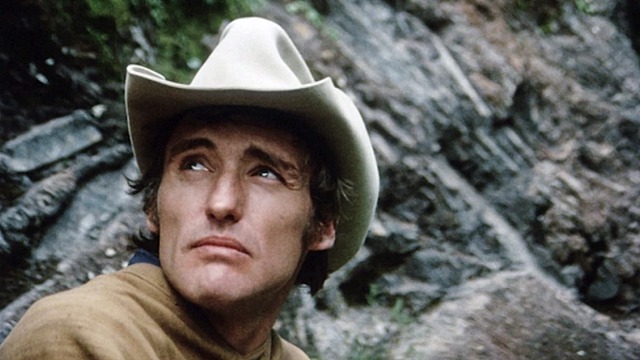
Earlier today I saw Dennis Hopper‘s The Last Movie at the Metrograph. The first third is half-interesting so I’m not sorry I saw it, but it’s mostly a sloppy mess, and that’s entirely on Hopper — the director, editor and star. The middle portion and final third are boring for the most part, and at times repellent. I read somewhere that Stewart Stern‘s original screenplay told an actual story that made sense, but the way it’s been cut together is lazy and haphazard; at times it almost feels spazzy. The film is interesting here and there (I liked the “SCENE MISSING” inserts and the fact that the main-title card doesn’t appear until 20 minutes in) but there’s no tension in any of it.

And Hopper’s lead character, a stunt coordinator named Kansas, is just an ass. A weak, squishy, impulsive jellyfish whom you half-tolerate at first, and then you grow to vaguely dislike and then hate him by the end of the first hour. He doesn’t die soon enough.
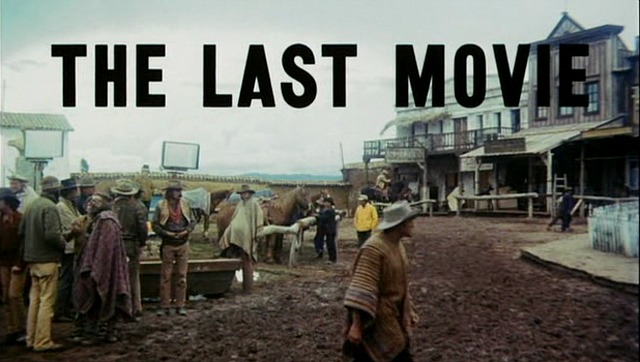
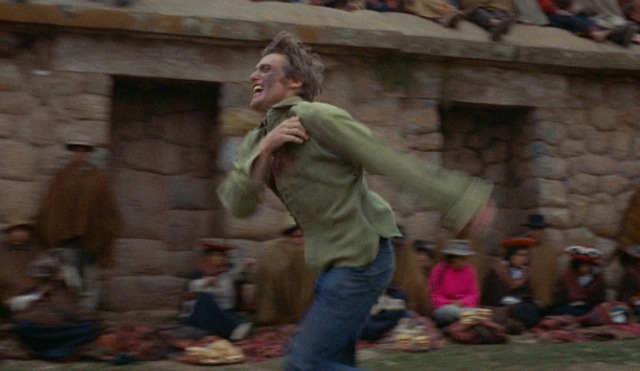
The Last Movie is set in a Peruvian village (actually a small town named Chinchero) in the Andes foothills. It’s about a Sam Fuller-directed western shooting there, and some guy dying in a stunt accident and Kansas, who seems like a reasonably decent fellow at first, deciding to stay in the village when the film wraps. He hooks up with Maria (Stella Garcia), an attractive, good-hearted woman who may or may not be a prostitute.

Kansas gradually turns into a weasel, breaking poor Maria’s heart by coming on to another woman (Julie Adams, best known for The Creature From The Black Lagoon) in her presence.

Then what happens? Kansas gets worried about running out of funds (this didn’t occur to him when he decided to stay on?) and decides to invest $500 in a sketchy goldmine scheme that quickly goes south. And then some of the native Chincherans — this is the really stupid part — decide to start making their own imaginary film with pretend cameras and microphone booms made of wood, except they don’t understand play-acting and start engaging in real violence. And Kansas gets caught in the wringer.

The primitive-natives thing is patronizing. The locals aren’t some tribe of spear-throwing jungle dwellers but small-town guys who wear boots and jeans and use telephones and order drinks in bars, and yet the movie tells us they’re as clueless and cut off from 20th Century civilization as New Guinea cannibals. A crap premise. Maria is from the same town, remember, and she seems as attuned to the complexities of modern life as anyone. If you don’t buy the idea that the natives are unable to understand the concept of acting and pretending, The Last Movie collapses like a house of cards.

The best part of The Last Movie is the first-act footage of Michelle Phillips, who was around 26 when the film was shot in 1970 and really, really beautiful. My whole mood brightened when I saw her. She married Hopper not long after The Last Movie wrapped, but they got divorced after only eight days. (Married on 10.31.70, divorced on 11.8.70.)


Michelle Phillips during filming of The Last Movie.

Hell Is Other Whistlers

I was sitting at a train station this morning (10:40ish) when all of a sudden I heard whistling coming from the parking lot. I don’t like whistlers any more than I like groups of women in bars who shriek and giggle after their second glass of wine, and so my first reaction was one of mild irritation. I looked around and didn’t see anyone. Then I heard it again. And then I saw him — an older guy in shorts, T-shirt, socks and tennis sneakers, slightly bent over as he shuffled along. It would be one thing if he was whistling “Don’t Let The Sun Go Down on Me” or “Beautiful Dreamer” or the Full Metal Jacket “Mickey Mouse Club” tune or even “Whistle While You Work,’ but no recognizable tune could be discerned.

What he was doing, in fact, was idiot-whistling — just hitting random notes and scales and feeling peppy for the hell of it. I scowled and seethed, not at the guy but at life and happenstance. There was nothing to be done or said. I for one have never whistled in mixed company. I might whistle if I was walking all alone at night in the middle of the Sonoran desert or along the beach in New Jersey or if I was in downtown Baghdad and looking to brush off a feeling of fear, but never at a suburban train station. I know I sound like a miserable misanthrope, but all he had to do was whistle a melody I could follow. And he refused.

Considering Superhero Mythology as Authoritarian

The MCU and D.C. superheroes are always presented as smirky, mild-mannered individualists — unpretentious, anti-corporate, egalitarian types with extraordinary powers, rock-hard bods and dry senses of humor. In a phrase, friends of the common man. I’m not saying they aren’t that or that the general superhero mythology is a mountain of bullshit, but just for the sake of argument or conjecture imagine that the superhero thing is all about authority, and that fans of superhero films are, in a sense, sheep or cattle. As in (a) “they love to eat that grass” and (b) “nothing makes them feel better than to obey by buying tickets.”

What’s the first requirement of any authoritarian figure? Obviously a widely accepted belief in his or her power and omnipotence. But the authoritarianism I’m speaking of isn’t a matter of this or that costumed brand monkey…Captain America, Batman, Mystique, Black Widow, Black Panther, etc. I’m speaking of the corporate authority wielded by the Marvel (Disney/Fox) and D.C. (Warner Bros.) guys. They’re only in it for the money, of course, but imagine if they also loved the power and control and had begun to get used to that extra-special warm feeling in their blood…that feeling of having built a super-empire and having convinced tens of millions worldwide to follow with a high degree of worship and obedience that would be the envy of any strongman dictator.

I’m not saying this is the case today, but imagine if it were. Because once you let this scenario into your head, everything becomes clear.

Distressed Bohemian

For decades my default definition of “taste” was one attributed to Francois Truffaut — “Taste is a result of a thousand distastes.” Which feels right as rain and a comfortable concept in this corner. If Hollywood Elsewhere is about anything, it’s about distastes. (And therefore about loving and worshipping things that don’t inspire pique or revulsion all the more.)

This morning I decided to add a supplement. It comes (or came rather) from London designer Christopher Gibbs, a renowned interior designer, antiques dealer and fashion maven who died two or three days ago at age 80.

Taste, Gibbs said, “is something you catch, like measles or religion.”

18 years ago Christopher Mason explained that Gibbs “is a leading proponent of that elusive brand of anti-decoration, high-bohemian taste favored by self-confident Englishmen, a look based on well-worn grandeur, disarming charm and unexpected contrasts.

“The magic is in the mix of masterpieces and oddities — like an assemblage of refined and wild-card house guests who mysteriously combine to create the ideal convivial country-house weekend. The allergy here is to the banal, not to dust.”

This aesthetic, which I’ve sworn by (or tried to swear by) for decades, is all but dead in this country, certainly among the flamboyantly wealthy. It’s been killed for the most part by the wannabe-Kardashian mentality that says everything has to look obnoxiously expensive and McMansiony, which is to say grand and over-sized and generally lacking in aroma and historic texure, which is to say clueless for the most part.

Gibbs: “I like things in their natural state — people especially. As life goes by, that’s what I admire: objects and people that are unmonkeyed with, that are themselves, not trying to be something else.”

The Times obit, written by Sam Roberts, reminds that Gibbs’ Cheyne Walk home in London “was borrowed by Michelangelo Antonioni for the party scene in his movie Blow-up (1966) and by Kenneth Anger to shoot the occult film Lucifer Rising (’72).

Gibbs also designed what he called the “earthly paradise” inhabited by the has-been rock star played by Mick Jagger in Donald Cammell and Nicolas Roeg’s film Performance (’70). A similar aesthetic was used for the spacious vampire home occupied by Tilda Swinton and Tom Hiddleston in Jim Jarmusch‘s Only Lovers Left Alive.

Read more