
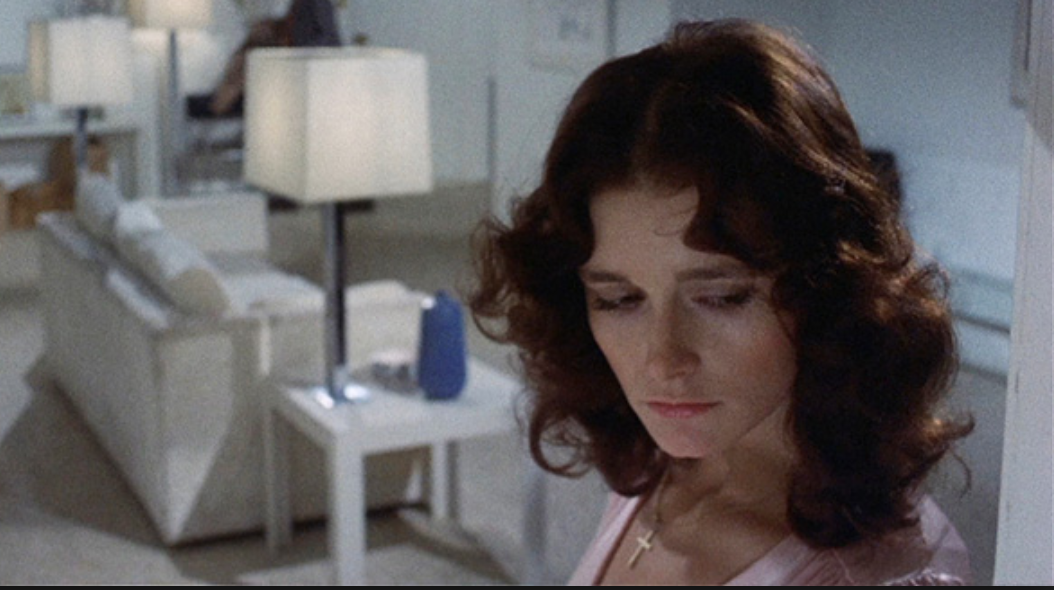
Criterion Teal Gremlin Returns

In the wake of Criterion’s garishly tealed-up Midnight Cowboy and Bull Durham Blurays, the teal monster has re-appeared in Criterion’s forthcoming Bluray of Brian DePalma‘s Sisters (’73). Or it has, at least, according to frame captures posted by DVD Beaver’s Gary. W Tooze.

HE to Tooze: “This continuing Criterion teal thing is crazy. WHAT IS CRITERION DOING? No disrespect but is there any chance at all there’s something screwy on your end? Something to do with 4K discs or your 4K player? Nobody else is talking about Criterion’s teal obsession. Please level with me — WHAT COULD BE HAPPENING HERE? BECAUSE IT’S INSANE. Why would Criterion do this? The latest offender is Sisters.”

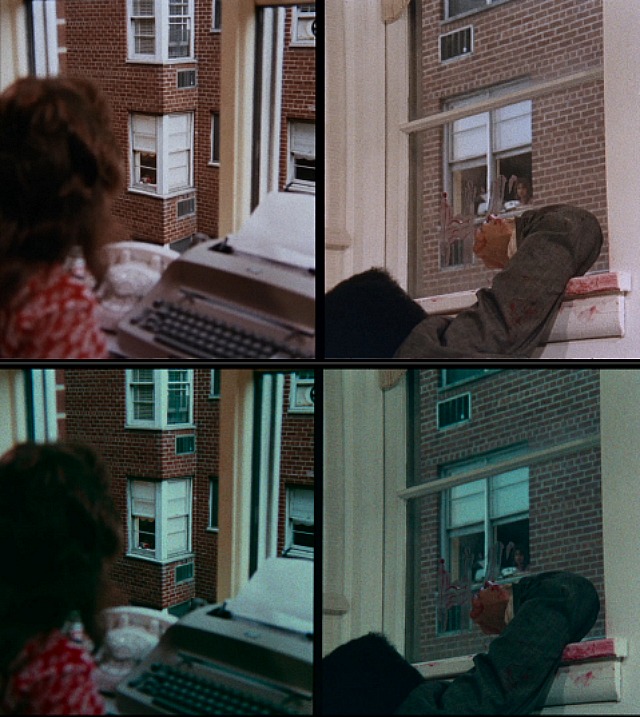
Notice the distinct teal tint in the bottom image, which is taken from Criterion’s Sisters Bluray; the above image is from an earlier Arrow Bluray.

Mark Smith to HE: “To go by DVD Beaver frame captures Criterion’s Sisters Bluray is not as egregious, offensive and baffling as the recent Bull Durham and Midnight Cowboy releases, but it’s in the ballpark.

“This MUST have something to do with color technology on 4K or HDR or…something. I cannot believe that this is just a series of fullon botchjobs. These transfers are director- or cinematographer-approved. There’s no way Criterion and Adam Holender looked at the teal sky in Midnight Cowboy and said, ‘Perfect!’

“What is Gary Tooze seeing that Criterion is not? What monitors are they all using? Why are not all of Criterion’s new releases tealed-up? I’d be willing to bet that this is an HDR/4K monitor problem.”

Tooze replies: “Hello, Jeffrey — We don’t obtain our captures on 4K UHD monitors. We have sampled comparisons with other sites (that also use the VLC software) and they seem to be the same on our reviews of other films.

“As I noted in our review, [the teal tint] is less-visible on my OLED (4K UHD) but all systems may have different filters, especially nowadays. We used the latest version of VLC — flat with no enhancement.

The teal effect has been noticed on plenty of non-Criterion Blurays for years. And you can see about 800 Criterion reviews on DVD Beaver WITHOUT the teal…so it ain’t me. I’ve been doing this 18 years.

“Maybe directors in the booth are swayed by modern technical-ability to shift colors? I don’t have an answer as to why it exists – I am just reporting it.” — Regards, Gary Tooze”

And The Oscar For 1993 Best Hindsight Award Goes To…

Hollywood Elsewhere also totally agrees with Virginia Postrel’s additionally brilliant suggestion for a Best Hindsight Oscar for the Best Picture from 25 years ago.

“Nominees would be selected through the same process as the current year’s Best Picture nominees but from the earlier year’s offerings,” Postrel explains. “To keep already-confusing dates consistent, the award would count back from the year whose films are being honored — say, 2018 — rather than the year of the ceremony.”

If, in other words, the Academy was to hand out a Best Hindsight Oscar next February, the applicable year (a quarter century prior to 2018) would be 1993…right? Academy voters who therefore re-consider the best films of that year (Groundhog Day, Jurassic Park, True Romance, Philadelphia, Schindler’s List, The Firm, The Age of Innocence, In The Line of Fire, Falling Down, A Perfect World, A Bronx Tale, In The Name of the Father) and vote for their favorite.

Schindler’s List might still take the top prize, of course, but guess what definitely wouldn’t win? Correct — Philadelphia. What should win? Correct — Groundhog Day.

Brilliant Popcorn Oscar Solution

Three or four days ago Bloomberg’s Virginia Postrel re-posted a solution to the Best Picture Oscar problem (tickets buyers preferring mass appeal or FX-driven popcorn flicks, Academy members preferring to honor movies that are actually good in some kind of profound, refined or zeitgeist-reflecting way) that I think makes a lot of sense.

The short-lived Best Achievement in Popular Film Oscar idea died because (a) it was too vaguely defined and (b) it would have essentially denigrated the potential contenders in this category by categorizing them as popular but a bit slovenly — i.e., lower on the cultural totem pole than bona fide Best Picture nominees.

Postrel’s idea is to not cast indirect shade upon mass-appeal films but simply create two Best Picture categories based on admissions — a Spirit Awards-type Best Picture Oscar for films that have sold less than 10 million tickets and a mainstream Best Picture Oscar for films that have sold more than 10 million tickets. Simple, no shade, and fully reflective of how the the movie-watching world is defined these days.

This is it! This really and truly solves the problem, and nobody (not even Kris Tapley, Mark Harris or Jeff Sneider) could possibly argue against it. Attention John Bailey, Dawn Hudson and all the ships at sea — this double-Oscar solution will boost Oscar telecast ratings, save the Oscar brand and make everyone completely happy in a fair, even-steven way.

Now watch the Academy dither and delay and probably never act upon it. But I’m telling you straight and true that this is the answer on a silver effing platter.

It’s the admissions, stupid!

In Postrel’s words: “[The solution would be to] emulate journalism awards that divide publications by circulation: Divide the Best Picture awards into two categories, best picture (under 10 million tickets sold) and best picture (10 million tickets or more). Just as publications with wildly different circulations operate under different constraints, so do movies aimed at different-sized audiences.

“Rather than stigmatizing one or both categories, this division would treat them as equally valid, just as the Oscars do with short versus standard-length films. Adding a December 31st cutoff date for counting tickets would encourage less crowding of Oscar-worthy pictures in the waning weeks of the year.

“Ten million tickets puts a movie in about the top 40 for the year, a large-enough universe to offer diversity in both genre and artistic ambition. For 2017, nominees might have included Baby Driver, Blade Runner 2049, Coco, Dunkirk, Get Out, Girls Trip, It, Logan, Wonder and Wonder Woman.”

Final Postrel commentary: “The Academy Awards have two purposes. One is to let industry insiders honor their peers and congratulate themselves for jobs well done. But their more important goal is to get the general public to appreciate and patronize the movies — and thereby to keep the insiders in business.

“In that pursuit, the Oscars need to find ways to recognize that popular taste isn’t always bad. You don’t win fans by insulting your audience. And many popular movies are actually excellent, even if it takes hindsight to realize their merits.”