

Buchanan Understands

In his first Oscar-odds-assessment piece of the season, N.Y. Times “Carpetbagger” columnist Kyle Buchanan notes that “uncertainty makes the Best Actress field hard to predict, since The Favourite fields three women, each of whom could position herself as a lead: Olivia Colman shines as a diminished Queen Anne manipulated by two crafty women in her court, played with comic precision by Emma Stone and Rachel Weisz.”

However, later in the piece Buchanan adds that “should Ms. Colman drop down to the supporting-actress category for The Favourite, she would probably coast through Oscar season, picking up trophies right and left.”

HE to 20th Century Fox award-season strategists: One, Colman’s role in The Favourite is not a lead — she’s Robert Shaw in The Sting. It would not be category fraud if she ran for supporting. And two, she’s this year’s Bruce Dern. Remember how Dern’s performance as a doddering old guy in Nebraska was praised left and right but he refused to campaign for Best Supporting Actor? And then lost? He could have easily won if he’d gone for supporting. Easily.

Ballot-Stuffing Gaga Fans?

The Toronto Film Festival People’s Choice Awards will be revealed tomorrow. I’m hoping that Green Book wins the popularity prize, but the betting is that A Star Is Born has it in the bag; ditto Lady Gaga for Best Actress. The suspicion is that high-fervor Lady Gaga fans will be avalanching the process.

It’s been claimed that the voting system isn’t fair — that you don’t have to see the film to vote & can vote multiple times for the same film with different email addresses. But TIFF spokesperson Andrea Grau says this isn’t true — that TIFF has “ensured that an individual cannot vote for the same film multiple times by email address. The data is processed through our system which then analyses the origin of the vote and matches votes to TIFF’s ticket buyer information and database.

“Using these methods any attempts to sway the result through mass campaign voting can be quickly identified and discounted.”

It’s also been suggested that TIFF should reinstate the rule that voting for a film is limited to those who actually watched a film (e.g., entering some sort of proof or barcode or whatever). I’m not even sure when or if that rule was removed. I’ve asked around; hard to pin down.

Irony of the Game

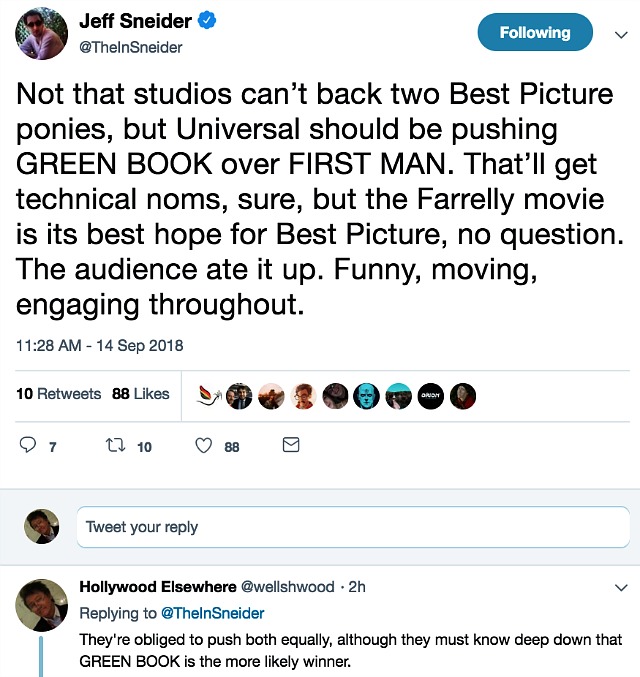
Universal’s two big Oscar ponies are Damien Chazelle‘s First Man (10.12) and Peter Farrelly‘s Green Book (11.21). By any comprehensive, even-handed standard Chazelle’s film is the grander, more far-reaching and more muscular achievement — a movie that delivers a somewhat familiar tale in unusually intimate terms, and with fresh cinematic brushstrokes. And yet Farrelly’s film, conventional and safely conceived as it is, is more emotionally winning than Chazelle’s by a country mile. And it deals with a subject and a climate that every over-45 person can recall (black-white relations as they used to be in the bad old days) while engaging audiences in an easy, comforting, non-challenging way. In a phrase, Green Book has a better shot at winning the Best Picture Oscar. I’m sorry but it does.

Slumberball

After averaging five or six hours of nightly sleep over the last two and a half weeks (Telluride + Toronto), I actually allowed myself to catch eight hours last night. Which is why I began a little later this morning than usual. Perhaps a little more relaxation this weekend, and then New York Film Festival press screenings begin early Monday morning. The first will be (what the hell) Alex Ross Perry‘s Her Smell.

Read more

Making Molehill Out of Mountain

Last night Bill Maher reiterated his longstanding frustration with Democrats who seem constitutionally incapable of talking tough and blunt about Donald Trump, and about the fact that the guys who are really letting him have it are fellow Republicans. Agreed — with the exception of Elizabeth Warren, Kamala Harris and a few others, Democrats are mostly acting like cowards. Yes, I know — they’re waiting for the blue mandate that will presumably come in November. But the fact that there’s still no galvanizing Democratic frontrunner for the Democratic presidential nomination is troublesome.

Read more

Water Under The Bridge

Two or three days ago Sasha Stone sent me a Gene Maddaus Variety story about ongoing litigation about the failure of Warren Beatty‘s Rules Don’t Apply. Beatty and Regency Enterprises (Yariv Milchan and his billionaire dad Arnon Milchan) have sued and counter-sued each other** about who bungled the marketing of Beatty’s Howard Hughes film, which opened and quickly died in late November of 2016. It ended up with a lousy $3.9 million domestic.

My reply to Sasha: “Who gives a shit? Outside of journalists and industry types nobody much cared when Rules opened and flopped two years ago. It was an odd duck of a film — partly farcical, partly constipated and partly a repressed love story between Alden Ehrenreich and Lily Collins, whom no one cared about. The strongest elements all came from Beatty’s darkly eccentric performance as Hughes. The problem was that Hughes was in his early to mid 50s in the realm of the story (1958 to ’64) and Beatty was 76 and 77 when he performed the role in 2014. The bottom line is that Beatty looked too damn old, plus he hadn’t been in a film for 15 years. He was certainly too long of tooth to have sex with the 20something, champagne-buzzed Collins in that one scene. Some of Rules Don’t Apply worked, but too much of it didn’t.”

Here’s my review (“Notes to Myself about Rules Don’t Apply“), posted on 11.12.16.

** From Wikipage: “In December 2017, it was announced that Arnon Milchan and Regency Enterprises, one of the film’s financiers, was suing Beatty for $18 million. The company cited breach of contract, claiming Beatty had not repaid the promotion cost losses the company took on following the underperformance at the box office. In March 2018, an investment group including Brett Ratner, Ron Burkle and Steve Bing counter-sued Regency for $50 million, claiming it was their under-promotion of the film that had led to its ‘disastrous box office results and the loss of cross-complainants’ entire investment.'”