Another Anderson Time Trip

I don’t know how to react to an Indiewire report about Wes Anderson‘s latest, The French Dispatch, a 20th Century journalism saga with three parallel storylines and set in Paris. Shooting recently began in Angoulême, France. The ensemble cast includes Timothee Chalamet, Bill Murray, Benicio del Toro, Frances McDormand, Jeffrey Wright and Tilda Swinton.

Bullshit HE speculation: Pic is set sometime in the early days of the French nouvelle vague (’59 or ’60). Just a thought, just a guess, insect antennae, etc.

Will The French Dispatch follow the lead of my favorite Anderson film of the last few years, The Grand Budapest Hotel? I liked ghat 2014 film because it came close to stepping outside of “Andersonville,” that carefully styled, ultra-hermetic world that Wes’s films and characters always reside in. Wes will always be Wes, but I’m craving darker, heavier subject matter. In ’07 I suggested that he remake Jean-Luc Godard‘s Weekend.

“I’d really like to see an Anderson flick about adult characters dealing with adult-type stuff. They can act like adolescents all they want, but enough with the precious adolescents and stop-motion animals and robots and bright young obsessives with father issues. We need a Wes movie about guys in their late 30s or 40s who don’t come from inherited wealth and have had to scrap to survive and who ride motorcycles and fuck well and have more or less found their place in life.” — from a 3.23.12 HE post called “End of Phase One.”

Little People

I’ve been hearing about Robert Zemeckis‘s Welcome to Marwen (Universal 12.21) since last summer. It opens on 12.21 (19 days hence) and I haven’t heard zip about screenings.

We all know the drill: It’s about the true saga of Mark Hogancamp (Steve Carell), a photographer and model builder who was attacked 18 years ago by a group of neo-Nazi ruffians. (Hogan camp went to a blue-collar bar and brilliantly mentioned being a cross-dresser.) He suffered severe brain damage and a near-complete loss of memory, and had to re-learn how to walk and speak. As a form of therapy he created a small-scale, World War II-era Belgian village which became a kind of alternate-universe environment for the guy.

Formerly called The Women of Marwen, pic costars Leslie Mann, Merritt Wever, Janelle Monae, Gwendoline Christie, Diane Kruger and Eliza Gonzalez.

The script by Zemeckis and Caroline Thompson is based on Marwencol, Jeff Malmberg‘s 2010 documentary about same.

Read more

Sad Memory Play

I first saw Kenneth Lonergan‘s You Can Count On Me, probably the best written and most affecting sister-brother drama I’ve ever seen, at the January 2000 Sundance Film Festival. I was especially touched by Mark Ruffalo‘s lost-soul character as he resembled my younger brother Tony, who died of an accidental Oxycontin overdose in October 2009.

Two months later I read a couple of reviews of Lonergan’s just-opened The Waverly Gallery, a “memory play” (i.e., one without much of a story). It’s about Gladys Green, an 80-something art gallery manager and woman attorney coping with the ravages of Alzheimer’s disease, and how this burgeoning condition affects her daughter Ellen, son-in-law Howard and grandson Daniel.

Lonergan based it on his grandmother’s deterioration from said disease. The great Eileen Heckart played Gladys to great acclaim; Josh Hamilton played Daniel.

Freshly attuned and excited as I was about Lonergan back then, I remember saying to myself “jeez, where the hell can you go with a play about Alzheimer’s?” I couldn’t imagine anything but a downward trajectory. The family in question can only do their best and tough it out until the end. Especially if they’re determined to not put the Alzheimer’s sufferer into assisted living, which (be honest) is what many if not most families do these days.
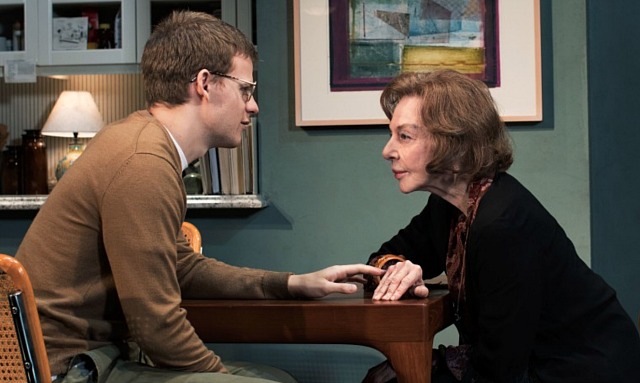

Lucas Hedges, Elaine May in The Waverly Gallery.

Then again there’s always the nourishment to be had from Lonergan’s excellent writing along with the fact that The Waverly Gallery is a kind of dark comedy.

My initial conclusion was that since there’s nowhere to go with Alzheimer’s plot-wise, the only thing Lonergan could do is somehow persuade the audience that this horrid, godawful disease is a metaphor for the selective memories and occasional delusions that affect all of us from time to time.

How would he do that? Play it dead straight. Recreate this sad, ghastly experience as closely and sharply as he could, get excellent actors to make the characters come to life, and don’t throw in any kind of fake-bullshit upbeat ending.

18 and 1/2 years later or more specifically last night, I saw a revival of The Waverly Gallery at the John Golden theatre on West 45th. I was deeply impressed by Lonergan’s writing, as I knew I would be. And by Elaine May‘s feisty, sharp-as-a-tack performance as Gladys — the last time she was on Broadway was 58 years ago in An Evening With Mike Nichols and Elaine May. (Which was also performed at the John Golden theatre.) And by Lucas Hedges‘ performance as Daniel. And Michael Cera‘s as Don, a not-very-talented painter whose work Gladys hangs in her gallery, and David Cromer‘s as Howard.

I don’t know what to say other than it’s very well done. There was never a second in which I didn’t feel fully engaged and fascinated, and generally delighted to be in the company of all these talented people, director Lila Neugebauer included. This is what a first-rate theatrical sink-in can and should feel like for the most part, I was telling myself.

I just can’t honestly say that I was blown away, but how many times does a stage play manage that?

For The Waverly Gallery isn’t so much a “play” that begins at point A and ends at point C or D, but a meditative memoir that says “you may think your life sucks but wait until you have to deal with a grandmother who’s losing more and more of her mind until there’s almost nothing left, and then she’s deep in the dungeon from which there’s no returning.”

And yet The Waverly Gallery is a seriously composed experience that reminds you of reality in a hundred different ways with a hundred little shoulder taps, and which echoes all over the place.

I’m taken with the following line from Ben Brantley’s 3.23.00 N.Y. Times review: “The language itself ranges from the careful elegance of Daniel’s monologues to lines that find the startling patterns and potency in the rambling speech of senility.”

Thanks so much to David Pollick for helping me with the tickets. The seats were excellent — row G, 102 and 104.

Trust What Ebbs and Flows?

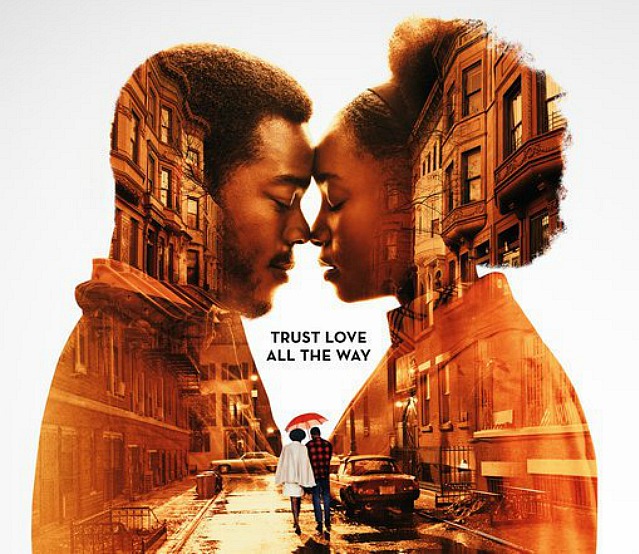
“Trust love all the way” is the marketing slogan for Barry JenkinsIf Beale Street Could Talk (Annapurna, 12.14). I’m sorry but I regard that advice as a bill of goods.

Boil the snow out of Beale Street and the basic idea is this: Life is unfair and sometimes cruel, especially for POCs in ’70s Harlem and double-especially when a fraudulent rape charge lands poor young Fonny (Stephan James) in jail, leaving his pregnant young wife Tish (Kiki Layne) and their respective families (including Tish’s mom, played by Regina King) trying to somehow clear his name.

The basic drill is that justice is possible but too often unlikely, and in the end the thing that gets Fonny and Kiki through is love, as in (a) “black love is black wealth,” (b) “love is the fuel of survival, and (c) “despite the hardship and the fact that sometimes life sucks extra hard, love is the key to surviving the brutality of White America.”

Satisfying movies always deliver a sense of justice at the end. The punishing of the guilty, the exoneration of the innocent, he/she gets what’s coming to him/her. Some sense of balance and fairness. “As you sow, so shall you reap” = Michael Corleone at the end of The Godfather, Part II or Zampano at the end of La Strada.

The bold strategy of If Beale Street Could Talk (which I fully respect) is to deny this payoff to Fonny, Tish and their families, and therefore to the audience. And at the same time it offers the “love will see you through if you really trust it” homily, which I regard as more of a bromide.

I’m in no way questioning the message or the metaphor in James Baldwin’s same-titled 1974 novel, and the meaning of Beale Street as a condition, a state of mind, the blues and the history of that, you can’t sing it if you haven’t felt it, black Americans trying to get by and pull through despite a sometimes wicked system.

But If Beale Street Could Talk is fundamentally unsatisfying because people we’ve come to know and care about are handed a shit sandwich at the end. (Or at the very least my idea of one.) Which is why when it slips out of the safety cocoon of industry screenings and award-season events and critical praise and whatnot, Beale Street is going to quietly die. Which sometimes happens with good films.

The bottom line is that people generally don’t pay to see a film in order to share in the eating of a shit sandwich.

Read more