Brian Wilson’s “Wouldn’t It Be Nice?”

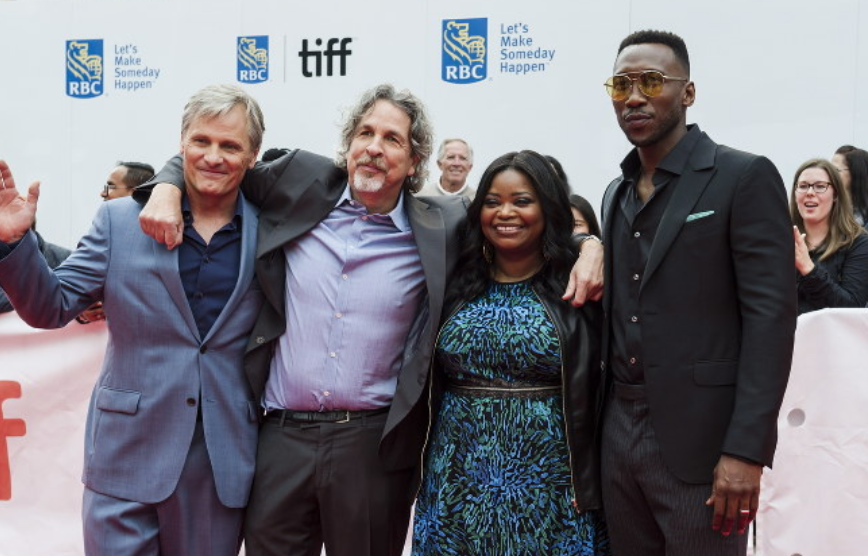
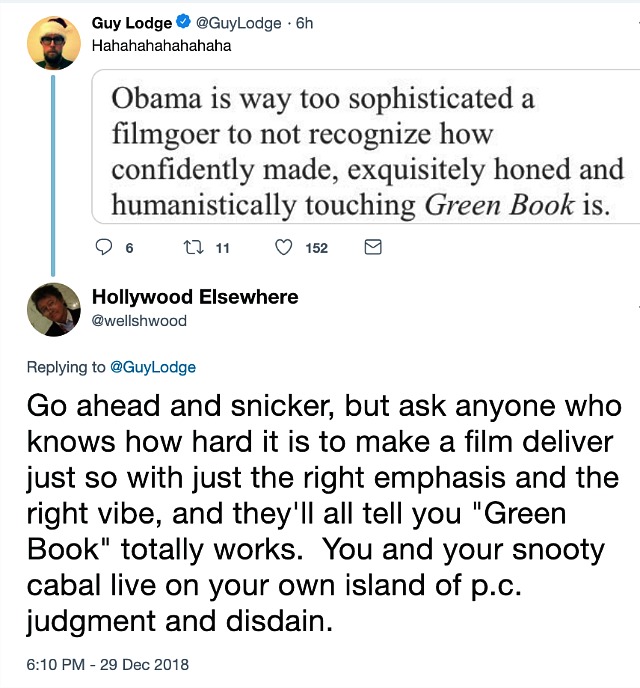
I know this’ll never happen for the same reason that cowardice doesn’t require a conspiracy — it just comes naturally to so many. But it would be so wonderful if Green Book fans within the Academy, guilds, HFPA and BFCA would quietly resolve to vote for Peter Farrelly’s film in order to send a nice, big, friendly “kiss our collective ass” message to the woke thugs in the film critic community.

Not because it’s necessarily the best film of 2018 (although it may be that to some), but because it’s clean and confident and very well made — a genial film that knows exactly what it’s doing and why and, despite what the p.c. take-down crowd has written, isn’t guilty of any significant crimes. It has a good adult heart, and feels like sublime anti-Trump medicine while you’re watching it.

In other words, a vote for Green Book could, with the right collective adjustment of attitude, be understood as a vote of solidarity with all the Joe and Jane Popcorns out there who despise politically correct culture.

From Owen Gleiberman‘s latest Variety column, titled “What Each Possible 2018 Best Picture Winner Would Mean“:

“Last fall, when I first saw this racially themed 1962 buddies-with-nothing-in-common road movie, I thought it had a clear chance to win best picture. It’s that kind of finely etched and wittily sincere lump-in-the-throat liberal crowd-pleaser. But its politics, in the eyes of some, are tainted by (it is argued) a certain patronizing quaintness that has lived past its cinematic sell-by date.

“So what will it mean if Green Book emerges from all that and wins anyway? It will mean not just that the movie strikes a powerful comedic-dramatic chord, but that the more traditional voices of Hollywood want the world to know that this is the sort of middlebrow humanistic movie that still resonates with them. It would represent, in many ways, a vote against the new wave of Academy members.”
Read more

Unprotected Sex

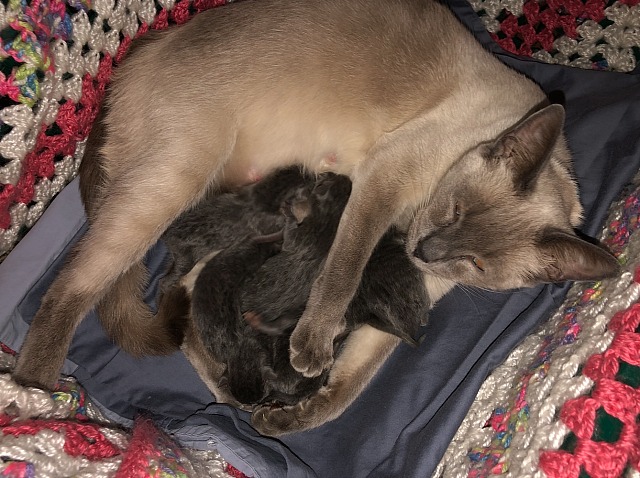
It’s my fault for failing to get Anya, our 18-month-old Siamese, spayed last spring or summer. Guilty. But I wasn’t the one who let her out when she was in heat. She wound up doing the deed with a dark gray alley cat — a commoner. She gave birth to seven kittens two days ago around noon, and every one is the spittin’ image of trampy dad. I was hoping at least one or two would be a junior Anya (creamy beige coat, bright blue eyes, exceptional intelligence) but no dice.

Worse, Anya is apparently uncomfortable with the challenge of nursing seven kittens. (She has eight nipples so go figure.) For reasons I can’t fathom she’s been carrying one, two or three kittens out of the kitten box and into the bedroom and under the sheets. She’s constantly moving them around. She seems to be saying one of two things: (a) “Help me out…I can’t do this alone” or (b) “I’m not comfortable with the kitten box being in the living room…the bedroom feels safer.”

I’ve read that if feline queens decide they have too many kittens they’ll isolate one from the brood, the idea being to let nature takes its course. To guard against one of them dying from malnutrition I’ve bought a can of KMR (kitten milk replacer) and a tiny plastic nursing bottle. I’ve been nursing two or three every so often, at random.

You can’t tell them apart. All the same shade of gray, their eyes closed…seven squeaky little mice.

Read more

Goodness Hides Behind Its Gates

“And I wish I’d been out in Stone Canyon /
When the lights on all the Christmas trees went out /
But I been burnin’ my bell, book and candle /
And the restoration plays have all gone ’round” — from “Winter“, a Jagger-Richards song on Goat’s Head Soup, their least admired ’70s album.

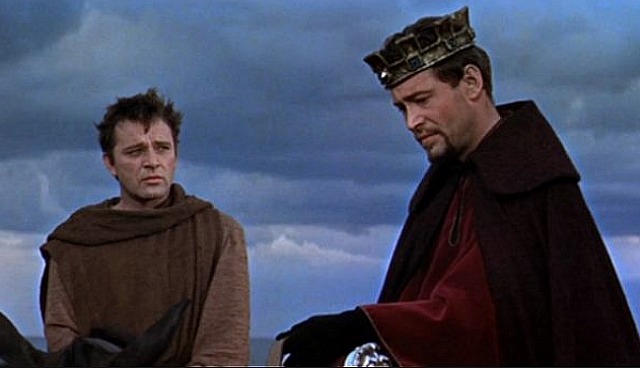
When “Becket” Was A Thing

As far as I’m able to tell, Armond White‘s N.Y. Press review of Peter Glenville‘s Becket, which appeared roughly 12 years ago, is no longer retrievable. I posted a condensed version on 1.30.07. It closely echoed a Becket riff I’d posted on 2.3.06. I’m re-posting both here.

White: “Ostensibly the story of King Henry II appointing his confident Thomas a’ Becket to be Archbishop of Canterbury and then reneging on his bequest — a decision that historically split England’s religious affiliation — Becket is mostly fascinating as a love story between two men.

Jean Anoulih‘s stage play is strengthened by the conflict of worldly affection and spiritual devotion when Becket’s born-again allegiance to God takes precedent over his fealty to Henry. This movie version is deeper than anything the makers of Brokeback Mountain could ever conceive — or admit to.

“Re-seeing Becket in light of the recent so-called breakthrough for gay film subjects makes one realize how advanced mainstream filmmaking used to be. Peter O’Toole‘s Henry and Richard Burton‘s Becket profess their regard for each other with bold openness and extravagant anguish. Precisely because this affection remains Becket’s subtext, it is never treated as a self-congratulatory end in itself. O’Toole and Burton are artistically free to fully vent their characters’ emotions.”

Director Peter Glenville “subtly encodes this historical epic with sexual intimations: Henry and Becket’s tandem escapades, phallic candles, bareback horseriding, etc. But he takes a dry approach to the complications of lost-love and how these legendary leaders deprived themselves — Becket through an excess of religious fervor, opposing the King’s edict out of personal arrogance; Henry through unchecked emotionalism and personal vengeance.

“This psychological depth gives Becket an edge over the other ’60s dramas about the Plantagenet rulers (A Man for All Seasons, The Lion in Winter, Anne of the Thousand Days) and puts it close to the sophistication of Lawrence of Arabia and, yes, My Own Private Idaho.”

Read more

Charisma Factor

It’s been obvious from the get-go that Disney’s forthcoming Jungle Cruise (7.24.20) is strictly for the family-moron trade. It therefore shouldn’t matter (certainly not to HE readers) how much Dwayne Johnson or Emily Blunt were paid for their services. Nonetheless TMZ reported yesterday with some hoo-hah that Johnson was paid $22 million while Blunt “only” received a piddly $9 million.

Sorry but this doesn’t have the same pay disparity ring as the notorious Mark Wahlberg-Michelle Williams additional shooting compensation saga on All The Money in the World.

As the term “jungle” connotes thrills and danger in a wild, slithery, Tarzan-like atmosphere with hippos, pythons and chimpanzees, the film is obviously geared to allow Johnson to perform his brawny machismo routine at certain critical junctures in the narrative.

If the template is a dumbshit African Queen, Johnson is aping Humphrey Bogart‘s Charlie Allnut character with Blunt playing Katharine Hepburn‘s Rosie. Two-handers are all about conflict and chemistry and give-and-take so why isn’t the pay even-steven? Fair question.

But Jungle Cruise is obviously adhering to a classic formula — a flawed male alpha figure in the front-and-center position with a spirited woman of refinement and sensitivity who steps in and gradually ups his game. Blunt isn’t the Jungle Cruise charisma magnet — Johnson is. She knows it, Disney knows it, HE readers know it.

Read more

Last Lardbuckets

Wiki synopsis for Greg Pritikin‘s The Last Laugh (Netflix, 1.11.19): “Buddy Green (Richard Dreyfuss), a former stand up comedian who retired from the spotlight 50 years ago, reunites with his former manager Al Hart (Chevy Chase) after being convinced to do one last comedy tour.”

Green is presumably meant to be in his early 70s, or roughly Dreyfuss’s age. Does it make any sense that Green retired in ’68, or five years before Dreyfuss’s glow-of-youth breakout performance in American Graffiti (’73)? Why couldn’t he at least have retired in the late ’80s as he was hitting 40? I could half-buy that, but nobody retires at age 21. Or 31, for that matter.

Pritikin Wikipage warning: “Pritikin feels very strongly about people using electronic devices on airplanes. Quote from a 2013 New York Times article: ‘I’ve almost come to fisticuffs with some passengers who refuse to turn off their phone. I take airplane safety very seriously.’