Lethal Weapon

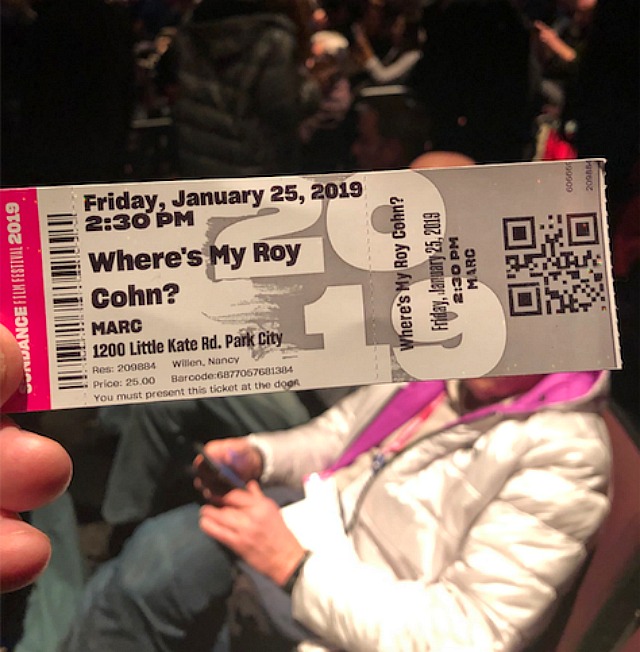
I caught Matt Tyrnauer‘s Where’s My Roy Cohn? earlier today at the MARC. How can a study of perhaps the most notoriously ruthless attack-dog attorney in U.S. history be anything but a dark poem? A movie, I’m thinking, about ghosts, demons, banshees, goblins. A merging of fact and nightmare.

The film is actually less poetic than a smart, sturdy, well-assembled thing — an efficient portrait of a closeted, scabrous, old-school shithead. It’s fully respectable as far as it goes, but Cohn’s legend doesn’t feel all that linked or connected in the current zeitgeist. He was raised and shaped in another era, a darker time.

The only element that vibrates is the fact that Donald Trump admires Cohn’s fang-toothed approach back in the day. Yes, Cohn was an inspiration to the youngish Trump in the ’60s, ’70s and ’80s, but Trump’s hyper-aggressive approach to the rough and tumble of big-time politics, looking to exploit whatever fears and anxieties might be lying around…well, we knew that going in.

How absorbing is Where Is My Roy Cohn? — how sharply assembled, how hard-htting? Very, but at the same time it never really sheds its skin and transforms itself into something you might not see coming. I’m sorry but I didn’t enjoy it as much as Tyrnauer’s Scotty and the Secrets of Hollywood or Studio 54 docs, both of which were released last year.

Cohn was a cold, bloodless, out-for-numero-uno creep, and seemingly a drag to be around. As a subject, I mean, as well as in real life.

I guess I was looking for some kind of crazier current, maybe something borrowed from the realm of Mike NicholsAngels in America. The film is “good,” as far as that goes. Tyrnauer is a gifted, highly intelligent filmmaker. I have no complaints with what it is — I just wish it had unfolded in a loopier, less conventional way.


Maher Pities Enraged Comic-Book Geeks

Bill Maher “New Rules” rant on comic-book culture, aired tonight: “Can we stop pretending that the writing in comic books is so good? Please — every superhero movie is the same thing. A person who doesn’t have powers gets them, has to figure out how they work, and manages to find a glowing thing.

Justice League, glowing things. Iron Man, glowing things. Spider-Man, glowing things. Captain America, glowing things. Glowing things, glowing things, glowing things!”

Maher to Multitudes of Middle-Aged Comic Book Fans: “I’m not glad Stan Lee is dead — I’m sad you’re alive.”

Read more

Soderbergh Likes “Vast of Night”

I’m determined to see Andrew Patterson‘s The Vast of Night at the Slamdance Ballroom on Monday, 1.28 at 8pm. A low-budget but allegedly resourceful ’50s sci-fi thriller, it’s about a single night in New Mexico in which a young switchboard operator and a radio DJ uncover a strange frequency (aliens?) that could change their lives, their small town and in fact the planet Earth.

Variety contributor Nick Clement recently saw Patterson’s film, and mentioned his admiration of it while interviewing director Steven Soderbergh, whose High Flying Bird will premiere at Slamdance the day after tomorrow (Sunday, 1.27, 3 pm).

Clement: “The interview was for a curtain-raiser piece about the 25th anniversary of Slamdance. I told Soderbergh how much I love Vast of Night and he asked to see it — and then he messaged me saying how much he loved it and how he’s gotta meet the filmmakers.”

Directed by Patterson and written by James Montague and Craig W. Sanger, The Vast of Night stars Sierra McCormick, Jake Horowitz, Gail Cronauer and Bruce Davis.

Mood Stabilizers


Just after exiting 2:30 pm MARC screening of Matt Tyrnauer’s Where Is My Roy Cohn?, which is about smart and sturdy and engrossing as a doc about an old-school shithead could be expected to be.

Dinner at Cafe Terigo with director and dp Svetlana Cvetko and editor-producer David Scott Smith.

Hail and Hearty Fellows

Early yesterday afternoon I did another “what say ye about the Oscar race?” Gold Derby podcast chat with Tom O’Neil and Michael Musto. The usual usual but we had fun. I agreed with Musto that Roma is a lock to win Best Picture “with Green Book on the outside as a close runner-up.”

For my money we didn’t sufficiently discuss the all-but-total collapse of A Star Is Born and Bradley Cooper enough, but Tom was leading the discussion.

HE quote: “I don’t think there’s stopping Mahershala Ali (Green Book) in the race for Best Supporting Actor,” I said. “He’s been ahead since the get-go. I’d like to see Richard E. Grant win because I loved him in that role more than just about anyone else.”

Musto quote: “It’s time for Glenn Close to get the freakin’ Oscar and everyone knows it! [Plus] Glenn plays a character who deserves the award that someone else gets. And she’s getting it this time. There is no chance for Lady Gaga!”

I was forced to participate from the lobby of the Park Regency because that’s the only spot in that otherwise comfy condo complex which the wifi is half decent. At the last minute I moved a small green palm plant right behind me for color design reasons — the green looked good along with the red glasses.

Sweet Gentle Monster

Leaving Neverland is a talking-heads horror film — an intimate, obviously believable, sometimes sexually explicit story of two boys — Wade Robson and Jimmy Safechuck, now pushing 40 — who became Michael Jackson’s special “friends” — i.e., lovers, masturbation buddies, fellators — while their more or less oblivious parents went along, thinking that the relationship was more of a kindly innocent bond.

Wake up: Jackson was a finagling fiend, a smooth predator, the kindest serpent.

You should have seen the faces of the audience members during the ten-minute intermission of Leaving Neverland at the Egyptian. They had that look of hollowed-out nausea, submerged disgust…trying to hide their revulsion.


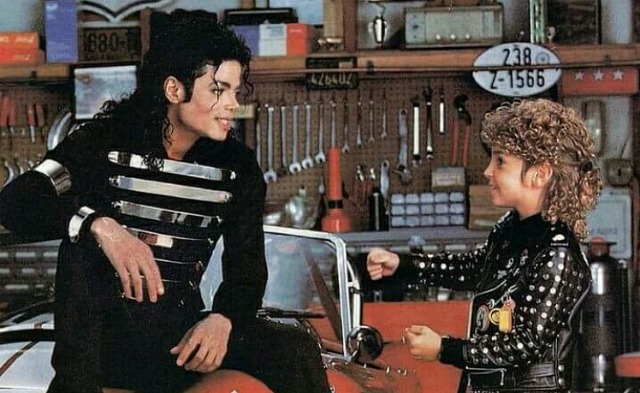
Michael Jackson, Wade Robson sometime around ’88, when Robson was seven or eight.

The Jackson-guilt denialists are finished. Jig’s up. Once this four-hour doc hits HBO, forget it.

Leaving Neverland is also, of course, a very sad story. Damage and dysfunction are passed on and on. You’re only as healthy or sick as the amount of ugly secrets you’re carrying around. Oh, and the two complicit mothers of the victims are dealt tough cards at the end by their trying-to-heal sons.

From Owen Gleiberman’s Variety review: “[Director] Dan Reed forces us to confront the reality that the greatest pop genius since the Beatles was, beneath his talent, a monster. Leaving Neverland is no thriller, but it’s undeniably a kind of true-life horror movie. You walk out of it shaken, but on some level liberated by its dark expose.”

From David Ehrlich’s Indiewire review: “Steel yourself for specifics, as dancing around them would defeat the purpose of this documentary: Jackson was a man who convinced their most innocent relatives to bend over and spread their butt cheeks while he masturbated to the sight; who forced them to suck on his nipples while he serviced himself; who installed an elaborate system of alarm bells at the Neverland Ranch so that he would hear if anyone was going to walk in on an eight-year-old boy with the pop star’s penis inside his mouth.

“Penetration was a more complicated process, but one that got increasingly possible as the boys grew older. There was even a mock wedding ceremony at one point; the kid involved still can’t bear to look at the ring. The mothers chaperoned many of these vile trysts, oblivious to (or in denial about) what Jackson was doing to their sons behind closed doors. A teenage sibling even defended the pop star in court. She didn’t know any better, but will still regret that decision until the day she dies.”

Incidentally: I waited outside (25 degrees) in a ticket-holders line for 40, 45 minutes. Sundance staff & Park City police (checking bags, wanding everyone) didn’t exhibit the slightest interest in allowing the 9 am screening of Leaving Neverland to start on time. It started at 9:28 am — 9:30 am after the Sundance promos.

Read more

Don’t Listen to Ehrlich About “Memory”

I loved Alexandre O. Philippe‘s Memory — The Origins of Alien, which I saw last night at 10 pm. It digs down, re-explores and triple-dip examines each and every aspect of Ridley Scott’s 1979 classic…an absolute delight. It has everything, delivers everything…you leave completely sated, satisfied and well fed.

Please pay no attention to David Ehrlich’s pissy Indiewire review, to wit: “Philippe’s feature-length analysis of the roots and repercussions of Ridley Scott‘s horror masterpiece, seems determined to reconcile its two fundamental truths. The first is that every successful movie reveals something profound about the time when it was made. The second is that great art taps into a collective unconscious as old as time itself, tracing a direct line from ancient mythologies to modern pop culture.” — correct.

“At the very least, Philippe’s entertaining but frustratingly incomplete documentary confirms that Alien did both of those things, and it did them well. [But it’s] far more interested in exploring where the Xenomorph came from than it is in contextualizing why it was born in 1979 (and continues to grow inside of us today)” — and I didn’t care.

“Caught somewhere between a genealogy project, an oral history, and an in-depth video essay about the iconic scene that seared Alien into our imaginations, it reaffirms the film’s basic power without probing deeply enough to achieve any power of its own” — bullshit.

Guillermo del Toro is going to worship Memory, and tweet his ass off about it.