Parking Lot Ogres

When you pull into a supermarket parking spot, what’s the first thing you do? Turn off the engine and the lights, right? Because you’re about to go shopping and you have no need for either until you return with groceries…right? Except there are sociopaths out there who pull into parking spaces and don’t turn their lights off until 15, 30, 45 or even 60 seconds have elapsed. For no reason that makes any sense to anyone. They just do this. Because they’re sociopaths.

Earlier this evening I was sitting in my little car in the parking lot of West Hollywood Pavilions. Engine off, lights off, surfing Twitter and thinking things over.

Directly across from me a big fat Range Rover pulled in, and as it sat there and sat there with no one getting out, the lights were flashing right in my face for the longest time. The lights were so bright I was squinting and shielding my eyes. After 25 or 30 seconds I was muttering “what the fuck are you doing, man?” After about 60 seconds, the dick behind the wheel finally turned his lights off and got out and went into the market.

For what it’s worth I’ve never done this. After I pull into my spot I kill the lights and the engine because — logic! — I’m there to buy some yogurt, cat food and mineral water, and I won’t need the lights or the engine until I return.

Three or four minutes later a white SUV pulled in next to the Range Rover and did the same damn thing. Sat there, sat there and fucking sat there with the lights still burning. Has the driver changed his/her mind? Is he/she wondering whether he/she should be shopping this evening, or whether there’s something more important that he/she needs to do? Okay, maybe so, but what’s the problem with turning your fucking lights off while you think things over? Has it occured to you that others (i.e., people like myself) might find your super-glarey lights obnoxious? Oh, this hasn’t occured to you? I see.

45 seconds later the lights on the white SUV finally went off. Thanks for the squinting session!

15 minutes later the Range Rover guy returned with a couple of grocery bags. He loaded them into the back seat, got in and turned on the lights. And just fucking sat there again. If you’re like me and you don’t feel like driving off into the night, fine. But why sit in your car with your lights on? Are you doing this to, what, aggravate people or something?

Please turn them off. Please. He didn’t. He wouldn’t. I was sitting there going “you dick, you dick, you dick, you dick…what is your MALFUNCTION?”

Hell is other people in a parking lot.
Criterion Channel Report Card

Eric Kohn’s 4.8 interview with Criterion Channel honcho Peter Becker made no mention of image quality whatsoever. 1080p vs. 720p vs. 4K streaming down the road…nothing. Not to mention a concern that HE readers have shared about Filmstruck streaming occasionally choking and stalling.

A few days ago I asked a Criterion spokesperson if the Criterion Channel is going to be 100% 1080p or not. Answer: “Criterion shows the best format they can secure. The overall goal is to connect the audience with the movies they want to see and not let tech requirements keep good films invisible, but that said they always seek out the best format they can find, and when they improve a master they replace the one they have improved upon.”

To which I replied, “Got it — the Criterion Channel will presumably offer 1080p for the most part but may sometimes show films at 480p or 720p (‘not let tech requirements keep good films invisible’). They will always seek out the best format they can find, cool — but what about 4K streaming, which other providers offer from time to time?” Answer: “4K is not supported at the moment. We’ll see what the future brings.”

HE followup questions: “One, what percentage of Criterion Channel films are being presented at 1080p (HD)? And what percentage are being offered at 480p (DVD standard)? Two, why aren’t the films being offered with a posted assurance that they’re being streamed at 1080p, when applicable? Failing that, why not a general assurance that all films are in HD except when otherwise specified? And three, what’s the problem with 4K streaming? Does it cost too much or something? 4K streaming is becoming more and more common with other services. And so many Criterion upgrades and restorations have been scanned and restored at 4K.”

The response to the last three questions was that the spokesperson couldn’t offer specific percentages as the Criterion Channel is just starting to launch.

Read more

Mayor Pete Announces

Scroll forward to 1:40: “There is no such thing in honest politics that revolves around the word ‘again.’ I’m here to join you to make a little news. My name is Pete Buttigieg. They call me Mayor Pete. I am a proud son of South Bend, Indiana, and I’m running for President of the United States.”

Bibi Andersson and That White Robe

Famed Ingmar Bergman actress Bibi Andersson died today at age 83, after suffering a stroke nine years ago. Seemingly unrelated to HE’s own Harriet Andersson (or am I mistaken?), Bibi had a 14-year peak period between ’57 (costarring roles in Smiles of a Summer Night, The Seventh Seal and Wild Strawberries coupled with an “intense” affair with Bergman) to Bergman’s The Touch (’71, costarring Elliot Gould).

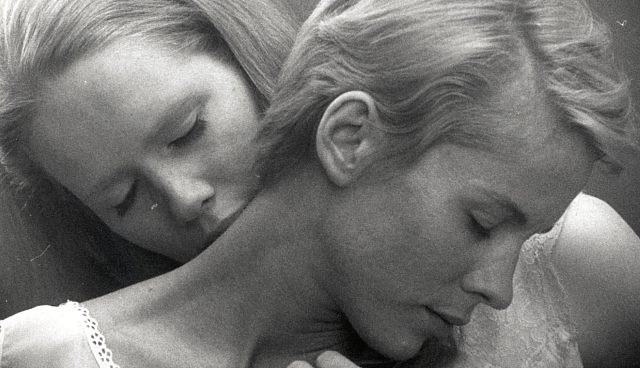
Andersson’s most significant, respected and best-known Bergman role was opposite Liv Ullman in the probing, psychologically layered, somewhat lezzy-ish Persona.

Her other noteworthy performances were in The Passion of Anna (’69), The Kremlin Letter (’70), Scenes from a Marriage (’73), I Never Promised You a Rose Garden (’77), An Enemy of the People (’78), Quintet (’79), The Concorde — Airport ’79 (’79) and Babette’s Feast (’87).

Andersson always delivered a palpable undercurrent. Complex, a bit bothered. Nobody of her generation did moody and vaguely mysterious better or more provocatively.

The fanatics may or may not flinch over the following but Andersson was something of a high-toned Swedish sex object in her ’60s and early ’70s prime. A fair amount of tasteful nude scenes, a brightener of moviegoer imaginations, etc. Anyone who knows her career will tell you this. I shouldn’t mention this for obvious reasons, I realize, but honesty compels it.

Read more

Best Bruhs

In yesterday’s Paths of Glory thread (“And Today’s Verdict Is…?“), LexG claimed that my recent assertion about Quentin Tarantino‘s Once Upon A Time in Hollywood being based on the 1969 situations of Burt Reynolds and redneck movie director Hal Needham is a “Wells loony tune” riff. LexG allegedly knows this town pretty well, and yet he says “where did this gem come from?”

I’ll tell him where it came from — (a) common knowledge and (b) Reynolds and Needham‘s Wiki pages.

Tarantino will probably tap-dance or shilly-shally when some junket journalist asks him this point blank, but it all fits together. It’s right there on the page. The 1969 career situations of DiCaprio’s “Rick Dalton” (struggling, pushing-40 TV actor) and Pitt’s “Cliff Booth” (Dalton’s same-aged stuntman-buddy who shares his home) mirror Reynolds-Needham. Fucking obvious. Okay, with a little Clint Eastwood thrown in.


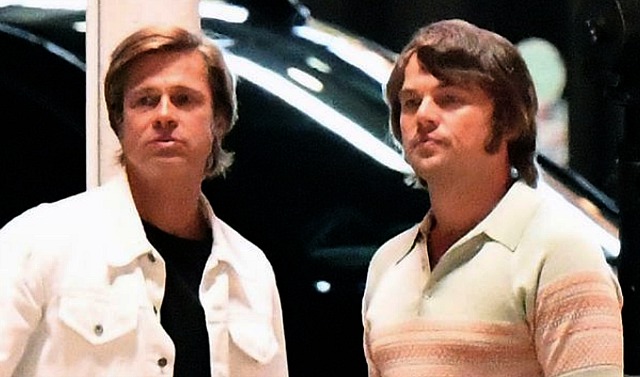
Cliff Booth, Rick Dalton in Once Upon A Time in Hollywood.

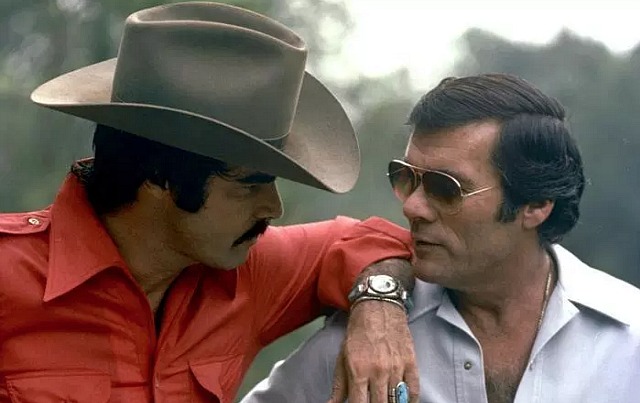
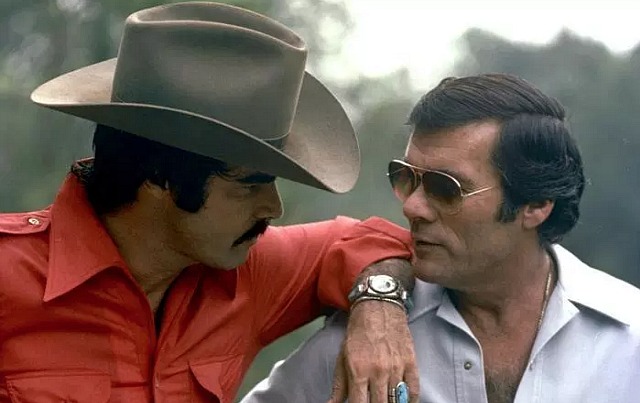
Burt Reynolds, Hal Needham during filming of Smokey and the Bandit.

In ’69 Reynolds, who had been acting on TV since the late ’50s (when he was in his early 20s), was a steadily working but diminished “known quantity” who was more or less poking along with B-level features like Sam Whiskey and 100 Rifles and short-lived TV series like Hawk and Dan August.

Reynolds had been trying and trying but was unable, during the first year of the Nixon administration when he was 33 years old, to break through into the bucks-up realm of A-level features.

And then, after 15 years in the business (when he was 20 or 21 he was told he couldn’t play a supporting role in Sayonara because he looked too much like Marlon Brando), Reynolds finally made it over the hump and became BURT REYNOLDS.

He accomplished this with the one-two-three punch of (a) his breakthrough lead role (studly survivalist Lewis with the bow-and-arrow) in John Boorman‘s Deliverance (’72), (b) that Cosmopolitan centerfold and (c) becoming a talk-show star with his amusing, self-deprecating patter in chats with Johnny Carson, Merv Griffin and David Frost.

In the space of a few months Reynolds was no longer Mr. Semi-Obscuro but suddenly the cool guy whom everyone liked and admired.

Reynolds Wiki excerpt: “Deliverance director John Boorman cast Reynolds on the basis of a talk-show appearance. ‘It’s the first time I haven’t had a script with Paul Newman‘s and Robert Redford‘s fingerprints all over it,’ Reynolds joked. ‘The producers actually came to me first.’

“‘I’ve waited 15 years to do a really good movie,’ Reynolds said in 1972. ‘I made so many bad pictures. I was never able to turn anyone down. The greatest curse in Hollywood is to be a well-known unknown.'”

Read more