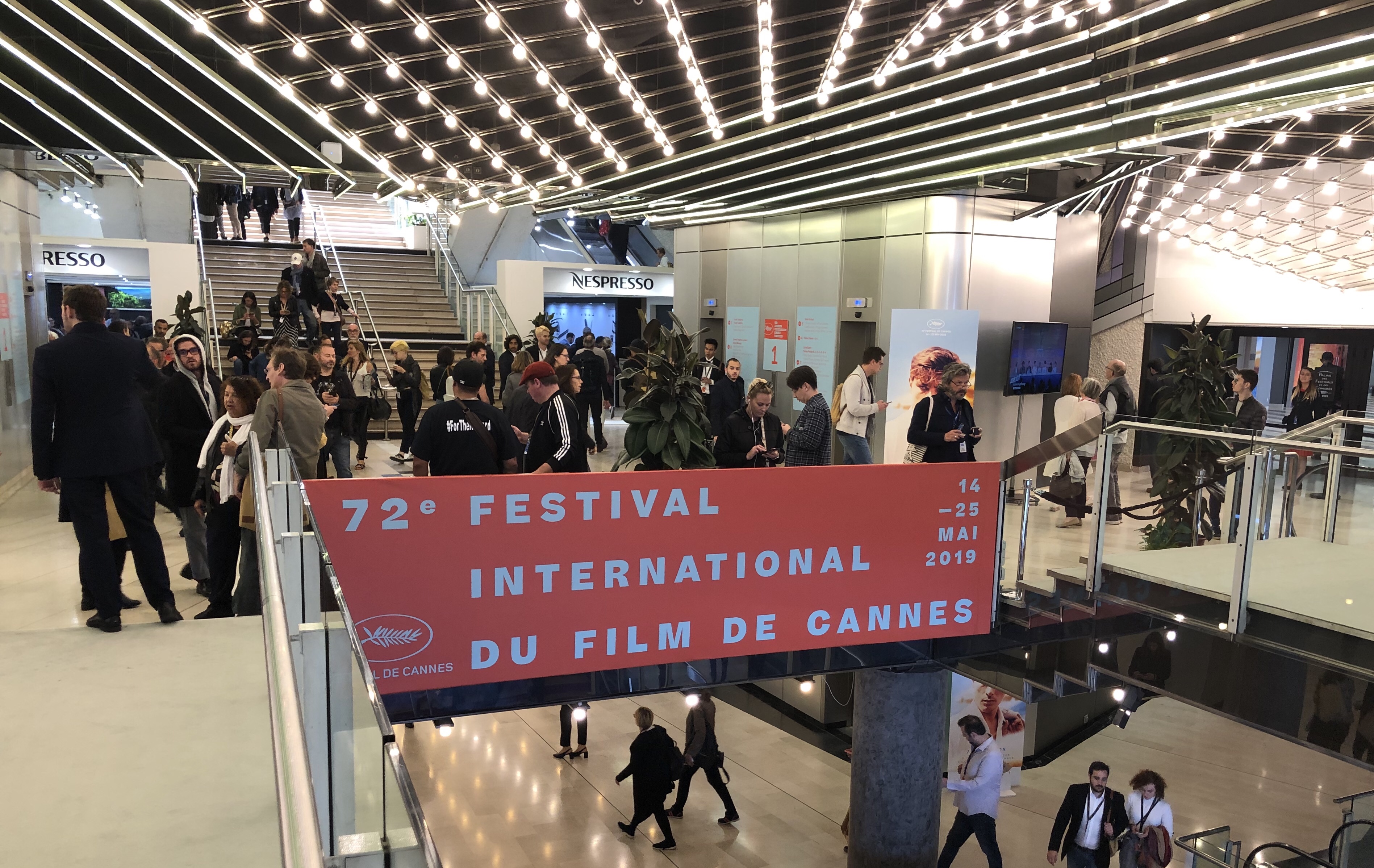
Thursday is my last full day of Cannes Film Festival showings, and it’ll be a triple-header: Arnaud Depleschin‘s Oh, Mercy at 11:30 am, Marco Bellochio‘s The Traitor at 6:30 pm, and Abdellatif Kechiche‘s four-hour Mektoub, My Love — Intermezzo, starting at 10 pm. My Paris train departs Friday at 11:30 am. And the Cannes awards ceremony happens on Saturday night.
It’s been predicted that Pedro Almodovar‘s Pain and Glory, a deeply personal and subtle meditation on creative blockage and the gradual end of things, is an odds-on favorite to win a top festival prize — the Palme d’Or, a special Jury Prize, Best Director. Maybe, but I sensed more respect than great waves of passion after it screened, and I’m not sure that the Almodovar is strong enough to float a large boat.
The passion levels are very strong for Celine Sciamma‘s Portrait of a Lady on Fire. The fact that I wilted when it came time to write a review, and that I only managed the following tribute — “By my sights as close to perfect as a gently erotic, deeply passionate period drama could be” — doesn’t mean it’s not emotionally impactful and superbly composed. That long closing shot of Adèle Haenel melting as she listens to a concert performance of Vivaldi’s “Four Seasons” (or perhaps just a performance in her head) is devastating.
I can’t see any big prizes going to Terrence Malick‘s A Hidden Life. As I more or less said in my review, the substance and ramifications of Franz Jägerstatter‘s anti-Hitler stance aren’t really delved into or articulated, and the style and mood of this 173-minute film falls completely in line with Malick’s last four films (Song to Song, Knight of Cups, To The Wonder, The Tree of Life). It’s basically more of the same with an Austrian WWII backdrop.
If Robert Eggers‘ The Lighthouse had been given a competition slot instead of opting for Directors’ Fortnight, it would definitely be a top Palme d’Or contender. Or a likely winner of the Best Director prize. Or so I keep thinking, and keep hearing.
I remain a staunch champion of Ladj Ly‘s Les Miserables. I would find it stunning if the Cannes jury doesn’t honor it with some kind of significant award come Saturday.
And I remain floored by the vibrant stylistic brio that energizes Diao Yinan‘s The Wild Goose Lake. Critics have complained that the internals don’t live up to Black Coal, Thin Ice and maybe they don’t, but Goose Lake‘s direction is nonetheless genius-level. I was awestruck.
I chose to write a longish review of Once Upon A Time in Hollywood rather than see Bong Joon ho‘s Parasite so I’ve nothing to say on this. I also failed to see Mati Diop‘s Atlantique and Jessica Hausner‘s Little Joe — apologies.
As much as the Cannes jury may enjoy the flash and pizazz of Once Upon a Time in Hollywood, I doubt it will land a major award. It’s heartfelt on a certain level, but…hell, I don’t know how this’ll shake out. If they’re in a giving, light-hearted mood they might hand a Best Actor to Brad Pitt for the confident muscular swagger element. I would certainly push for Pitt if I were a jury member.
Jim Jarmusch‘s The Dead Don’t Die hasn’t a prayer.
In my humble opinion that Kleber Mendonça Filho‘s ultra-violent Bacurau hasn’t a chance of winning anything. Ditto Corneliu Porumboiu‘s The Whistlers. Ditto Xavier Dolan‘s Matthias et Maxime, which I saw earlier today and was bored by.
Ken Loach’s sad and straightforward Sorry We Missed You addresses the anguish of working-class Brits being squeezed by heartless employers and corporations (obviously a situation that applies to other countries), but I found it merely sufficient. Now watch it take the Palme d’Or — what do I know?
I’ll likewise be flabbergasted if Ira Sachs‘ morose, flatly written, on-the-nose Frankie wins anything.