
Joe Popcorn Ignored Moral Message

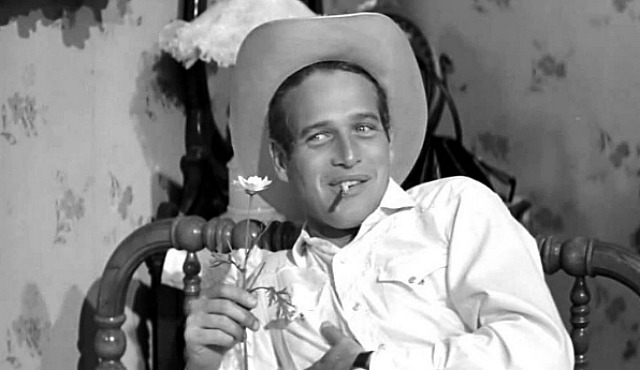
We all know what happened with Martin Ritt‘s Hud. Ritt, screenwriters Irving Ravetch and Harriet Frank and Paul Newman wanted audiences to react to the selfish and insensitive Hud Bannon with a mixture of fascination and repulsion — as a symbol of middle-class cynicism and opportunism that was shaping the culture of 1963 America.

Instead audiences (teens especially) found Hud a roguishly charming renegade, and even a half-admirable rascal on a certain level. Newman: “The last thing people would do, we thought, was accept Hud as a heroic character…his amorality just went over their heads…all they saw was this western, heroic individual”.

The bottom line, I think, is that younger audiences weren’t so much delighted with Hud’s caddish behavior as uncomfortable with Melvyn Douglas‘s Homer, a gruff and taciturn voice of old-school morality who constantly frowns at Hud and regards him as rank and poisoned.

Younger audiences interpreted Homer’s admonishments as an echo of their parents and grandparents’ beliefs, which they found stifling to some extent. Hud repped a certain impudent freedom.

Years later Ritt said that kids who saw Hud as some kind of irreverent anti-establishment type were expressing the emerging values of the coming counterculture of the late 1960s.

50 years later the same kind of thing happened with Martin Scorsese‘s The Wolf of Wall Street. Scorsese, screenwriter Terence Winter and Leonardo DiCaprio presented what they believed was a half-comic, half-repugnant satire of Wall Street lunatics and the rancid values of guys like Jordan Belfort — a darkly comic indictment of greed and avarice among the 1%.

Instead a good portion of the audience got a huge kick out of Belfort’s excessive behaviors and ravenous appetites, and those of Jonah Hill‘s Donnie Azoff and the general madman culture of Stratton Oakmont. I remember LexG tweeting back then that he’d enjoyed WoWS for “the wrong reasons.” I had a distinct sense that a lot of people were in the same boat.

What other significant films were supposed to deliver a sobering moral lesson or inspire ethical revulsion, but in the minds of moviegoers wound up providing a kind of debased brand of entertainment?
Second Viewing of “Rocketman”

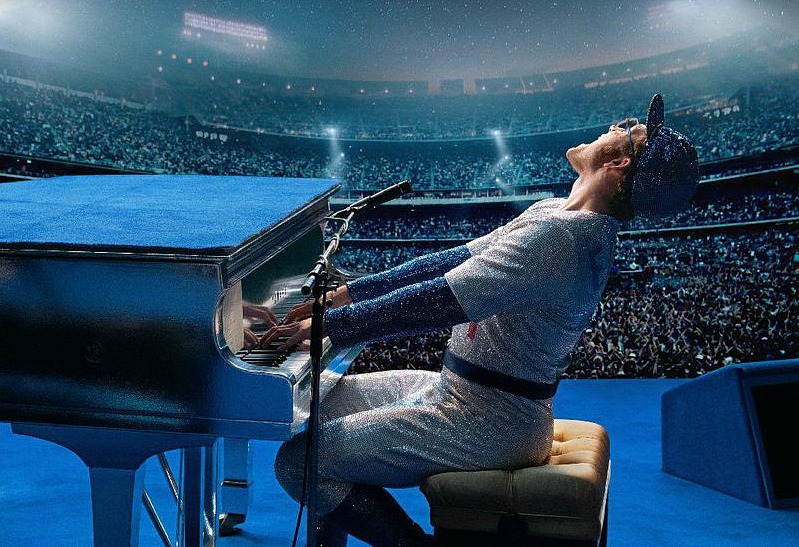
Among my initial reactions to Rocketman, filed during the Cannes Film Festival: (a) I respected the traditional musical scheme and the Ken Russell-meets-All That Jazz theatricality, (b) it’s a “better”, more ambitious film than Bohemian Rhapsody, and yet (c) the only portions I actually “liked” were the first 40 or 45 minutes’ worth (i.e., the young-Elton English stuff), and (d) that once Elton hits the big-time in Los Angeles and starts self-destructing with booze and cocaine (a section that lasts 60 to 70 minutes) the film becomes…well, a bit tiring.

Watching an angry, miserable, emotionally distraught rock star self-destruct (which I’ve seen a hundred times in a hundred rockstar bios and docs) is essentially numbing.

I paid to see Rocketman again last night with Tatyana, and experienced roughly the same reactions. Except, that is, for (d) — those 60 minutes of flamboyant self-destruction don’t play very well the second time. Like, at all.

I’m not walking back my view that Rocketman is a “better” film than Bohemian Rhapsody — it’s certainly more ambitious — but it’s boring to watch a guy snort coke, guzzle vodka, wipe away tears and snarl at people in scene after scene. Get to rehab already!

My advice to those who liked Rocketman after a single viewing is to leave it there.

Tatyana was moderately okay with it and appreciated the early song-and-dance sequences (“I Want Love”, “Saturday Night’s All Right for Fightin’) but she, too, felt that some scenes dragged on for too long during the second hour. She said she liked Bohemian Rhapsody better. She respected Taron Egerton’s performance and thinks he’s a good actor “but I noticed the time when I was watching Rocketman, but I never noticed the time with Rami Malek.”

I’ve mentioned this before but Egerton bothers me. His singing voice isn’t close to Elton’s, and he doesn’t begin to physically resemble him. Plus he’s taller, broader and more muscular than the Real McCoy. I’m sorry but Egerton just isn’t right. Plus he’s constantly “acting”. I’ve seen Elton twice in concert, talked with him at a party, been listening to his songs since the Nixon administration, etc. And I just can’t give in to Egerton the way I submitted to Malek-as-Freddie Mercury.

Respectful Meyers Reply

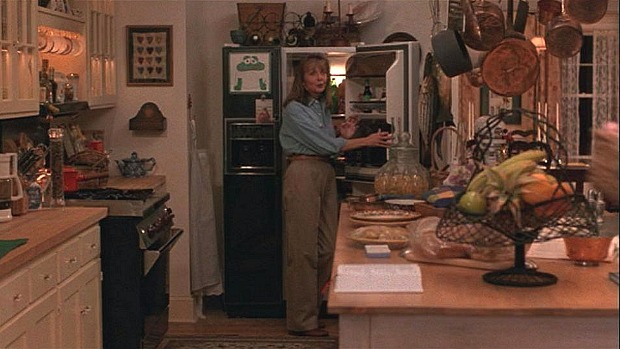
In a chat yesterday with Late Night screenwriter and costar Mindy Kaling, director Nancy Meyers (It’s Complicated, Something’s Gotta Give, Father of the Bride) struck back at critics who have taken her to task for making superficial “copper pots and white sweater” movies — i.e., wish-fulfillment romcoms about well-off women who live in swanky homes with luxurious, to-die-for kitchens.

“I don’t love [it] when a journalist or critic will pick up on that aspect, because they’re missing why it works,” Meyers complained. “It’s never done to male directors who make gorgeous movies, or where the leads live in a gorgeous house.”

As one who’s repeatedly brought up the copper-pot thing, I’ve never felt there was anything necessarily problematic about Meyers’ characters hanging out in spacious kitchens with gleaming copper frying pans, etc. The problem is that her romcoms rarely seem to rise above this fetishy focus or characteristic — they rarely dig in and climb up to the next level a la James L. Brooks in the’80s and’90s. With one exception (i.e., The Intern), her movies are primarily delivery devices for upmarket wealth porn.

Just about every Nancy Meyers movie involving a female lead of a certain age begins with Meyers saying to herself, “Wouldn’t it be wonderfully satisfying and exciting if…?”

Example: The romantic fantasy in It’s Complicated is that after a foxy older divorced woman (Meryl Streep) begins seeing an attractive new guy (Steve Martin) her re-married, somewhat girthy ex-husband (Alec Baldwin) gets the hots for her and starts cheating on his younger wife (Lake Bell) as they begin an extra-marital affair.

I didn’t buy this any more than I bought the basic plot of Meyers’ Something’s Got To Give (Jack Nicholson‘s randy music executive falling for Diane Keaton‘s affluent screenwriter as she’s courted by Keanu Reeves‘ young physician). In real life a guy like Baldwin would cheat on his new 30something wife with another young ‘un.

The point is that Meyers’ films are always about comfort — i.e., about upper-middle-class affluence, bright chatter, attractive lighting and an attractive older female lead getting to express how strong and soulful she is in the third act.

From my thumbs-up review of The Intern (9.25.15): “Meyers is just as much of a consistent and well-defined auteur as Michael Mann or John Ford or Samuel Fuller — she just makes movies that always happen within a realm of comfort, affluent insulation, alpha vibes and 40-plus romantic pangs. And so nothing rude or disturbing or creepy or traumatic happens, and you just have to accept that this is par for the course.

“A visit to Nancy Meyers Land means shutting out…what, 80% or 90% of the misery and aesthetic offenses and uncertainties and annoyances and dull horrors of real life?”

Someone Besides Maher Is “Squishy” About Abortion

Imagine if the night before last Jack Nicholson was a Real Time With Bill Maher guest along with Rep. Katie Porter, and when the subject of abortion came up Nicholson explained why he’s “squishy” on the subject.

“I’m very contra my constituency in terms of abortion because I’m positively against it,” Nicholson might have said, repeating a quote that he gave to Rolling Stone in ’84. “I don’t have the right to any other view. My only emotion is gratitude, literally, for my life. I’m pro-choice but against abortion because I’m an illegitimate child myself and it would be hypocritical to take any other position.”

Nicholson’s mom came close to aborting him in the late summer of 1936, but decided against it. Nicholson popped out in April 1937. He’s repeatedly expressed gratitude about not being terminated.

Imagine if Porter said in response, “Well, Jack, your mother made a choice, and we’re all living with the consequences of that.” Do you think she would’ve gotten a big laugh from the audience and a “you go, girl!” from certain journos in response?

This is what Porter said to Bill Maher on Friday’s Real Time when he said he was “squishy” about abortion for the same reason — i.e., his mom had seriously considered aborting him. I’m sorry but that was a mildly shitty thing for Porter to have said.